
An Ancient Corinth tour visits the ruins of ancient Corinth and the rock of Acrocorinth above them, near the isthmus that joins the Peloponnese to mainland Greece. The city once controlled two seas and their trade. The tour is one of the Greece Tours on Greece Ville.
This post covers what an Ancient Corinth tour includes, the Temple of Apollo and the visit of the apostle Paul. It also covers Acrocorinth, the trade that made the city rich and the people who dug it up. The sites nearby, the best months and common questions come last.
The sections include Ancient Corinth tours and related Peloponnese day trips that can be booked online.
What is an Ancient Corinth tour?
An Ancient Corinth tour walks the ruins of a Greek and Roman city. The Culture Ministry places the site on the northern foot of Acrocorinth. The village of Archaia Korinthos stands there too. It lies 76 m above sea level.
An Ancient Corinth tour reaches a village once called Palaia Korinthos, or Old Corinth. The village lies in the municipal unit of Corinth. It had 1,939 people at the 2011 census.
The village was the Ottoman capital of Corinthia and the first capital of the prefecture until 1859. It continues the medieval and Ottoman town of Corinth. The modern city rose elsewhere in the 19th century.
An Ancient Corinth tour reaches the Roman forum, once a huge open space. It ran about 200 m from east to west and 100 m from north to south.
In 146 BC the Roman general Mummius cut down the city walls. A small non-Corinthian population then farmed the land. Rome auctioned the farmland every two years as public land.
- Municipality of Corinth: It was set up on 1 January 2011 from five older municipalities.
- People: It had 55,641 people in 2021, and its symbol is Pegasus.
- Latin name: The Latin form of the city name is Corinthus.
The writer Pausanias said colonists sent out by Rome lived in Corinth. Strabo says Caesar settled the new colony with people who were mainly freed slaves. An Ancient Corinth tour walks a city that Rome rebuilt.


What does the Temple of Apollo show on an Ancient Corinth tour?
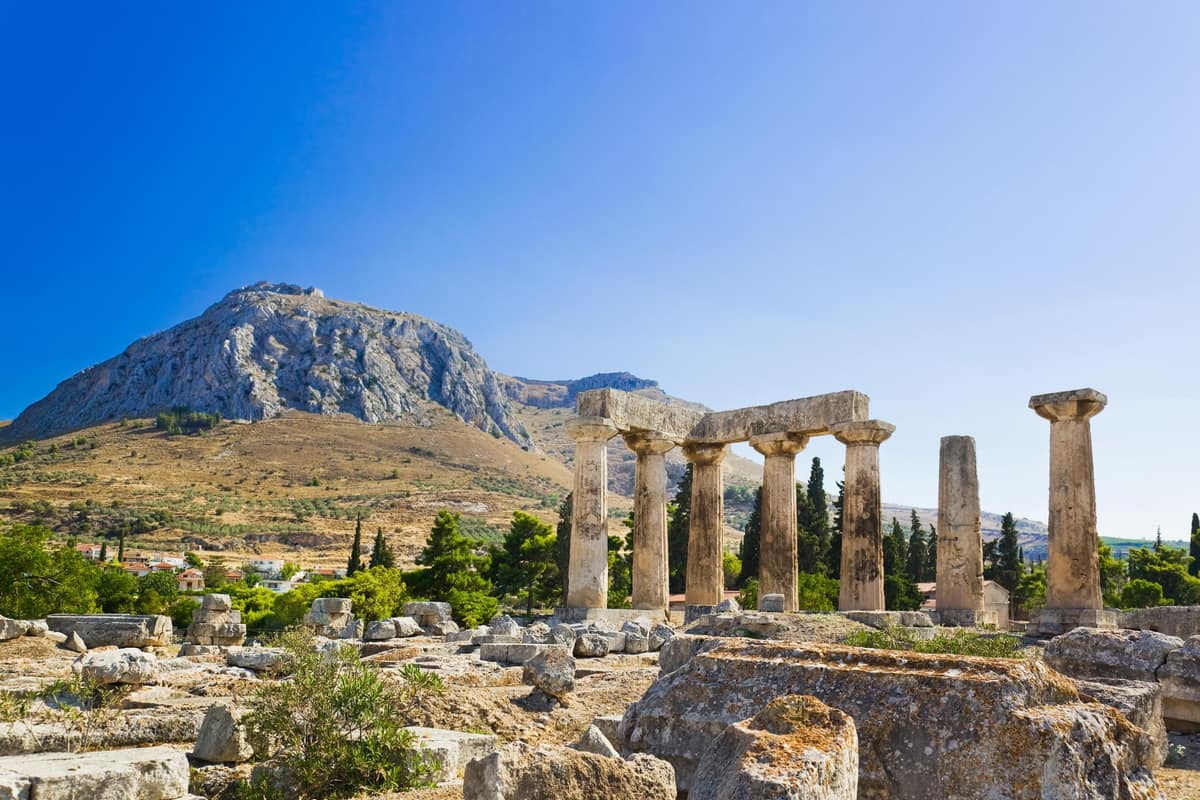
An Ancient Corinth tour shows the Temple of Apollo. The Culture Ministry places it among the first Doric temples built on the Greek mainland. It stands on a rocky hill north of Acrocorinth. Builders used limestone.
An Ancient Corinth tour shows how the temple was laid out. The front and back porches each had two columns. A cross wall split the long inner room, the cella, into two rooms.
The first temple on the rise north of the forum was built in the 7th century. It was destroyed around 580 BC. The temple that survives followed about forty years later.
An Ancient Corinth tour shows clues to the date. The temple is long for its width. Its capitals, the tops of the columns, are squat and flare widely. These marks show an early Greek date, called Archaic.
Cuttings in the bedrock for the foundation blocks let experts rebuild the plan. The broad capitals were carved as separate pieces and coated with marble stucco.
- Name link: Pausanias and a small plaque to Apollo link the temple to the god.
- Stairs: At first, a monumental staircase at the south-east corner led up the hill.
- Roman turn: The colonists turned the temple around by 180 degrees.
In Roman times the temple was renovated to house the cult of the Emperor. A Byzantine church rose on the north-east part of Temple Hill. In the Ottoman period the east part of the temple was pulled down.
What did the apostle Paul do on an Ancient Corinth tour?
An Ancient Corinth tour follows the places linked to the apostle Paul. In Corinth he met Aquila, a Jew born in Pontus, and his wife Priscilla. Acts 18:3 is the first place that names Paul’s trade: he was a tentmaker.
Aquila and Priscilla left Italy when Emperor Claudius ordered the Jews out of Rome. The Roman writer Suetonius says the order followed constant disturbances at the urging of Chrestus.
Paul left the synagogue and moved next door to the house of Titius Justus, a worshiper of God. On an Ancient Corinth tour, the name of Gallio, a proconsul, is a key date marker. Proconsuls served for one year only.
The Delphi Inscription is a letter of Claudius. It dates from the 26th time Claudius was hailed as emperor. That was between January AD 51 and August AD 52. Gallio had told Claudius that Delphi lacked citizens.
An Ancient Corinth tour reaches the marble Bema of the mid-1st century AD. Its pedestal was 15.6 m long and 7.2 m wide. The proconsul of Corinth spoke from it to citizens at public ceremonies.
- Place: The Erastus inscription was reused in the floor of the courtyard east of the theatre stage.
- Text: Erastus paved the area at his own expense for his post as aedile, a city official.
- Find: Parts were found in 1928 to 1929 and in 1947.
Paul names an Erastus, the city treasurer, in his letter to the Romans. The Erastus of the inscription is widely linked to him. An Ancient Corinth tour joins these clues.
What does Acrocorinth show on an Ancient Corinth tour?
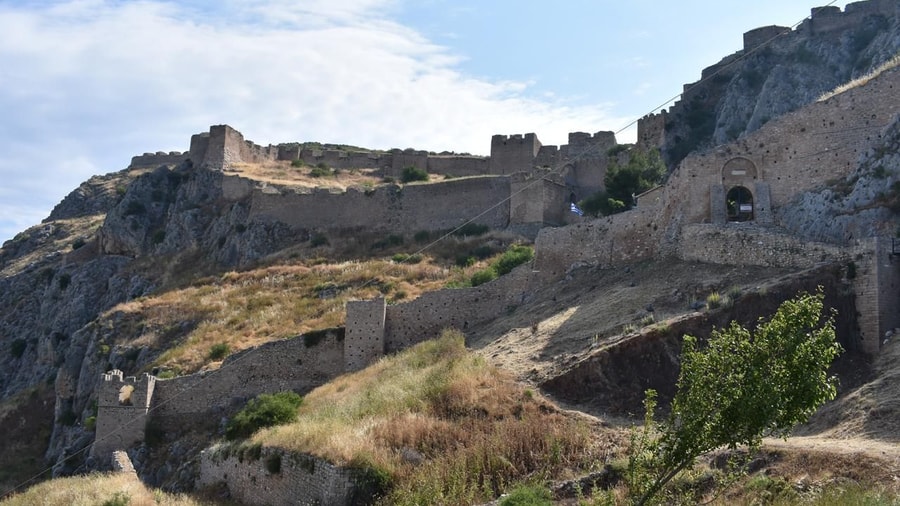
An Ancient Corinth tour shows Acrocorinth, a fortress on the rock above the ruins. Its walls record Byzantine, Frankish, Venetian and Ottoman rule. A ruined temple of Aphrodite crowns the top. Upper Peirene, a spring, lies inside the walls.
In 243 BC Aratus of Sicyon took Acrocorinth by surprise from its Macedonian soldiers. He led 400 picked men. Of these, 100 scaled the walls with ladders, barefoot to keep quiet.
On an Ancient Corinth tour, the walls average 2 metres thick. The Second Gate rebuilds a Byzantine gate of the 9th to 10th century. Its upper floor carries the lion of St Mark, the emblem of Venice.
Around 1201 to 1202 a local Greek lord, Leo Sgouros, seized the fortresses of Argos and Corinth. By spring 1205 the Crusaders held the countryside, and Sgouros was shut in on Acrocorinth.
An Ancient Corinth tour recalls the siege that followed. The Franks built a control castle, the Pedeskoufi, opposite the entrance. Legend says Sgouros rode his horse off the high cliffs in 1208.
- Mosque: A 16th-century mosque stands beyond the third line of walls.
- Temple: Built in the 5th century BC, the Aphrodite temple measured 10 by 16 metres.
- Upper Peirene: Pausanias says Asopus gave this spring to Sisyphus.
On 14 January 1822 Theodoros Kolokotronis freed Acrocorinth. Later that year the Ottoman general Dramali found it abandoned without a fight. An Ancient Corinth tour passes every layer of this story.
Why did trade make Corinth rich on an Ancient Corinth tour?
An Ancient Corinth tour shows why trade made Corinth rich. Boats were hauled across the land on the Diolkos. Two harbours handled the sea trade. Tyrants, potters, bronze makers and Greek colonies all belong to the same story.
An Ancient Corinth tour explains the Diolkos, a paved trackway across the Isthmus of Corinth. It let boats skip the long sail round the Peloponnese, whose headlands were known for fierce winds.
Scholars think thick ropes called hypozomata ran from front to back to stop a hull sagging. The road was 3.4 to 6 metres wide. Experts think it mainly carried cargo, like marble and timber.
The first tyrant, Cypselus, increased trade with the colonies in Italy and Sicily. Under his son Periander, tolls on goods entering the port paid for nearly all of the government’s income.
Corinth had two ports, and an Ancient Corinth tour names both. Lechaion was built with three inner harbours and three outer harbours. A harbour project from 2013 found a Roman mole at Lechaion, 45 metres long and 18 metres wide.
- Pottery: Corinth led the Orientalizing style, which grew from trade links with the East.
- Pot trick: By the mid-6th century BC, certain Corinthian potters hid pots under a red Athenian-style slip.
- Syracuse: Corinthian settlers landed on the island of Ortygia and drove out the Sicels who lived there.
In 344 BC Syracuse asked its mother city, Corinth, for help. Corinth sent Timoleon with seven ships and 700 hired soldiers. An Ancient Corinth tour shows how far Corinth’s ties reached.
Who dug up the city on an Ancient Corinth tour?
An Ancient Corinth tour follows the American School of Classical Studies, which began digging at Corinth in 1896. Its teams uncovered the fountains of Peirene and Glauke, the Lechaion Road and the Asklepieion. A museum, a theft and a recovery complete the story.
Rufus B. Richardson was director of the School from 1893 to 1903. Bert Hodge Hill directed the School from 1906 to 1926. He focused his Corinth work on the springs of Peirene, Glauke and the Sacred Spring.
Four huge reservoirs fed Peirene through channels dug hundreds of metres back under the forum. Scholars think it suffered little when the Roman general Mummius attacked Corinth. It was among the first rebuilt.
An Ancient Corinth tour walks the Lechaion Road. Benjamin Meritt dug it from April to the end of June 1927. De Waele dug the Asklepieion, a healing sanctuary, in 1929 and 1930.
Diggers found up to 900 life-size terracotta body parts at the Asklepieion, left by patients. A 1933 notebook entry records 109 men moving 399 cars of earth in one day.
- Glauke: Four large reservoirs sit behind three basins for drawing water.
- Water: Pipes fed Glauke from the south, not a natural spring.
- Directors: Charles K. Williams II led the digs from 1965 to 1997.
An Ancient Corinth tour reaches the Corinth Museum, which thieves struck in April 1990. In 1999 agents found 265 of the objects in a Miami warehouse, hidden in crates of fresh fish. Greece announced in 2001 that 274 had come home.
What lies near the site on an Ancient Corinth tour?
An Ancient Corinth tour lies close to four other places. Isthmia was a sanctuary of the sea god Poseidon. Kenchreai was the eastern harbour of Corinth. Perachora held a sanctuary of the goddess Hera, and Loutraki has thermal springs.
Isthmia lies on a very active fault line. People called the god Poseidon “Earth-holder”, since they thought he caused and stopped earthquakes. That made Isthmia the centre of his festivals.
Its Games ranked second only to those at Olympia. In 338 BC, a council at Isthmia formed the League of Corinth. In AD 67, Nero performed in the Games’ music contests.
Kenchreai seems to take its name from the Greek word for millet. In Roman times, massive concrete breakwaters closed in its crescent-shaped harbour. Writings name cults of Aphrodite, Isis and Pan.
Diggers found over a hundred glass panels from the fourth century at Kenchreai. They lay in packing crates, ready for a possible sanctuary of Isis. Earthquakes made the coast sink a little.
- Perachora: The fountain house had three rock-cut basins.
- Loutraki: The first casino in Greece opened there in 1930.
- Canal: A submersible bridge sets no height limit for ships.
In 1847, an announcement in Italy praised the healing power of bathing in Loutraki’s thermal springs. Settlers came, creating modern Loutraki. It is the spa town near an Ancient Corinth tour.
Which months suit an Ancient Corinth tour?
An Ancient Corinth tour follows a calendar of games, feasts and harvests. The Isthmian Games ran in April or late spring. The feast of Peter and Paul falls on 29 June. The currant harvest starts in the first half of August.
The Isthmian Games took place in the year after each Olympic Games. The Olympics ran in July and August. Before the Games began, Corinth declared a truce, so athletes travelled safely.
In summer, an Ancient Corinth tour meets breezes from the Isthmus. The philosopher Diogenes spent his summers outdoors in Corinth, cooled by them. He even rolled in the hot sand.
The Apostle Paul is the patron saint of Corinth. On 29 June, the feast of Peter and Paul honours their martyrdom in Rome. For Orthodox Christians, it ends the Apostles’ Fast.
In the first half of July, the village of Agios Ioannis holds a large festival named Gkiosa. Psari and Archaies Kleones hold currant festivals at the end of August.
- Pruning: Saint Tryphon’s feast, in February, marks the start of pruning.
- Drying: Grapes dry in the sun for ten to fifteen days.
- Farm year: Currant farmers work eleven months a year.
An Ancient Corinth tour in August meets the harvest, just after the Transfiguration feast. Experts think Aigio, home of the Vostitsa currant, got that name between the 9th and 13th century.
What do travelers want to know about an Ancient Corinth tour?
An Ancient Corinth tour leads to a city whose name lives on in four ways. It names a metal, a column style, a coin and a word. Earthquakes, a great fire and a philosopher also shaped its story.
What is Corinthian bronze on an Ancient Corinth tour?
Corinthian bronze was an ancient metal mix, thought to be copper with gold or silver, or both. No certain example survives today. A legend says it formed by accident when Corinth burned in 146 BC and its metals melted together.
What is the Corinthian order on an Ancient Corinth tour?
The Corinthian order is named after Corinth. Experts think Athens invented it. Its capital, the column top, seems to fix a corner problem of the Ionic capital. The top level of the Roman Colosseum has Corinthian columns that carry the least weight.
What do Corinthian coins show on an Ancient Corinth tour?
From about 570 BC, Corinth used silver coins called “colts” or “foals”. A Corinthian stater, or coin, shows the winged horse Pegasus with the letter koppa below its breast. Koppa stood for Qorinthos, the oldest spelling of the city’s name.
What does Corinthianize mean on an Ancient Corinth tour?
In English, the verb Corinthianize means to be sexually immoral. The word Corinthian can also mean elaborate and ornate, or loose in character. These meanings, linked to riches and loose living, come from the reputation of ancient Corinth.
Who was Diogenes on an Ancient Corinth tour?
The philosopher Diogenes lived on the edge of Corinth, in a cypress grove above the harbour. At the Isthmian Games, he crowned himself victor with a pine wreath. The Corinthians buried him outside the city walls near the western gate.
Which earthquakes hit the modern city near an Ancient Corinth tour?
A major earthquake struck Corinth and its region in AD 857 and caused around 45,000 deaths. A magnitude 6.3 earthquake devastated the new city in 1928, and it was rebuilt. A great fire in 1933 hit the new city, which was rebuilt again.