

An Epidaurus tour visits the sanctuary of Asclepius, the Greek god of healing, and its ancient theatre in the hills of the Argolis, in the Peloponnese. The theatre still hosts plays every summer. The tour is one of the Greece Tours on Greece Ville.
This post covers what an Epidaurus tour includes, how the theatre was built and why its acoustics are famous. It also covers Asclepius, the Tholos and the Abaton, the cures carved in stone, the museum, the festival and Palaia Epidavros by the sea. The area around the sanctuary, the best months and common questions come last.
The sections include Epidaurus tours and related Argolis day trips that can be booked online.
What is an Epidaurus tour?
An Epidaurus tour is a visit to the ancient sanctuary of Epidaurus in the Peloponnese. UNESCO says the site lies in a small valley. Its monuments are spread over two terraces. A preserved natural landscape surrounds them on every side.

A visitor on an Epidaurus tour enters the site from the south side. The path first passes the museum. Then it leads to the theatre or to the sanctuary buildings. The Ministry of Culture runs the site through the Ephorate of Antiquities of Argolis, its regional office.
UNESCO counts a library, baths, sports grounds and guest rooms among the functions of the sanctuary. A hospital and a theatre belonged to it too. It calls the buildings of the 4th century BCE an outstanding example of a Greek building group.
UNESCO adds that Epidaurus influenced all the Asklepieia, the healing temples of the Greek world. It influenced the Roman sanctuaries of the same god later. An Epidaurus tour therefore visits a place that shaped later temples.
UNESCO says the setting is almost entirely preserved, so visitors still feel the spiritual character of the site. More than 250,000 people visit the sanctuary each year. In 2012 the state widened the protected area to cover land beyond the sanctuary.
An Epidaurus tour lies inside the municipality of Epidaurus, which had 7,030 residents in the 2021 census. Its unit of Epidavros had 3,418 residents and covers 160.6 square kilometres. The unit of Asklipieio, named after the sanctuary, covers 179.838 square kilometres.
- Population: Lygourio had 2,197 residents in the 2021 census.
- Distance: The ancient theatre stands two kilometres from Lygourio.
- Name: One idea says the name comes from Elaiogyrion, a Greek word for an olive factory.
- Ancient city: The city of Lessa stood where Lygourio lies, and Pausanias wrote about it.
The name Lygourio first appears in writing in the 14th century. It appears again in Venetian papers of the 15th century. An Epidaurus tour stands in a district with a long written record.
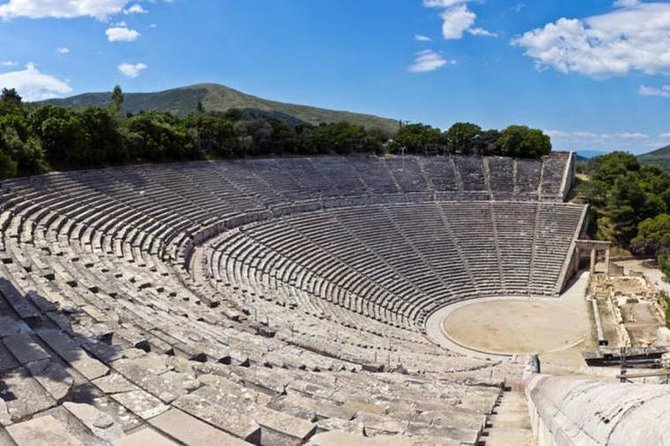


How was the theatre built on an Epidaurus tour?
An Epidaurus tour reaches a theatre whose builder is still debated. Pausanias, an ancient traveller, credits Polykleitos the Younger of Argos. Researchers dispute this name and say the true designer is unknown. Even the building phases are debated.
On an Epidaurus tour, the Tholos helps with the date. Greece’s culture ministry says it rose almost fifty years before the theatre. Historians suggest Pausanias mixed up two men named Polykleitos. A later architect of that name fits a date near 360 BCE.
Scholars argue about the phases. Armin von Gerkan and Wolfgang Müller-Wiener saw two phases, with only the lower seats first. The archaeologist Tomlinson found it more sensible that both seating sections were planned together.
An Epidaurus tour shows seating called the cavea. It curves over slightly more than a half circle and flares out like a shell. It is 120 metres across at its widest point. From the top row to the ground there is a drop of 24 metres.
A rush to restore the theatre put stone blocks in the wrong places before the 20th century began. The large works of 1954 to 1963 restored and strengthened all the lower seats. The east end of the upper seats got the same care.
In those works the east side gate and the retaining walls were rebuilt in Piraeus stone. New blocks carved for the stage front were never used. The restorer Anastasios Orlandos said the objections of stage directors played a part.
- Hollow seats: The ministry says hollow spaces under the seats improved how sound bounced and faded.
- Open view: Unlike Athens, Epidaurus had no cliff or building in the way, so its seating is symmetrical.
- Orchestra floor: The floor is beaten earth with a ring of stones around its edge.
The builders made small, clearly deliberate changes in the wedge widths and arcs. They make the layout look less like a pure maths shape. The current programme protects the theatre from physical change and careless use. An Epidaurus tour meets both design and care.
Why are the acoustics famous on an Epidaurus tour?
An Epidaurus tour is famous for acoustics that carry a voice across a huge theatre. Scientists have tested the claim with computer models and sound measurements. Georgia Tech researchers pointed to the seat rows. Later teams found other causes.
Georgia Tech researchers treated the seat rows as a ridged surface. Such surfaces filter sound the way ridges on a butterfly wing pick out light. Older ideas credited the wind, yet a modern performer is heard well on a windless day.
The researchers say the noise at the theatre was low-pitched, such as rustling trees and murmuring spectators. The human brain can rebuild missing low tones from high ones, a trick called virtual pitch.
Before that study, writers such as Vitruvius and Izenour held that the slope mattered more than the seats. In the Georgia Tech model, the slope did not change which pitches the seat rows boosted. On an Epidaurus tour, the seat rows sit at the centre of the debate.
Aalto University researchers say each seat row is 0.367 metres high and 0.746 metres deep. The depth of a row makes a ringing tone near 220 hertz, the musical note A. Hertz counts the times a sound wave shakes in one second. It is close to the basic pitch of speech.
The site of an Epidaurus tour lies in quiet countryside. In ancient times the stage building blocked noise from the valley. Echoes from the stage wall, the floor and the seats merge with the voice and make it louder.
- Low tones: Field measurements found no big cut in low tones, and tones below 150 hertz were stronger.
- First echo: Close seats heard the first echo from the floor 1.7 milliseconds after the direct sound.
- Fade time: Early echoes faded by 40 decibels within about 60 milliseconds.
A team at Eindhoven University of Technology placed microphones at 264 listening positions. An echo is sound that bounces back to the listener. On an Epidaurus tour, sound differs by area. The two edges of the seating face each other. In those edge areas the echo lasted 0.3 seconds longer.
Who was Asclepius on an Epidaurus tour?
An Epidaurus tour visits the sanctuary of Asclepius, the Greek god of healing. Storytellers told different tales of his birth. Snakes and five daughters belong to his story. His cult spread from Epidaurus to Athens, Pergamon and Rome.
On an Epidaurus tour, the tales of his birth do not agree. A Phoenician tradition said Apollo alone fathered him. Another tale says Artemis killed Coronis for being unfaithful to Apollo. The unborn child was saved from the funeral fire.
The Epidaurian story differs. Phlegyas took his daughter to the Peloponnese without knowing that Apollo had made her pregnant. The herdsman Aresthanas found the baby. He saw lightning flash from the child and turned away, sure that he was divine.
The Epidaurians insisted that his worship began in their land and did not come from Trikka in Thessaly. On an Epidaurus tour, the low peak of Titthion lies in front of the sanctuary.
A snake licked his ears clean and taught him secret knowledge. The Greeks saw snakes as sacred beings of wisdom, healing and resurrection. In one tale, a snake revived a dead snake with a healing herb.
An Epidaurus tour also names his family. Asclepius and his wife Epione had five daughters: Iaso, Panacea, Hygieia, Aceso and Aegle. Hygieia stood for keeping people well, while her father was linked more with curing the sick.
- Athens: According to tradition, Sophocles took the image of Asclepius into his house in 420 BC.
- Rome: The Sibyl told the Roman Senate to build a temple to the Greek god of healing.
- Island: Romans later shaped Tiber Island like a ship, with an obelisk as its mast.
Archias sprained himself on a hunt and was healed in the land of Epidaurus. He then brought the cult to Pergamon. The best-known new sanctuaries of Asclepius rose in Athens, Kos, Pergamon and Rome. An Epidaurus tour visits the sanctuary that all of them looked to as their patron.
What do the Tholos and the Abaton show on an Epidaurus tour?
An Epidaurus tour shows the Tholos and the Abaton, two buildings of the healing sanctuary. The Tholos hid a maze under its floor. The Abaton was a long hall where patients slept. Nearby stood the temple of Asclepius and a small temple of Artemis.
On an Epidaurus tour, the Tholos stands out as a round building with a maze under its floor. The maze was about 13.36 metres wide. A maze is a puzzle of winding paths. A hole in the middle of the floor led down into it.
A ramp over a three-step platform led to the east door of the Tholos. Windows stood on both sides of the door. The carved column tops, called capitals, are thought to have introduced the rosette. A rosette is a flower carved at the centre of each side.
On an Epidaurus tour, the stone building accounts show that the Tholos took at least twenty-seven years. Money trouble seems to have slowed the work. The temple of Asclepius took only four years and eight months, says its building account.
On an Epidaurus tour, the word abaton needs a short note. It and adyton both mean a place not to be entered. Only the patients who came to sleep there were allowed in.
The Abaton was 70 metres long and 9.50 metres wide. The east half had one floor, and the west half had two because the ground slopes steeply. Patients slept in a closed inner room behind the open front porch.
- Size: The Temple of Asclepius measured 23.06 by 11.76 metres.
- Floor: The floor was made of black and white marble slabs.
- Door: The door was inlaid with ebony, ivory, gold and other rich materials.
- Statue: The statue and its throne stood over a cistern, a water tank.
Ten Corinthian columns stood inside the main room of the small Temple of Artemis on an Epidaurus tour. Corinthian is a Greek column style with tops carved like leaves. A ramp and a paved area on the east side linked it to an altar.
Which cures were carved in stone on an Epidaurus tour?
An Epidaurus tour meets the cure stories carved in stone. They survive on four large slabs called stelae. Each story starts with the name of the patient and the illness, and it ends with the cure. Modern editions number 43 cures on the two best-kept stones.
On an Epidaurus tour, the stones name patients from Troizen and Hermione nearby. Others came from Epirus, Mytilene and Knidos far away. The tales like to say that the case looked hopeless. They did this to show the power of the god and to win the trust of patients.
On an Epidaurus tour, the story of Kleo stands out. She carried a child for five years. She gave birth to a son as soon as she left the abaton. Then she set up a plaque to thank the god.
Ambrosia of Athens, blind in one eye, laughed at the cures. The god asked her for a silver pig as a reminder of her ignorance, and she left healed. A man with paralysed fingers also scoffed. The god straightened them and called him Unbeliever.
An Epidaurus tour hears of Euphanes, a boy who suffered from a stone. He answered the god’s question about payment with ten knucklebones, small game bones. The god laughed and cured him.
An Epidaurus tour also hears of snakes that healed. A snake from the sanctuary rode home on the axle of a cart. It cured the sick Thersandros of Halieis. The people of Halieis asked Delphi what to do with the snake.
- Eyes: A dog treated the eyes of Lyson, a blind boy from Hermione, and he went away well.
- Neck: A dog healed a boy from Aigina who had a growth on his neck, using its tongue.
- Toe: A snake came out of the abaton and healed a man’s sore toe with its tongue.
A well in the south-east corner of the Abaton was found full of tablets that told of cures. Gifts of thanks ranged from cheap food or leaves to fine inscribed statues. Such gifts to a god are called votive offerings.
What does the site museum hold on an Epidaurus tour?
An Epidaurus tour includes the site museum, which shows finds from the sanctuary. It holds a hymn to Apollo and Asklepios, medical tools, roof pieces and rebuilt parts of temples. Carved stones and plaster casts fill its rooms and halls.
The museum on an Epidaurus tour ends in two-storey wings shaped like a double T. In 1958, builders added rooms for storing sculptures and pottery. A separate hall for inscriptions followed in 1971. An inscription is writing cut into stone.
The museum shows roof gutters called simas and end tiles called antefixes from ancient buildings. Plaster casts show the roof figures of the Artemis temple, and the originals are in Athens.
On an Epidaurus tour, the first room holds a stone with a hymn to Apollo and Asklepios. It is dated to 280 BC and was written by the poet Isyllos. The text has 72 lines of verse, mostly in Doric, a regional form of Greek.
On an Epidaurus tour, that room also shows a case of medical tools. The case holds small finds from the sanctuaries of Apollo and Asklepios. A large number of tools hints at real operations at the sanctuary, beside cures in dreams.
The archaeologist Kavvadias first published the Isyllos text in 1885. A British colleague wrote that the summer dig at Epidaurus was almost his only holiday. His last season there began in June 1928, and he died in July.
- Second room: Mostly carved gifts from the late years of worship fill this room.
- Colonnade: A rebuilt row of columns from the gateway stands at the back of the second room.
- Third room: Rebuilt parts of the temples of Asklepios and Hygieia stand here.
- Tholos display: A temporary show of drawings, photos and blocks explains the shape of the Tholos.
Pointing at the theatre, Kavvadias told a colleague that he had sacrificed and destroyed there. A historian suggests he meant the clearing of the large forest that once covered the ruins. On an Epidaurus tour, the museum shows finds from that dig.
What has the summer festival staged on an Epidaurus tour?
An Epidaurus tour visits a theatre that hosts a summer festival of drama and opera. Directors, actors and the singer Maria Callas have all worked on its stage. Its modern story starts with a single play staged long ago.
In 1938, Sophocles’ Electra became the first modern performance at the ancient theatre. Dimitris Rontiris directed it, and Katina Paxinou played Electra. The show had no set and no lighting design. Without electricity, it used the natural light of the afternoon.
The Peripatetic Club organised that show to start an annual Epidaurus theatre season. World War II and the Greek Civil War stopped the plan. An Epidaurus tour visits the home of the festival that opened later with Euripides’ Hippolytus.
Rontiris directed Hippolytus as well. In his style, the chorus moved as one and spoke its lines in unison. Critics called his style German. Rontiris answered that he drew on laments, which are songs of grief, and Byzantine music.
An Epidaurus tour reaches the stage where Maria Callas sang Norma. Alexis Minotis directed it, and Tullio Serafin conducted. Greece had never seen Norma on stage before. An opera is a drama set to music and sung. The first night, with 12,000 tickets sold, was cancelled after a downpour.
An Epidaurus tour also recalls Medea, which Callas sang there. Minotis changed its finale with a deus ex machina, a stage device that Euripides knew. The second night drew 17,500 people, and about 2,000 were left without a ticket.
- Rival: The Art Theatre of Karolos Koun, founded in 1942, rivalled the National Theatre.
- Persians: Koun staged The Persians by Aeschylus at Epidaurus with music by Jani Christou.
- Last bow: Medea was the last official appearance of Callas in Greece.
- Organiser: From 1998 a company called Hellenic Festival S.A. ran the festival.
A board of seven members, who served three-year terms, led that company. Its money came from the state budget, casino income, sponsors and income from shows. The festival also set up the Epidaurus Lyceum, a summer school of ancient drama for young actors worldwide.
What lies at Palaia Epidavros on an Epidaurus tour?
An Epidaurus tour can reach Palaia Epidavros, a small village on a bay of the Saronic Gulf. It has a Small Theatre from ancient times and a sunken building under the water. The village counted 1,540 people in 2021.
On an Epidaurus tour, the Small Theatre is the second ancient theatre of the area. Every stone seat carries the name of an official or sponsor. The names show that the theatre belonged to the god Dionysus.
The ancient traveller Pausanias described the city by the sea. He names its temples, its market and its harbour, but not the theatre. When archaeologists found the Small Theatre, an olive grove covered all of it.
The archaeologist Evangelia Deilaki started the dig in the early 1970s, and it went slowly. The dig started again in the 1990s and goes on today. On an Epidaurus tour, about 800 seats are open for summer shows.
An Epidaurus tour reaches the site of a leading port of the ancient world. The Nisi peninsula splits the shore into two smaller and safer harbours. A peninsula is land with water on three sides. Today the village is built around a narrow bay that serves as its harbour.
In 1971, Charalambos Kritzas and Julian Whittlesey found remains of an ancient port under the sea. A well-kept building lies 45 m off the coast at Agios Vlasis. It is 32 m long and 12 m wide, in water 0.5 to 2 m deep.
- Dining room: Researchers found an arched dining room for six people and a storage room with jars.
- Sinking: A 1971 study estimated that the coast has sunk by about 2.7 m.
- Protection: The government declared the sea floor here an underwater archaeological site in 1998.
- Research: The project Tectonic lists Epidaurus among at least seven sunken harbours in the Saronic Gulf.
A small plain of orange trees lies behind the harbour. An Epidaurus tour passes a village that had 359 people in 1879 and 1,618 in 2011. The wider community counted 1,713 in 2021.
What lies around the sanctuary on an Epidaurus tour?
An Epidaurus tour reaches well beyond the theatre. A stadium, a guest house, a gymnasium and baths stand around the sanctuary. The villages of Lygourio and Nea Epidavros and a hill sanctuary of Apollo add more places to see.
The ancient stadium is 196.44 m long overall and 23 m wide. Stone seats survive in 14 rows on the south side. The north side keeps 22 rows, and 5 more stand at the turning post. On an Epidaurus tour, this track recalls the ancient games. A turning post marked the end of each lap.
A vaulted underground passage ran under the north side of the stadium. It joined the stadium to a square building with a columned court. It also reached a building with rooms for athletes to stay in and an arena for training.
The hippodrome, the track for horse races, lies south-west of the stadium. Nobody has dug it. The Katagogion, the guest house for pilgrims, had two floors. It was abandoned in the first half of the first century BC.
On an Epidaurus tour, the big hall of the gymnasium measures 69 m by 75 m. A small odeon, a little concert hall, stood in its court. The gateway of the gymnasium became a temple of Hygieia at that time.
A building of the 2nd century BC honoured Apollo, Asklepios and Hygieia as Egyptian gods. The Greek Baths were a square building with two floors, a central court and a water supply. In Roman times, two swimming pools and cisterns were added.
- Chapels: Twelve small Byzantine chapels stand in and around Lygourio.
- Residents: Lygourio had 2,482 people in 2011, and Nea Epidavros had 814 in 2021.
- Pyramid: The Lygourio pyramid is one of three pyramids that Pausanias names in the Argolid.
- Fossils: The Kotsiomytis Natural History Museum was founded in 1993 and holds fossil shells called ammonites and hippurites.
On Mount Kynortion, an open-air altar saw animal sacrifices early in the Late Bronze Age. Worshippers left bronze double axes, bronze swords and clay animals in its ash. The temple of Apollo rose in 380 BC. An Epidaurus tour adding this hill meets a rare sanctuary of the Muses.
Which months suit an Epidaurus tour?
Epidaurus tour numbers climb in spring and stay high through October. They drop sharply in winter. ELSTAT, the Greek statistics office, counts the visitors at the site each month. Older games and spring gatherings of ancient times add a second calendar.
ELSTAT has run its survey of museum and archaeological site visits since 1970. The survey counted 68,935 visitors at the Epidaurus site in April 2023. Late spring 2023 brought 70,403 visitors in one month.
August 2023 brought 64,008 visitors, and October 2023 brought 54,159. December 2023 fell to 12,603 visitors. An Epidaurus tour in the quiet months meets smaller crowds. The gap between late spring and December is wide.
In August 2022 the site counted 57,460 visitors. September 2022 counted 50,892, up from 34,971 in September 2021. October 2022 counted 48,293. Between January and September 2022, the site counted 316,854 visitors.
April 2018 counted 72,339 visitors. Late spring 2018 counted 87,407, and late spring 2019 counted 66,894. November 2018 counted only 16,156. December 2016 counted 8,496. Winter on an Epidaurus tour stays quiet in every year listed.
Around 400 BC, poetry and music contests joined the games and horse races at Epidaurus. The Asclepieia were the games held in honour of Asclepius. The emperor Hadrian later moved their date. This kept them from clashing with other festival games in Greece.
- Spring: Local people gathered each spring at the sanctuary of Malos to celebrate new growth.
- Games: Baths, a palaestra, a gymnasium, a small concert hall and a stadium served the Asklepian Games.
- Summer: An agrotourism fair runs at the harbour of Ancient Epidaurus from early July to August.
From January to October 2023, the site counted 491,733 visitors. Spring through October stays busy, and winter stays quiet. Each choice gives an Epidaurus tour its own feel. Visitors who plan by month can match the choice to the crowd they want.
What do travelers want to know about an Epidaurus tour?
Epidaurus tour questions start with numbers, names and dates. The First National Assembly, the first dig and the visitor counts all have clear records. The old water supply and the late history of the sanctuary add two more topics.
What did the First National Assembly decide on an Epidaurus tour?
The First National Assembly first proclaimed the independence of the Greek nation from the Ottoman Empire. It then adopted the Provisional Regime of Greece, the first constitution of modern Greece, on 1 January 1822. That constitution had four parts and 109 articles.
What do the official visitor counts say about an Epidaurus tour?
ELSTAT, the Greek statistics office, counts visitors at the Epidaurus site every year. It counted 525,982 in 2023 and 393,077 in 2022. The count was 182,118 in 2021, 548,900 in 2018 and 469,060 in 2017. An Epidaurus tour therefore visits a site with hundreds of thousands of yearly visitors.
Who first dug the site on an Epidaurus tour?
Epidaurus was the first major dig that Panagiotis Kavvadias led himself. Valerios Stais joined the dig as a supervisor in early 1886 and became its field director in 1887. Lygourio villagers gave their work and their nearby fields for free.
Is there a second Epidaurus beyond an Epidaurus tour?
Yes, Epidaurus Limera on the east coast of Laconia was founded by settlers from Epidaurus in the Argolid. Three tales name the hero Epidaurus as a son of Argus, Pelops or Apollo. A tale says a message from Asclepius led to the founding of Epidaurus Limera.
How long did the healing centre last on an Epidaurus tour?
The healing centre at Epidaurus lasted almost 12 centuries. The sanctuary had no outer wall until the 4th century AD. Then a double wall was built to protect it. The ruins of a large church hall, the basilica of Agios Ioannis, lie outside the sanctuary.
Where did the water come from on an Epidaurus tour?
Channels and settling basins carried water from mineral springs to the Doric Spring and the Sacred Spring. A large Roman bath collected rainwater and sent it to the sanctuary. Inscriptions call that bath Akoaia. Pausanias wrote that a rainwater cistern at the sanctuary of Apollo Maleatas was a gift of Antoninus.