
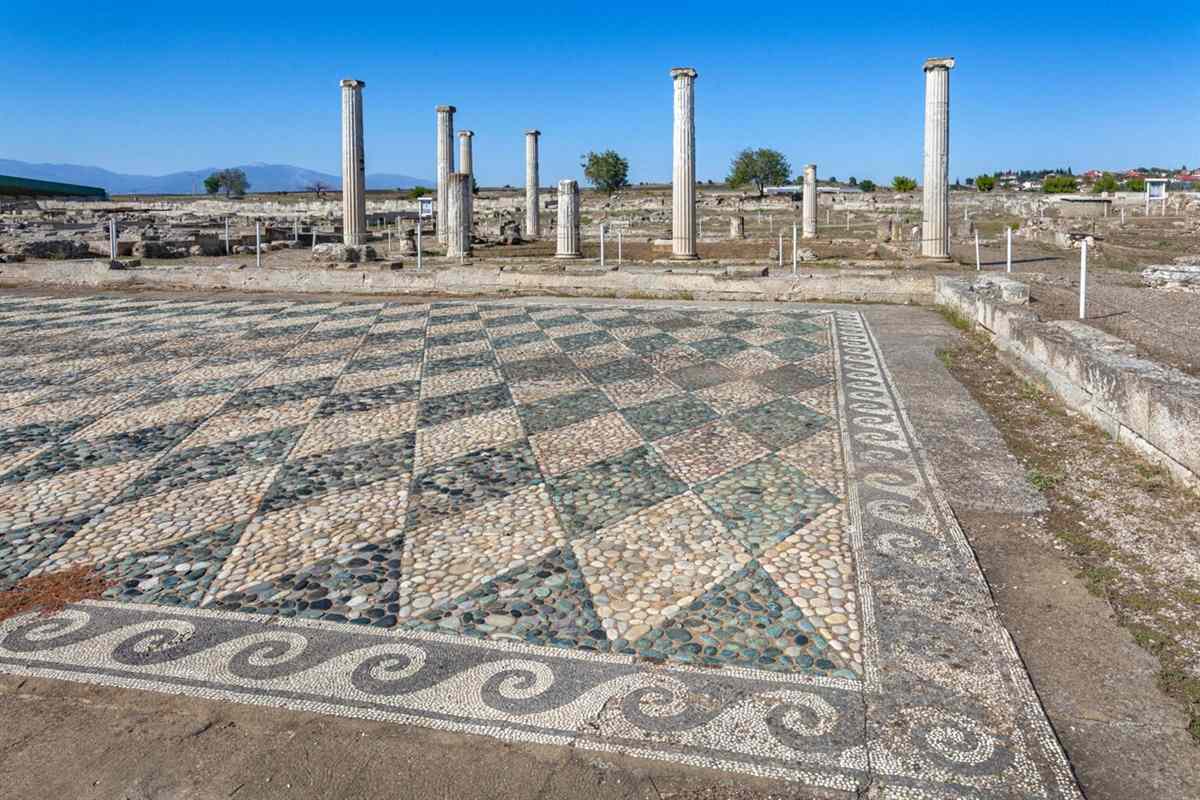
The Pella archaeological site holds the ruins of the capital of ancient Macedon west of Thessaloniki, with its houses, agora and pebble mosaics, beside the museum that keeps the finds. The visit is one of the Greece Tours on Greece Ville, listed with the other Northern Greece tours and day trips from Thessaloniki.
This post covers the formats on sale, how Pella became the capital, the city of Alexander, the Stag Hunt and other mosaics, the museum and the curse tablet and the questions that come up before booking.
What is the Pella archaeological site and where does it lie?
The Pella archaeological site holds the ruins of the capital of the ancient Greek kingdom of Macedon, the royal seat from the 4th century BC until the Roman conquest in 168 BC. It lies 1 km outside the modern town of Pella.
The modern town of Pella stands in Central Macedonia, Greece, within the Pella regional unit. That unit borders the Thessaloniki regional unit to the east, which places the Pella archaeological site west of Thessaloniki.
In antiquity the city served as a strategic port of Lower Macedonia. A navigable inlet linked it to the Thermaic Gulf, but the harbour and the gulf have since silted up and left the ruins inland.
The name Pella is traced to an ancient word pella, meaning stone, which also seems to appear in Pellene. Robert Beekes links that word to the city name but suggests a pre-Greek origin.
In 168 BC the Romans sacked the city during the Third Macedonian War and shipped its treasury to Rome. Nearby Thessalonica then took the lead as capital of the Roman province of Macedonia.
- Earthquake: An earthquake destroyed the city in about 90 BC, and it was later rebuilt over its ruins.
- Roman colony: Between 45 and 30 BC the city became a colony with coins marked Colonia Iulia Augusta Pella.
- Later name: The settlement for a time bore the name Diocletianopolis.
- Byzantine period: A fortified village occupied the Roman site in Byzantine times.
The sections below follow the Pella archaeological site through the formats on sale, the move of the capital, the city at its height, the mosaics, the museum and common questions.


Which tour formats include the Pella archaeological site?
The Pella archaeological site appears in day trips from Thessaloniki that pair it with Vergina or with Aigai, in private day tours and road trips, and in two private tours named after Alexander the Great that also cover Vergina.
Two listed day trips join Pella and Vergina, and one of them names Thessaloniki as its starting city. The other frames the pair as a day trip to the Macedonian Kingdom.
A third day trip from Thessaloniki joins the Pella archaeological site with Aigai. Its title lists Pella first, while the two Vergina day trips place Vergina ahead of Pella.
Two private formats cover the same pair. One is a Vergina and Pella private day tour themed on the footsteps of Alexander, and the other is a private road trip from Thessaloniki to Pella and Vergina.
Two further private tours carry the name of Alexander the Great. One is billed as an Alexander experience across Vergina and Pella, and the other as a private tour at Pella and Vergina.
- Vergina pairing: Two day trips and four private formats put the Pella archaeological site beside Vergina.
- Starting city: Three of the seven titles name Thessaloniki as the place of departure.
- Private options: Four of the seven formats are sold as private tours or trips.
- Alexander theme: Three titles name Alexander, two as Alexander the Great and one through his footsteps.
The tour cards and availability boxes on this page list live dates for each format. The partner stop on these routes is covered in the post on the Vergina day trip.
How did Archelaus build up the Pella archaeological site as a capital?
The Pella archaeological site owes its rise to Archelaus, king of Macedon from 413 to 399 BC, who moved the capital to Pella, built a new palace in the city and widened cultural and artistic contacts with southern Greece.
The city at the Pella archaeological site rose early in the 4th century BC as the new capital of Macedon. Archelaus is credited with building it, though an alternative view names Amyntas III.
Soon after taking power, Archelaus turned the relationship with Athens around. After the Athenian defeat at Syracuse in 413 BC, he supplied timber for new ships and received the titles proxenos and euergetes.
Archelaus brought the painter Zeuxis to decorate his palace at Pella. The court also hosted the poet Timotheus of Miletus, the tragedian Agathon and the Athenian playwright Euripides.
Euripides finished his days at Pella, writing and producing a play named Archelaus. His Bacchae was first staged at Pella in about 408 BC, during the reign of the same king.
- Family: Archelaus was the son of Perdiccas II and his wife Simache.
- Reforms: He issued good quality coinage, built strongholds and cut straight roads for the army.
- Festival: He reorganised the Olympia at Dion, with musical and athletic contests for Zeus and the Muses.
- Death: Aelian records that a royal page, Crateuas, killed him during a hunt in 399 BC.
The city traced at the Pella archaeological site began as the seat of this king, whom Thucydides credited with more military building than all his predecessors together.
Why is the Pella archaeological site linked to Alexander the Great?
The Pella archaeological site marks the birthplace of Philip II in 382 BC and of his son Alexander the Great in 356 BC. The city grew into the largest and richest in Macedonia and reached its height under later kings.
Pella was already a walled city in the time of Philip II, who gave it great international importance. The oldest parts of the palace date from his time, between 350 and 330 BC.
Cassander later redesigned and expanded the city. The peak of prosperity is placed in the reign of Antigonus, the period that left the largest share of remains at the Pella archaeological site.
South of and below the palace, the city followed a grid plan in the manner of Hippodamus. Parallel streets crossed at right angles and formed eight rows of rectangular blocks, each about 45 m wide.
The agora filled ten blocks, about 7 hectares, at the centre of the city, ringed by stoas. Pella ranks among the first known cities with piped water to individual houses and waste water disposal.
- Palace hill: The palace sits on a 70 m high hill north of the city.
- South portico: A portico at least 153 metres long ran along the palace front facing the city.
- Propylaeum: A triple gateway 15 m high gave the palace a monumental look from the city below.
- Wall paintings: The first trompe-l’oeil murals imitating perspective views appeared on walls at Pella.
Modern Pella is the starting point of the Alexander The Great Marathon. Thessaloniki, where tours to the Pella archaeological site set out, is covered in the post on the Thessaloniki walking tour.
What do the pebble mosaics at the Pella archaeological site show?
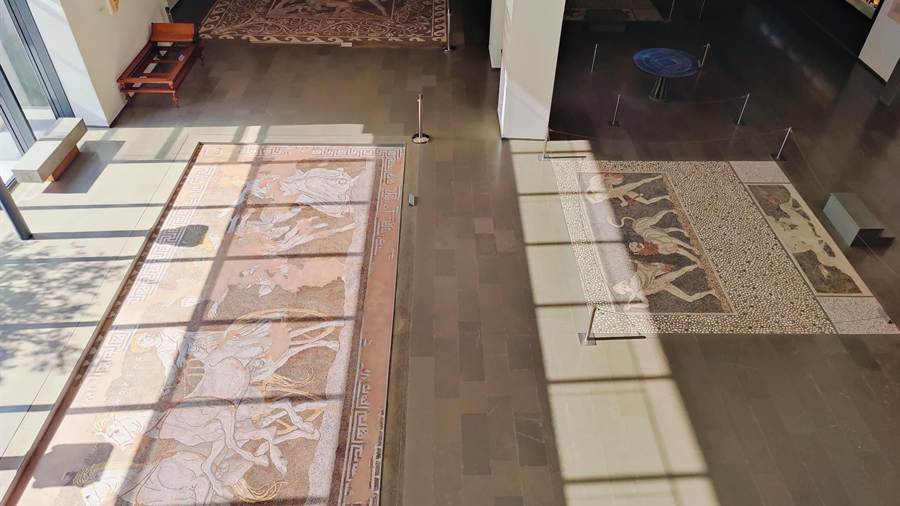
The Pella archaeological site is known for pebble-mosaic floors from wealthy houses, with scenes such as a lion hunt and the Stag Hunt, a mosaic of about 300 BC from the House of the Abduction of Helen, signed by Gnosis.
Excavations by the Greek Archaeological Service from 1957 revealed large, well-built houses with colonnaded courts. Their rooms had mosaic floors, and the houses took names from the scenes laid in them.
One floor shows a lion-griffin attacking a stag, a motif also familiar from Scythian art, while another shows Dionysus riding a leopard. Other floors at the Pella archaeological site reproduce Greek paintings.
In the Stag Hunt, pebbles gathered from beaches and riverbanks were set into cement. A floral border frames the central panel, and a band of stylised waves runs around that border.
The figure on the right is possibly Alexander the Great, judged by the date and the upswept hair. The figure on the left holds a double-headed axe, and one reading names him as the general Hephaestion.
- Signature: The words Gnosis epoesen form the first known signature of a mosaicist.
- Shading: Shading known to the Greeks as skiagraphia models the muscles and cloaks.
- Hound: The dog in the scene is possibly Peritas, the companion of Alexander.
- Myth: In Greek myth, Artemis turns the hunter Actaeon into a stag, and his own hounds tear him apart.
The Stag Hunt has since moved from its house at the Pella archaeological site to the Archaeological Museum of Pella, covered in the next section.
What does the museum at the Pella archaeological site hold?
The Pella archaeological site has its own museum, completed in 2009 to a design by Kostas Skroumpellos. It holds mosaics, finds from the agora, sanctuaries and cemeteries, a palace gallery and the Pella curse tablet, a lead scroll written in Doric Greek.
At the entrance stand a head thought to portray Alexander the Great and a statuette with the attributes of the god Pan. Five thematic groups follow, starting with daily life.
The Pella curse tablet came to light at the Pella archaeological site in 1986. It is a lead scroll carrying a katadesmos, or magic spell, dated to about 380 to 350 BC.
A woman, possibly named Dagina or Phila, wrote the spell to stop her love interest Dionysophon from marrying Thetima. She entrusted it to the body of a dead man named Macron.
Its Doric Greek idiom has been put forward as evidence that ancient Macedonian was a form of Northwest Greek. The tablet indicates that this Doric dialect was proper to Macedon, not imported.
- Daily life: Mosaic floors from the Houses of Dionysus sit with restored furniture and models.
- Public life: Coins, inscriptions and sculpture from the agora trace the running of the city.
- Sanctuaries: Mosaics come from the sanctuaries of Darron, of the Mother of Gods and Aphrodite, and the Thesmophorion.
- Cemeteries: Burials run from the Bronze Age to the Hellenistic period, and a palace gallery closes the visit.
The curse tablet and the Stag Hunt both rest in this museum, so a visit to the Pella archaeological site joins the open ruins with the indoor galleries.
What do travellers ask about the Pella archaeological site?
The Pella archaeological site prompts four common questions before a booking: whether tours leave from Thessaloniki, whether a tour joins Pella with Vergina, what the Stag Hunt Mosaic shows and which king moved the capital of Macedon to Pella.
Do tours to the Pella archaeological site leave from Thessaloniki?
Three formats for the Pella archaeological site name Thessaloniki in their titles: a Vergina and Pella day trip, a Pella and Aigai day trip and a private road trip to Pella and Vergina. The other four titles do not name a starting city.
Does any tour join the Pella archaeological site with Vergina?
Yes. Six of the seven listed formats pair Pella with Vergina. They include two day trips, a private day tour themed on the footsteps of Alexander, a private road trip and two private tours named after Alexander the Great. The remaining day trip pairs Pella with Aigai.
What does the Stag Hunt Mosaic from the Pella archaeological site show?
The mosaic shows two figures and a dog attacking a stag inside a floral border. One reading links the stag to the Persians whom Alexander later conquered, and another to the myth of Actaeon, giving the theme of the hunter being hunted.
Which king moved the capital of Macedon to the Pella archaeological site?
Archelaus, who ruled Macedon from 413 to 399 BC, moved the capital to Pella and built a new palace there. He made Macedon a significantly stronger power, and his court hosted the tragedian Euripides, whose Bacchae was first staged at Pella.