
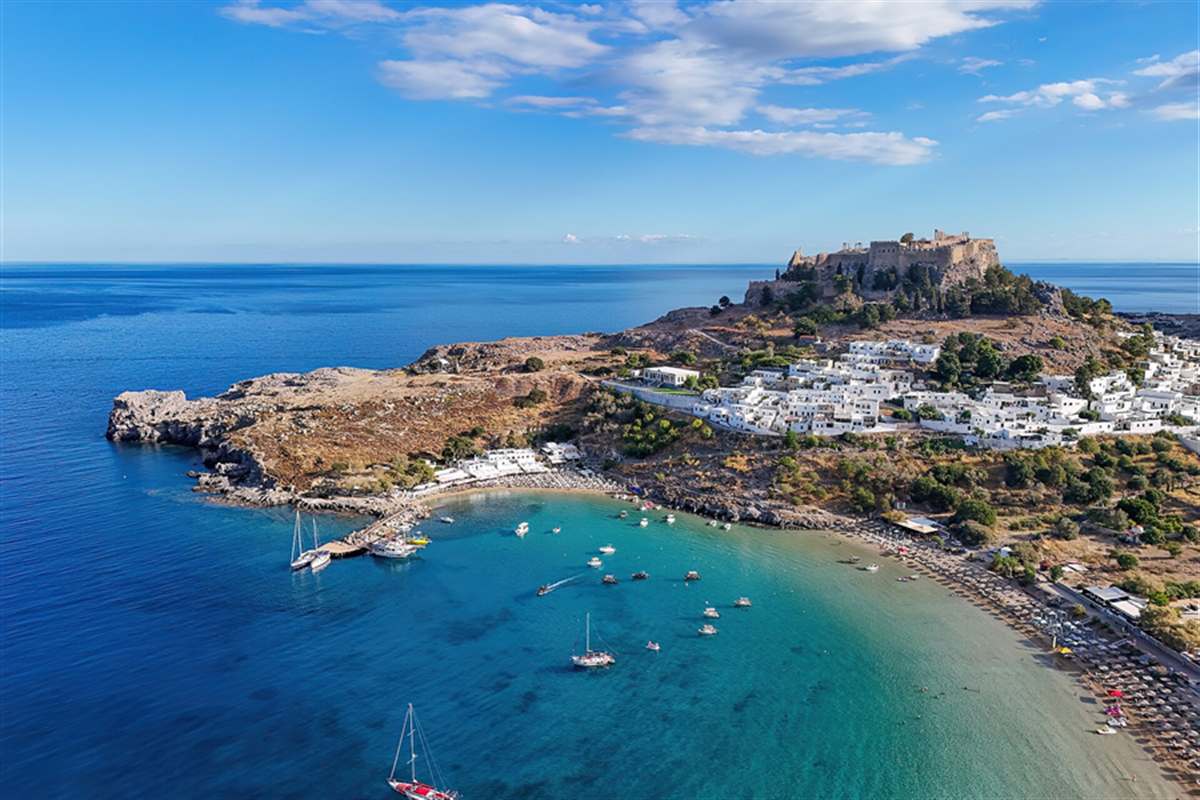
Lindos Acropolis tickets open the citadel of Lindos on Rhodes, with the walls of the Knights’ castle, the Hellenistic stoa, the Temple of Athena Lindia, the Propylaia and the carved ship relief. The post is one of the Greece Tours on Greece Ville, listed with the other Greek archaeological site tickets and Rhodes tours.
This post covers what the tickets include and the rules of a visit, the castle walls, the stoa, the temple of Athena Lindia, the Propylaia, the Church of St John and the formats on sale. Common questions come last.
What do Lindos Acropolis tickets cover, and which rules apply to a visit?
Lindos Acropolis tickets admit holders to the archaeological area on the rock above the east-coast village of Lindos on Rhodes, where a Greek sanctuary, Roman remains and a castle of the Knights of St John share one fortified summit.
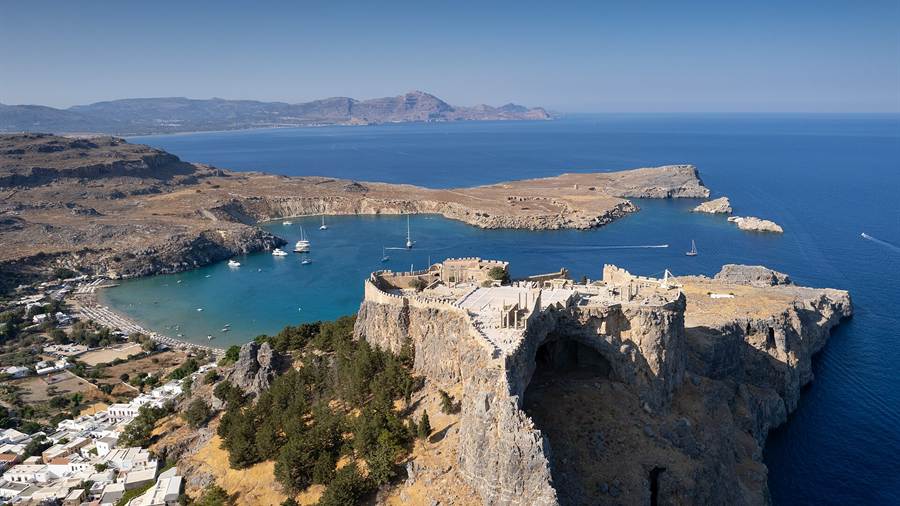
Later builders reused the summit again and again. That makes it difficult to excavate and to interpret, so Lindos Acropolis tickets open a layered site, not a ruin of one period.
Excavators dug the summit down to bedrock and uncovered the foundations of all the buildings. Work of that kind lets a visitor read the plan of the sanctuary from the stones that remain.
Restoration and protection now fall to Greek and international archaeologists working under the Greek Ministry of Culture. That ministry sets the rules of entry, and every holder of Lindos Acropolis tickets follows them on the site.
The remains in view span a long run of centuries: a Doric temple, a monumental stairway, a long stoa, a carved ship, a Roman temple, a wall, a castle and a church.
- Temple: The Doric Temple of Athena Lindia dominated the acropolis in classical times.
- Stoa: Parts of a Hellenistic stoa still stand on the rock.
- Castle: Two towers of the castle of the Knights of St John survive in part.
- Church: The Greek Orthodox Church of St John stands on the acropolis.
The sections below follow the route through the site, from the castle walls to the church, and show what each part of the summit adds to the visit.
What do the Knights’ castle walls and the entrance ramp add to Lindos Acropolis tickets visits?
Lindos Acropolis tickets reach a summit ringed by walls, among them the castle of the Knights of St John, whose towers and walls follow the natural line of the cliff and whose surviving towers rise at the southwest corner and on the west.
A large round tower once faced the sea on the east side. Two more towers stood on the northeast, one round and the other at a corner, so the castle watched the water.
Today only one tower at the southwest corner and one to the west survive, and Lindos Acropolis tickets give holders the chance to see them from close range.
The walls and towers follow the natural conformation of the cliff, so the fortification shares its outline with the rock and rises and falls with it.
The castle is not the only wall. A Hellenistic wall, built at the same time as the stairway to the entrance, also surrounds the summit.
The Knights of St John trace their order to a hospital in Jerusalem dedicated to John the Baptist. Merchants from Amalfi founded it in the eleventh century, and Pope Paschal II recognised the order in 1113.
- Early seat: The order had its headquarters in Jerusalem and Acre until 1291.
- Militarised: The hospital order became a military body in the 1120s and 1130s.
- Charge: A papal charter made it responsible for the care and defence of the Holy Land.
- Rhodes: After the reconquest of the Holy Land, the knights operated from Rhodes, over which they were sovereign.
The Lindos tour post covers the village, the bays and the castles around the rock.
What does the Hellenistic stoa add to Lindos Acropolis tickets visits?
Lindos Acropolis tickets include the Hellenistic stoa, a covered colonnade of the sanctuary that Italian restorers rebuilt in part during the occupation of Rhodes, when they raised columns again and covered large surfaces of the acropolis with concrete.
In ancient Greek architecture, a stoa was a covered walkway or portico for public use. Early examples stood open at the front, with a row of columns along the open side.
Later stoas rose to two storeys with inner colonnades, and shops or offices sat behind them. Merchants sold goods there, artists showed their work, and religious gatherings took place under the roof.
Stoas surrounded the agoras of large cities and framed them. The name of the Stoic school of philosophy comes from the word stoa, so the building type gave a whole philosophy its label.
During the Italian occupation of the island, between 1912 and 1945, workers rebuilt the monumental staircase to the propylaea and re-erected a number of the stoa’s columns. Bases and inscribed blocks were moved to the restored walls.
Judged by modern standards, that work took too little note of the excavation evidence and damaged the remains. Lindos Acropolis tickets therefore show a stoa that is part ancient stone and part rebuilding.
- Role: Stoas gave shelter to public life and trade.
- Name: The word stoa gave the Stoic school its name.
- Columns: Italian restorers re-erected a number of the columns at Lindos.
- Famous example: The Stoa of Attalos in Athens is among the best-known stoas.
The stoa shows how Hellenistic builders gave the sanctuary a public face, and how later repairs changed that face for every visitor who holds Lindos Acropolis tickets today.
What does the Temple of Athena Lindia add to Lindos Acropolis tickets visits?
Lindos Acropolis tickets reach the Doric Temple of Athena Lindia, a significant Pan-Hellenic shrine of the goddess and a centre of her cult on Rhodes, where a first seated statue was later replaced by a standing figure carrying a shield.
Scholars reconstructed the first cult statue of Athena Lindia from votive statuettes. It showed the goddess seated and wearing a polos, a crown of cylindrical shape, and it belongs to the earliest phase of the sanctuary.
The later statue stood and carried a shield, yet it wore a polos, not a helmet. Fastened to the wall of the cella, it was possibly over life-size.
In Greek myth, Danaus built a ship under the care of Athena, put his fifty daughters on board and escaped. Landing on Rhodes, he dedicated a statue of Athena Lindia, as Pseudo-Apollodorus tells it.
Before the temple, the site appears to have been the place of the cult of a local goddess. Italian archaeologists, Maiuri and Jacopi, dug the sanctuary from 1910 to 1932, and the Danish scholars Kinch and Blinkenberg also worked there.
Italian restorers rebuilt the north-east side of the Temple of Athena. Lindos Acropolis tickets therefore show a temple that was partly restored in the twentieth century.
- Style: The temple was built in the Doric style.
- Rank: Rhodes was a significant place for the cult of Athena, and its sanctuary is named beside the one at Athens.
- Statue base: The base of the cult statue remains inside the temple.
- Digs: Italian teams and Danish teams both excavated the sanctuary.
The temple is the reason the rock mattered to the ancient world, and it is the centre of the route that Lindos Acropolis tickets open.
What do the Propylaia and the carved ship relief add to Lindos Acropolis tickets visits?
Lindos Acropolis tickets pass the Propylaia, the monumental gateway of the sanctuary, and a carved ship relief at the foot of the steps, which together mark the move from the seafaring world of Rhodes to the sacred precinct above.
A propylon is a monumental gateway. It serves as a partition between the secular and religious parts of a city, and the prototype is the Propylaea at the entrance to the Athenian Acropolis.
The Propylaia of Lindos belong to the sanctuary of Athena. Italian workers rebuilt their monumental staircase, so the steps seen today join ancient design with twentieth-century work.
The Hellenistic wall round the acropolis is contemporary with the Propylaia, so gateway and wall belong to one building scheme, and Lindos Acropolis tickets cross both in a single climb.
The ship cut into the rock is a trireme, an ancient warship named for its three banks of oars. Triremes played a vital role in the Persian Wars and in the creation of the Athenian maritime empire.
Rhodes was a mercantile republic with a large navy that controlled the entrance to the Aegean Sea. A warship carved at the approach to a sanctuary therefore speaks for the strength of the island.
- Gateway: A propylon separates the secular zone from the religious one.
- Model: The Propylaea of the Athenian Acropolis is the prototype of such gates.
- Wall: The Hellenistic wall and the Propylaia date from the same period.
- Ship: The relief shows a trireme, a ship with three banks of oars.
The Rhodes Old Town tour post covers the walled medieval city on the same island, where the story of Rhodian sea power continues.
What does the Church of St John add to Lindos Acropolis tickets visits?
Lindos Acropolis tickets include the Greek Orthodox Church of St John on the acropolis, dating from the thirteenth or fourteenth century and built on the ruins of an earlier church that possibly goes back as far as the sixth century.
Earlier layers lie beside it. Remains of a Roman temple, possibly dedicated to the Emperor Diocletian, date from about AD 300, so the summit shows Greek, Roman and Christian phases in turn.
Eastern Orthodox church architecture grew from the Byzantine legacy. In the East a compact, centralised plan became the norm, while the West favoured the basilica, a long aisled hall with an apse at one end.
The basilican east end allowed the erection of an iconostasis, a screen hung with icons that hides the altar from worshippers except at points in the liturgy when its doors open.
A church of St John stands near a castle of the Knights of St John. The two share a name but not a rite: the order was Catholic, and the church is Greek Orthodox.
- Rite: The church belongs to the Greek Orthodox tradition.
- Date: The present building dates from the thirteenth or fourteenth century.
- Earlier church: A previous church on the spot possibly dates to the sixth century.
- Roman layer: A Roman temple stood on the acropolis about AD 300.
The Symi day trip from Rhodes post covers a boat trip from Rhodes to the island of Symi, a trip that fits the days around Lindos Acropolis tickets.
Which formats of Lindos Acropolis tickets are on sale?
Lindos Acropolis tickets are on sale as plain entry with an optional audio tour, as entry with a multilingual 3D audiovisual tour, and as part of bus, sidecar, private and cruise trips from Rhodes that also visit the village of Lindos.
The plainest formats are two entry tickets for the Acropolis of Lindos. One lists an optional audio tour, and the other lists an audio tour as part of the entry.
A third entry format pairs the Acropolis of Lindos with a multilingual 3D audiovisual tour, which adds a screen-based telling of the history to the ruins.
Transfer formats start in Rhodes or in North Rhodes hotels and return to the same place. They include a round-trip bus transfer with free time, a small group with free time, and an Acropolis of Lindos trip with a stop at St Paul’s Bay.
Longer formats widen the day. One bus tour adds the Seven Springs valley, and another is the Best of Rhodes tour including Lindos and the Medieval City.
Sea and evening formats complete the list: a relaxing cruise with two swim stops, a Lindos cruise with two swim stops, a private tour with Anthony Quinn Bay and Kallithea, and evening trips with a sunset view.
- Entry: Two tickets give entry to the acropolis, one with an optional audio tour.
- Transfer: Round-trip bus trips run from Rhodes and from North Rhodes hotels.
- Sidecar and private: A sidecar tour and private formats shape the day around Lindos.
- By sea: Cruise formats add swim stops on the way to the village.
The tour cards and availability boxes on this page list live dates for each format of Lindos Acropolis tickets, so the choice can follow the days that suit the traveller.
What do travellers ask about Lindos Acropolis tickets?
Lindos Acropolis tickets raise questions about what the entry covers, who wrote about the sanctuary, how Lindos lost ground to the city of Rhodes, and who founded the town. The four answers below rest on the saved record of the site.
What do Lindos Acropolis tickets let a visitor see on the summit?
Lindos Acropolis tickets cover the Doric Temple of Athena Lindia, the Propylaia, the Hellenistic stoa, the stairway, a Roman temple, the Hellenistic wall, the castle of the Knights of St John and the Greek Orthodox Church of St John, all on the rock above the village.
Which ancient writers describe the sanctuary behind Lindos Acropolis tickets?
Strabo called the temple of Athena Lindia famous and said the daughters of Danaus founded it. Callimachus described the early cult image placed by Danaus as a xoanon, later replaced by a statue, which points to a very old shrine behind Lindos Acropolis tickets.
How did Lindos lose ground to the city of Rhodes, and what do Lindos Acropolis tickets still show?
The importance of Lindos declined after the founding of the city of Rhodes in the late fifth century BC. The precinct still grew in Hellenistic and Roman times, as more buildings were added, and Lindos Acropolis tickets show those later layers.
Who founded the town beneath the rock that Lindos Acropolis tickets overlook?
According to myth, Dorians led by the king Tlepolemus founded Lindos, arriving about the tenth century BC. Lindos became one of six Dorian cities in the area, and by the eighth century it was a major trading centre, as the setting of Lindos Acropolis tickets shows.
Featured photo: Giles Laurent, CC BY-SA 4.0, via Wikimedia Commons.