
Delphi tickets open the sanctuary of Apollo and its museum, with the Sacred Way, the Treasury of the Athenians, the Temple of Apollo, the theatre, the stadium, the Castalian Spring and the Tholos. The post is one of the Greece Tours on Greece Ville, listed with the other Greek archaeological site tickets and Central Greece tours.
This post covers what the tickets include, the rules of a visit, the monuments from the Treasury to the stadium, Athena Pronaia, the museum and the formats on sale. Common questions come last.
What do Delphi tickets cover?
Delphi tickets cover the archaeological site of the sanctuary of Apollo on Mount Parnassus and, in the formats that list it, the Delphi Archaeological Museum beside it. The site holds temples, treasuries, a theatre, a stadium, a spring and a gymnasium.
The Delphi Archaeological Museum is run by the Greek Ministry of Culture through the Ephorate of Antiquities of Phocis. Its galleries display statues, architectural elements and offerings dedicated to Pythian Apollo.
Storage and conservation rooms for mosaics, ceramics and metals take up 558 square metres. An entrance hall, a cafeteria and a gift shop also serve the visitors who hold Delphi tickets.
On the open ground, Delphi tickets lead to the Temple of Apollo and the treasuries along the Sacred Way. The theatre lies farther up the hill, and the stadium lies beyond it.
Two areas lie apart from the main terrace. Athena Pronaia and the Tholos stand less than a mile east of the main ruins, and the Castalian Spring rises in the ravine between the Phaedriades.
The Delphi day trip from Athens post covers the road from the capital and the story of the oracle, while this post follows the ticket from the gate to the museum.
- Site: The sanctuary of Apollo, with its temple, treasuries, theatre and stadium.
- Museum: Statues, architectural elements and offerings found at the sanctuary.
- Pronaia: The sanctuary of Athena Pronaia and the round Tholos.
- Spring: The Castalian Spring in the ravine between the Phaedriades.
Each later section takes one item of this list in turn, so that every part of the ticket can be matched to the stone and to the story behind it.
What are the rules of a visit with Delphi tickets, and how does the Sacred Way climb?
Delphi tickets lead through the Roman Agora, the first remains met on entry, and the rules of the visit follow one route. The Sacred Way climbs past votive statues and treasuries to the Temple of Apollo, with the theatre and stadium higher up.
The Roman Agora is the first set of remains that the visitor sees on entering the site. It lay outside the precinct walls, between the sanctuary and the Castalian Spring.
From the entrance of the upper site, the Sacred Way runs up the slope almost to the Temple of Apollo. Votive statues and treasuries line the path, so the climb with Delphi tickets passes city-state gifts.
The Stoa of the Athenians faces the Sacred Way. Seven fluted columns remain, each cut from one stone. An inscription says the Athenians built the stoa after their naval victory over the Persians in 478 BC.
Beside the same stretch, a polygonal retaining wall holds up the terrace of the temple. From 200 BC its stones were cut with slave manumission contracts, and about a thousand are recorded there.
- Entry: The Roman Agora comes first, outside the precinct walls.
- Path: The Sacred Way climbs almost to the Temple of Apollo.
- Stoa: Seven single-piece columns survive from the Stoa of the Athenians.
- Wall: The polygonal wall carries about a thousand manumission records.
Rules on hours and fees are not listed here. The route above is the order in which Delphi tickets meet the stone, from the agora to the wall.
What does the Treasury of the Athenians show to holders of Delphi tickets?
Delphi tickets reach the Treasury of the Athenians, a restored building on the Sacred Way whose metopes show the deeds of Theseus and Heracles. Twenty-seven of its thirty metopes survive and are displayed in the museum in two rooms.
The museum gives the treasury two rooms. The first holds the metopes, and the second holds the acroteria, the pedimental sculpture and the inscriptions, so the carved parts stay together for holders of Delphi tickets.
The metopes are cut in deep relief. The metopes of the east side show a battle with the Amazons, and the other sides carry the deeds of two heroes.
On the south side, Theseus kills the Minotaur, meets the bull of Marathon and fights the bandits Cercyon and Skiron. In one panel the hero stands with the goddess Athena.
The north side shows nine deeds of Heracles. His fight against Geryon fills four metopes in a row, told in an unusual narrative style that links the panels into one story.
The pediments seen with Delphi tickets are fragmentary. The eastern pediment apparently shows the meeting of Theseus and Peirithous, and the western pediment shows Heracles in a battle scene.
- Argos: One of the largest treasuries, completed in 380 BC.
- Sicyon: Its metopes show the Argonauts, the Calydonian boar hunt and the abduction of Europe.
- Thebes: The Thebans built an identified treasury on the slope.
- Boeotia: The Boeotians also built an identified treasury.
City-states from across Greece built these treasuries, each with its own building beside the Sacred Way, so Delphi tickets cover a row of separate gifts and not a single monument.
What do Delphi tickets show at the Temple of Apollo?
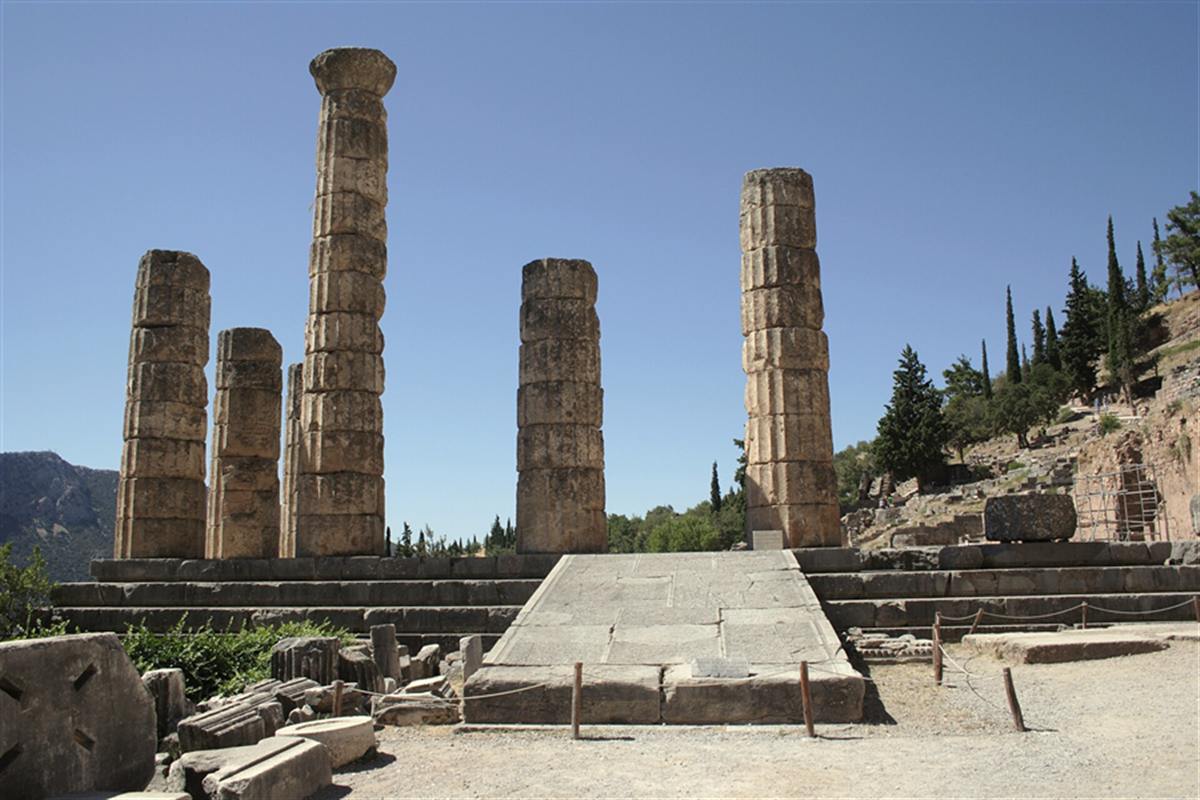
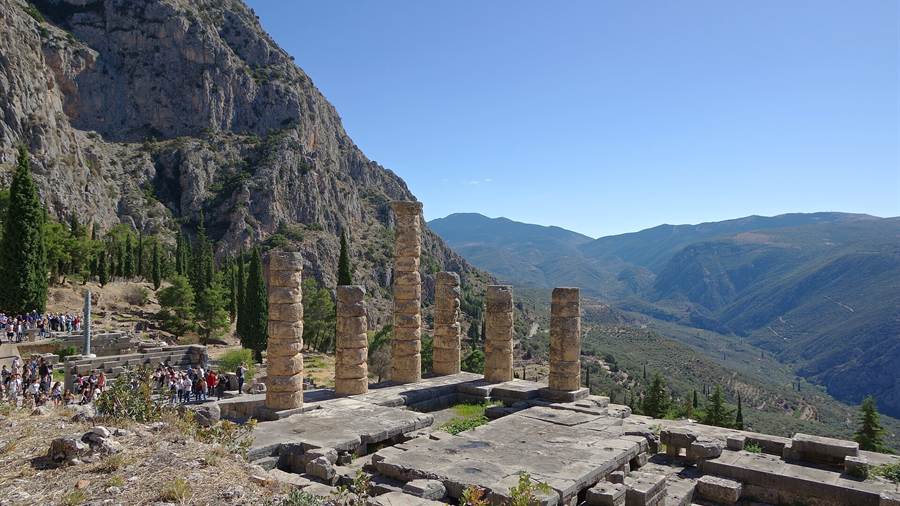
Delphi tickets show the ruins of the Doric Temple of Apollo, a peripteral building of the fourth century BC. Tradition counted three mythical temples before it, built of olive branches, of beeswax and wings, and by Hephaestus and Athena.
According to tradition, the first mythical temple was made of olive branches from Tempe. A second was built of beeswax and the wings of bees, and Hephaestus and Athena made the third.
The first temple attested by archaeology dates from the seventh century BC. The ruins that Delphi tickets reach belong to a later Doric building of the fourth century BC, with columns on all four sides.
The museum keeps the archaic temple facade in Room 6. Its Parian marble pediment showed Apollo arriving in a carriage with four horses, with three women on the left and three men on the right.
Above that facade stood a running Nike as the central acroterion, with a sphinx at each side. The western pediment showed a Gigantomachy, and both pediments are attributed to the Athenian sculptor Antenor.
- Altar: The main altar in front of the temple was paid for by the people of Chios.
- Pediment: The western pediment of the fourth-century temple showed Dionysus with the Thyades.
- Plataea: After the battle of Plataea, Greek cities put out their fires and brought new fire from Delphi.
- Raid: In 278 BC a Thracian tribe burned the temple and stole the unquenchable fire from the altar.
The temple stands on the terrace that the polygonal wall holds up, so the temple, the altar and the wall form one group for Delphi tickets.
What do Delphi tickets show at the theatre and the stadium?
Delphi tickets reach the ancient theatre, built in the fourth century BC above the temple, and the stadium higher still. The theatre gave spectators a view of the whole sanctuary, and the stadium held the track and field contests of the Pythian Games.
In the theatre that Delphi tickets reach, the lower seating held twenty-seven rows and the upper only eight, divided by a corridor called the diazoma. Six stairs split the lower part into seven tiers.
The theatre took about 4,500 spectators. On the walls of the side corridors, large numbers of inscriptions record fictitious sales of slaves to the god, which were a form of freeing.
The track of the stadium measured 177.55 metres by 25.50 metres. On the east, the starting line survives with two rows of incised slabs for the runners’ feet, and four pillars carried an arch.
An inscription calls the building the pythikon stadion. Another, carved on the eastern support wall, forbids taking out the wine meant for sacred rituals, although it has been proposed that the stone was moved from elsewhere.
- Torrent: The eastern seating overrides a small torrent that carried the water of the Cassotis fountain.
- Phases: The stadium shows at least four building phases.
- Tiers: The tiers on the south side were added in 100 BC.
- Rank: It is the best preserved ancient stadium in Greece.
The theatre and the stadium show that Delphi tickets cover contests of music and sport as well as prayer at the temple, and both stand high above the sanctuary.
What do Delphi tickets show at the Castalian Spring and the gymnasium?
Delphi tickets pass the Castalian Spring, where two fountains of different ages survive in the ravine, and the gymnasium, a two-level complex built for the young people of Delphi. Both lie apart from the main terrace, near the sanctuary of Athena Pronaia.
The archaic fountain dates from the sixth century BC. Its marble-lined basin is surrounded by benches, and a short aqueduct brought the water to a set of pipes that ended in lion-headed spouts.
The Roman fountain dates from the first century BC and stands about 50 metres higher up the slope, cut into the rock. A closed aqueduct fed it, and seven bronze spouts decorated its facade.
A modern fountain stands near the street that leads to the site and offers respite to travellers. The old spring belonged to the ritual of the sanctuary, and Delphi tickets reach it first.
The gymnasium had two levels. A stoa on the upper level gave open space, while a palaestra, a pool and baths lay on the lower floor, all used by the young people of Delphi.
Above the ancient gymnasium rose the monastery of the Dormition of Mary, an early modern building. Lord Byron, visiting in 1809, carved his name on the same gymnasium column as Lord Aberdeen.
- Archaic: A sixth-century fountain house with a marble-lined basin and benches.
- Roman: A first-century fountain with seven bronze spouts.
- Upper level: A stoa that gave the youth of Delphi open space.
- Lower level: A palaestra, a pool and baths.
The Arachova day trip post covers the mountain village on the road to the site. The spring and the gymnasium lie apart from the main sanctuary, and Delphi tickets reach both.
What do Delphi tickets show at Athena Pronaia and the Tholos?
Delphi tickets reach the sanctuary of Athena Pronaia, whose name means Athena of forethought, and the Tholos, a round stone building with three restored Doric columns. The Tholos stands less than a mile east of the main ruins at Delphi.
The Tholos blended materials as well as orders. Thin Eleusinian slabs and Pentelic marble formed the upper parts, while limestone formed the platform, and the mix of colours gave the building a natural polychrome effect.
Inside the cella, a stone bench ran along the wall, and ten Corinthian pilasters stood against it. The marble roof was decorated with eight female statues carved in lively motion.
The outer metopes showed battles with Amazons and with Centaurs, subjects dear to Greek sculptors. The inner frieze survives only in small, broken pieces, and it is said to have shown labours of Heracles or Theseus.
The sculpture dates between 380 and 370 BC. In the early Christian years, builders reused the loose metopes as building material and tomb covers, so the reliefs survive in fragments.
Rooms 9 and 10 of the museum hold finds from this sanctuary. Room 10 shows lion-head simae and two rows of metopes from the Tholos, and Room 9 shows sculptures of the Treasury of the Massaliots.
- Materials: Eleusinian slabs, Pentelic marble and a limestone platform.
- Roof: Marble, decorated with eight female statues.
- Metopes: Amazon and Centaur battles on the outer side.
- Museum: Rooms 9 and 10 hold the finds of Athena Pronaia.
The Galaxidi day trip post covers the harbour town on the gulf coast. The Tholos ends the walk through the sanctuary for visitors who plan Delphi tickets.
What does the museum add to Delphi tickets?
Delphi tickets that include the museum add galleries of statues, reliefs and offerings arranged in order of date, with the Charioteer, the Sphinx of Naxos and the Siphnian frieze among the best known pieces. The collection grew from the discoveries made at the sanctuary.
Room 3 holds the kouroi known as Cleobis and Biton, made at Argos between 610 and 580 BCE, and four Sicyonian metopes with scenes of the Argonauts and of the Calydonian boar hunt.
With Delphi tickets for the museum, Room 5 shows the Sphinx of Naxos, a statue that crowned an Ionic column and stood 12 metres high with it. Naxos dedicated it between 575 and 560 BCE.
Room 13 holds the Charioteer, one of the finest bronzes of the fifth century BC, made in the so-called austere style. Room 14 shows three marble heads and a stele with a dedication to Plutarch.
Between 1999 and 2003 the architect Alexandros Tombazis gave the museum a new facade, a new lobby and a new hall for the Charioteer. The museum opened its doors once more for its centenary.
- Order: The collections are arranged by date.
- Cave: Finds from the Corycian cave fill a long case on the ground floor.
- Vaults: The finest objects spent ten years in the vaults of the Bank of Greece.
- Tombs: Part of the collection was kept in Roman tombs and in pits in front of the museum.
A museum visit turns the ruins into a set of objects, and Delphi tickets in the formats that list the museum cover both.
Which formats of Delphi tickets are on sale?
Delphi tickets are sold as site and museum entry with an audio tour, as walking tours with admission, as day trips from Athens with an Arachova stop, as small-group or private tours, and as a combined Delphi and Meteora route with tickets.
One format is a site and museum ticket with an audio tour. A second pairs the entry ticket with a virtual reality audio tour, and a third offers a multilingual three-dimensional audiovisual tour.
A walking tour with an admission ticket covers the site on foot. Other titles name a licensed local expert who leads the group through the story of the oracle and the museum.
Day trips from Athens form a family of formats. Titles include a day tour to Delphi, a day trip with an Arachova village stop, and a day tour with the museum and an Arachova visit.
Small-group formats of Delphi tickets appear as a day trip and as a day excursion to Delphi and Arachova with tickets. A private tour with tickets carries the title of mystic Delphi.
Themed formats include a mythology tour with the museum, a Percy Jackson day trip with a custom app, and a temple and oracle day trip. A combined route adds Meteora, with tickets and hotel pickup.
- Entry: Site and museum tickets with an audio tour.
- Digital: Virtual reality and audiovisual tours.
- Group: Small-group day trips from Athens.
- Combined: A Delphi and Meteora route with tickets and hotel pickup.
The tour cards and availability boxes on this page list live dates for each format, so Delphi tickets can be matched to a calendar day there.
What do travellers ask about Delphi tickets?
Delphi tickets raise four plain questions: whether the museum is included, what the first stop is, whether the Tholos belongs to the visit, and whether the oracle can still be consulted. The answers below follow the sources and the format titles.
Do Delphi tickets include the museum?
The titles of the formats answer this. A site and museum ticket with an audio tour names both parts, while an entry ticket with a virtual reality audio tour names only the entry. The museum itself is run through the Ephorate of Antiquities of Phocis and displays statues, architectural elements and offerings.
What is the first stop with Delphi tickets?
The first remains seen on entering the site belong to the Roman Agora, which lay just outside the precinct walls. Next comes the Sacred Way, which climbs the slope almost to the Temple of Apollo, past votive statues and the treasuries of the city-states.
Do Delphi tickets reach the Tholos?
The Tholos is part of the Delphi UNESCO World Heritage Site. It stands in the sanctuary of Athena Pronaia, less than a mile east of the main ruins, in the regional unit of Phocis. The tour cards name the stops of each format.
Can Delphi tickets be used to consult the oracle?
No. The oracle ended in antiquity, when Theodosius I shut it down in 381 AD during the persecution of pagans. The Pythia once sat on a tripod in the sunken adyton of the temple, and a visit today reads the ruins and the finds.
Featured photo: Zde, CC BY-SA 4.0, via Wikimedia Commons.