
An Athens segway tour is a ride on a two-wheeled self-balancing scooter through the centre of Athens, past the slopes of the Acropolis, the Temple of Olympian Zeus and the National Garden. The tour is one of the Greece Tours on Greece Ville, listed with the other Athens tours and Greece small group tours.
This post covers the routes and the sights an Athens segway tour passes, then the rules, safety and the formats on sale. Common questions come last.
What is an Athens segway tour?
An Athens segway tour is a ride through the old centre of the Greek capital on a two-wheeled, self-balancing electric transporter. The Athens segway tour joins the slopes of the Acropolis, the National Garden, the Temple of Olympian Zeus and Plaka.
Readers who want every capital route in one place can start with the Athens tours post, where the machine ride has its entry for riders who cover the old centre on wheels. An Athens segway tour sits in that list.
The Segway was invented by Dean Kamen and reached the market in 2001 as the Segway HT. The name is a registered trademark, and HT in the first model stood for human transporter.
Production of the Segway PT ended in June 2020, after only 140,000 units had been sold. The machine has stayed popular for security and tourism, which is the work it does in Athens.
Athens keeps strict height restriction laws so that the Acropolis hill is visible throughout the city. An Athens segway tour therefore rolls through streets where the rock stays in view.
- Inventor: Dean Kamen invented the self-balancing transporter that the rides use.
- Names: HT is an initialism for human transporter and PT stands for personal transporter.
- Owner: Ninebot, a Beijing-based rival, acquired Segway Inc. in April 2015.
- Police use: Special police forces trained to protect the 2008 Summer Olympics used the Segway for mobility.
Each later section follows one stretch of the route, from the machine itself to the slopes of the Acropolis, the National Garden, the columns of Olympian Zeus and the lanes of Plaka.


How does the machine on an Athens segway tour work?
The Athens segway tour runs on a transporter that keeps itself upright. Tilt sensors and gyroscopic sensors read the lean of the rider, and a brushless electric motor in each wheel answers it, so leaning forward moves the rider forward.
The Athens bike tour post covers the same centre on pedals. An Athens segway tour replaces pedalling with a platform, two wheels and a handlebar that the rider leans on to steer.
The dynamics follow a classic control problem, the inverted pendulum. Lithium-ion batteries power the motors, and the sensors that hold the balance were developed at the BAE Systems Advanced Technology Centre.
Early versions steered with a twist grip. In August 2006 the i2 and x2 models introduced steering by leaning the handlebars, and the i2 reached a top speed of 12.5 miles per hour, or 20.1 kilometres per hour.
The learning curve of balancing on the platform was one factor in the end of production. An Athens segway tour depends on riders who learn the lean before the route begins.
- Sensors: Tilt and gyroscopic sensors keep the platform level under the rider.
- Motors: A brushless electric motor sits in each wheel.
- Steering: The i2 and x2 models steer by leaning the handlebars to the right or left.
- Range: Those models ran for 15 to 25 miles, depending on terrain, riding style and battery.
The machine explains how an Athens segway tour moves. The next section explains where it moves first, along the ground under the Acropolis.
What does an Athens segway tour show below the Acropolis?
An Athens segway tour passes below the Acropolis, on slopes that hold the Theatre of Dionysus, the Areopagus and the Philopappos Monument. These sites stand around the rock and are seen from the lanes at its base, not from the summit.
The Acropolis tour post covers the climb to the summit and the rules of the site. An Athens segway tour keeps to the ground under the rock.
The Theatre of Dionysus is built on the south slope of the Acropolis hill, in the old sanctuary of Dionysus Eleuthereus. It reached its fullest extent in the fourth century BC, with a capacity of up to 25,000.
The Areopagus is a rocky outcrop called the Hill of Ares, northwest of the Acropolis. In myth the war god Ares was tried there by the other gods, and the council that met on the hill took its name from him.
The Philopappos Monument stands on Mouseion Hill, southwest of the Acropolis. It is a Roman mausoleum for Philopappos, a prince of Commagene who died in 116 AD, raised by his sister Julia Balbilla and the citizens of Athens.
- Drama: Sophocles, Aristophanes and Euripides were all performed at the theatre.
- Council: The Areopagus later served mainly as a judicial body for homicide, wounding and certain religious offences.
- Stone: The monument is built of white Pentelic marble on a socle of porous marble.
- Frieze: The lower level shows Philopappos as a consul, riding a chariot led by lictors.
Slopes, hills and monuments follow one another within sight of the rock. An Athens segway tour covers them in one run before it turns toward the Zappeion and the National Garden.
What does an Athens segway tour show at the Zappeion and the National Garden?
An Athens segway tour reaches the Zappeion and the National Garden on flat ground east of the Acropolis. The Zappeion is a palatial hall built for the Olympic Games revival, and the garden is a former royal park behind Parliament.
Queen Amalia commissioned the Royal Garden in 1838. The German agronomist Friedrich Schmidt designed it and imported over 500 species of plants. An Athens segway tour rides past that planted ground.
In the 1920s the park opened to the public and took the name National Garden. The entrance moved to the 12 palms that Amalia planted, and the street in front became Queen Amalia Avenue. Roman ruins fill the garden, including a villa with a mosaic.
The cornerstone of the Zappeion was laid on 20 January 1874, and the hall opened on 20 October 1888. Evangelis Zappas did not live to see it.
The Zappeion served as the main fencing hall at the 1896 Summer Olympics and as the Olympic Village in 1906. Greece signed the documents for its accession to the European Community in its atrium in 1979.
- Radio: The first national broadcaster began operating in the Zappeion in 1938.
- Olympic purpose: The Zappeion was the first building erected specifically for the revival of the Olympic Games.
- Busts: A bust of Dionysios Solomos, author of the Greek National Anthem, stands on the south side.
- Gates: The main entrance is on Leoforos Amalias, with three other gates.
In 1869 the Greek Parliament set aside public land between the Palace Gardens and the Temple of Olympian Zeus. An Athens segway tour crosses that same strip on the way to the next stop.
What does an Athens segway tour show at the Temple of Olympian Zeus?
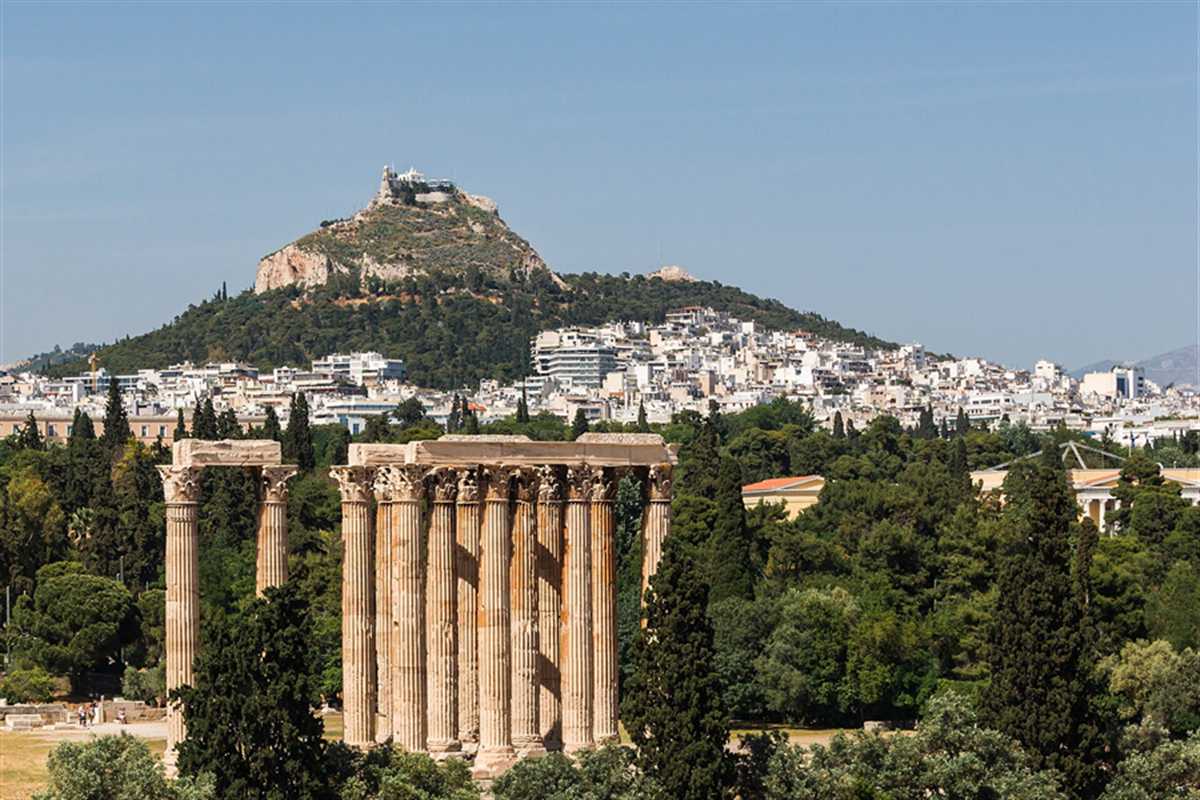
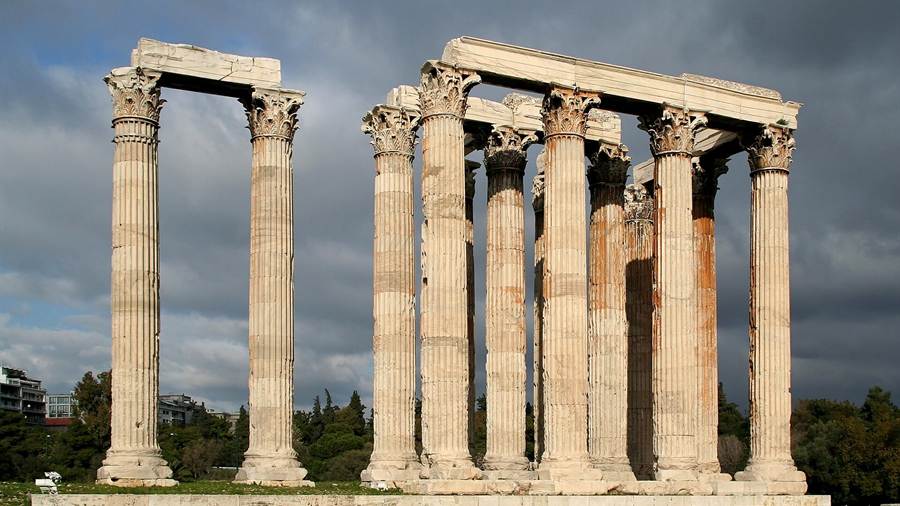
An Athens segway tour stops at the Temple of Olympian Zeus, a colossal ruin about 500 metres south-east of the Acropolis. The temple took around 638 years to finish, and 16 of its original 104 columns survive today.
Work began around 520 BC under Hippias and Hipparchos, the sons of Peisistratus, and stopped when the tyranny fell in 510 BC. Only the platform and parts of the columns stood, and the site stayed unfinished for 336 years.
Antiochus IV Epiphanes revived the project in 174 BC and put the Roman architect Decimus Cossutius in charge. The design changed to Pentelic marble and the Corinthian order, the first use of that order on the outside of a major temple.
Hadrian visited Athens in 124 and 125 AD and began a building programme that included the temple. He dedicated it in 132 and took the title Panhellenios. A walled, marble-paved precinct surrounded the building.
When Cyriacus of Ancona visited Athens in 1436 he found 21 columns standing. A Greek inscription records that a column was pulled down on 27 April 1759, and one column lies where it fell in a storm in 1852.
- Size: The building measured 110.35 metres in length and 43.68 metres in width.
- Layout: Long sides had a double row of twenty columns.
- Concert: On 28 June 2001 Vangelis staged the Mythodea concert at the site.
- Excavation: The earliest documented modern dig dates to 1886.
The temple closes the open ground of the route. From here the lanes narrow, and the Athens segway tour enters Plaka under the north-east side of the rock.
What does an Athens segway tour show in Plaka?
An Athens segway tour enters Plaka, a neighbourhood built on top of the residential areas of the ancient town of Athens. Plaka has been continuously inhabited from the Neolithic to the present day, so it holds monuments from all periods of the city.
On foot, the same neighbourhood is the subject of the Athens walking tour post, stop by stop. An Athens segway tour gives a faster view of the same streets.
The name Plaka has two proposed origins. One derives it from the Arvanitika Pliak Athena, meaning Old Athens. The other derives it from a plaque or ancient marbles that once marked a central intersection.
After the Ottoman conquest, Albanian settlers moved into Attica in waves, in 1540 and again in 1570, when the Ottoman administration decreed their mandatory settlement. Part of the north-eastern district they settled later became known as Plaka.
Plaka was abandoned in 1826 because of severe battles, and it was repopulated in the first years of the reign of Otto. In his period settlers from the island of Anafi built the quarter of Anafiotika.
- Family: Plaka was the home of the Benizelos family, from which Saint Philothei came.
- Museums: The Museum of Greek Folk Art has an annex in the Old Public Baths building.
- Visitors: Hundreds of thousands of tourists visit Plaka around the year.
- Cinema: The Greek film Woe to the Young was shot in the area.
Plaka returns the Athens segway tour to the foot of the Acropolis, among streets inhabited since the Neolithic. The final stretch is made of lanes rather than avenues.
Which formats of the Athens segway tour are on sale?
The Athens segway tour is on sale in classical, ancient, modern, panorama, night and food formats. The listed Athens segway tour options also include a route featuring Mars Hill and a tour of the National Gardens and landmarks.
Classical and ancient formats head for the Acropolis. One is a classical tour to the Acropolis, one is an Ancient Athens ride, and two mix ancient and modern sights in a single ride.
Modern Athens has a ride of its own, and a panorama ride adds viewpoints over the city. Two night rides show the capital after dark, so the evening streets replace the daytime crowd.
Food formats pair the machine with a souvlaki tasting. Two listings follow that theme, one titled a souvlaki food tour by segway and one a souvlaki segway food tour, so a meal forms part of the ride.
Other wheeled formats appear beside them: a four-wheel e-scooter tour of the Acropolis, Plaka and Ancient Athens, and a small-group electric bike tour through Plaka. Extras include a silk workshop, a sightseeing bus ticket and an airport transfer.
- Day: Classical, ancient, modern and panorama rides cover the centre in daylight.
- Night: Two night rides cover the city after dark.
- Food: Two souvlaki rides pair the machine with a meal.
- Other wheels: A four-wheel e-scooter tour and an electric bike tour sit beside the segway listings.
Live dates for each format appear in the availability boxes and the tour cards on this page, so the choice between day, night, food and scooter rides can be made against open dates.
What do travellers ask about Athens segway tour?
The Athens segway tour raises questions about the machine, the route and the formats. Travellers ask what a segway is, which landmarks the ride passes, whether food and night options exist, and how the ride differs from walking or cycling.
What is a segway on an Athens segway tour?
A segway is a two-wheeled, self-balancing personal transporter invented by Dean Kamen and sold from 2001. Tilt and gyroscopic sensors keep it upright, and a motor in each wheel answers the lean of the rider. An Athens segway tour uses that machine, although its production ended in June 2020.
Which landmarks does an Athens segway tour pass?
Routes differ by format. The slopes of the Acropolis hold the Theatre of Dionysus, while the National Garden and the Zappeion lie to the east. The Temple of Olympian Zeus and the lanes of Plaka complete the central circuit that an Athens segway tour follows.
Does an Athens segway tour include food or night rides?
Yes, the listings include both. Two souvlaki formats pair the ride with a tasting, and two night formats show Athens after dark. Day formats cover the classical and modern sights, and one listing features Mars Hill. Each Athens segway tour format has live dates on the page.
How does an Athens segway tour differ from walking or cycling?
A segway has no pedals and is steered by leaning the handlebars. The learning curve of balancing on the platform is one reason production ended. Walking and cycling cover the same centre at another pace, and the listings also include an electric bike tour through Plaka.
Featured photo: Jebulon, CC0, via Wikimedia Commons.