
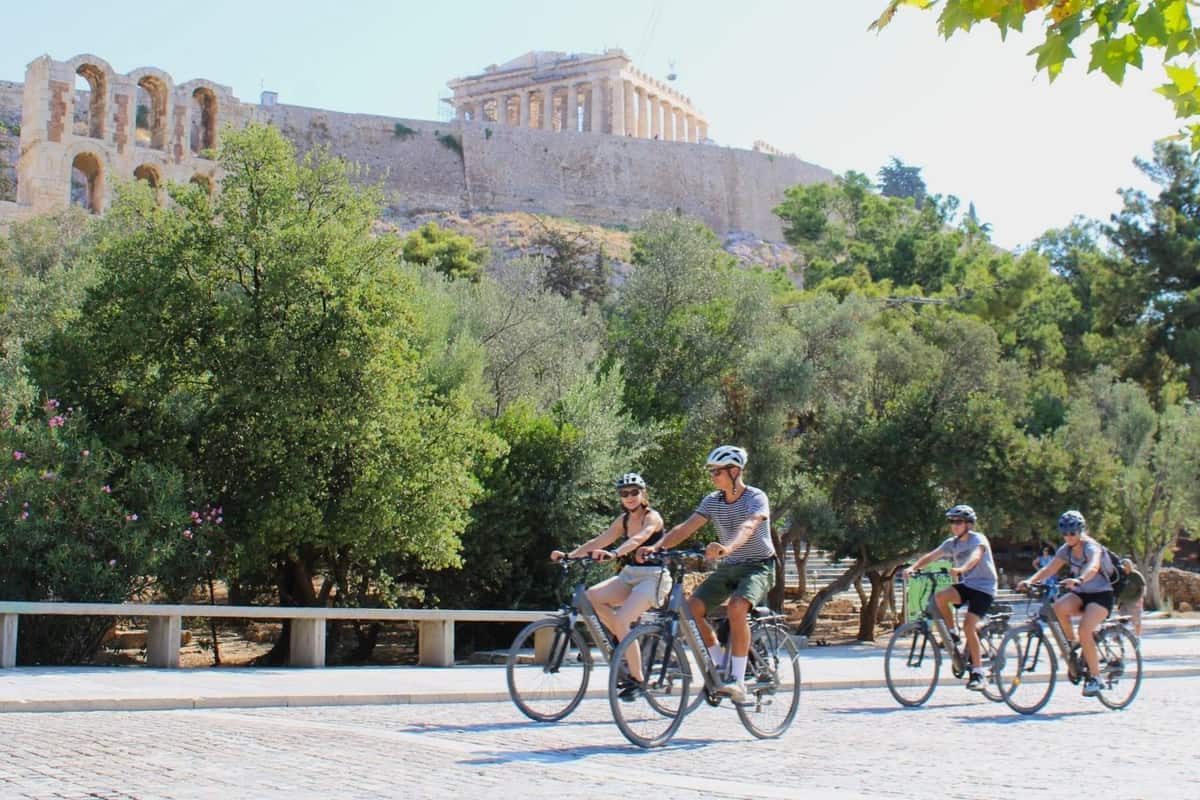
An Athens bike tour rides the car-free streets of the centre past ancient sites, parks and squares. The ride is one of the Greece Tours on Greece Ville, listed with the other Athens tours.
This post covers cycling history, car-free streets, buried rivers, metro finds, hills, road rules, city heat, clean air, the best months and common questions.
What is an Athens bike tour?
An Athens bike tour is a bicycle trip through the Greek capital. In 2021, the four regional units of the former Athens prefecture held 2,611,713 people. The Central Athens regional unit had 1,002,212 residents in 2021, on 87.4 km2.
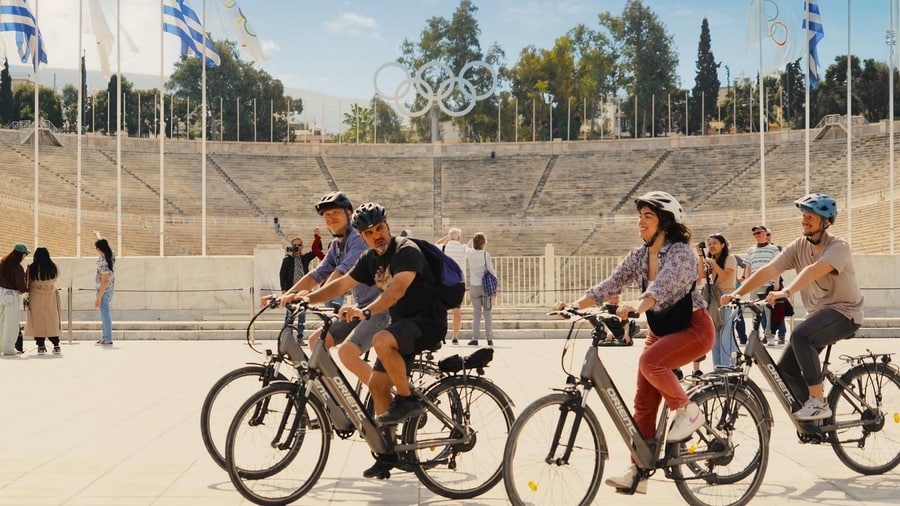
On an Athens bike tour, riders explore the Athens area. In 2006, cycling made up 2% of journeys to work there. Public transport took 37% and private motor vehicles 53%.
A 4 km cycle lane runs through the Zografou university campus in Athens. In north-eastern Athens, a cycle lane runs between Ekali and Psychiko, but it has gaps.
On an Athens bike tour, Panepistimiou Street shows what one lane can do. During the Athens Great Walk pilot, a two-way bicycle lane was created there. Bicycle traffic then rose.
Students at the Technological Educational Institute of Athens in Egaleo took a survey. Nearly 75% did not own a bicycle. About 85% felt unsafe cycling because Athens lacked bicycle infrastructure.
- Nea Erythraia: This suburb in the Athens area has a dense network of cycle lanes.
- Gazi lane: A cycle lane links the Gazi district of Athens with the Faliro coast.
- Athens Master Plan: It foresees a 230 km Metropolitan Bicycle Network, with core routes on main roads.
A study of app ride data covered Chalandri and Vrilissia. It found bike parking and public transport stops near a route draw more rides.


How did cycling come to Athens before an Athens bike tour?
An Athens bike tour follows a long cycling history. The first bicycle reached Greece in 1885. Aristidis Konstantinidis, from Lefkoniko in Cyprus, was among the first to bring a bicycle to Greece. He founded the Athens Cycling Club in 1891.
On an Athens bike tour, the city’s 1896 Olympics are part of the story. At those Games, nineteen male cyclists from five nations raced in six cycling events.
The Athens-Piraeus train company gave the Neo Phaliron Velodrome land to the Hellenic Olympic Committee. The track was a third of a kilometre, so the 100 km race took 300 laps.
On an Athens bike tour, it helps to know the 1896 Olympic road race. It ran 87 km from Athens to Marathon and back, on 12 April.
Konstantinidis broke his bike once and crashed twice. So he borrowed bicycles from friends who followed the race. He took back the lead just before Faliro and became Olympic champion.
- Road race: It began near Evangelismos Hospital and ended at the Palaio Faliro cycle track.
- 100 km race: Léon Flameng waited while the Greek Georgios Koletis had his broken bike fixed.
- 12-hour race: It was the only Olympic race set by time, not by distance.
Greece’s first cycling governing body, the Greek Cycling Federation, was formed in 1937. The Athens Olympic Velodrome was first built between 1989 and 1991.
Which car-free streets shape an Athens bike tour?
An Athens bike tour can follow car-free streets across the centre. Eastern Ermou runs about 700 m as a pedestrian zone. It stretches from Filellinon Street to Aiolou Street. Voukourestiou in Kolonaki became the first pedestrian street in central Athens, in 1978.
On an Athens bike tour, eastern Ermou carries no car traffic. Work to close it to cars began in 1996. It has been a pedestrian street since 1997.
Voukourestiou is car-free from Stadiou Street to Akadimias Street. Designer clothing shops and jewellers line this stretch. Themistokleous Street is pedestrian from Exarchia Square up to Strefi Hill.
On an Athens bike tour, Vasilissis Olgas Avenue runs 525 metres. It lies between the National Garden and the Olympieion columns. It informally became a pedestrian street in 2020.
In 2023, the City of Athens signed a contract to make Vasilissis Olgas permanently car-free. Works there uncovered a Roman building complex built between the 3rd and 5th centuries AD.
- Plaka: As a minister, Stefanos Manos banned its nightclubs and then made its streets pedestrian lanes.
- Koukaki: The G. Olympiou pedestrian zone starts at Koukaki Square and is lined with cafés and restaurants.
- Unified sites: Pathways that unify the archaeological sites include Makrygianni Street, Dionysiou Areopagitou, Apostolou Pavlou and Ermou.
The unification of the archaeological sites entered the Athens Master Plan in 1983. The plan was approved in 1985 under minister Antonis Tritsis.
Which buried rivers flow under an Athens bike tour?
An Athens bike tour can cross city streets that run on top of buried rivers. The Kifisos is the largest river in Attica, and it is 27 km long. It cuts through the capital on its way to Phaleron Bay.
On an Athens bike tour, the Kifisos and the Ilissos share a catchment of 420 square kilometres. Before the 2004 Olympics, 13 km of the Kifisos was boxed in reinforced concrete.
From Treis Gefyres to Agia Anna, the Kifisos runs fully covered under Kifisou Avenue. In 1977, the river overflowed, and the flood again cost lives in Kaminia, a district of Piraeus.
On an Athens bike tour, the Ilissos lies buried up to the Panathenaic Stadium. This happened between 1939 and 1948. It came after Metaxas declared the river’s burial.
Under Hadrian, in 117-138 AD, the Eridanos was closed under a brick vault. It was turned into a sewer. Athens Metro excavations rediscovered it in the late 1990s.
- Monastiraki Square: The Eridanos brick tunnel forms a small open-air museum between Ermou and Ifaistou streets.
- Syntagma station: A cross-section of the Eridanos riverbed is exposed and on display at the metro station.
- Kerameikos: The open Eridanos bed is two metres wide and crosses the excavations for about 200 metres.
Only a small number of open Ilissos stretches remain: at Goudi park, in Mets and in Kallithea.
Which metro finds lie along an Athens bike tour?
An Athens bike tour crosses streets with ancient finds below them. Metro digs brought them to light. Building work on the original metro began in November 1992. Akropoli station shows 85 ancient objects from its dig in a 15-metre showcase.
On an Athens bike tour, Kerameikos has a long metro story. Digs at the first station site began in 1992, lasting five years. They uncovered the western edge of the Kerameikos cemetery.
More than 800 graves were destroyed while the station was being built in 1996. In June 1996, the tunnel route moved 45 metres to bypass and protect the cemetery.
On an Athens bike tour, Akropoli’s showcase is split into parts. One part shows grave goods from the 17th to the 9th century BC. The site was a cemetery then.
Another part shows an ancient Attic home. Its finds include clay pots and pieces of a mosaic floor. This part of the display also holds a rebuilt upright loom.
- Kerameikos: In 1997, the Central Archaeological Council banned a tunnel under the cemetery, so the station moved.
- Akropoli: Its first level copies part of the Parthenon’s east pediment, showing Helios and his chariot.
- Syntagma: Station finds include a 4th–5th century AD mosaic floor, oil lamps and loom weights.
At Monastiraki, crews dug the Line 3 tunnel without a boring machine. Soft schist, groundwater and a large number of antiquities forced this.
How do hills test riders on an Athens bike tour?
An Athens bike tour meets steep hills in and around the city. The Tourkovounia range reaches 337 metres above sea level. The Lycabettus Funicular climbs at a maximum gradient of 28 degrees. It travels at up to 7.2 km/h.
On an Athens bike tour, the Tourkovounia carry old names. In ancient times they were called Anchesmos, after their sharp peaks. Another old name is Lykovounia, meaning “wolf mountains”.
In the late 19th century, the notorious brigand Kakaras hid in the range. A quarry worked it from 1937 to 1976. It damaged large areas of land beyond repair.
On an Athens bike tour, Ardittos hill carries a name from myth. It comes from Ardettes, a mythical hero. He made peace among the people of Attica there with an oath.
Ardittos is also a burial site. The tomb of Herodes Atticus lies on top of the hill, right behind the Panathenaic Stadium. Herodes Atticus died in 179 AD.
- Hill of the Nymphs: Its name comes from a sanctuary on its top in the 6th century BC.
- Parnitha: The ancient Phyle fortress stands at 687 metres on the mountain’s west side.
- Mount Aigaleo: Athinon Avenue at Chaidari splits it from its extension, Poikilo Oros, which locals call Zacharitsa.
The winter of 1941 was deadly. That winter, residents cut down the whole south side of Aigaleo’s forest for heating.
Which road rules apply on an Athens bike tour?
An Athens bike tour runs under Greek road law. Riders must hold the handlebars with both hands, except when giving a hand signal. They cannot be towed by another vehicle. They must obey traffic lights with a bicycle symbol.
On an Athens bike tour, cyclists must get off and push when riding blocks or endangers pedestrians. Riders also cannot lead an animal on a leash while cycling.
A steady green bicycle light lets riders go straight or turn, unless another sign forbids it. Drivers turning across a bus, bicycle or moped lane must give way to its traffic.
On an Athens bike tour, bicycles can ride both ways on cycle streets covering the whole road. Walkers there must give way to moving bicycles unless they have their own walkway.
One Greek road sign means no bicycles. Another marks a lane reserved for buses, trolleybuses and bicycles. Greek warning signs tell cyclists about a steep hill, going down or going up.
- Crossings: Stopping or parking on a pedestrian crossing or a cyclist crossing is banned.
- E-bike standard: EN 15194, the European safety standard for electric bicycles, was published in 2009.
- First light: Athens got its first electric traffic light in July 1936, where Stadiou meets Pesmazoglou.
That light was bought in Berlin. Each night, a city worker turned it off with a switch.
How does city heat shape an Athens bike tour?
An Athens bike tour in summer faces strong heat. On hot summer days, central Athens can be over 10 °C warmer than nearby rural areas. In heat waves, the Athens heat island grows by up to 3.5 °C compared with ordinary summer days.
On an Athens bike tour, heat matters. Athens summers have warmed about 1 °C per decade since the mid-1970s. Athens had five heat waves between 1 July and 31 August 2012.
Tree crowns cover 11% of Athens, against a 29% average for European capitals. Green areas and trees cover 17% of Athens, the joint lowest share among European capitals, level with Valletta.
On an Athens bike tour, heat has a dark past. The 1987 Athens heat wave killed about 1,300–1,500 people. Greece then restricted outdoor building and farm work from 11am to 4pm.
The oikostegi, a green roof on the Treasury in Constitution (Syntagma) Square, opened in September 2008. In August 2009, the floor under it used 50% less energy for air conditioning.
- Night heat: In 1987, concrete apartment blocks in Athens stored daytime heat and released it at night.
- Heat levels: Two decades of weather data, matched with Greek statistics office death records, define Athens heat-wave categories.
- Cooler ground: The cool paving at Flisvos lowered the park’s surface temperature by 12 K.
At Flisvos, 4500 m2 of reflective paving cut peak summer air temperature by up to 1.9 K.
How clean is the air on an Athens bike tour?
An Athens bike tour moves through air tracked since 1987. At Patission, sulphur dioxide fell 52% between 1988–1990 and 1995–1997. Carbon monoxide fell 34% and nitrogen oxides 26% there. Scientists credit this mainly to replacing old petrol cars and cutting sulphur in diesel.
On an Athens bike tour, the Parthenon’s west side has a story. By the late 1970s, pollution had all but wiped out a horseman’s face there. Culture Minister Constantine Trypanis said so.
Athens began licence-plate road rationing in 1982. Santiago followed in 1986 and Mexico City in 1989. The Green Daktylios lets electric cars and hybrids into the inner ring anytime.
On an Athens bike tour, the season shapes the air. Carbon monoxide, nitrogen oxides, sulphur dioxide and black smoke peak in winter. They fall to their lowest in summer.
Two outer stations tracked ozone-type pollution. Liossia lies 10 km north-west of the centre, and Smyrni 5 km south-east. At both, it stayed at about the same level after 1990.
- Dust: Desert dust reaches Athens on about 30 days a year, mainly from spring to autumn.
- Asthma: In Athens data for 2001–2006, emergency asthma visits were 38% higher on desert dust days.
- Wood smoke: In winter 2013–2014, heating smoke gave Athens frequent night spikes of hourly PM10 above 75 µg/m³.
In a September 1994 study, a strong north wind kept Athens ozone low on 12 and 13 September.
Which months suit an Athens bike tour?
An Athens bike tour sees little rain in July. On 1955–2010 averages, the Nea Filadelfia station in Athens counts only 1.9 rain days that month. December is the rainiest month there, with 12.5 rain days. January follows with 12.0.
On an Athens bike tour, spring gets drier step by step. Nea Filadelfia counts 10.2 rain days in March and 8.3 in April. The month after April has just 5.8.
In autumn, the same station turns wetter month by month. Rain days rise from 4.1 in September to 7.4 in October. They climb again to 10.1 in November.
On an Athens bike tour, the wind shifts by season. Nea Filadelfia’s main wind blows from the north-east for nine months. From April to June, it comes from the south-west.
Nea Filadelfia’s wind speed also changes across the year. In July, the average wind reaches 6.5 knots from the north-east. In November, it drops to 4.1 knots.
- Driest August: In August, Tatoi counts just 1.4 rain days, the lowest of four national stations in Attica.
- Elliniko: At Elliniko, the average wind reaches 7.3 knots from the north in August.
- Strongest wind: Elefsina’s July average wind, 7.5 knots from the north, tops the four Attica stations.
In 1991–2020, Athens rainfall rose in almost every month compared with 1961–1990. Days with over 30 mm of rain doubled. But October turned drier.
What do visitors ask about an Athens bike tour?
An Athens bike tour leads visitors to ask practical questions about the city. Common topics include bikes on the metro, the tram and suburban trains. Others cover long cycle routes, passengers, children, night rules and bike sharing in the Athens area.
Can bikes go on the metro and tram on the day of an Athens bike tour?
Athens metro and tram trains carry full-size bikes, up to 2 per train. Cyclists walk their bikes in stations and keep off the escalators. They board through the last door.
How do suburban trains and trams work for an Athens bike tour?
On the Piraeus–Airport–Kiato–Aigio suburban line, bikes ride as hand luggage when there is room. They never go between the seats. Athens trams average 22 km/h, with a top speed of 70 km/h.
Which long-distance cycle routes reach the city of an Athens bike tour?
EuroVelo 8, the Mediterranean Route, follows the coast from Cádiz in Spain to Athens. It continues to Turkey and Cyprus. EuroVelo 11 runs from the North Cape in Norway to Athens.
What Greek rules on passengers and children matter for an Athens bike tour?
Greek law allows one passenger only on bikes with two pairs of pedal cranks and built-in extra seats. Under-12 riders on roads open to motor traffic need a companion aged 16 or older.
When does night start under Greek law for an Athens bike tour?
Greek road law counts night from half an hour after sunset until half an hour before sunrise. Reflectors shine back only in a headlight beam and do not light the road ahead.
Where did bike sharing open in the area of an Athens bike tour?
In the Athens area, a bike-share system opened in Keratsini-Drapetsona in November 2012. Moschato-Tavros followed in January 2013, and Maroussi in February 2013. Coastal Glyfada joined in June 2016 with 20 bikes.