
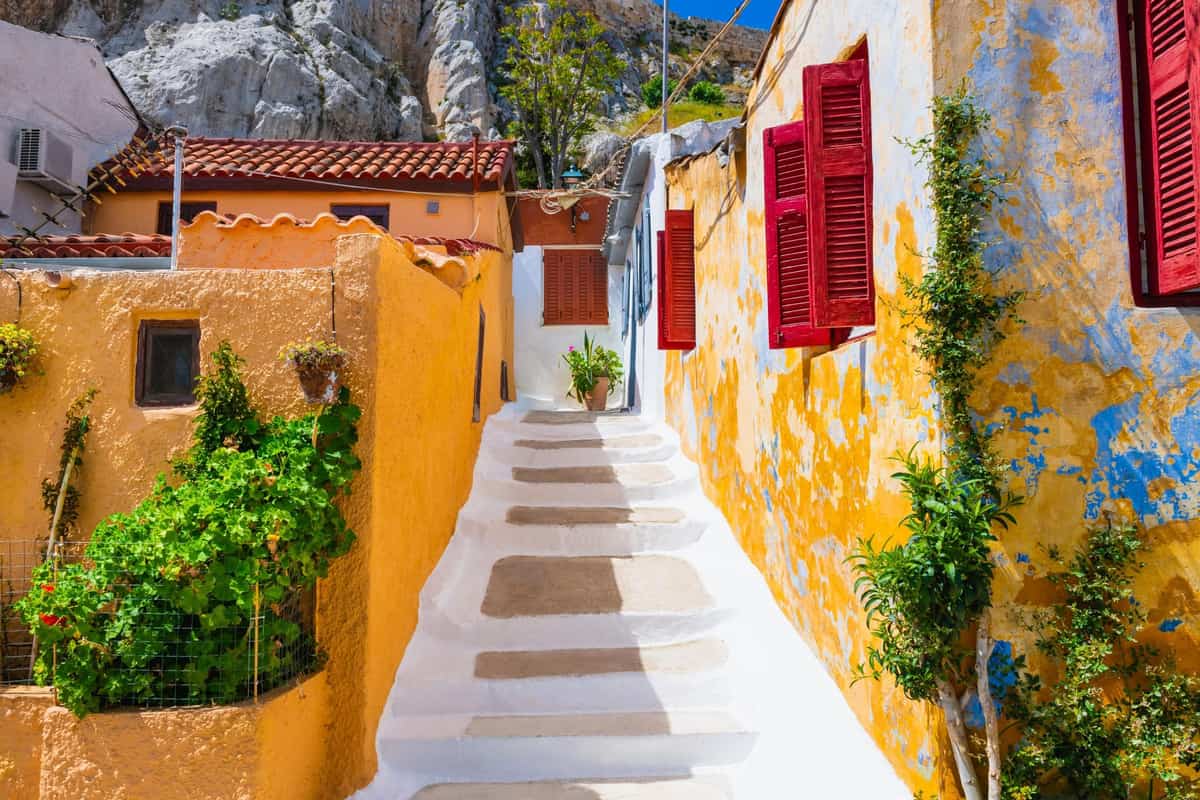
An Athens walking tour follows the old streets of the historic centre on foot, below the Acropolis. The walk is one of the Greece Tours on Greece Ville.
This post covers the 1833 town plan, Byzantine churches, Ottoman traces, mansions, street names, writers, open-air cinemas, kiosks, Pikionis paths, museums, water works, festivals, the best months and common questions.
What is an Athens walking tour?
An Athens walking tour moves through a city that grew fast after 1834. In that year, Athens had roughly 12,000 residents. That number doubled over the next ten years. The city passed 100,000 residents only at the end of the 1880s.

On an Athens walking tour, the old lanes recall a far smaller town. Before the War of Independence, Athens was the third town of later free Greece, after Tripoli and Patras.
An October 1824 census of Athens counted 9,040 inhabitants and 1,605 houses. The town was divided into 35 parishes. Arriving in 1833, Regency member Georg Maurer found not even 300 houses standing.
On an Athens walking tour, neighbourhood names point to local landmarks. The municipality of Athens has 144 official neighbourhoods. The bulk of them take the name of a church, a monument or a square.
After the Second World War, every Plaka building was declared listed. Plaka thus keeps the townscape of the late 19th and early 20th centuries. No other part of Athens does so to such an extent.
- Aiolou Street: At least a third of its buildings still date from the 19th century.
- Athinas Street: It runs nearly 1 km, and an 80 m stretch has been a walkway since 1999.
- Panepistimiou Street: This street runs about 1.2 km from Syntagma Square to Omonoia Square.
Plaka is officially classed as a traditional settlement. Since 1980, the Ministry of Culture has ordered unpermitted structures and inscriptions removed from its buildings.



How did the 1833 town plan shape an Athens walking tour?
An Athens walking tour crosses a centre first drawn in an 1833 town plan. The Regency approved the Kleanthis and Schaubert plan on 29 June 1833. A royal decree of 6 July 1833 confirmed it. The plan’s main streets formed a triangle.
On an Athens walking tour, Omonoia Square is where the plan put the triangle’s tip. In the plan, Piraeus and Stadiou streets formed its sides, with Ermou Street as its base.
The architects planned a palace balcony at the tip. They wrote that it was to show Lycabettus and the Panathenaic Stadium. It was also to show the Acropolis and the ships of Piraeus.
On an Athens walking tour, the old town is the area the plan split. The new city took in about half of it. It also spread out to the old town’s west, north and east.
The other half, bounded by Hephaestus, Pandrosos and Adrianou streets, was to be taken over for archaeological digs. Landowners protested once the street lines were marked. On 11 June 1834, the Regency halted the plan.
- Klenze’s changes: Leo von Klenze made the city smaller, the streets narrower and the squares smaller.
- Two boulevards: Of Klenze’s ring of boulevards, only today’s Panepistimiou Street and Amalias Avenue were built.
- Klafthmonos Square: This is the plan’s Theatre Square on Stadiou Street, but no theatre was built there.
Klenze’s plan was approved on 18 September 1834. The seat of state was to move from Nafplio on 1 December.
Which Byzantine churches does an Athens walking tour pass?
An Athens walking tour can pass Kapnikarea, the Little Metropolis and the Russian Church. Agioi Theodoroi, Agios Nikolaos Rangavas and Agioi Asomatoi are other Byzantine churches in Athens. Their walls, domes and floors hold clues to older layers of the city.
On an Athens walking tour, Kapnikarea is a church founded around 1050 AD. It was possibly named after its donor. It stands on the ruins of an ancient temple to a goddess, possibly Athena or Demeter.
The Little Metropolis is small: 7.6 m long and 12.2 m wide. Its walls are made only of reused marble. Ninety carved reliefs sit above window height. No bricks were used, except in the dome.
On an Athens walking tour, the Russian Church is the largest surviving Byzantine church in Athens. It was once called Soteira Lykodimou. Graffiti inside show it was built before 1044 and name its first founder, Stephen.
Plaques over the west entrance of Agioi Theodoroi record that Nikolaos Kalomalos renovated the church in 1065. Later, in 1967, repair works found graves and part of a Roman mosaic beneath the building.
- Kapnikarea: The bulk of its paintings are by modern Greek artist Fotis Kontoglou, signed in 1955.
- Carved plea: A dome colonnette of Agios Nikolaos Rangavas asks the Lord to help Leo Rangavas.
- Agioi Asomatoi: Two clay tiles with Kufic Arabic lettering are still built into its west face.
In 1821 an Ottoman cannonball brought down two-thirds of the Russian Church’s dome and its entire west wall.
Which Ottoman traces survive on an Athens walking tour?
An Athens walking tour can pass the Fethiye Mosque and the Tzistarakis Mosque. The Bath House of the Winds and the gate of the old Medrese also survive. These buildings recall the centuries when Athens was an Ottoman town.
On an Athens walking tour, the Fethiye Mosque dates from 1668 to 1670. It replaced an older mosque there. Greek Athenians called it the Wheat Market Mosque, as it stood in the Roman Agora’s grain bazaar.
The Tzistarakis Mosque was also called the Mosque of the Lower Fountain, or of the Lower Market. Its builder’s Turkish name was Dizdar Mustafa Ağa. The title dizdar means commander of a fort.
On an Athens walking tour, the surviving Medrese gate stands where Aiolou and Pelopida streets meet. Under King Otto and King George the First, the Islamic Medrese was a prison and execution site.
The Bath House of the Winds is the only Ottoman-era public hammam still standing in Athens. Small glazed holes called phengides are set in its domes and vaults. They let light into the bathing rooms.
- Venetian occupation: From 1687 to 1688, the Fethiye became a Catholic church for Dionysius the Areopagite.
- Mihrab: The prayer niche inside the Tzistarakis Mosque has honeycomb vaulting, painted plant motifs and inscriptions.
- Demolition: The Medrese was demolished in 1898 to make way for archaeological excavations.
In the 16th century, Athens had about 16,000 people. For a time, it was the fourth-largest Ottoman town in the Balkans.
Which neoclassical mansions line an Athens walking tour?
An Athens walking tour passes the Iliou Melathron and Crown Prince’s Palace. Ernst Ziller designed an estimated 700 buildings across Greece. He became the Official Court Architect of King George the First. Lysandros Kaftanzoglou, born in Thessaloniki in 1811, studied architecture in Rome.
On an Athens walking tour, the Iliou Melathron stands on Panepistimiou Street. Ziller built it for Heinrich Schliemann between 1878 and 1880. Its name means “Palace of Ilion”, another name for Troy.
The interior follows Pompeii’s architecture. Mosaics and murals show Trojan War scenes or Greek mottos. Schliemann’s widow Sophia sold the mansion to the Greek state in 1927. The Numismatic Museum opened there in 1998.
On an Athens walking tour, the Crown Prince’s Palace has roots in 1868. That year, Greece decided to give the newborn heir Constantine a home. Ziller built it from 1891 to 1897.
Queen Amalia laid the foundation of the Old Parliament House in August 1858. French architect François Boulanger drew its plans. Prime Minister Theodoros Deligiannis was assassinated on its steps on 13 June 1905.
- Crown Prince’s Palace: King George the First reportedly told Ziller not to make it too pretentious.
- Old Royal Palace: Islanders from Tinos, Sifnos, Paros and Naxos worked on it as unpaid volunteers.
- Academy Street 58a: Ziller designed this three-storey mansion in 1885, and his family lived there until 1912.
Kaftanzoglou’s Averof building of the Athens Polytechnic rose on Patission Avenue from 1862 to 1878. The Acropolis monuments influenced its design.
Which street names tell stories on an Athens walking tour?
An Athens walking tour follows streets named after gods, an emperor and landmarks. Ermou Street takes its name from Hermes, messenger of the gods and protector of trade. Aiolou Street is named after Aeolus, god of the winds in Greek mythology.
On an Athens walking tour, one stretch of Ermou got the name Ekatoncheir. It came from a plaster hundred-handed giant holding a boulder. The giant was on a house between Monastiraki and Asomaton Street.
Aiolou was called “Aiolian Road” until 1884. The name possibly came from the Tower of the Winds, which shows Aeolus’s children. Aiolou was the first street marked on the 1834 city plan by Kleanthis and Schaubert.
On an Athens walking tour, Adrianou Street honours Hadrian, a Roman emperor and friend of the Greeks. During Frankish and Ottoman rule, it was called “Ruga tis Chrysaliotissas”, after a small church of that name.
In 1835, Adrianou became the first paved street in Athens. In the early years after independence, it held the Ministries of Military and Navy. It also held the embassies of Russia, Britain, Turkey and Spain.
- Adrianou 96: The Benizelos Mansion there, from the 15th-16th century, is the oldest house in Athens.
- Panepistimiou: The name means “University Street”, after the University of Athens at the street’s upper corner.
- Vasilissis Sofias: On 1 March 1932, its stretch from Syntagma to Ampelokipoi was renamed for Queen Sophia.
Stadiou Street is named after the Panathenaic Stadium, about 3 km southeast, and aligned directly with it.
Which writers lived along an Athens walking tour?
An Athens walking tour passes places linked to Lord Byron, Kostis Palamas, George Seferis and Odysseas Elytis. Seferis’s house still stands on Agras Street, next to the Panathenaic Stadium. Elytis’s last home, from 1972, was a fifth-floor flat at Skoufa 23.
On an Athens walking tour, a French Capuchin monastery once stood beside the Lysicrates monument. Lord Byron stayed there during his second visit to Greece. The Ottomans burned it in 1821; it was later demolished.
Byron attacked Lord Elgin’s removal of the Parthenon marbles in The Curse of Minerva. Outside the National Garden, a statue shows Greece as a woman crowning Byron. Henri-Michel Chapu and Alexandre Falguière created it.
On an Athens walking tour, Asklipiou 3 recalls Kostis Palamas, who lived there for over forty years. Writers gathered there on Saturday evenings to read new work. The house was demolished in 1966 despite protests.
The press then called the demolition a “spiritual crime”. In 1935 Palamas moved to Periandrou 5 in Plaka, facing the columns of Olympian Zeus. A plaque says the national poet died there in 1943.
- Kydathineon Street: Seferis married Maria Zannou in the Church of the Transfiguration of the Saviour in 1941.
- Seferis’s funeral: In 1971, crowds followed his coffin through Athens, singing his banned poem “Denial”.
- Areos 14, Monastiraki: Alexandros Papadiamantis chanted at Agios Elissaios, a small church in the Logothetis mansion courtyard.
Palamas’s funeral was in the First Cemetery of Athens. There, thousands sang the national anthem in front of the occupying powers’ representatives.
Which open-air cinemas glow along an Athens walking tour?
An Athens walking tour passes open-air cinemas. They stayed the favourite with Athenians, because they suited the climate. Athens has 65 outdoor cinemas today, both municipal and private. Aigli Zappeiou, founded in 1910, is the oldest open-air cinema in Athens.
On an Athens walking tour, film history goes back to 1896, when cinema arrived in Greece. Travelling projectionists called provolatzides unfolded big cloths to screen films in busy parts of Athens.
The first official open-air cinemas in Athens let people in for free at first. On hot nights, the National Garden’s greenery around Aigli helps the temperature drop a couple of degrees.
On an Athens walking tour, Cine Paris stands in Plaka. A Greek hairdresser in love with Paris first opened it in 1920. In 1986 the kiosk owner across the street bought and reopened it.
Cine Thision, with its Acropolis view, has been called the “world’s coolest cinema”. Cine Dexameni first opened in 1905 and served as a shadow-puppet theatre stage from 1909. It showed films again from 1991.
- Zefyros, Petralona: It began in 1932 with shadow-puppet and variety theatre, then reopened as a cinema in 1988.
- Vox: This outdoor cinema opened in 1938, and its terrace looks over Exarchia Square.
- Riviera: Theodoros Riggas founded it in 1969 on a plot left empty after a neighbourhood fire.
Attica’s cinemas fell from 685 in 1970 to 414 in 1979, as television and video kept viewers away.
Which kiosks and old trades line an Athens walking tour?
An Athens walking tour passes street kiosks and lanes of old trades. The first Athens kiosk appeared in 1911 on Panepistimiou Street. The Sunday bazaar at Avyssinias Square started in July 1912 under a special royal decree. It still runs today.
On an Athens walking tour, street kiosks have a long story. At first, Athens kiosks sold only newspapers. After the First World War, they began to sell cigarettes and a handful of sweets.
By law, the old wooden kiosks were not allowed to exceed 70 by 70 cm. The first kiosk on Panepistimiou Street later collapsed during work on a nearby Metro station. Nobody was hurt.
On an Athens walking tour, the corner of Stadiou and Patission Streets holds a kiosk story. In 1934, Giannis Georgakas opened a kiosk there. That kiosk grew into the first store in Greece with escalators.
In the 1950s and 60s, large numbers of Athenians made phone calls at kiosks. They did so because home landlines were a rare luxury. The economic crisis forced over 500 kiosks to shut down.
- Auction house: Since 1910, Avyssinias Square has held the second-hand auction house, known as the giousouroum.
- Ifestou Street: This street starts beside Monastiraki station, and blacksmiths’ shops once clustered along it.
- Psyrri trades: In 1936, a reporter found Psyrri full of cobblers, printers and soap makers.
In the Ancient Agora, a dug-up shop near the Tholos yielded lots of hobnails. It also held a 5th-century cup base inscribed “Simon’s”.
Which paths did Pikionis lay for an Athens walking tour?
An Athens walking tour can follow the footpaths of Pikionis. He laid them from 1954 to 1957 with his architecture students from the National Technical University of Athens. The paths link Dionysiou Areopagitou and Apostolou Pavlou streets with the Acropolis and Philopappos Hill.
On an Athens walking tour, two main spiral routes start nearly opposite each other. Both begin where Dionysiou Areopagitou meets Apostolou Pavlou. One climbs north up the Acropolis hill, while the other winds away from it.
Pikionis gathered marble and clay shards from demolished nineteenth-century Athens buildings. He set them into the paths like a collage. He mixed the old pieces with new marble stones and concrete elements.
On an Athens walking tour, the main face of the Parthenon appears head-on at Loumbardiaris. It is the route’s only such view. Marble seats on the hilltop terrace set walkers at the best Propylaia views.
The design was never drawn in detail, so everything was adapted on site during building. Small teams of builders did the work. Pikionis led these teams through suggestions, examples and dialogue.
- Old frescoes: Restoration work at Agios Dimitrios Loumbardiaris uncovered worn frescoes, dated by an inscription to 1732.
- Cannon tale: Tradition says the Acropolis commander Yusuf aimed a large cannon, a loumbarda, at the church.
- Storm: The tale says lightning struck the powder store, and the blast killed Yusuf and his family.
Pikionis wanted walkers to feel surprise, admiration and curiosity before they reached the Acropolis or Philopappos Hill.
Which small museums sit along an Athens walking tour?
An Athens walking tour can link six small museums. The Benaki and Cycladic Art museums come first. The Canellopoulos and Jewish museums keep large collections. The Museum of Modern Greek Culture and the Museum of Greek Children’s Art complete the set.
On an Athens walking tour, the Benaki Museum’s main building began as the Charokopou Residence. It was built in 1867-1868. In 1910 Emmanouil Benakis bought it. That year, architect Anastasios Metaxas radically rebuilt the house.
Antonis Benakis stayed active in the Benaki Museum right up until his death in 1954. Under director Angelos Delivorrias, the museum added more than 60,000 objects, books and documents to its holdings.
On an Athens walking tour, the Museum of Cycladic Art shows 350 objects in its Cycladic collection. That collection is on the main building’s first floor. The 4th floor houses the Charles and Rita Politis Collection.
The Culture Ministry now lists the Folk Art Museum as the Museum of Modern Greek Culture. One annex, the old Public Baths at 8 Kyrristou Street, is the city’s only surviving public baths building.
- Canellopoulos Museum: Its new wing keeps a medieval house beside the Rizokastro, a 13th-century Acropolis wall.
- Children’s art: The Museum of Greek Children’s Art was founded in 1994 as a non-profit association.
- Jewish Museum: Nicholas Stavroulakis founded it in 1977 to preserve the material culture of the Greek Jews.
The Jewish Museum’s collections and archives contain over 10,000 artifacts. In 1998 the museum moved into a separate building of its own.
Which water works fed the city on an Athens walking tour?
An Athens walking tour can follow three ancient water works. The aqueduct of the tyrant Peisistratos came first. The Enneakrounos fountain and Hadrian’s Aqueduct also served Athens. In modern times, the Marathon Dam and the Boyati Tunnel joined them.
On an Athens walking tour, the story of water starts with Peisistratos. The first major water project in Athens was built under him and his sons. He ruled as tyrant from 546 to 527 BC.
His aqueduct brought water 7.5 km from the foothills of Mount Ymittos. The water reached the city centre near the Acropolis. The bulk of the aqueduct was carved as a tunnel reaching 14 m deep.
On an Athens walking tour, the Enneakrounos sat at the edge of the Ancient Agora. This public fountain had nine spouts. It is believed to have drawn water from Peisistratos’ aqueduct.
Work on the Hadrianic aqueduct ran from 134 AD to 140 AD. It began at Tatoi and carried water to a stone tank of 500 m3. That tank sat on the foothills of Lycabettus.
- Main purpose: The aqueduct was built mainly to supply the Roman quarter, which covered today’s Zappeion park.
- Hand work: The tunnel was dug by hand, possibly by slaves using simple tools to cut the stone.
- Record: Nearly 2,000 years old, Hadrian’s Aqueduct is considered Europe’s longest functional underground aqueduct.
Prime Minister Alexandros Zaimis laid the Marathon Dam’s foundation stone in October 1926. Venizelos was present.
Which festivals fill the streets on an Athens walking tour?
An Athens walking tour can share the streets with feasts, parades and music. At Apokries in Plaka, people young and old walk in disguise. They drink, dance and tease each other. Every 21 June, musicians fill squares, streets, stations and parks with concerts.
On an Athens walking tour, spring flowers decorate the Epitaphios bier on Good Friday morning. In towns with more than one parish, processions can meet in a square. Together they sing a common Trisagion hymn.
People who miss the service stand on balconies and pavements with lit candles as the procession passes. On Holy Saturday night, the hymn Christos Anesti comes with church bells, kisses of love, fireworks and firecrackers.
On an Athens walking tour, the largest 25 March parade marches through the city. It sets off from Vasilissis Sofias Avenue and passes Parliament and the Academy of Athens on Panepistimiou Street.
Georgios Rallis planned a festival at the Odeon of Herodes Atticus, modelled on the Week of Ancient Drama. Its first artistic director, Dinos Giannopoulos, was a stage director at the Metropolitan Opera in New York.
- 25 March: Before the parade, the President attends a wreath-laying service at the Tomb of the Unknown Soldier.
- Music Day: In 1985, Athens became the first city outside France to hold the event.
- Marathon: In 1983, the Athens Peace Marathon was the first to hold both popular and elite races.
Since 2001, Athens has welcomed the Holy Fire with head-of-state honours. It then goes to the Metropolitan Cathedral.
Which months suit an Athens walking tour?
An Athens walking tour suits the month after April, with the highest share of comfortable days. In that month, about 80% of days fell within the thermal comfort range. September and October each had thermal comfort on about 55% of days.
On an Athens walking tour, thermal comfort means a felt temperature (PET) between 18 °C and 29 °C. A climate study counted 88 days a year of thermal comfort in Athens for 1961–1990.
April offered comfortable conditions on about 40% of days, and June on about 30%. Thermal comfort fell to only 5–20% of days in July and August, as well as March and November.
On an Athens walking tour, 90–100% of days were sunny from April to October. From November to March, the share was about 55%. Sultry, humid-warm conditions appeared only in late summer, on 20–25% of days.
At the Nea Filadelfeia station, relative humidity averages 74.4% in January and 74.5% in November. It drops to 53.4% in the month after April and 45.7% in June. It climbs back to 54.6% in September.
- Cold stress: A felt temperature below 8 °C hit about half of days in December, January and February.
- Spring warmth: In Nea Filadelfeia, the month after April averaged 26.2 °C highs and 14.2 °C lows.
- Autumn warmth: In October, Nea Filadelfeia averaged highs of 23.5 °C and lows of 13.8 °C.
Athens has 14 hours 45 minutes of daylight on 1 July. On 1 September, daylight lasts 13 hours 1 minute.
What do visitors ask about an Athens walking tour?
An Athens walking tour brings up plain questions before the first step. Visitors ask where to turn for help. They ask about water, rest stops, toilets and smoking rules. They also ask about special days and walking distances between sights.
Who can help visitors during an Athens walking tour?
In 1929, Greece set up its Tourist Police and the national tourism organisation, EOT. Law 6450 of 1935 founded the Tourist Police Directorate. The 1571 police line answers callers in Greek, English, French and German.
Where can walkers find water and rest on an Athens walking tour?
A public fountain at the start of Ermou Street, beside Syntagma Square, gives free drinking water. The square has quite a lot of benches and shade. Still, no spot there is sheltered from rain.
What smoking rules matter on an Athens walking tour?
Greek law bans smoking in outdoor seating closed in by a tent. This applies to seating not open on at least two sides. The ban also covers atria and inside areas with removable roof covers.
Which special days relate to an Athens walking tour?
ICOMOS proposed the International Day for Monuments and Sites on 18 April 1982. UNESCO approved the day in 1983. The International Council of Museums, ICOM, held the first International Museum Day in 1977.
Where can visitors find toilets on an Athens walking tour?
Adapted toilets stand next to the information booth at the Acropolis ticket office. The Tourism Information Centre Athens also has an adapted WC. The centre sits at the corner where Makrigianni Street meets Areopagitou Street.
What walking distances come up on an Athens walking tour?
From the start of Ermou Street at Syntagma, the Kapnikarea church lies 450 metres downhill. Pedestrian Adrianou Street runs 500 metres from Hadrian’s Library to Thissio. The Ancient Agora sits on one side of it.