
Ancient Agora tickets open the civic centre of ancient Athens, with the Stoa of Attalos and its museum, the Temple of Hephaestus, the Tholos, the Panathenaic Way and the law courts. The post is one of the Greece Tours on Greece Ville, listed with the other Greek archaeological site tickets and Athens tours.
This post covers what the tickets include, the Stoa of Attalos, the Temple of Hephaestus, the Tholos, Bouleuterion and Metroon, the Panathenaic Way, ostracism and the visit rules. Common questions come last.
What do Ancient Agora tickets cover?
Ancient Agora tickets cover entry to the excavated civic centre of classical Athens, including the reconstructed Stoa of Attalos with its museum and the Temple of Hephaestus on Market Hill. The monuments date from the sixth century BC to Roman times.
The Ancient Agora of Athens, also called the Classical Agora, is bounded on the south by the Areopagus hill and on the west by Agoraios Kolonos, also known as Market Hill.
The square began as a gathering place for trade, assembly and housing. Ancient Agora tickets therefore reach a site that mixed markets, politics and daily life, not a single monument.
Archaeologists list the buildings by the north, east, south and west sides of the square. Ancient Agora tickets lead into a site organised that way, with stoas in the north and the Strategeion in the west.
By the close of the 1935 season, about half of the site was cleared. The finds included almost 600 items of sculpture, over 6,000 pieces of pottery and over 41,000 coins.
The Acropolis tickets post covers entry to the rock above the Agora. That monument is a separate site with its own admission, so the two posts sit side by side.
- Museum: The collection sits in the Stoa of Attalos.
- Temple: The Temple of Hephaestus crowns the Agoraios Kolonos hill.
- Directors: John McK. Camp directed the dig from 1994 to 2022, and John K. Papadopoulos now holds the post.
- Virtual model: The American School and the Foundation of the Hellenic World built a virtual reconstruction.
The sections below take the monuments in turn, from the stoa and the temple to the council houses, the processional road and the courts. Ancient Agora tickets open all of these remains.
Why do Ancient Agora tickets lead into the civic centre of Athens?
Ancient Agora tickets lead into the square where Athenians met, traded and posted public notices. The Eponymous Heroes monument, a mint, a speakers platform and marble workshops all stood here, which makes the site a map of civic life.
The Eponymous Heroes monument honoured the ten tribal heroes of Athens. It also served as a notice board for new legislation, public events and military conscription.
The Library of Pantainos changed the layout of the east side. After its construction, the official entrance into the Agora ran between the library and the Stoa of Attalos.
A mint stood in the square and struck bronze coinage in the 2nd and 3rd centuries BC. Evidence is lacking that it ever struck Athenian silver, so the record shows bronze alone.
The Bema, a speakers platform, stood near the Stoa of Attalos. Ancient Agora tickets therefore reach the area where public speech and public business shared the same open ground.
Marble working also shaped the square. The earliest workshops date from the early 5th century BC, and workers moved among the ruined temples of the South Square after Sulla sacked Athens in 86 BC.
- Notice board: The Eponymous Heroes monument carried legislation, event notices and conscription lists.
- Entrance: The Library of Pantainos marked the official way into the square.
- Coinage: The mint produced bronze coins and left no trace of silver production.
- Platform: The Bema gave speakers a raised place near the Stoa of Attalos.
These civic fittings explain why the square drew so much building. Ancient Agora tickets give access to the ground where each of them stood.
What do Ancient Agora tickets show at the Stoa of Attalos and its museum?
Ancient Agora tickets show the Stoa of Attalos, a two-storey colonnade built by King Attalos II of Pergamon, who ruled from 159 to 138 BC. The reconstructed building now houses the Museum of the Ancient Agora on the east side of the square.
The stoa measures 115 by 20 metres and is made of Pentelic marble and limestone. It had two storeys, which made it larger and more elaborate than the earlier buildings of Athens.
Three architectural orders appear in the building. The ground floor used Doric for the outer colonnade and Ionic inside, while the upper floor used Ionic outside and the Pergamene order within.
Each storey had two aisles and twenty-one rooms along the western wall. The ground floor also had a row of 42 closed rooms at the rear that served as shops.
The Heruli burned the woodwork in AD 267. The ruins then formed part of a fortification wall, and the rebuild of 1952 to 1956 used the original foundations.
The museum shows clay, bronze and glass objects, sculptures, coins and inscriptions from the 7th to the 5th century BC. Ancient Agora tickets thus connect the building to the democracy that used the square.
- Size: The building runs 115 metres long and 20 metres deep.
- Shops: Forty-two closed rooms at the back of the ground floor served as shops.
- Portraits: A newer sculpture exhibition centres on portraits found in the Agora excavations.
- Treaty: The Treaty of Accession of ten countries to the European Union was signed here on 16 April 2003.
The upper floor was refurbished and reopened in 2012. Ancient Agora tickets for the museum lead through a rebuilt hall that follows the ancient plan.
Why do Ancient Agora tickets name the Temple of Hephaestus?
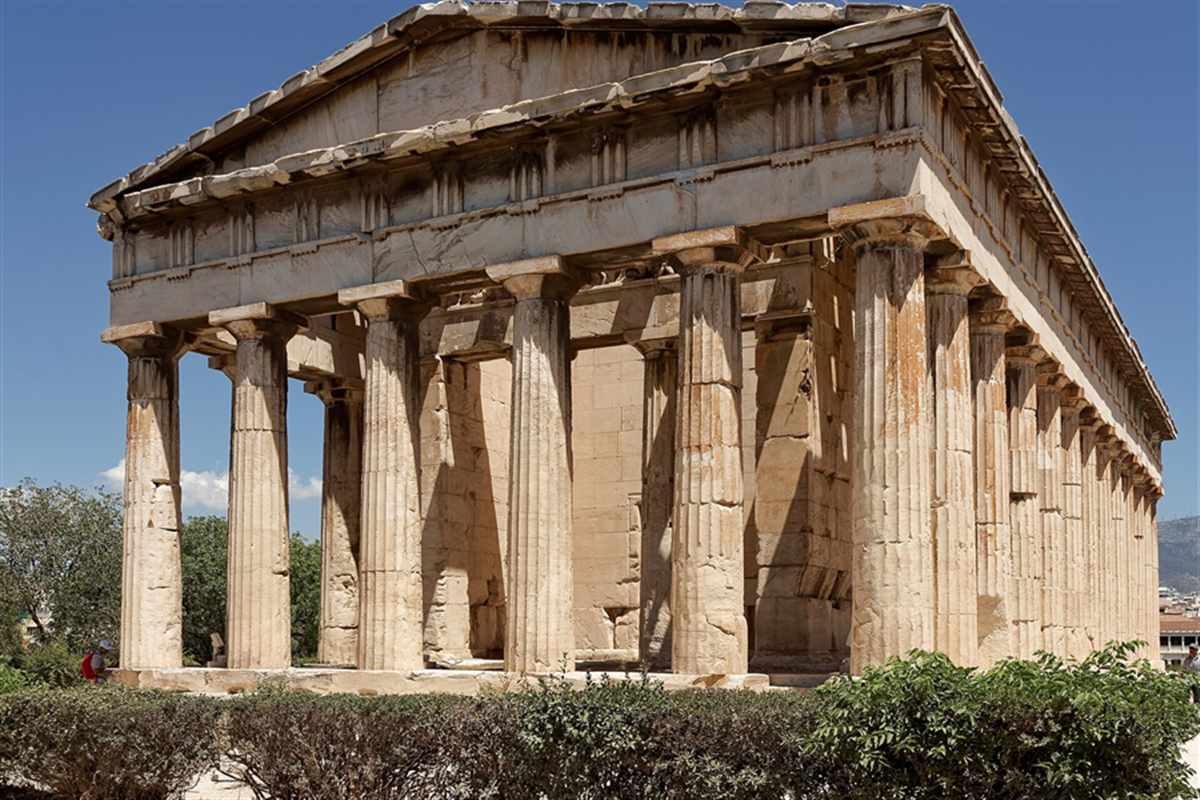
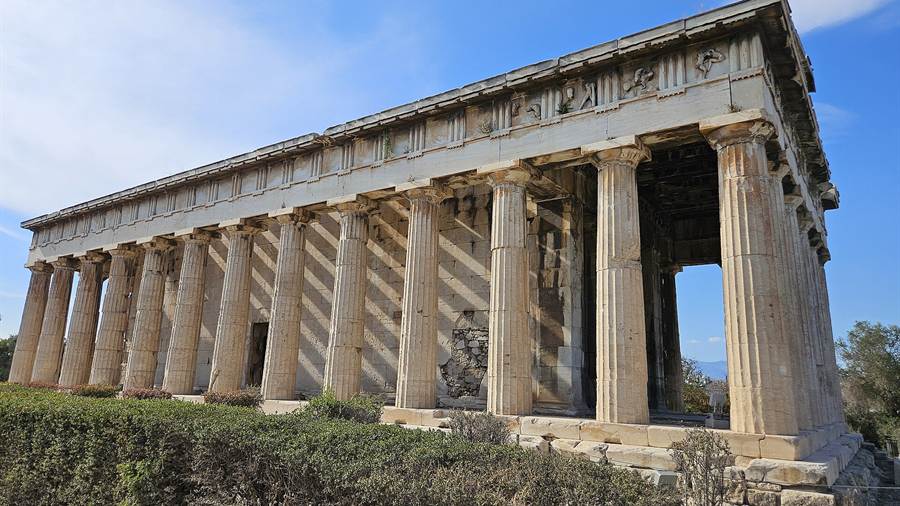
Ancient Agora tickets name the Temple of Hephaestus because it is the well-preserved Doric temple on Agoraios Kolonos, at the north-west side of the square. It served as a Christian church from the 7th century until 1834.
The temple measures 13.71 metres from north to south and 31.78 metres from east to west. It has six columns on each short side and thirteen along each long side.
Pentelic marble from the nearby mountain forms the building, except for the bottom step. Only 18 of the 68 metopes were sculpted, and the ten on the east side show the Labours of Heracles.
Modern writers once called the building the Theseion, after a mistaken belief that it held the bones of Theseus. Kimon had brought bones from Skyros in 475 BC, but inscriptions tie the temple to Hephaestus.
Workshops of potters and metalworkers stood near the temple, which suits a god of metalworking and fire. In the 3rd century BC a small garden of pomegranate, myrtle and laurel was planted around it.
The church of Saint George Akamates held its last liturgy on 21 February 1833. Ancient Agora tickets lead to a building that later served as a museum until 1934.
- Columns: Six columns stand on the short sides and thirteen on the long sides.
- Metopes: The four easternmost metopes on each long side show the Labours of Theseus.
- Burials: Non-Orthodox Europeans, including philhellenes, were buried here in the 19th century.
- Welcome: King Otto I was officially welcomed at the temple in 1834.
The building survives largely intact because of its varied use. Ancient Agora tickets for the Agora and Hephaistos temple lead to that rare standing roofed monument.
What do Ancient Agora tickets reveal about the Tholos, Bouleuterion and Metroon?
Ancient Agora tickets reveal the council buildings on the west side of the square, where the Council of 500 met and dined. The Tholos, the Old and New Bouleuterion and the Metroon stood close together below Agoraios Kolonos.
The Athenian Boule is better known as the Council of 500. After the constitution of around 507 BC, it held 50 men from each of ten tribes, and each served a one-year term.
The Old Bouleuterion rose around 500 BC. It was almost square, with wooden benches along the walls and five columns holding up the roof. Its sides measured 23.5 by 23.8 metres.
The New Bouleuterion followed in the late 5th century BCE and measured 17.5 by 22.5 metres. It was smaller than the old hall, and no source explains why Athens built it.
The Tholos served as the dining hall of the executive group of the Boule, since a kitchen leads off the main round hall. Ancient Agora tickets reach the site where that group ate.
The Old Bouleuterion became the Metroon, a temple of the mother goddess Cybele, and housed the official archives of the city. The philosopher Epicurus filed a donatio mortis causa there.
- Tribes: Ten tribes each sent 50 members to the Council.
- Metroon: The name means House of the Mother.
- Legend: Tradition says a plague followed the killing of a wandering priest of Cybele, and honouring her ended it.
- Dig: In 1934 the excavation uncovered the Tholos and fixed the sites of the Bouleuterion and the Metroon.
Together these buildings show how a democracy housed its council, its meals and its records. Ancient Agora tickets give access to their foundations.
Where do Ancient Agora tickets meet the Panathenaic Way and the Altar of the Twelve Gods?
Ancient Agora tickets meet the Panathenaic Way where the processional road crossed the square, and the Altar of the Twelve Gods stood beside it. Pisistratus the Younger, grandson of the tyrant Pisistratus, set up that altar during his archonship.
Tradition dates the formal road to 566 BCE and links it to the Great Panathenaia. Parts of its surface show use as far back as the Neolithic period.
The Pompeion was the place where processions began their route along the road. Torch-bearing runners also raced along it from the Academy to the Acropolis during the Great Panathenaia.
A milestone of about 400 BC gives the distance from the harbour to the altar as forty-five stades. In 519 BC the Plataeans sat at the altar as suppliants and asked Athens for protection.
The enclosure was roughly square at 9.5 metres a side. Workers found part of it in 1891 during the building of the Athens-Piraeus Electric Railway, and by 1992 the line covered nearly nine-tenths of it.
Tracks were removed for maintenance in 2011, and the altar was exposed before it was covered again in August of that year. The Panathenaic Stadium tickets post covers the stadium that hosted the Panathenaic athletic events.
- Founder: Pisistratus the Younger was the son of Hippias.
- Refuge: The general Callistratus took refuge at the altar shortly before his execution.
- Rediscovery: Part of the road was found again in 1837.
- Games: From 566 BC the Panathenaic Games were held in Athens at four-year intervals.
The altar and the road explain much of the shape of the square. Ancient Agora tickets lead past both, though much of the altar lies under the railway.
What do Ancient Agora tickets say about the law courts and ostracism?
Ancient Agora tickets lead to the ground where Athenians judged cases and voted on ostracism. The Heliaia was the largest court venue, and citizens scratched names on pottery sherds to expel a rival from the city for ten years.
The Square Peristyle was a law court that stood under the northern end of the Stoa of Attalos. Other courts met at places around the Agora, so the square doubled as a courthouse.
The largest panels of the Heliaia held more than 500 and up to 2,500 jurors. The exact site remains unknown, and a long-favoured candidate was reidentified in 1998 as the Aiakeion.
Each year the assembly was asked whether to hold an ostracism, and a vote followed two months later. Citizens gave names to a scribe, who scratched them on sherds called ostraka.
A quorum of 6,000 votes made the result valid, according to Plutarch. The person with the largest pile of sherds had ten days to leave, and his property was not confiscated.
Around 12,000 political ostraka have been excavated in the Agora and the Kerameikos. Ancient Agora tickets thus sit beside the place where the evidence for the practice was dug up.
- First victim: Hipparchos, son of Charmos, was expelled in 487 BC.
- Last victim: Hyperbolus was the last known case, around 417 BC.
- Penalty: An ostracised man who returned early faced death.
- Return: After ten years he came back without stigma.
Ostracism had no charge and no defence, which set it apart from a trial. Ancient Agora tickets give access to the area where these votes were counted.
What are the rules of a visit with Ancient Agora tickets?
Ancient Agora tickets lead to an open excavation, and the Ministry of Culture site publishes its schedule, tickets and contact details. This post lists no hours or prices, because the ministry schedule governs entry and is the reference.
The Hellenic Ministry of Culture runs the official site for the Ancient Agora. Its pages carry the schedule of opening hours, the ticket details and the contact information.
The site lies between two hills. The temple stands on top of one of them, and the Panathenaic Way had retaining walls and steps where it climbs the Acropolis.
The Stoa of Attalos has stairways at each end that lead to the upper storey. Ancient Agora tickets for the museum therefore include a climb to the refurbished upper floor.
Planted trees now mark the site. On 4 January 1954 Queen Frederika and King Paul planted the first oak and laurel trees around the Altar of Zeus to recall ancient planting.
The Athens walking tour post covers routes through the old city that pass close to the square. It suits readers who plan to pair the site with other districts.
- Schedule: The ministry site is the reference for hours and tickets.
- Hill: The Temple of Hephaestus sits on the Agoraios Kolonos hill.
- Stairs: The Stoa of Attalos has stairways at both ends.
- Trees: Oak and laurel trees stand around the Altar of Zeus.
Rules change with the season and the monument, so the ministry pages are the place to check. Ancient Agora tickets follow whatever those pages state.
Which formats of Ancient Agora tickets are on sale?
Ancient Agora tickets on sale include e-tickets with an audio tour, entrance tickets for the Agora and the Hephaistos temple, combined Roman Agora options and expert-led tours that pair the Agora with the Acropolis or the Plaka district.
One format is an e-ticket for the Ancient Agora with an audio tour. It suits visitors who want recorded commentary at their own pace along the paths of the square.
A second format is an entrance ticket for the Agora and the Temple of Hephaestus. It names the Temple of Hephaestus, the well-preserved building of the square, beside the Agora itself.
Another format combines the Roman Agora and the Ancient Agora in one e-ticket with two audio tours. A separate listing offers a Roman Agora e-ticket with an audio tour alone.
Expert-led tours add a person to the visit. One tour pairs the Acropolis with the Ancient Agora and includes all entrances, another adds an optional museum, and a third adds the Plaka district.
A premium tour of the Ancient Agora also appears among the listings. Ancient Agora tickets in this format centre on the Agora alone, not on a wider route.
- Audio: The e-ticket formats carry audio tours.
- Temple: One entrance ticket names the Hephaistos temple.
- Roman Agora: Combined and separate Roman Agora options exist.
- Expert-led: Tours pair the Agora with the Acropolis or Plaka.
The tour cards and availability boxes on this page list live dates. Ancient Agora tickets show their current options there, with each card naming its format.
What do travellers ask about Ancient Agora tickets?
Ancient Agora tickets raise questions about museum access, the council buildings, the excavation history and the sculptors linked to the square. The answers below rest on the monuments that the site preserves and on the records of its excavation.
Do Ancient Agora tickets include the museum in the Stoa of Attalos?
The Museum of the Ancient Agora is housed inside the reconstructed Stoa of Attalos, on the east side of the square. The Ministry of Culture site states what each ticket covers, so that source settles the question for any given format.
Which sculptors worked at the monuments Ancient Agora tickets reach?
The excavations link the square to Phidias and his associate Alkamenes, whose bronze cult statues of Hephaestus and Athena belonged to the temple. Euphranor made a colossal Apollo for the Temple of Apollo Patroos, and Bryaxis left a signed statue behind the Royal Stoa.
How did war affect the digging behind Ancient Agora tickets?
The 1939 season cleared 56,000 tons of earth, more than in any other year. In 1940 the team prepared to halt work for the Second World War, handed finds to the Greek government and photographed the records before placing them in a bomb-proof shelter.
Do Ancient Agora tickets reach the Odeon of Agrippa?
The Odeon of Agrippa stood in the centre of the Agora and was a gift from the Roman statesman Marcus Vipsanius Agrippa. The 1936 campaign uncovered it, together with the fountain house identified as the Enneakrounos, so the ground it covered is part of the excavated site.
Featured photo: Jakub Halun, CC BY 4.0, via Wikimedia Commons.