
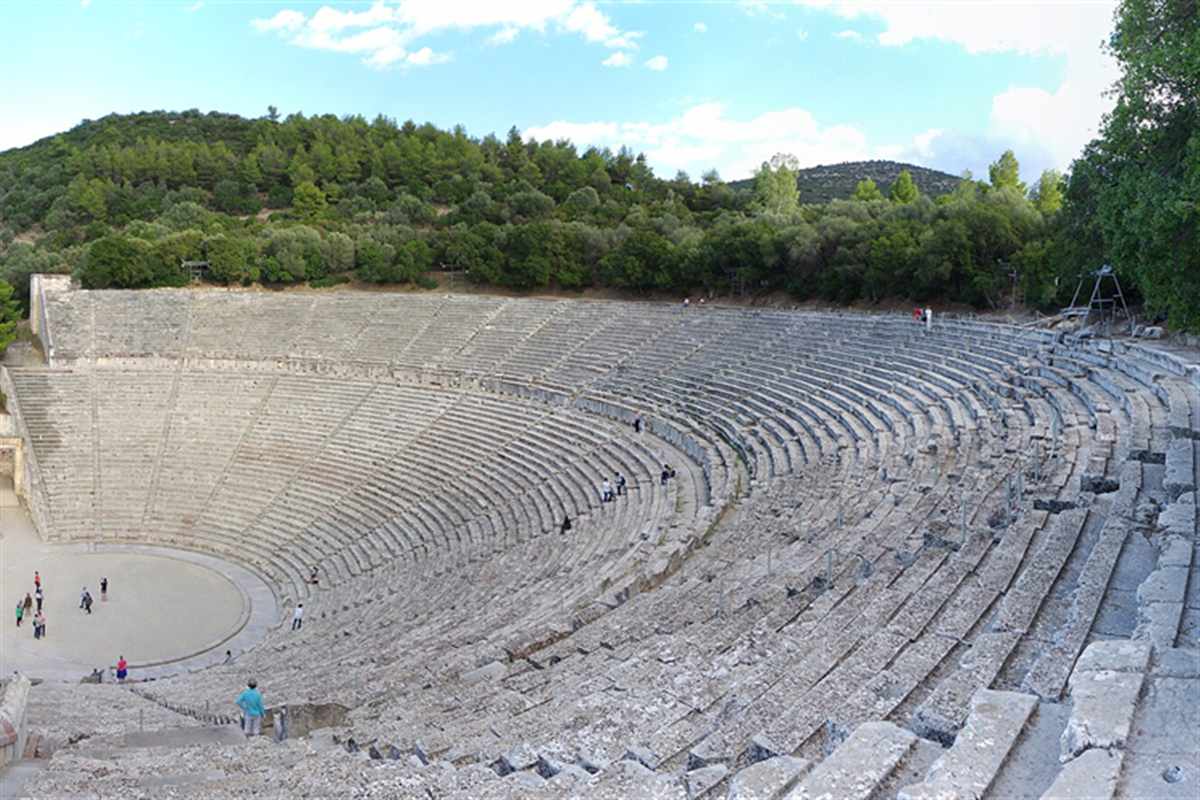
Epidaurus tickets open the sanctuary of Asklepios, with the ancient theatre, the Tholos, the Temple of Asklepios and the abaton, the stadium, gymnasium and Katagogion, the Temple of Artemis and the museum. The post is one of the Greece Tours on Greece Ville, listed with the other Greek archaeological site tickets and Peloponnese tours.
This post covers what the tickets include and the rules that governed the sanctuary, the theatre, the Tholos, the temple and abaton, the other buildings, the museum and the formats on sale. Common questions come last.
What do Epidaurus tickets cover, and which rules governed the sanctuary?
Epidaurus tickets cover the archaeological site of the sanctuary of Asclepius in the Argolid, with its theatre, temples, stadium and museum. The rules of the ancient enclosure survive in Pausanias, who recorded that every offering was consumed inside its bounds.
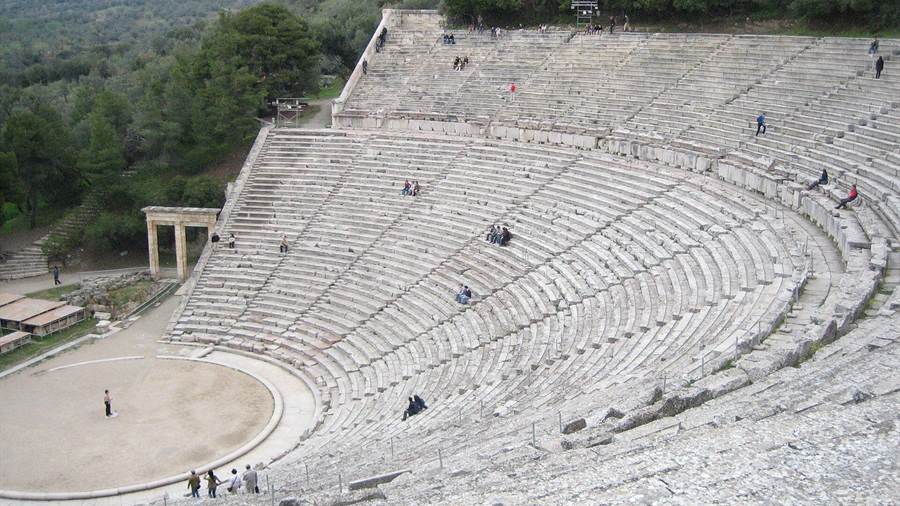
The geographer Pausanias of the second century AD described the sanctuary in detail. He wrote that every offering, whether brought by an Epidaurian or by a stranger, was consumed entirely within the bounds of the enclosure.
That rule shaped the use of the ground. Sacrificial food stayed inside the sanctuary, and Epidaurus tickets today open the same enclosed space, which holds the temples, the sleeping hall and the round marble building.
Pausanias also listed what stood in the holy area and the grove of the temple. His list names a theatre, a temple of Artemis, an image of Epione, and a sanctuary of Aphrodite and Themis.
The sacred grove lay to the west of the sanctuary. The theatre stands on the hillside to the northwest, so the site stretches from the core of the sanctuary to the slope of the theatre.
- Enclosure: The sanctuary sat inside marked bounds, and its rules applied to Epidaurians and strangers alike.
- Offerings: Pausanias reported that offerings were consumed entirely inside those bounds.
- Race-course: He listed a race-course among the smaller buildings of the holy area.
- Fountain: He also noted a fountain worth seeing for its roof and general splendour.
Epidaurus tickets therefore open a place with written rules as well as ruins. The Mycenae Epidaurus day trip post covers the sanctuary together with the citadel of Mycenae in one outing.
What do Epidaurus tickets show at the ancient theatre?
Epidaurus tickets lead to an ancient theatre that keeps the three-part plan of a Hellenistic theatre: the theatron for the audience, the orchestra for the chorus and the skene for the stage building. Roman builders left that plan unchanged.
The stage building that Epidaurus tickets reach rose in two phases. The first belongs to the end of the fourth century BCE, and the second to the middle of the second century BCE.
The Hellenistic stage had two storeys and a proscenium in front of it. A colonnade stood before the proscenium and along both of its sides, and two backstages projected slightly forward.
Small rectangular rooms east and west of the backstages served the performers. Two ramps led up to the roof of the proscenium, the logeion, where actors played in later periods.
Roman rule left the theatre alone. Unlike other Greek theatres, it received no changes in that period, and its two gates have since been restored by the teams that repaired the monument.
- Skene: The stage building dates from two phases, one in the fourth century BCE and one in the second.
- Logeion: Two ramps climbed to the platform on the roof of the proscenium.
- Festival days: The summer festival plays in the theatre on Fridays and Saturdays in July and August.
- Repertoire: Tragedies of Aeschylus, Sophocles and Euripides appear there, with surviving comedies of Aristophanes.
Epidaurus tickets thus reach a stage that has served two kinds of performance, the games of the ancient cult and the modern festival, and the restored gates frame both.
What is the Tholos that Epidaurus tickets reach?
Epidaurus tickets reach the Tholos, a round marble building that ancient opinion ranked as the finest of all tholoi. Polykleitos the Younger is named as its architect, and Pausanias called the building the Round House, set beside the temple of Asclepius.
A tholos is a round structure with a circular wall and a roof, raised on a couple of steps. The Greek word means a conical roof or a dome.
Pausanias placed the circular building of white marble near the hall where the suppliants of the god slept. He gave its name as Tholos, and Epidaurus tickets lead to the remains of that round plan.
Tradition names Polykleitos the Younger as the architect of both the theatre and the Tholos. One designer therefore stands behind the two buildings that define the sanctuary today.
The inner ring of columns used the Corinthian order, which was still an innovation. The capitals were carved in a delicate version that later builders appear to have followed as a model.
- Shape: A circular wall carried the roof, and the whole building stood on a podium of steps.
- Rosette: One suggestion credits the building with the flower that touches the abacus on each face of the capital.
- Windows: Unlike a Greek temple, it had at least two windows flanking the doorway.
- Study: Kavvadias published a monograph on the building in German in 1910.
Epidaurus tickets give a close view of a plan that Greek builders used for dining halls, temples and monuments alike. At Epidaurus the form stood beside the temple of the healing god.
What do Epidaurus tickets show of the Temple of Asklepios and the abaton?
Epidaurus tickets reach the foundations of the Temple of Asclepius and the abaton, the hall where suppliants slept. Pausanias described the sleeping place opposite the temple and read the slabs that recorded the names of the people said to be healed.
The temple that Epidaurus tickets reach is preserved in its foundations only. Its pedimental sculpture at front and back and the figural acroteria on the roof belong to a building that visitors now picture from the plan.
An acroterion is an ornament set on a pedestal at the apex or corner of a pediment. Its form varies from a statue to a tripod, a disc, an urn or a palmette.
Pausanias placed the sleeping place of the suppliants opposite the temple. The Greek words abaton and enkoimeterion name that hall, where patients lay down for the night in the hope of a dream.
Slabs stood in the enclosure beside the hall. Six remained in the time of Pausanias, though more stood earlier, and they carried the names of men and women, their illnesses and the means of cure.
- Foundations: Only the foundations of the temple survive on the ground.
- Language: The inscriptions on the slabs were written in the Doric dialect.
- Dedication: One old slab recorded that Hippolytos dedicated twenty horses to the god.
- Beard: Cicero told how Dionysius I of Syracuse ordered the golden beard of Aesculapius removed from the image.
Epidaurus tickets thus reach the place where records, dreams and offerings met. The building remains are low, yet the account of Pausanias describes what once filled the ground.
What do Epidaurus tickets show of the stadium, gymnasium and Katagogion?
Epidaurus tickets cover the athletic and guest buildings around the sanctuary: the stadium, the gymnasium and the Katagogion, the guest house. Prosperity from the healing cult also paid for a banqueting hall and a palaestra, the wrestling school.
The stadium of the sanctuary had been discovered by 1893. In 1902 the archaeologist Kavvadias found parts of a building next to it, joined to the track by an entrance tunnel.
The findings from that building were never fully published. In 1992 the archaeologist Stephen G. Miller suggested a use as an apodyterion, a changing room where athletes undressed before training.
In 1928 Kavvadias uncovered an elaborate building to the north of the stadium. The building was possibly used by athletes preparing for competition, and Epidaurus tickets cover the ground around it.
A palaestra was a wrestling school with a rectangular court surrounded by colonnades and adjoining rooms. The gymnasium was the wider training facility, and no gymnasium existed without a palaestra.
- Stadium: It was already known by 1893, well before the last digs of Kavvadias.
- Tunnel: An entrance tunnel joined the adjoining building to the stadium.
- Katagogion: The guest house, the gymnasium and the water supply were abandoned after damage in the first half of the first century BC.
- Banqueting hall: The hestiatoreion, a ceremonial hall for dining, belonged to the civic monuments of the town.
Epidaurus tickets thus extend from the sleeping hall to the running track. These buildings tie worship to sport, and the water supply they needed served the important rituals of the sanctuary.
What do Epidaurus tickets show of the Temple of Artemis and the Propylaia?
Epidaurus tickets reach the Temple of Artemis and the Great Propylaia, the monumental gateway of the sanctuary. A propylon separates the secular and religious parts of a city, and at Epidaurus such a gate marked the entry to holy ground.
A propylon is a monumental gateway, and its plural forms are propyla and propylaea. The Greek word originally meant that which is before the gate, and it came to mean simply a gate building.
The French historian Charles Chipiez described the excavation of Epidaurus in 1896 as of capital importance to the history of Greek architecture. He criticised the restrained reconstructions of the German Wilhelm Dörpfeld.
Chipiez preferred the lavish reconstructions of the sanctuary that the French architect Alphonse Defrasse drew in 1895. By the later twentieth century scholars judged those reconstructions to be largely erroneous.
In the second century AD the senator Pythodorus restored the sanctuary of the Epidotae, the helping gods, whose circle included Artemis Enodia and Artemis Lysaea. Epidaurus tickets cover the ground of that sanctuary.
- Gateway: A propylon marks the line between secular ground and religious ground.
- Reconstruction: Defrasse drew his lavish plans in 1895, a year before Chipiez wrote.
- Maleatas: Pythodorus added a propylon, a nymphaeum and a vast subterranean cistern at the Sanctuary of Apollo Maleatas.
- Hygieia: Her primary temples stood at Epidaurus, Corinth, Cos and Pergamon.
Epidaurus tickets thus reach both a gate and a temple of Artemis. The Nafplio walking tour post covers a walk through the old town of Nafplio.
What do Epidaurus tickets show in the museum?
Epidaurus tickets lead past the Archaeological Museum of Epidaurus, noted for its reconstructions of temples, its columns and its inscriptions. The museum shows the artifacts that excavators unearthed in the ancient site and in the area around it.
Fragments of the upper structure of the temple of Asclepius, recovered in the excavation, are kept in the archaeological museum at the site. The display shows what the low foundations outside cannot.
Kavvadias published a report in 1900 on the Roman-period odeion at the site. Later scholars called it invaluable, because it preserves evidence that the later decay of the building has erased.
In 1903 Kavvadias published part of the inscription on a third stele, which gave further accounts of cures claimed at the sanctuary. He published the inscription in full in 1918.
A royal decree of 1885 created the Archaeological Receipts Fund. It used the proceeds from the sale of tickets, casts and catalogues at museums to pay for the conservation and restoration of ancient monuments.
- Reconstructions: The museum is noted for rebuilt parts of temples, which fill the gap left by the low foundations outside.
- Columns: Restored columns form part of the display, set among the inscribed stones.
- Inscriptions: Texts on stone record the life of the sanctuary and the cures claimed there.
- Landmark: The excavation of Epidaurus has been called a landmark in the institutional history of Greek archaeology.
Epidaurus tickets thus link the site to the museum that explains it. The Ancient Corinth tour post covers entry to the ancient city of Corinth.
Which formats of Epidaurus tickets are on sale?
Epidaurus tickets are on sale as site entry with an audio option, as private tours with a licensed local expert, and as day trips that join Epidaurus with Mycenae, Nafplio or Corinth. Two sea formats visit the sunken city of Epidaurus.
The simplest format is entry to the Temple of Asclepius and the theatre, with an optional audio tour. A second entry format adds a virtual reality audio tour.
An e-ticket for the Temple of Asclepius comes with an audio tour. Private tours add a licensed local expert, and one private tour is led by an expert at Epidaurus alone.
Combined day trips pair Epidaurus with Mycenae and Nafplio. They run as shared trips, small-group trips from Athens, private trips and a private trip in an electric car.
A shared tour starts from Nafplio and links Mycenae with Epidaurus. A separate Epidaurus tour from Nafplio adds the ancient theatre and Old Epidaurus. Both start from Nafplio.
Wider routes add Corinth to Epidaurus and Mycenae, and a private luxury tour joins Corinth, Mycenae, Epidaurus and Nafplio. A Peloponnese private tour adds audio to Epidaurus tickets for the same three places.
- Entry: Epidaurus tickets for the site alone come as entry with audio, an e-ticket or a virtual reality version.
- Combined: Day trips from Athens or Nafplio join Epidaurus with Mycenae, Nafplio and Corinth.
- Private: Private tours run with a licensed local expert or with audio.
- Sea: A day cruise from Athens and a sea kayak trip both visit the sunken city.
The tour cards and availability boxes on the page list live dates for each format of Epidaurus tickets, so the cards show which departures are open.
What do travellers ask about Epidaurus tickets?
Epidaurus tickets raise questions about a second theatre, about the late history of the sanctuary, about the origin of the name and about the spread of the cult. The answers below rest on the written record of the site and of its town.
Which second theatre belongs with Epidaurus tickets?
The Small Theatre of Epidauros stands at the foot of the acropolis of the ancient city, in the town now called Palaia Epidavros. It was built in the middle of the fourth century BCE, rediscovered in 1970 and excavated in 1972.
What did Livy write about the sanctuary behind Epidaurus tickets?
Livy, in the early first century AD, wrote that Epidaurus was once rich with gifts for the god, and that only vestiges of wrecked dedications remained. In the same century the wealthy Statilius and Claudius-Cornelius families held the main priestly offices and funded the Apolloneia Asclapieia Caesarea Games.
Where does the name on Epidaurus tickets come from?
The city was named after the hero Epidauros, a son of Apollo. According to Strabo it was first called Epikaros under the Carians, then Epitauros under the Ionians, and finally Epidauros after the Dorians conquered the city, so each ruling people left its mark on the name.
Which Athens festival is tied to Epidaurus tickets?
The Epidauria was a festival at Athens in honour of Asclepius. The Asclepieion of Athens on the Acropolis was established in 419 or 418 BC, and the Asclepieion at Pergamum followed early in the third century BC, so the cult spread outward from Epidaurus.
Featured photo: Berthold Werner, CC BY-SA 3.0, via Wikimedia Commons.