
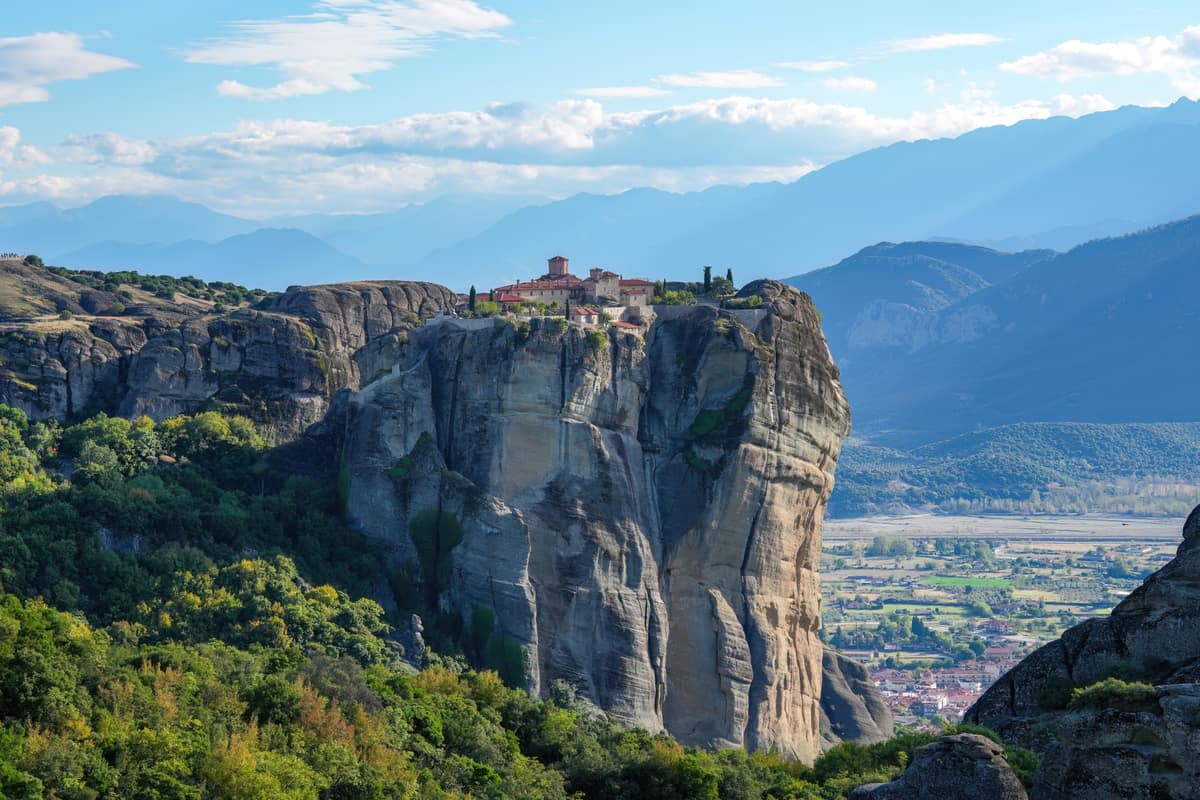
A Delphi Meteora tour links the sanctuary of Delphi with the rock monasteries above Kalambaka, across Central Greece and the plain of Thessaly. The trip is one of the Greece Tours on Greece Ville.
This post covers why UNESCO listed both sites, the battle of Domokos, who owned the plain, Storm Daniel and Lake Karla.
Trikala, the climbers, the birds of prey, the Vlachs, the north side of Parnassus and the Jewish past of Trikala follow. Visitor numbers at Delphi, the best months and common questions come last. The sections include tours that can be booked online.
What is a Delphi Meteora tour?
A Delphi Meteora tour is a road trip from Athens to Delphi and on to the Meteora rocks. It passes through Boeotia, Phocis, Phthiotis and Trikala, four of the regional units that divide Greek regions. National roads and motorways link them.
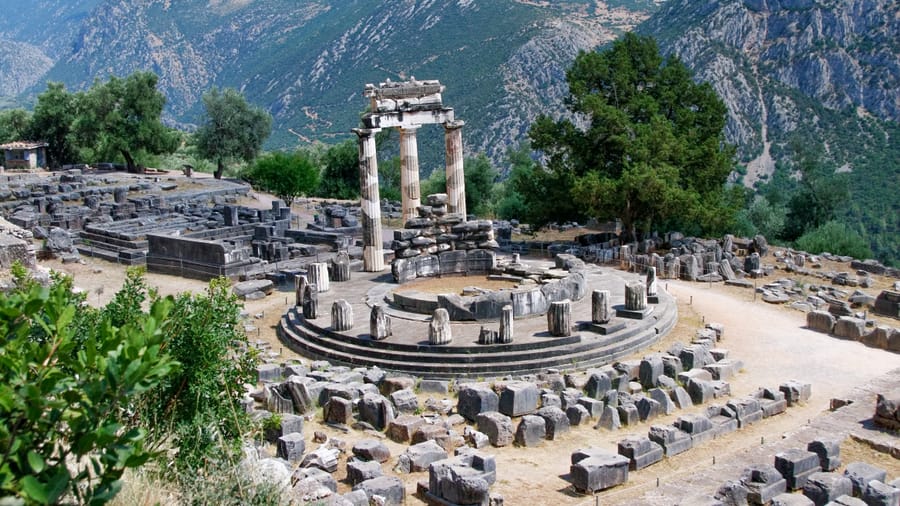
A Delphi Meteora tour first crosses Boeotia. The 2021 census counted 106,056 residents there. West of Tsoukalades, National Road 48 enters the Karakolithos tunnel, 300 metres long.
Phocis had 36,199 residents at the same census. Forest covers 560 square kilometres of Phocis, while plains cover only 36. The rest is mountain country. Delphi municipality alone counted 24,165 of those people.
From Amfissa, National Road 27 runs 36.7 kilometres north to Bralos. Its last stretch lies in Phthiotis. A Delphi Meteora tour then crosses this unit on its way north to Thessaly.
A Delphi Meteora tour ends in Trikala regional unit, which covers 3,383.48 square kilometres. It counted 122,081 residents. Its southern part split off in 1947 to form Karditsa Prefecture, a separate district.
National Road 3 runs 493.5 kilometres from Elefsina to the North Macedonia border at Niki. It passes Thebes, Livadeia, Lamia and Farsala. National Road 6 runs 355.5 kilometres from Volos to Igoumenitsa, through Kalambaka.
- National Road 48: This road has no dividing barrier and runs 181.4 kilometres from Livadeia to Antirrio.
- Delphi community: Within the Delphi municipal unit, the Delphi community itself counted 867 people.
- Road decree: Ministerial Decision G25871 of 9 July 1963 created National Roads 3, 27 and 48.
Back at Delphi, the municipal unit counted 1,465 people in 2021. A municipal unit is a former municipality that merged into a larger one.


Why did UNESCO list the two sites of a Delphi Meteora tour?
A Delphi Meteora tour links two sites that UNESCO listed under criteria, the tests a site must pass. Delphi meets criteria (1), (2), (3), (4) and (6). Meteora meets (1), (2), (4), (5) and (7). ICOMOS, the monuments council that advises UNESCO, wrote both evaluations.
UNESCO defines each criterion behind a Delphi Meteora tour. Criterion (1) asks for a masterpiece of human creative genius. Criterion (2) asks for an exchange of human values. Criterion (3) asks for exceptional testimony to a civilization.
Criterion (4) asks for an outstanding building type that marks a stage in history. Criterion (6) asks for ties to beliefs of universal significance. Until the end of 2004, UNESCO kept six cultural and four natural criteria. Since 2005, one combined list of ten criteria applies.
Greece nominated Delphi, the southern site of a Delphi Meteora tour, on 6 March 1986. ICOMOS compared its layout with Machu Picchu under criterion (1). ICOMOS dated its evaluation October 1987.
ICOMOS noted one Greek decision with relief. An aluminium plant planned at Aghia Euthimia, 11.5 kilometres from Delphi, was dropped. The plant moved 55 kilometres away, to Dombrena. Greece announced it to a UNESCO meeting on 23 June 1987.
For Meteora, ICOMOS recommended four cultural criteria in July 1988. IUCN, the nature body that advises UNESCO, said the rocks alone lacked universal significance. At Brasília, the World Heritage Committee added natural criterion (3), now numbered (7).
- Delphi session: The committee listed Delphi at its 11th session, held in Paris on 7-11 December 1987.
- Meteora size: The listed core of Meteora covers 271.87 hectares.
- 1993 report: Greece told the committee it granted no permit for an olive packing unit in Zone A.
The Delphi property covers 51.04 hectares. Its buffer zone covers 14,313.67 hectares. A protection zone reaches into two regional units, Boeotia and Phocis. Building is banned on the Parnassus slopes and in the olive grove.
What happened at Domokos on a Delphi Meteora tour?
A Delphi Meteora tour passes Domokos, where Greece lost a battle in late spring 1897. Crown Prince Constantine led the Greeks against Edhem Pasha. It was the last battle on the Thessaly front. The defeat sped up an armistice, a formal halt to fighting.
Edhem Pasha, 46, was young for an Ottoman commander. His army at Domokos held 45,000 men against 40,000 Greeks. About 2,000 Italian volunteers joined the Greeks under Ricciotti Garibaldi, son of Giuseppe Garibaldi.
A local history of Domokos, a town on a Delphi Meteora tour, gives finer counts. The Greek side had 28,200 rifles, 1,325 cavalry sabres and 85 cannons. The Ottoman side had 44,000 rifles, 1,200 sabres and 168 cannons.
Domokos, on the road of a Delphi Meteora tour, saw two notable deaths. Antonio Fratti, an Italian member of parliament, died there. Abdülezel Pasha, an Ottoman commander, also fell. That night Constantine retreated, leaving campfires burning to hide it.
The Greeks tried to regroup at the Derven Fourka pass, today’s Kalamaki, on the slopes of Othrys. Tsar Nicholas II of Russia telegraphed Sultan Abdul Hamid to demand a stop. The armistice was signed at Taratsa near Lamia.
The Treaty of Constantinople followed on 4 December 1897. Greece regained Thessaly, with small border changes in Ottoman favour. It owed 4,000,000 Ottoman liras as an indemnity, a war payment. Ottoman troops stayed until it was paid.
- Whole war: Greece lost between 700 and 832 men killed and 2,481 wounded.
- Debt control: A six-member International Financial Commission was set up in 1898 to make Greece repay creditors.
- Domokos castle: Its medieval walls have been a listed Byzantine monument since 1922.
Domokos stands on ancient Thaumakoi, an independent Thessalian town. Livy, a Roman historian, wrote that travellers there saw a plain like a vast sea. At the town’s southern edge, castle walls stand on the ancient acropolis, a fortified hilltop.
Who owned the plain crossed by a Delphi Meteora tour?
A Delphi Meteora tour crosses fields once held as chifliks, large private estates from Ottoman rule. Ottoman landlords and rich Greek bankers owned them. Tenant farmers called kolligoi worked the soil. Land reform after a bloody farmers’ revolt finally broke up the estates.
The chiflik was a Turkish term for Ottoman private estates passed down within families. Under it, peasants were ruled as serfs. When Greece took over, 460 of Thessaly’s 658 villages were chifliks. Only 198 were free villages.
A Delphi Meteora tour crosses the old estate heartland of Karditsa, Larissa and Trikala. There, Konstantinos Zappas bought 14 estates between 1879 and 1889. They covered 218,000 stremmata, a stremma being 0.10 hectares.
The Stefanovik-Skylitsis brothers bought 28 estates in 1887 and 1888. The Greek state bought their 511,000-stremma holding in 1902. With gifts from Zappas and Kassavetis, the state became the top landowner, holding 756,000 stremmata.
Marinos Antypas was among Greece’s first socialists. At his uncle’s estate in Pyrgetos, he raised the tenants’ crop share from 25% to 75%. Estate owners paid 30,000 drachmas, the Greek currency, to have him killed on 8 March 1907.
On 6 March 1910, farmers boarded a train at Kileler for a Larissa rally. Soldiers fired and killed Athanasios Ntafoulis and Athanasios Bokas. At Tsoulár, now Melia, two more died. The unrest gripped the plain a Delphi Meteora tour crosses.
- Living conditions: Tenant farmers lived in hovels without medical care and died of diseases like malaria.
- Trial: On 23 June that year, 62 protesters were tried and all acquitted.
- Reform law: In late spring 1917, estates over 1,000 stremmata faced compulsory expropriation, a forced state purchase.
After 1923, the government of Nikolaos Plastiras expropriated large estates on a big scale. By 1940, 1,938,952 stremmata in Thessaly had gone to 40,484 families. Large landowners still held 906,217 stremmata at that point.
What did Storm Daniel do to the plain of a Delphi Meteora tour?
A Delphi Meteora tour crosses fields that Storm Daniel drowned under record rain. The storm killed 17 people in Greece. Rivers burst their banks, and thick mud buried Thessaly’s farmland. Scientists found that climate change made such rain heavier.
The station at Zagora, on Mount Pelion, logged 754 millimetres of rain in a single day. That broke Greece’s daily record. The old record was 644.7 millimetres at Paliki, Kefalonia, set during Storm Ianos in 2020.
Over the whole storm, Zagora collected 910 millimetres. Karditsa, a town on the plain a Delphi Meteora tour crosses, received 659 millimetres.
Makrinitsa, another Pelion station, measured 1,235 millimetres by 20 September. No station in Europe had ever logged more rain in a month. The old mark was 1,225 millimetres at Askyfou, Crete, in February 2019.
After the rain ended, the Pineios river kept rising. At Larissa, it reached 9.5 metres, against a normal level of 4 metres. In the Tempe valley, the river’s water rose to 18 metres.
The EU’s Copernicus emergency mapping service tracked the floods from space. It counted damage across more than 700 square kilometres of Greece’s central farm belt. A Delphi Meteora tour crosses part of that belt.
- Livestock: Officials told Parliament that 110,000 animals died and 135,000 poultry were lost.
- Crops: Thessaly grows 38% of Greece’s cotton, and the floods wiped out that year’s harvest.
- Cost: Greek authorities put the direct damage at €2.3 billion in a request for EU aid.
World Weather Attribution, a team of climate scientists, studied the storm. It found that human-caused warming raised the odds of such rain up to 10 times. In central Greece, such rain is expected only once in 80 to 250 years.
How did Lake Karla return near a Delphi Meteora tour?
A Delphi Meteora tour crosses the plain where Lake Karla came back twice. Greece drained it in 1962 and later rebuilt part of it as a reservoir. Storm Daniel’s floods then refilled the old lakebed far beyond the new shores.
In ancient times, Lake Karla was called Boibeis, or Voiviis. It is the only lake on the plain a Delphi Meteora tour crosses. Before draining, it covered 180 square kilometres. It was then Greece’s largest natural lake by area.
Officials drained the lake because it flooded nearby crops and its marshes bred insects. Work began in late August with a tunnel 10,150 metres long. Yet farming never thrived on the salty old lakebed.
Local people backed a plan to bring the lake back. It aimed to reflood 50 square kilometres. The European Commission helped fund the project, valued at 100 million ECU, the euro’s forerunner. The rebuilt lake opened in October 2018.
Storm Daniel brought the old lake back. As the Pineios rose, its floodwater spread across the former lakebed. By 16 September, Landsat satellite images showed about 190 square kilometres under water. That passed the lake’s size before its drainage.
On the plain a Delphi Meteora tour crosses, birds moved in fast. The reservoir began filling in 2009, and Dalmatian pelicans began breeding there in 2011. By 2017, 445 pairs nested there, Europe’s second-largest colony of this pelican.
- Fishing life: On the old lake, fishermen spent about nine months a year in reed huts.
- Archaeology: Building works uncovered coins, tombs and a Neolithic, or New Stone Age, village.
- Water supply: Planners meant the lake to give Volos 15 million cubic metres of water a year.
Three months after the storm, the EU’s Copernicus service mapped the area again. Radar images from December 2023 showed about 10,000 hectares still flooded. That water lay north and north-west of the lake.
What does Trikala add to a Delphi Meteora tour?
A Delphi Meteora tour gains Trikala, a city of Byzantine, Ottoman and modern layers. A governor’s mosque and a hilltop fortress show who ruled the plain. Small museums keep art and sports history. The city tests new digital services.
On a Delphi Meteora tour, the Osman Shah mosque recalls a founder also known as Kara Osman Pasha. His father was Çoban Mustafa Pasha, a vizier or senior minister. The father died in 1529.
Scholars date the mosque to 1550–60, with the late 1550s as best estimate. Osman added a madrasa, or Islamic school, and an alms house. A caravanserai, or traders’ inn, completed it. Worship there stopped around the 1890s.
Visitors on a Delphi Meteora tour see a front porch rebuilt in the 1998 renovations. Local tradition says the founder built it after recovering from an illness in Trikala.
The fortress saw major building works in the Palaiologan period, the late Byzantine era. The Ottomans captured the city in 1395. They kept the fortress as a forward base against the mountain peoples of Pindus and Agrafa.
Under Ottoman rule, the city on a Delphi Meteora tour made woollen textiles and leather goods. Evliya Çelebi, a 17th-century Ottoman traveller, counted 2,300 houses there. They stood in sixteen Muslim and eight Christian quarters.
- Art: The Katsikogiannis Museum, opened in 1994 in old cold stores, shows 1,236 paintings.
- Sports museum: The Municipal Historical Sports Museum, founded in 1998, traces local sport from 1896.
- Digital city: Trikala aimed to become Greece’s first 5G city, with fast mobile data.
Trikala stayed capital of a large sanjak, covering Thessaly and part of Central Greece, until 1770. From 1543 to 1854 the city hosted the Trikki School, later the Greek School. Its teachers included Dionysius the Philosopher.
How do climbers use the rocks of a Delphi Meteora tour?
A Delphi Meteora tour reaches a global climbing destination. Climbers scale conglomerate, a pebbly rock, on multi-pitch routes split into rope lengths. German climbers opened the first modern routes. A local climbing community later grew in Kalambaka and Kastraki.
The rocks of a Delphi Meteora tour first tested monks, shepherds and hunters. Researchers believe they drove wooden or iron stakes into the rock. A ladder rested on the stakes. Climbers fixed higher stakes and moved the ladder up.
Climbing on a Delphi Meteora tour also meets nature rules. The Antichasia-Meteora bird protection zone lists uncontrolled climbing as a threat. It names the lighting of the rocks as a threat too.
Modern climbing on a Delphi Meteora tour began with Dietrich Hasse of Saxony. In the 1950s he ranked among the best climbers of the Elbe Sandstone Mountains. In August 1975, he and Sepp Eichinger made the first four routes.
In spring 1976, Hasse and photographer Heinz Lothar Stutte added more routes. In 1977 the pair published the first climbing handbook, listing 83 routes. By 1985 climbers had opened over 200 routes. Around 900 multi-pitch routes exist today.
The rock of a Delphi Meteora tour mixes pebbles, cobbles and large stones in a cement-like sandstone. Shallow holes form where pebbles break away. The slope and the pebble size set each route’s grade, or difficulty.
- Bolts: Widely spaced ringbolts, metal rings set in rock, leave long gaps between clips.
- Pebbles: Climbers tie thin slings around pebbles to protect the climb.
- Rules: Campfires, camping and bivouacs, or nights outdoors, are banned between the towers.
The Panhellenic Climbing Meeting has met at Meteora since 1988. It runs under the Mountaineering and Climbing Federation, with Kalambaka’s municipality and climbing club. In 1994, American Jane Balister climbed the Pillar of Dreams without a rope.
Which birds of prey nest on the rocks of a Delphi Meteora tour?
A Delphi Meteora tour passes cliffs where the Egyptian vulture still nests, in tiny numbers. Griffon vultures and lammergeiers, or bearded vultures, no longer breed there. Poisoned baits, lack of food and human disturbance caused the crash. Teams now watch each nest.
In late spring 2018, the season’s first Egyptian vulture chick in the Balkans hatched at Meteora. Its parents had failed for four years. After that nest, the Hellenic Ornithological Society (HOS) saw only one male return each spring.
Poison baits struck the Delphi Meteora tour area. In 2012 an Egyptian vulture lay poisoned beside a poisoned dog. A livestock breeder took it to a vet in Trikala. The bird survived and was freed in the Antichasia mountains.
In July 2015, researchers found an adult dead in its nest at Meteora. All evidence pointed to poison. It struck one of the last three local pairs. Experts estimate that only 10% of poisoned wildlife is ever found.
Conservation around a Delphi Meteora tour includes a feeding station near Vlachava. HOS ran it for over ten years under two EU LIFE nature projects. Anti-poison dog units of NECCA, the state nature agency, patrol with Kalambaka foresters.
Greece reported 5 to 12 Egyptian vulture pairs for 2013–2018. Its EU report shows a 90% fall since 1980. HOS now counts only six pairs nationwide. HOS ranks it Greece’s bird in greatest danger.
- Eagles: A Greek habitat database lists Bonelli’s and golden eagles among 105 bird species.
- Passing falcon: The lesser kestrel visits only on passage, or migration.
- Tracking: In 2013, a satellite tag led researchers to Lazarus, poisoned near Amfipoli.
After six years without a young bird, HOS confirmed a chick at Meteora in early June. A researcher spotted its head among sheep’s wool lining the nest. In Thessaly, people call this vulture the cheese maker.
Who are the Vlachs near a Delphi Meteora tour?
A Delphi Meteora tour meets the Vlachs, also called Aromanians, of Thessaly and the Pindus range. They speak Aromanian, an Eastern Romance language that grew from Latin. Greece counts them as a linguistic minority, not an ethnic one.
The language descends from Common Romanian, the shared parent of the Eastern Romance tongues. That parent split into southern and northern branches by the 10th century.
A Delphi Meteora tour crosses ground where a threatened language survives. The UNESCO Atlas of the World’s Languages in Danger rates Aromanian “Definitely Endangered”. One estimate counted 210,000 native speakers. Greece held 50,000 of them.
The 1951 Greek census recorded 39,855 Aromanians. A 2002 study by Kahl estimated up to 300,000. The same study counted over 200 Vlach cultural associations in Greece. In the 1990s, the European Commission’s Euromosaic Project mapped Aromanian across Greece.
Written records place Vlachs in Thessaly from the 11th century, in works by Kekaumenos and Anna Komnene. In the 12th century, Niketas Choniates set “Great Vlachia” near Meteora, a stop on a Delphi Meteora tour.
Under Ottoman rule, Vlachs belonged to the Rum millet, the community of Orthodox subjects. The Ottomans called Thessaly’s Vlachs Küçük Ulah, meaning Little Vlachs. Greek turned that into Koutsovlachoi. In 1905 the Ottomans recognised a separate Ullah millet for them.
- Chaliki: This Vlach village at 1,160 metres first appears in a Byzantine record of 1332 or 1336.
- Kalarites: This Aromanian village flourished in the 18th century through trade and silver and gold work.
- Dress: Aromanians have worn the fustanella, a pleated kilt, since at least the 15th century.
Gardiki, called Gardisti in Aromanian, holds its largest feast on 15 August for the Dormition of the Virgin. In that month its summer population passes 5,000. Its name comes from gardu, an Aromanian word for fort.
What lies on the north side of Parnassus on a Delphi Meteora tour?
A Delphi Meteora tour on the north side of Parnassus finds Amfikleia, Tithorea, Polydrosos and Eptalofos. Ancient Lilaia stood here at the springs of the Cephissus, or Kifissos, river. Each village dropped an older name for a new one.
Amfikleia lies at the northern foot of Parnassus. It carried the name Dadi until 1915. The Persians under Xerxes destroyed ancient Amphicleia in 480 BC. By the 2nd century AD, the rebuilt town was known for Dionysus worship.
A Delphi Meteora tour reaches the source of the Cephissus at Lilaia, on the north-western slope. Pausanias reported that the Lilaeans threw cakes into its spring. They believed the cakes resurfaced in the Castalian Spring at Delphi.
Lilaia took its name from the Naiad Lilaea, a water nymph and daughter of the river god Cephissus. Philip II of Macedon destroyed the town in 346 BC. Its walls and gates stand east of the modern village.
Two villages here once shared the name Agoriani. Lilaia was Kato Agoriani, meaning Lower Agoriani, until 1920. Eptalofos, once Upper Agoriani, took its new name in 1927. A Delphi Meteora tour finds it at 830 metres on the north-east slopes.
Tithorea, called Velitsa until 1926, keeps the walls of its ancient city. Scholars class them with Messene and Eleutherai as the finest examples of 4th-century work. The squared stone blocks rise up to 14 courses, or layers, high.
- National park: The Parnassus park covers about 150 square kilometres of protected mountain.
- Old name: Polydrosos was officially called Souvala until 1928.
- Polydrosos: A water-powered electric plant built in 1924 lit the village.
In October 1943, German troops burned Eptalofos as revenge for partisan action in the area. They destroyed 146 of its 184 houses. They also executed 17 civilians, and 7 of them came from one family.
What did the Jewish community leave in Trikala on a Delphi Meteora tour?
A Delphi Meteora tour in Trikala meets the traces of a centuries-old Jewish community. Its members kept a Romaniote character, the tradition of Greek-speaking Jews. They left behind a restored synagogue, a hillside cemetery and a Holocaust memorial.
Byzantine-period sources already mention Jews in Trikala. Sephardic Jews from Spain settled there in 1492. Later arrivals came from Valona, Portugal and Sicily. In 1545, the Turks brought Jews back from a Hungarian campaign and settled them here.
A Delphi Meteora tour enters a city where Ottoman records counted 19 Jewish families in 1506. By 1520/38 that figure had reached 181. From the 16th century, Jews here produced wool, cotton, silk and linen fabrics.
The old Jewish quarter held three synagogues: Romaniote, Sephardic and Ashkenazi. Ashkenazi and Sephardic Jews reached Greece from elsewhere in Europe after the Romaniotes. A fire on 11 July 1749 badly damaged the Jewish quarter and its synagogues.
A Delphi Meteora tour finds Kahal Kadosh Yevanim, meaning Greek Community, on Diakou Street. It was rebuilt on its site after demolition in 1930. The Germans made it a stable. It reopened on 16 June 1957 after the 1954 earthquakes.
On the night of 23–24 March 1944, the Nazis arrested 139 of the 520 Jews in Trikala. Rabbi Kastel led more than 300 community members into the mountains. The community lost 31% of its people.
- Survivors: After the war, only 10 of the deported hostages came back.
- Cemetery: The hillside cemetery covers 15,000 square metres and holds more than 800 graves.
- Restoration: The synagogue was restored in 2017–2019 and reopened in October 2022.
In 2018, a Holocaust memorial to the murdered Jews of Trikala went up on Plutonos Street. That pedestrian street marks the start of the old Jewish quarter. Today the community counts 40 people.
What do visitor numbers show at Delphi on a Delphi Meteora tour?
A Delphi Meteora tour reaches a site with a fast-growing crowd. ELSTAT counted 482,293 admissions at the Archaeological Site of Delphi in 2023. The Delphi Archaeological Museum logged 203,445 admissions in the same year. Both figures beat the totals of the year before.
In 2022, the Delphi site recorded 332,870 admissions, and the museum recorded 151,512. ELSTAT draws these counts from HOCRED, the Hellenic Organization of Cultural Resources Development. The Ministry of Culture and Sports supervises that body.
A Delphi Meteora tour follows a strong recovery after the pandemic. The site drew 405,348 admissions in 2019 and only 75,983 a year later. Greek archaeological sites stayed shut from 7 November 2020 until 21 March 2021.
That reopening year ended with 146,061 admissions at the Delphi site. Its first month back counted just 178 visitors. The museum reopened later and recorded 58,102 admissions. Greek museums stayed closed from 1 November 2020 until late spring 2021.
A Delphi Meteora tour visits a site that edged past Ancient Olympia in 2023. Olympia recorded 481,211 admissions that year. The Acropolis of Athens led all Greek sites with 3,958,405 admissions. Greek archaeological sites together logged 13,407,338 admissions.
In 2003, the site drew 430,690 admissions. The museum logged only 8,068, all of them in January.
- Free entry: Greek archaeological sites logged 3,484,967 free-of-charge tickets in 2023.
- Joint ticket: A flat-rate ticket covering a museum and its nearby site began in April 1999.
- Olympia gap: The Delphi site beat Ancient Olympia by 1,082 admissions in 2023.
The museum still trailed its pre-pandemic mark of 275,993 admissions, set in 2019. The site had already passed its 2018 total of 405,947. A Delphi Meteora tour thus meets a busier sanctuary than before the pandemic.
Which months suit a Delphi Meteora tour?
A Delphi Meteora tour suits spring and autumn best. In 2023, the Delphi site was busiest in late spring and quietest in January. Mild highs at Karditsa match those seasons. Midsummer brings hotter days and smaller crowds than spring.
The late-spring peak reached 63,404 admissions at the Delphi site. January was the low point, with 13,192. April added 56,017, and June followed with 53,601. Spring therefore brings the largest crowds of the year.
A Delphi Meteora tour in midsummer meets a dip in crowds. July counted 45,397 admissions, fewer than October’s 50,262. August rose to 51,231, and September reached 54,658. Early autumn therefore draws more visitors than high summer.
The national weather service, HNMS, gives Karditsa in western Thessaly mild spring days. April highs average 20.28 °C, and late spring reaches 25.29 °C. July highs climb to 32.31 °C. September still averages 27.78 °C by day.
A Delphi Meteora tour in October meets highs of 21.85 °C at Karditsa. That month also brings 91.44 millimetres of rain there. Late spring gets 267.05 hours of sunshine, against 170.41 in October.
Ancient Haliartus, beside modern Aliartos, stood on the road from Thebes to Livadeia. The Aliartos HNMS station logs 6.4 days of rain in late spring. January brings 12.0 rain days there, the highest count of the year.
- Humidity: Aliartos averages 56.1% humidity in late spring and 68.0% in October.
- Museum months: The Delphi museum peaked at 28,296 admissions in late spring and dipped to 6,826 in January.
- Ohi Day: Every 28 October brings military and student parades across Greece.
Peak months shift from year to year at Delphi. In 2022, August led with 47,076 site admissions, while February sank to 7,679. In 2003, September topped the year with 61,400. Spring and autumn stay the steadiest choice.
What do visitors ask about a Delphi Meteora tour?
A Delphi Meteora tour ends in the region of Thessaly, which covers 14,036.64 square kilometres. Its airports and railways shape the practical side of the trip. Hellenic Train runs the passenger trains on its main line. Mainland civilian flights for the area land at Nea Anchialos, near Volos.
Which airport serves the Thessaly side of a Delphi Meteora tour?
Nea Anchialos National Airport, also called Central Greece Airport, serves this side. Its airport codes are VOL and LGBL. It opened in February 1991 and lies about 24 km south-west of Volos. It is the only civilian airport for Kalambaka, Trikala and Karditsa.
Which airport serves Ioannina, west of a Delphi Meteora tour?
Ioannina National Airport, with the aviation code LGIO, dates from 1932. It stands 475 metres above sea level, 4 km from the city centre. Its new terminal of 5,290 m² opened on 11 July 2019. The airport took the name King Pyrrhus in 2007.
Why do airliners skip Larissa on a Delphi Meteora tour?
Larissa State Airport “Thessaly” was built in 1912. It served as the commercial airport of Larissa until 1997. That year it closed to civilian traffic. Today only Hellenic Air Force aircraft use it, and the 110th Combat Wing is based there. Its runways lack an instrument landing system.
What kind of railway reaches Kalambaka on a Delphi Meteora tour?
The branch to Kalambaka is a single-track line without electrification. It has 7 stations, and its top speed is 100 km/h. GAIAOSE owns the line, while Hellenic Train operates it. An upgrade plan adds a second track, electric power and ETCS Level 1, a European safety system.
Why does the rail line of a Delphi Meteora tour stop at Kalambaka?
Greek plans after the First World War aimed further north. In 1927, the state approved a line from Kalambaka to Kozani and Veroia. Work began in 1928, but costs soon ran far over the estimate. Construction stopped in 1932 and remains unfinished.
Who runs the main-line trains on a Delphi Meteora tour?
Hellenic Train runs them, and it bore the name TrainOSE until 2022. Ferrovie dello Stato Italiane, the Italian state railway, bought the company in September 2017. Its trains use the Piraeus–Platy line, 456.60 km long with 42 stations. Trains on that line reach up to 200 km/h.