
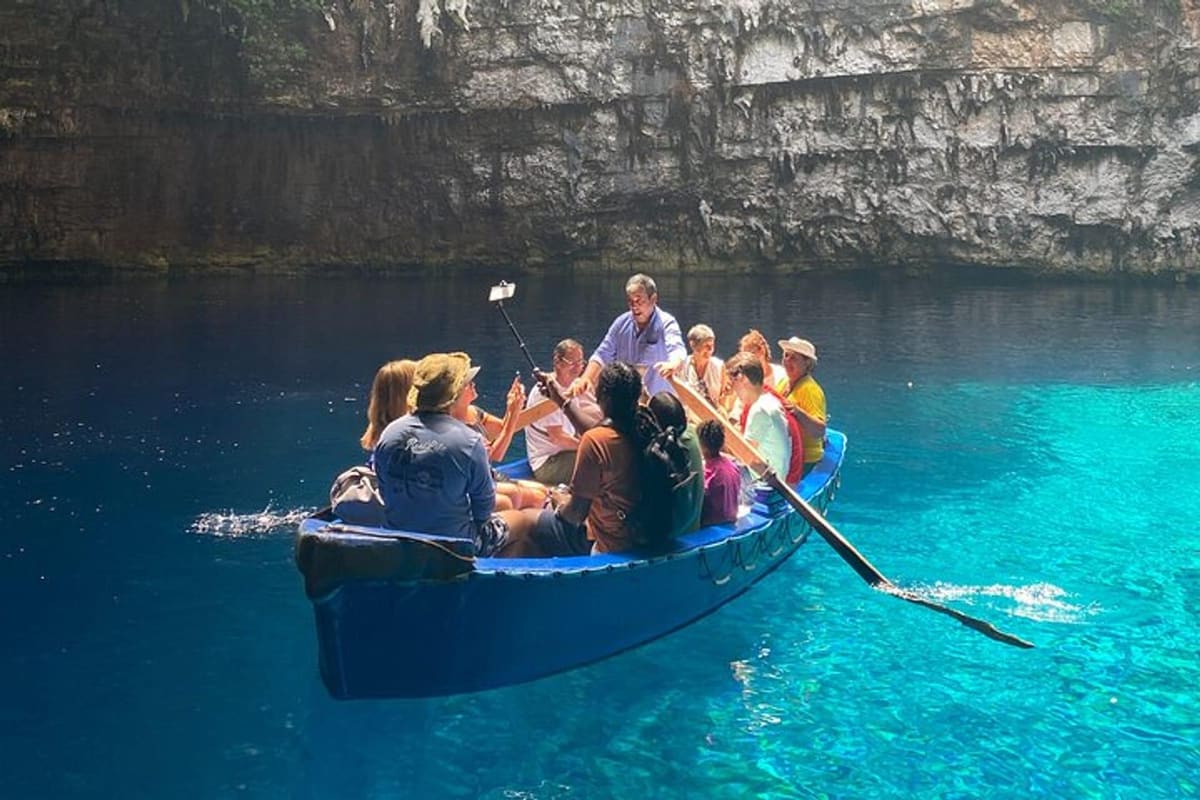
A Melissani cave tour takes a rowing boat across the lake of Melissani Cave at Karavomylos, near Sami on Kefalonia. The tour is one of the Greece Tours on Greece Ville, listed with the other Ionian Islands tours.
This post covers the cave in numbers, the rocks that hold it, the creatures in its water, the caves around it and the divers who explored them.
Karavomylos, ancient Sami, the best months and common questions come last. The sections include Melissani cave tours that can be booked online.
What is a Melissani cave tour?
A Melissani cave tour visits Geosite No 25 of the Kefalonia-Ithaca Geopark. Geologists class it as a submerged doline running north-northwest to south-southeast. Its natural oval roof opening measures 15 by 25 m. The open lake below measures 60 by 40 m.

The covered part of the cave begins with a ceiling 18 m high. It lies on the south-eastern slope of Frydi hill, near Karavomilos. The lake water mixes fresh water and sea water in a 5:1 ratio.
On a Melissani cave tour, the water moves. It flows from south-west to north-east and forms a calm eddy in the north-east. In September 1951, it measured 15°C.
A second, smaller siphon, a tunnel 1.50 by 0.80 m, starts under the boarding spot. The rock roof over the north chamber is only three metres thick, so it can fall one day.
- Ranking: The geopark ranks Melissani among the key caves of Greece for geology, ecology, archaeology, beauty and myths.
- Crooked stalactites: Air currents and shifting limestone blocks make Melissani’s stalactites grow crooked.
- Soda straws: Every limestone stalactite starts as a hollow tube 4 to 5 mm wide.


Which rocks hold a Melissani cave tour?
A Melissani cave tour sits in Mesozoic limestone, 252 to 66 million years old. Kefalonia is built from two rock zones of the External Hellenides. Both run north-northwest to south-southeast. The Ionian zone covers only 68.72 km².
The Pre-Apulian, or Paxos, zone covers the bulk of Kefalonia, about 483.4 km². It is seen as the eastern edge of the Apulian plate, which reaches south-east Italy.
On a Melissani cave tour, the rocks are older than they look. The oldest Pre-Apulian rocks on the surface are dolomites and limestones 145 to 100.5 million years old. White Upper Cretaceous limestone, full of Hippurites fossils, is the commonest rock.
Pure water dissolves calcium carbonate only at a ratio of 75,000 to 1. Part of the karst network now lies below sea level, flooded by sinking land and rising seas.
- Thrust: The Ionian thrust advanced across Kefalonia between 5.3 and 3.6 million years ago.
- Cenotes: Other cenotes near Sami include Fytidi, Agioi Pantes, Vrouspa and Xerovrouspa.
- Growth: Stalactites fed by a steady, slow drip can grow 3 mm a year.
Which creatures live in the water of a Melissani cave tour?
A Melissani cave tour crosses water used by European eels, which travel through Kefalonia’s underground network. They appear where it reaches the surface, as at Karavomilos. The IUCN rates the species as Critically Endangered. Eels spawn in the Sargasso Sea.
The European eel is the only European species that leaves inland waters to breed in the open ocean. Its life passes through five stages, from larva and glass eel to silver eel.
On a Melissani cave tour, a tiny animal found nowhere else lives in the groundwater. Niphargus denarius, an amphipod, is known only from Kefalonia. Its type male is 15 mm long, and its name recalls the Roman denarius coin.
Rock pigeons nest on the cave walls and gather on the islet in the lake. The Eurasian bittern, Endangered in Greece, is a rare visitor. A recent survey recorded land snails such as Albinaria senilis inside the cave.
- Bats: About 19 bat species live in the caves of the geopark. Of these, 16 live in Aenos National Park.
- Fast flyer: The European free-tailed bat, recorded on Kefalonia, reaches up to 65 km/h.
- Lifespan: In the wild, a European eel lives about 15 to 20 years.
Which other caves surround a Melissani cave tour?
A Melissani cave tour sits among about 17 sites with caves and karst lakes around Sami. Zervati Cave, also called the Blue Cave, lies in southern Karavomylos, about 250 m from the sea. It is 235 m long.
Zervati’s 50 by 30 m entrance formed when the roof of a closed hall fell in. Its two brackish lakes reach 4 and 5 m deep, at about sea level.
On a Melissani cave tour, the waters are linked. Zervati connects underground with Melissani and Aggalaki, and their water ends up at the Karavomylos springs. Aggalaki opens as a pothole about 20 m across.
The Agioi Theodoroi doline begins with a 20 m vertical drop. Its blue-green brackish lake reaches 88 m deep.
- Aggalaki lakes: A decorated chamber ends in a lake of about 5 m. A second small lake lies further in.
- Agia Eleousa: This doline, about 300 m from Agioi Theodoroi, has walls 50 to 70 m high.
- Chiridoni: This huge collapsed doline joins the cave of Sotira through a narrow passage.
Which divers explored the waters of a Melissani cave tour?
A Melissani cave tour owes its first studies to Ioannis Petrochilos. He founded the Hellenic Speleological Society in 1950 and led it until his death in 1960. In 1951, he found a Hellenistic lamp on the small island inside Melissani.
Underwater work showed that Melissani continues south as a siphon 240 m long. In its first 180 m, divers found two chambers, 27 to 33 m long. They had 1 m of air above the water.
On a Melissani cave tour, diving is not open to all. It needs permission from a government department in Athens, because of the archaeological finds. At 200 m in, the siphon shrinks to a 6 by 3 m passage blocked by rockfalls.
British cave diver Martyn Farr called Karavomilos the largest flooded cave he had dived in Europe. His team swam a 240 m sump, up to 25 m deep, from Hiridoni to Sotira.
- Zervati: Divers found that its northwest lake leads underwater to a second chamber of 85 by 58 m.
- Karavomylos: Cave divers found a 260 m siphon at the lake, up to 15 m deep.
- Stalactites: In the Agioi Theodoroi siphon, white stalactites hang 28 m below the surface.
Which village sits beside a Melissani cave tour?
A Melissani cave tour starts at Karavomylos, which had 391 residents in the 2021 census. The village grew from 260 people in 1981 to 385 in 2011. It is the only settlement in its community.
Karavomylos Lake is fed by an underwater karst spring of brackish water, 80 m from the coast. A wall cuts it off from the sea. The lake is almost round, 50 m across and about 1 m deep.
On a Melissani cave tour, water power shaped the village. In 1890, more than one watermill ran on the brackish flow. The village mill kept working until the middle of the 20th century.
The old wheel no longer turns. Water still rushes down a stone channel to the bay of Sami. The flooded Karavomilos cave runs beneath the church, the main road and much of the village.
- Mycenaean house: In 1963, Spyridon Marinatos dug up a Mycenaean house on Vounias hill, west of Zervati.
- Finds: It held handmade pottery, two clay spindle whorls and animal bones.
- Birds: Grey herons and little bitterns visit the lake, along with tame ducks and geese.
Which ancient city stands near a Melissani cave tour?
A Melissani cave tour lies near ancient Same. Its acropolises and walls covered two hills east of modern Sami, Palaiokastro and Agioi Fanentes. The fortifications ran for 3.4 km, with five gates. The walls show rectangular, trapezoidal and polygonal stonework.
A harbour mole shielded the port from the north wind and the waves of the Ithaca strait.
On a Melissani cave tour, the Roman siege of Same is the big story. The consul Marcus Fulvius Nobilior led the attack. Same was the only Cephalonian city that put up real resistance.
It had handed over hostages, then shut its gates, fearing that Rome planned to force its people out. Wherever a stretch of wall fell, the defenders built a strong new wall just inside it.
- Slingers: A hundred slingers from Aegium, Patrae and Dyme stopped the bulk of the defenders’ raids.
- Four months: Same held out for four months before the Romans broke through the citadel called Cyatis.
- Slavery: The next day the people surrendered, and the whole population was sold into slavery.
Which months suit a Melissani cave tour?
A Melissani cave tour plays with light from a high sun. On 21 June, the noon sun over Melissani reaches about 75 degrees, its yearly peak. That noon comes at 13:39 Greek summer time. The cave lies at about 38.26 degrees north.
On 14 April, the noon sun stands about 61 degrees above the horizon. On 15 July, it still stands about 73 degrees high. By 17 August, it has dropped to about 65 degrees.
On a Melissani cave tour in autumn, the sun sits lower. On 16 September, the noon sun reaches only about 54 degrees, and on 15 October about 43 degrees. On 21 December, it climbs no higher than about 28 degrees.
- Tropic: The sun never stands straight overhead at Melissani, which lies north of the Tropic of Cancer.
What do visitors ask about a Melissani cave tour?
A Melissani cave tour raises questions about water, air, the name, cave care, Ithaca and cave law. In normal weather, the big brackish springs of the Gulf of Sami are mixed. They hold 3.5 to 6 parts fresh water per part sea water.
How cold is the water on a Melissani cave tour?
The Phridi spring on the Sami coast read 15.1 °C in August 1959. It read 15.0 °C in March 1963. Karavomylos spring read 14.9 °C in April 1860 and again in August 1959.
Why does the air stay mild on a Melissani cave tour?
A cave’s average temperature roughly matches the yearly average at the surface. Rock and seeping water give caves inertia.
Where does the name come from on a Melissani cave tour?
A rarer theory links the name to the Odyssey. There, a cave is home to the Melisses, human souls named after bees. In ancient Greek, melissa means honeybee, and nymphs were at times called Melissae.
How are caves protected on a Melissani cave tour?
The UK caving code tells visitors to take nothing but photographs and not to touch formations. Lampenflora, or green sickness, grows around permanent cave lighting.
How far is Ithaca from a Melissani cave tour?
The Strait of Ithaca runs between Sami’s coast and Ithaca. It is about 20 km long and 4 to 6 km wide. Aetos on Ithaca has a ferry link with Sami.
Who looks after caves on a Melissani cave tour?
Greek caves fall under the Ephorate of Palaeoanthropology-Speleology, based in Athens. It inspects caves and prepares studies for their conservation and presentation to visitors.