
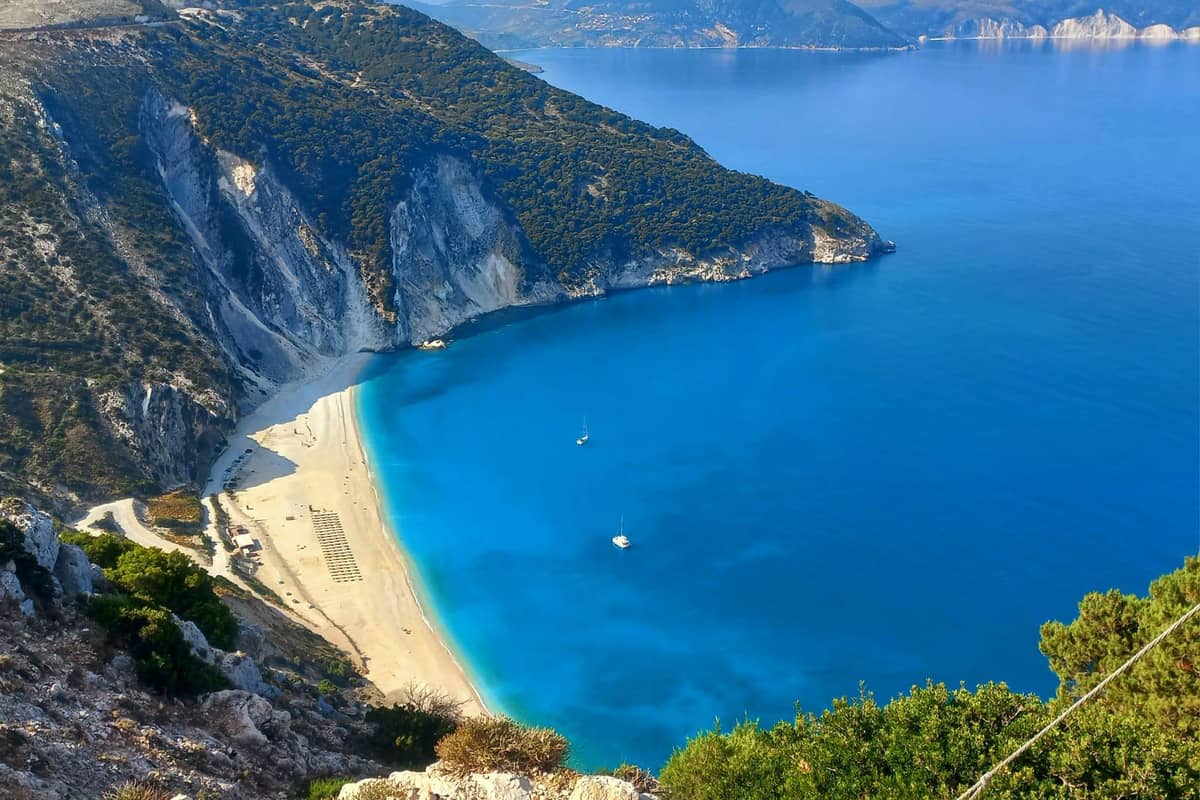
A Kefalonia island tour crosses the mountains, villages and coasts of Kefalonia in the Ionian Sea by road. The tour is one of the Greece Tours on Greece Ville, listed with the other Ionian Islands tours and Greece shore excursions.
This post covers the island in numbers, its fir forest and wildlife, its saints and feasts, its writers and composers, and the war years.
British works, the best months and common questions come last. The sections include Kefalonia island tours that can be booked online.
What is a Kefalonia island tour?
A Kefalonia island tour follows a coastline 270.4 km long. Gulfs and bays such as Myrtos, Argostoli and Sami cut into it. The island’s mean altitude is 358.5 m. Only 20% of it is lowland, while 37.5% is mountains.

Another 42.5% of Kefalonia is semi-mountainous. Its population peaked at 70,077 in the 1896 census and dropped to 39,793 by 1961.
On a Kefalonia island tour, Argostoli is the hub. Its municipality had 23,574 residents in 2021 on 377.0 km². It joins four units: Argostoli, Eleios-Pronnoi, Leivatho and Omala.
Lixouri municipality had 6,989 residents in 2021, and the town itself 3,549. From 2011 to 2019, the whole island formed one municipality, built from 8 former ones.
- Distances: The geopark lies 340.3 km from Athens, 165.37 km from Albania and 258 km from Italy.
- Climate: Across the geopark, about 820 mm of rain falls a year.


Which fir forest crowns a Kefalonia island tour?
A Kefalonia island tour climbs into forests of Kefalonian fir. John Claudius Loudon named it Abies cephalonica in 1838. Mount Ainos is the place where the species was first described. The forest grows between 580 and 1,600 m.
Experts first knew the tree from seeds that Charles James Napier sent to England in 1824. Its cones grow 10 to 20 cm long, with about 150 to 200 scales.
On a Kefalonia island tour, the forest’s past shows in old names. Strabo wrote that Kefalonia was also called Melaina, after its dark forests. Coins of ancient Pronnoi show a fir branch with an upside-down cone.
Near the end of the 16th century, a large fire wiped out two-thirds of the Ainos forest. More fires followed in 1730 and 1760. In 1797, a fire burned for weeks and destroyed half of what remained.
- Timber: Kefalonian fir has very strong wood, widely used in building and shipbuilding.
- Tree rings: A tree-ring record of the species covers 303 years, from 1676 to 1978.
- Black pines: Only five black pines grow inside the Ainos fir forest, at about 1,200 m.
- Plants: About 450 species of ferns and seed plants grow in Ainos National Park.
Which animals meet a Kefalonia island tour?
A Kefalonia island tour can meet the semi-wild horses of Mount Ainos, about 120 in number. They roam chiefly around the Zoodochos Pigi monastery on the south-east slopes. The bulk of Greece’s feral horses belong to the Pindos breed.
Sea turtle research on Kefalonia began in 1984, and 145 females have been linked to Mounda beach. Nests there have been monitored and protected since 1988.
On a Kefalonia island tour, the south coast is turtle country. Loggerheads also nest in smaller numbers on up to 20 south coast beaches. Turtles tagged on Zakynthos and the Peloponnese coast have come to nest at Mounda.
More than 100 bird species are recorded in Ainos National Park, and a third live there all year. Birds of prey include the short-toed snake eagle, the lanner falcon and the honey buzzard.
- Hatchlings: Hatchlings from a single nest can take up to 20 days to all emerge.
- Lizard: Algyroides nigropunctatus kephallithacius lives only on Kefalonia and Ithaca.
- Mole: The mole Talpa stankovici digs tunnels under Ainos and leaves small heaps of soil.
- Monk seals: The best-known monk seal breeding cave on Kefalonia is at Foki beach, near Fiskardo.
Which saints and feasts shape a Kefalonia island tour?
A Kefalonia island tour reaches the land of Saint Gerasimos, from the wealthy Notaras family. He reached Kefalonia in 1555 and spent his first 5 years in a cave at Lassi. He died on 15 August 1579.
Born in Trikala in Corinthia, he became a monk on Mount Athos. His body was dug up whole twice, so the church declared him a saint.
On a Kefalonia island tour, his hermitage is a tight squeeze. Two small underground rooms are joined by a square hole in the floor, 30 by 40 cm. After the 1953 earthquake, islanders said they saw the saint comforting trapped people.
The Agios Andreas Milapidias monastery was first founded in 1264 as Panagia Milopidia, named after a tree. In 1639, Princess Roxani, later the nun Romylia, brought a relic from Athos. It was the right foot of the Apostle Andrew.
- Kipoureon: Founded in 1759, the monastery was rebuilt step by step after the 1953 earthquake.
- 1915: A French cruiser fired on Kipoureon, mistaking its smoking chimney for an enemy ship.
- Holy snakes: The mid-August snakes appear at Arginia as well as Markopoulo.
Which writers and composers came from a Kefalonia island tour?
A Kefalonia island tour passes the home of Andreas Laskaratos, born in 1811. He studied law in Paris and was a pupil of the poet Andreas Kalvos. His satirical paper Lychnos attacked immorality and hypocrisy.
In 1856, Metropolitan Spyridon Kontomichalos excommunicated his book The Mysteries of Kefalonia, then Laskaratos himself. The ban was lifted a year before he died in Argostoli in 1901.
On a Kefalonia island tour, Argostoli recalls the composer Dionysios Lavrangas, born there in 1860. At the Paris Conservatoire, he studied with Delibes, Massenet and César Franck. His opera Two Brothers opened in 1900, with Greek singers.
Lavrangas wrote music for the first Greek feature film in 1918. He also scored the first Greek talking film in 1932. In 1888, his choir of about 30 Kefalonian serenade singers won first prize in Athens.
- Antypas: Marinos Antypas, born in 1872 at Ferentinata, named his goddaughters Anarchia and Epanastasi.
- Evangelatos: Composer Antiochos Evangelatos, born in Lixouri in 1903, studied with Felix Weingartner.
- Zervos: Christian Zervos, born in Argostoli in 1889, founded the Paris art magazine Cahiers d’art.
Which wartime events marked a Kefalonia island tour?
A Kefalonia island tour passes sites of the 1943 Acqui Division massacre. General Antonio Gandin took command on 18 June 1943. He had earned the German Iron Cross on the Russian front. In early July, 2,000 German soldiers and nine tanks arrived.
Gandin pulled his troops off Mount Kardakata, the island’s nerve centre, handing the Germans the high ground. He polled his men, and a large majority voted to resist.
On a Kefalonia island tour, September 1943 is the dark month. Stuka dive-bombers began attacking Italian positions on 15 September. On 17 September, German mountain troops landed.
On 24 September, Gandin and 137 senior officers were court-martialled and shot. Only 37 Italian officers survived, among them chaplain Romualdo Formato, whose 1946 book described the massacre.
- Bari: In the 1950s, the remains of about 3,000 soldiers went to the Italian War Cemetery in Bari.
- Memorial: President Sandro Pertini, a former partisan, unveiled the Acqui memorial on Kefalonia in 1980.
- Trial: In 2013, a Rome military court sentenced former corporal Alfred Stork to life in his absence.
- 1849: Sir Henry George Ward crushed a revolt against British rule, and 21 people were hanged.
Which British works stand on a Kefalonia island tour?
A Kefalonia island tour reaches Argostoli, shaped by its British governors. Charles Philippe de Bosset governed Kefalonia from 1810 to 1814. A small pyramid on his bridge carried the words To The Glory of The British Nation.
At a council meeting about the bridge, De Bosset struck a sword on the table. In 1810, he ordered digs at Mazarakata, which found the island’s biggest Mycenaean cemetery, with beehive tombs.
On a Kefalonia island tour, the bridge shows a careful restoration. Concrete fillings from 1953 gave way to sandstone, and asphalt to paving. Copies of the original lanterns replaced light poles anchored in the sea.
Sir Charles Napier governed Kefalonia from 1822 to 1830. He set out to link the five chief ports with main roads. His Memoir on the Roads of Cefalonia came out in London in 1825.
- Forced labour: Sir Frederick Adam criticised Napier’s use of forced labour on the roads. Napier was removed in 1830.
- Defences: Napier proposed Martello towers for the ports and a fort on Telegraph Hill.
- Law courts: The British built Argostoli’s law courts with stone from the ancient Cyclopean site at Krani.
Which months suit a Kefalonia island tour?
A Kefalonia island tour in March gets 6.9 hours of sunshine a day at the weather service station. March averages 12.9 °C, with highs of 16.4 °C and lows of 9.1 °C. Its mean wind is 6.5 m/s.
On a Kefalonia island tour in late autumn, November averages 16.2 °C, with highs of 19.8 °C. February and November both get 5.6 hours of sunshine a day.
December averages 12.6 °C, with highs of 16.1 °C and lows of 9.5 °C. November’s wettest day on record brought 116.8 mm of rain, and December’s 114.6 mm.
On a Kefalonia island tour in summer, storms are rare but possible. June’s wettest day brought 99.7 mm, and July’s 64.4 mm.
- Winter wind: February’s strongest wind on record reached 37.7 m/s.
- Summer wind: July’s strongest recorded wind reached 23.7 m/s, and June’s 26.3 m/s.
What do visitors ask about a Kefalonia island tour?
A Kefalonia island tour raises questions about Lixouri, the airport name, the dialect, Byron, buses and hospitals. Lixouri was long the island’s cultural centre, with a Catholic bishopric. Argostoli ran government and trade. A ferry links the two towns.
Why do Argostoli and Lixouri tease each other on a Kefalonia island tour?
A folk rivalry began in carnival season. Argostoli locals joke that Lixouri has nothing to see. Yet the 1st Primary School of Lixouri is a rare survivor from before the 1953 earthquake.
Who was the airport named after on a Kefalonia island tour?
Anna Pollatou, born on Kefalonia in 1983, won an Olympic bronze in rhythmic gymnastics at Sydney in 2000. She died in a car crash in Ilia in 2014.
Which dialect is heard on a Kefalonia island tour?
Heptanesian, the Ionian Greek dialect, is spoken on Corfu, Paxoi, Kefalonia, Ithaca and Zakynthos. In it, avokatos means lawyer, from Italian avvocato, and letera means a letter.
When did Byron stay on a Kefalonia island tour?
Lord Byron reached Kefalonia on 4 August 1823 on the brig Hercules. Agents of rival Greek factions besieged him there. He sailed for Missolonghi on the night of 28 December 1823.
Which buses serve a Kefalonia island tour?
KTEL, founded in 1952, joins 62 regional bus companies, and the island’s own is KTEL Kefallonias. KTEL companies carry 80% of all passenger transport in Greece.
Which hospitals serve a Kefalonia island tour?
The Kefalonia General Hospital in Argostoli, named Agios Gerasimos, dates from 1989. Lixouri has its own general hospital, the Mantzavinateio, from 1957.