

A Kalavryta tour climbs into the mountains of Achaea to the town of Kalavryta, with the rack railway through the Vouraikos gorge, the monasteries of Agia Lavra and Mega Spilaio and the Cave of the Lakes. The tour is one of the Greece Tours on Greece Ville.
This post covers the formats on sale, the town, Agia Lavra, Mega Spilaio, the rack railway and how it climbs, the Vouraikos gorge and Diakopto, the Cave of the Lakes and Mount Aroania and the questions that come up before booking.
What does a Kalavryta tour visit?
A Kalavryta tour visits a mountain town in Achaea in the northern Peloponnese. The route links a rack railway through the Vouraikos Gorge, the monasteries of Agia Lavra and Mega Spilaio, and the Cave of the Lakes near the village of Kastria.
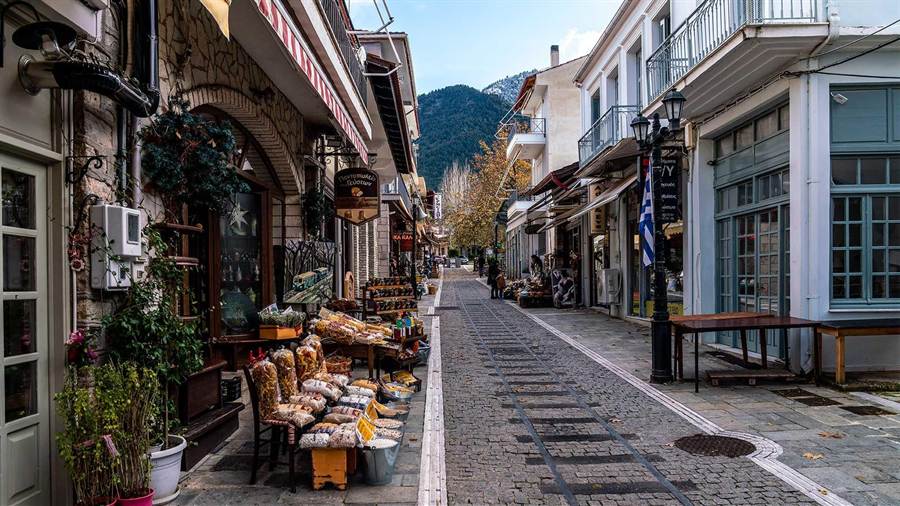
A Kalavryta tour centres on a town in the mountainous east-central part of Achaea. The regional unit sits in the northwestern part of the Peloponnese peninsula. Its capital is Patras, the third largest city in Greece.
The Diakopto-Kalavryta railway is a 750 mm gauge rack railway. It runs 22 kilometres from the coastal town of Diakopto through the Vouraikos Gorge up to Kalavryta. Its steepest stretches use toothed rails.
Two monasteries stand close to the line and the town. Agia Lavra lies on a hill 4 kilometres southwest of Kalavryta. Mega Spilaio occupies a large cave in a sheer cliff.
The Cave of the Lakes lies near the village of Kastria, 17 kilometres from Kalavryta. In summer the old underground river inside it dries up and leaves 13 lakes behind.
- Region: Achaea forms part of the region of Western Greece.
- Railway: The rack line climbs from sea level to 720 metres.
- Monasteries: Agia Lavra and Mega Spilaio are both Orthodox monasteries near Kalavryta.
- Cave: The Cave of the Lakes is an old subterranean river on three levels.
A Kalavryta tour therefore combines railway history, Orthodox monasteries and cave geology in one mountain district of Achaea. The sections below set out the facts behind each stop on the route.

Which Kalavryta tour formats are on sale?
A Kalavryta tour comes in distinct formats. The list covers a rack railway and lake caves trip, a 2-day private tour from Athens, departures from Olympia and Patras, and a trip that adds Ancient Corinth and a riverside lunch.
One format pairs the lake caves with the rack railway in Kalavryta. The train runs through the Vouraikos Gorge, and the cave lies near the village of Kastria.
A second Kalavryta tour format runs as a 2-day private tour from Athens. It covers the town of Kalavryta and the Cave of the Lakes, 17 kilometres from the town.
From Olympia, one format is titled as a Kalavryta tour with a cliff monastery and the cog railway. The cliff monastery near Kalavryta is Mega Spilaio, which sits in a sheer cliff.
Two formats start in Patras, which lies 40 kilometres northwest of Kalavryta. Both add a winery and a monastery to the visit, and one also includes the Cave of the Lakes.
Another format joins Ancient Corinth, the Cave of the Lakes and a riverside lunch. A seventh listing presents the trip as a way to explore nature and history in Kalavryta.
- Rail and caves: One format joins the rack railway with the lake caves.
- From Athens: A private format covers Kalavryta and the Cave of the Lakes.
- From Olympia: One format adds a cliff monastery and the cog railway.
- From Patras: Two formats add a winery and a monastery visit.
Travellers who also plan an Ancient Olympia tour can start the Kalavryta trip from Olympia. The tour cards and availability boxes on this page list live dates for each format.
What does a Kalavryta tour show of the mountain town?
A Kalavryta tour reaches a town on the right bank of the Vouraikos, at the top of a rack line that climbs to 720 metres. The town has Frankish, Byzantine and Ottoman layers and a prominent role in the revolt of 1821.
The town lies 24 kilometres south of Aigio and 62 kilometres northwest of Tripoli. Mount Erymanthos rises in the west of the municipality. Aroania, also called Chelmos, rises in the southeast.
Kalavryta is built near the ancient city of Cynaetha. In the late Middle Ages it was the centre of the Barony of Kalavryta within the Frankish Principality of Achaea.
The Byzantines retook the town in the 1270s and held it until the Despotate of the Morea fell to the Ottoman Turks in 1460. Apart from a 30-year Venetian interlude, Turkish rule lasted until 1821.
During the Axis occupation of Greece, German troops carried out the Kalavryta massacre against the people of the town. In the Greek Civil War, the Democratic Army of Greece seized Kalavryta on 11 April 1948.
- Municipality: The 2011 reform merged Aroania, Kalavryta, Kleitoria and Paia into one municipality.
- Area: The municipality covers 1,058.147 square kilometres.
- Province: The former province of Kalavryta had the same territory and was abolished in 2006.
- Ski centre: The town’s ski centre lies east of Kalavryta on the slopes of Chelmos.
A Kalavryta tour also meets the town’s role in Greek politics. Alexandros Zaimis, one of the notable people from Kalavryta, served as Prime Minister six times.
Why does a Kalavryta tour stop at Agia Lavra?
A Kalavryta tour stops at Agia Lavra because the monastery is called the symbolic birthplace of modern Greece. There, on 25 March 1821, the call for revolt against the Ottoman Empire was first heard, and Bishop Germanos raised the revolutionary flag.
Agia Lavra is an Eastern Orthodox monastery on Chelmos Mountain. It was built in 961 AD at 961 metres above sea level. It ranks among the oldest monasteries in the Peloponnese.
On 25 March 1821, Bishop Germanos of Patras performed a doxology and administered an oath to the Peloponnesian fighters. He raised the flag under the plane tree just outside the gate.
Germanos III of Old Patras was born Georgios Kontzias in Dimitsana, in northwestern Arcadia. He served as Orthodox Metropolitan of Patras and played an important role in the revolution. He died in Nafplio in 1826.
The Turks burnt the monastery to the ground in 1585. It was rebuilt in 1600, and the frescoes by Anthimos were completed in 1645. The armies of Ibrahim Pasha of Egypt burnt it in 1826.
- Calendar: The 25 March date of 1821 equals 6 April in the Gregorian calendar.
- Rebuilding: The building was completely rebuilt in 1850 after the rebirth of modern Greece.
- Museum: The museum keeps the vestments of Germanos and the Gospel of Tsarina Catherine II of Russia.
- Monument: A monument to the heroes of 1821 stands on a hill opposite and overlooks the monastery.
One listed format pairs the lake caves with Ancient Corinth. An Ancient Corinth tour covers that ancient city on its own, while a Kalavryta tour adds the monastery of 1821.
What is Mega Spilaio on a Kalavryta tour?
A Kalavryta tour reaches Mega Spilaio, the Great Cave, a Greek Orthodox monastery set in a large cave in a sheer cliff. The monastery stands where the western slopes of Mount Chelmos drop down to the gorge of the Vouraikos river.
Its formal name is the Monastery of the Dormition of the Theotokos. It lies in the municipality of Kalavryta. The rack railway stops at Kato Zachlorou, 12.6 kilometres from Diakopto, to serve its visitors.
People knew the cave in antiquity. Pausanias, the ancient geographer, records that the daughters of Proetus sheltered there during their madness. Christian hermits occupied it in the first Christian centuries.
Tradition dates the founding to 362 and names the Thessalonian brothers Symeon and Theodore. With the help of Euphrosyne, a local shepherdess, they found an icon of the Theotokos credited to Luke the Evangelist.
From about 1354 the monastery housed the Orthodox Metropolitan of Patras, because Latins still held the city. Large destructions struck the complex in 849, 1400 and 1640, when it was comprehensively rebuilt.
- Structure: The monastery, rebuilt from the ground after the war, forms an eight-storey complex in a 120-metre cliff face.
- Revolution: Monks joined the Filiki Etaireia and took part in the Greek War of Independence.
- Church: A fire destroyed the katholikon in 1934, and a new church followed in 1937.
- Feast days: The male monastery celebrates on 15 August, 14 September and 18 October.
A Kalavryta tour that rides the rack railway passes this monastery at about the halfway point of the line, between Diakopto and the town.
Which route does the rack railway on a Kalavryta tour follow?
A Kalavryta tour that includes the train rides a historic 750 mm gauge rack railway in the northern Peloponnese. The line runs 22 kilometres from Diakopto through the Vouraikos Gorge, past Mega Spilaio and up to Kalavryta, with a stop at Zachlorou.
Trains leave Diakopto and enter the gorge of the Vouraikos. They stop at Niamata, also called Mikrohelidou, and at Triklia. A former stop at kilometre 8.14 closed in 1960.
After 12.6 kilometres the train halts at Kato Zachlorou, which serves visitors to the monastery. At 18.2 kilometres it stops below the village of Kerpini, and then it ends at Kalavryta.
GAIAOSE owns and maintains the stations and the rolling stock. The Hellenic Railways Organisation, OSE, holds the line infrastructure. Hellenic Train operates the passenger trains on the route.
Four new three-car diesel-electric trainsets from Stadler Rail entered service in 2009 as Class 3107. The first modern trainsets came from Billard in 1958, and three more came from Decauville in 1967.
Since 1996 OSE has planned a 4.5-kilometre extension from Kalavryta to Agia Lavra and the ski centre. An earlier plan to reach Tripoli was cancelled for financial reasons.
- Stations: The main stations are Diakopto, Mega Spileo and Kalavryta.
- Connection: At Diakopto the line meets the standard-gauge Athens Airport-Patras railway.
- Steam: A steam locomotive delivered by Cail in 1891 stands preserved at Kalavryta station.
- Crossings: The line has 9 level crossings, and 3 of them are guarded.
Gerald Durrell placed the line’s steam engine, called Madame Hortense, in his 1974 book The Talking Parcel. A Kalavryta tour on the train follows the same track.
How does the train on a Kalavryta tour climb steep track?
A Kalavryta tour by train climbs with the help of a toothed rack rail. On three stretches where the gradient exceeds 10%, gear wheels on the train engage toothed rails in the centre of the track and pull it uphill.
A rack railway carries a toothed rack rail between the running rails. Cog wheels, or pinions, on the train mesh with this rack. The Diakopto line is the steepest railway in Greece.
Friction-based rail tops out at a 10% gradient. Rack lines can work on gradients of 100% or more. The rack also gives more controlled braking and reduces the effect of snow or ice.
The Diakopto line uses the Abt system on its three rack sections, 3.8 kilometres in total. Carl Roman Abt, a Swiss locomotive engineer, designed this rack with solid bars that carry vertical teeth.
Two or three bars sit between the rails with offset teeth. This keeps the pinions on the driving wheels constantly engaged. The system costs less to build than the Riggenbach rack.
- Gradient: The line reaches a maximum gradient of 17.5%.
- Speed: Trains run at up to 40 km/h on adhesion sections and 12 km/h on rack sections.
- Line type: Rack-and-adhesion lines use the cog drive only on the steepest sections.
- Transition: A spring-mounted rack section, invented by Roman Abt, brings the pinion teeth gradually into engagement.
A Kalavryta tour on the train therefore switches between normal running and rack working. The first mountain rack railway in continental Europe, on Mount Rigi in Switzerland, opened in 1871.
What does a Kalavryta tour see in the Vouraikos gorge and at Diakopto?
A Kalavryta tour on the rack line starts at Diakopto, a coastal town on the Gulf of Corinth. From there the track enters the Vouraikos gorge, about 20 kilometres long, where the river passes dense vegetation, steep cliffs, waterfalls and caves.
The Vouraikos is a river in Achaea. In ancient times it was the Erasinos, a name also given by Strabo. Its source lies in the Aroania mountains near the village of Priolithos.
The river flows past Kalavryta and Diakopto and enters the Gulf of Corinth near Diakopto. Its name comes from Boura, a mythological daughter of Ion and Helice, whom Hercules loved.
Legend says Hercules opened the gorge to get close to Boura. Another legend places a cave of Hercules on the river bank, where pilgrims read their fate in the Tables of Knowledge.
Diakopto sits near the mouth of the Vouraikos, at the lower end of the gorge. Since the 2011 reforms it has been a municipal unit of Aigialeia. It lies about 40 kilometres east of Patras.
- Ancient cities: Boura, Helike and Keryneia stood in the Diakopto area.
- Rule: Ottoman rule lasted from 1460 to 1821, apart from Venetian rule between 1687 and 1715.
- Old name: The municipality was created in 1835 under the name Voura.
- Depot: The rolling stock sheds and maintenance facilities of the railway stand at Diakopto.
Pausanias mentions the river in his Description of Greece. A Kalavryta tour by train crosses the gorge on bridges and through tunnels.
What are the Cave of the Lakes and Mount Aroania on a Kalavryta tour?
A Kalavryta tour reaches the Cave of the Lakes near Kastria, an old subterranean river on three levels. Mount Aroania, also called Chelmos, rises above the area to 2,355 metres and holds a ski resort and the Aristarchos telescope.
The cave was formerly called Troupisio. It lies 17 kilometres from Kalavryta and 9 kilometres from Kleitoria. When the snow melts in winter, it turns into a flowing river with waterfalls.
In summer the cave dries up and leaves 13 lakes behind. Pausanias, the ancient traveller, mentions it. Legend says Melampus cured two of the three daughters of Proetus, king of Tiryns, here.
The two cured daughters were Lysippe and Iphianassa. The third, Iphinoe, died on the way. Humans used the cave in the Neolithic Age and through the whole Bronze Age.
Fossilised bones of humans and other animals, including hippopotamus, have been identified on the lower level. The cave lies on Aroania, the third highest mountain of the Peloponnese after Taygetus and Kyllini.
- Rank: Aroania is the highest mountain in Achaea and stands near the border with Corinthia.
- Forests: Pine forests cover the slopes between 800 and 1,800 metres.
- Butterflies: The Chelmos blue butterfly lives between 1,100 and 1,800 metres.
- Peak: Psili Koryfi, at 2,355 metres, is the highest summit.
Travellers who want a second cave visit can compare this trip with a Diros caves tour. A Kalavryta tour keeps the focus on the lakes and the mountain.
What do travellers ask about a Kalavryta tour?
A Kalavryta tour raises four recurring questions. Travellers ask about departure points, about the rack railway, about the Cave of the Lakes and about the monastery in the cliff. The answers below follow the listed formats and the history of each site.
Does a Kalavryta tour leave from Athens, Patras or Olympia?
Yes. A Kalavryta tour leaves from each of these places in at least one listed format. A 2-day private tour starts in Athens. One format starts in Olympia and adds a cliff monastery and the cog railway. Two formats start in Patras and add a winery and a monastery.
Does every Kalavryta tour include the rack railway?
No. The rack railway appears by name in two formats: the lake caves and rack railway trip, and the tour from Olympia with the cog railway. The line runs 22 kilometres from Diakopto to Kalavryta. Other titles name the cave, a monastery, a winery or a riverside lunch instead.
What is the Cave of the Lakes on a Kalavryta tour?
The Cave of the Lakes is an old subterranean river near Kastria, in the municipality of Kalavryta. It has three levels. Snowmelt in winter turns it into a river with waterfalls. In summer it dries up and leaves 13 lakes. Fossil bones of hippopotamus lie on its lower level.
Which monastery on a Kalavryta tour stands against a cliff?
Mega Spilaio, the Great Cave, stands in a large cave in a sheer cliff, where Mount Chelmos drops to the Vouraikos gorge. The rebuilt complex has eight storeys set in a cliff face 120 metres high. A Kalavryta tour by rack railway reaches it from the stop at Kato Zachlorou.