
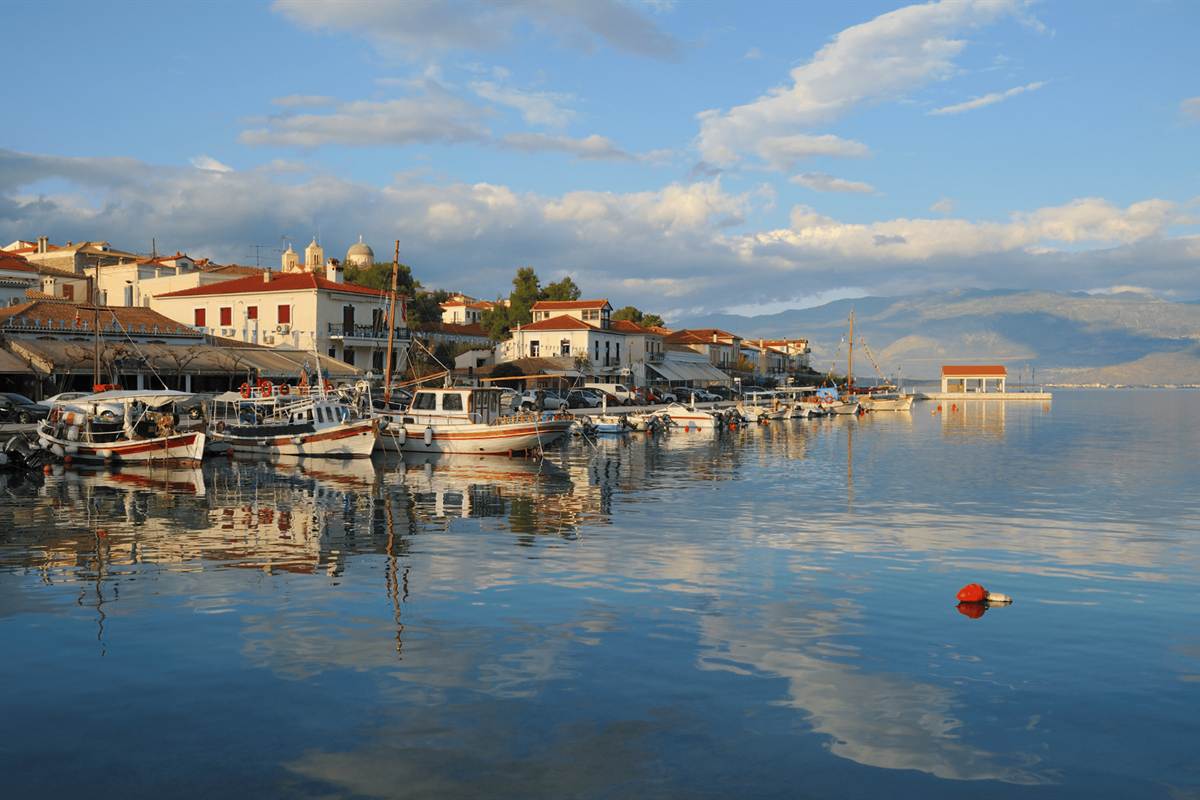
A Galaxidi day trip reaches Galaxidi, the old sea captains’ town on the north shore of the Gulf of Corinth in Phocis, with its harbours, mansions and churches, and links it with Itea, Kirra and the road to Delphi. The trip is one of the Greece Tours on Greece Ville.
This post covers the formats on sale, where Galaxidi sits, its ancient past, the ships and captains, the local customs, Itea and Kirra, the olive plain, the honey format, the Gulf of Corinth and the questions that come up before booking.
What is a Galaxidi day trip?
A Galaxidi day trip is a visit to a small port town in the southern part of Phocis, in Central Greece. The town flourished on sea trade, and its mansions, harbour front, museums and Clean Monday flour custom shape the visit.

Galaxidi, also spelled Galaxeidi, is a town and former municipality. After the 2011 local government reform it became a municipal unit of the municipality of Delphi, with an area of 126.088 square kilometres.
The municipal unit holds four communities: Agioi Pantes, Galaxidi, Penteoria and Vounichora. The town itself is a small port surrounded by mountains on the northern shore of the Gulf of Corinth.
Its main harbour gives docking space to yachts and small fishing boats. Restaurants, bars and stores line the quay, so the waterfront forms the natural start and end point of a Galaxidi day trip.
The town keeps its traditional architecture, and that preservation has helped tourism grow in recent decades. Galaxidi now works as a relatively popular weekend retreat, while commercial fish farming has been developing in recent years.
Two museums share one old mansion in the town. They are the Archaeological Collection and the Maritime and Historical Museum of Galaxidi, and they cover the ancient town and the seafaring age.
- Region: Galaxidi sits in the southern part of Phocis, a regional unit of Central Greece.
- Harbour: The main harbour serves yachts and small fishing boats.
- Museums: One old mansion holds the Archaeological Collection and the maritime museum.
- Economy: Tourism has grown with the preserved architecture, and fish farming is developing.
A Galaxidi day trip therefore mixes harbour time, two museums and a walk through preserved streets. The sections below cover each part in turn.
Which Galaxidi day trip formats are on sale?
The Galaxidi day trip appears in four formats in the current listings. They run from a tour around the traditional maritime village to departures from Athens with a honey experience, a private Delphi and coast route or an Arachova village stop.
The first format stays inside the town. It is a tour around the traditional maritime village, for travellers who reach Galaxidi on their own and want the harbour and mansions explained.
The second format departs from Athens. It pairs a honey experience with a visit to Galaxidi, and a Galaxidi day trip of this kind splits its attention between the food stop and the harbour town.
The third format is a private, premium tour. Its route joins Delphi, a coastal town on the gulf and Galaxidi, and the private basis keeps the group to the people who book it together.
The fourth format is a Delphi day trip from Athens with a stop in Arachova village. Galaxidi does not appear in its title, so travellers who want the harbour town need to check the programme.
Three of the four formats name Galaxidi directly. Two formats start in Athens and one starts in the town itself, so the main choice on a Galaxidi day trip lies between arranged transport and independent arrival.
- Village tour: A tour around the traditional maritime village starts in Galaxidi itself.
- Honey pairing: A departure from Athens links a honey experience with a Galaxidi visit.
- Private route: A premium private tour joins Delphi, a gulf town and Galaxidi.
- Delphi option: A day trip from Athens covers Delphi and adds an Arachova village stop.
The tour cards and availability boxes on this page list live dates for each format. Travellers focused on the sanctuary alone can compare the Delphi day trip from Athens.
Where does a Galaxidi day trip go in Greece?
A Galaxidi day trip goes to the southern part of Phocis, a regional unit of Central Greece. The town stands on the northern shore of the Gulf of Corinth, 15 km southwest of Delphi and 48 km east of Nafpaktos.
Phocis is a regional unit within the administrative region of Central Greece. It stretches from the western slopes of Parnassus to the Vardousia range and reaches the Gulf of Corinth.
Modern Phocis covers 2,120 square kilometres, and the ridge of Parnassus rises to 2,459 metres at its heart. With 40,343 residents in 2001, it ranks among the least populous regional units in Greece.
Phocis sees its population nearly double in the summer months because of the influx of tourists. A Galaxidi day trip in summer therefore meets a busier coast than census figures suggest.
The Gulf of Corinth is an inlet of the Ionian Sea that separates the Peloponnese from western mainland Greece. Galaxidi sits on the west shore of a northward bay of that gulf, facing the Peloponnese.
The town has a deeper main harbour and a smaller one called Chirolaka. On the rocky shore beside the larger harbour grows a pine forest that school children planted in the early twentieth century.
- Road: Greek National Road 48 links Galaxidi with Nafpaktos and Delphi.
- Islands: Residents fled to the offshore islands when Bulgarians under Tsar Samuel destroyed the town in the late 10th century.
- Old name: In the Middle Ages the Gulf of Corinth was known as the Gulf of Lepanto, the Italian form of Naupactus.
- Rift: Tectonic movement widens the Gulf of Corinth by 10 mm per year.
A Galaxidi day trip shares its road with Delphi, and the town also suits wider routes through Central Greece, such as a Delphi and Meteora tour.
What ancient history does a Galaxidi day trip cover?
A Galaxidi day trip covers the ancient town of Haleion, also known as Chalaeum, which stood on the site of the modern town. Haleion belonged to western Locris and flourished through the Hellenistic and Roman periods until the 2nd century AD.
Traces of habitation reach back to prehistoric times, with a peak in the Early Helladic period at Anemokambi, Pelekaris, Kefalari and the islet of Apsifia. A significant Mycenaean settlement lay at Villa.
The hill of Saint Athanasios held a fortified Geometric settlement around 700 BC. In the Archaic and Classical periods, from the 7th to the 4th century BC, the administrative and religious centre stood at Agios Vlasis.
Around 300 BC the present site was settled and ringed by a fortification wall, during the expansion of the Aetolian League. The wall made Haleion one of the best-protected ports on the Gulf of Corinth.
The ancient name appears as Chalaeum, Chalaion, Chaleion or Chaleos. During the Peloponnesian War it was among the Locrian towns forced to hand hostages to the Spartan army in 426 BC.
Inscriptions naming the town have been found. One records a sympoliteia with neighbouring Tritaea, under which citizens of each town were able to own or lease land in the other.
- Collection: The Archaeological Collection of Galaxidi was established in 1932 under the Ephorate of Antiquities of Phocis.
- Themes: Displays cover private and daily life, trade and maritime activity, and cemeteries.
- Glass: Seven glass vessels show the glass-making of the 1st century AD, among them an inscribed cast cup.
- Bronzes: More than 100 bronze vessels from the town sit in fifteen museums across America and Europe.
A Galaxidi day trip that includes the Archaeological Collection links these sites to real finds, from an Early Helladic amphora to clay loom-weights and terracotta lamps.
Why does a Galaxidi day trip focus on ships and shipowners?
A Galaxidi day trip focuses on ships because the town flourished through maritime trade in the 18th and 19th centuries. Its shipowners carried regional goods to the West, and the mansions and the maritime museum still record that seafaring prosperity.
Ottoman presence in the town stayed minimal, and the majority of inhabitants were Orthodox Christians. Trade with the West in the farm produce of Corinthia and the Corinthian Gulf gave rise to a local commercial fleet.
The natural port of the town supported that growth. After the Treaty of Küçük Kaynarca in 1774, a large number of Galaxidi shipowners operated their vessels under the Russian flag.
When the Greek War of Independence broke out, the inhabitants joined the revolutionaries at once, above all at sea. The Ottoman army destroyed the town twice, first in 1821 and again in 1825-26.
In 1821, while the Monemvasia garrison surrendered to her blockade, another ship of Laskarina Bouboulina resupplied Galaxidi. The town later recovered and thrived through the 19th century as a commercial and maritime centre.
At its peak the town ranked as the second-largest shipping centre in Greece after Syros. Its shipowners failed to switch to steam power after 1890, and the prosperity of the town then vanished.
- Mansions: The size and style of the old houses and mansions reflect the wealth of the shipping age.
- Museum building: The mansion holding both museums was built around 1870 for a girls’ school, town hall and police station.
- Exhibits: The marine museum contains exhibits from the era when the fleet thrived.
- Decline: The decline of Galaxidi and Hydra as shipping centres helped Andros rise after independence.
A Galaxidi day trip that pairs the maritime museum with a walk past the old shipowners’ houses reads the rise and fall of the fleet in the streets themselves.
What local customs does a Galaxidi day trip meet?
A Galaxidi day trip on Clean Monday meets Alevromoutzouroma, the flour war held on the day that closes the Carnival season. On other days the visit takes in the churches and monasteries around the town and the story of the painter Spyros Vassiliou.
Clean Monday is the first day of Great Lent, falling on the sixth Monday before Palm Sunday. In Greece it is a public holiday marked by outdoor excursions, shellfish, lagana bread and kite flying.
In Galaxidi the day brings Alevromoutzouroma, literally flour smudging, also called the Flour Wars. Its origins are unclear, but the custom has appeared in its current form since the mid-19th century.
Locals and visitors of all ages put on old clothes and gather at a set meeting point, where flour is handed out in large quantities. Colouring is added, and faces are painted with charcoal.
The crowd then marches to the harbour, which is split into a war zone and a neutral zone for observers. Participants throw coloured flour at each other until everyone runs out of supplies.
Churches also shape a Galaxidi day trip. No traces remain of the medieval castle, and the Church of Saint John of Jerusalem, built by the Hospitallers in 1404, stood until after the First World War.
- Saint Nicholas: A modern church dedicated to Saint Nicholas then took its place.
- Sotir: The Monastery of Sotir stands on a hill just outside the town.
- Metamorphosis: A mountain road behind the town leads to the Monastery of the Metamorphosis, a convent with one nun as of 2010.
- Painter: In 1921 the townsmen collected money to send the Galaxidi-born painter Spyros Vassiliou to study in Athens.
A Galaxidi day trip timed for Clean Monday meets the flour war at the harbour, while visits on other dates centre on the churches, the museums and the old streets.
What are Itea and Kirra on a Galaxidi day trip?
A Galaxidi day trip passes Itea and Kirra, two coastal communities of the Itea municipal unit within Delphi municipality. Itea gives its name to the gulf beside it, while Kirra keeps the name of Cirrha, the ancient harbour that served Delphi.
Itea sits in southeastern Phocis. It was once a municipality of its own, and the reforms of 2011 folded it into Delphi as a municipal unit. Three communities make up that unit: Itea, Kirra and Tritaia.
On a Galaxidi day trip the distances are small. Itea stands 2 km west of Kirra, 8 km southwest of Delphi and 11 km south of Amfissa. Galaxidi lies 7 km southwest of Itea.
Kirra carries the name of ancient Cirrha, the coastal town that served as harbour of Delphi. The old site is identified on a hill called Magoula Xeropigadas, close to the modern village.
Cirrha began as the port of Crissa, an older town set inland on a spur of Mount Parnassus. Over time the harbour town grew at the expense of Crissa, which declined.
Cirrha was later rebuilt as the port of Delphi. In the 2nd century, in the time of Pausanias, it held a temple of Apollo, Artemis and Leto with Attic statues.
- Walls: By the mid-19th century, wall remains traced a four-sided space about 1.6 km in circuit.
- Hippodrome: The ancient Hippodrome stood near the Cirrha ruins and always stayed in the coastal plain.
- Stadium: In the time of Pindar the Stadium also lay in that plain, before a later move up to Delphi.
- Tolls: Cirrha levied heavy tolls on pilgrims who landed there on the way to Delphi.
A Galaxidi day trip that stops at Itea and Kirra links the modern town of Itea with the site of the old harbour of Delphi.
What is the olive plain on a Galaxidi day trip?
A Galaxidi day trip crosses the olive plain that runs from the coast near Itea and Kirra up to Amfissa. Ancient writers called it the Crissaean plain, and its sacred status set off wars between Delphi’s league and its neighbours.
The plain lies between the sites of Crissa and Cirrha. Parnassus bounds it on the north, Mount Cirphis on the east and the mountains of the Ozolian Locrians on the west.
Strictly, the land holds two plains. The small Cirrhaean plain ran from the sea to the village of Xeropegado. Two jutting rocks there split it from the larger Crissaean plain, which reached Crissa and Amfissa.
On a Galaxidi day trip, Amfissa marks the top of the plain. It sits on the northern edge of the olive forest of the Crissaean plain, between Giona in the west and Parnassus in the east.
The groves reach into the Pleistos valley below Delphi. Locals call this belt of trees the sea of olives, and groves have stood on that valley floor since prehistoric times.
The First Sacred War broke out around 595 BCE, after Cirrha mistreated pilgrims bound for Delphi. After ten years the Amphictyons took the town, razed it and gave the coastal plain to Apollo.
- Curse: A formal curse fell on anyone who farmed or settled the dedicated land.
- Games: The Amphictyons used the spoils of Cirrha to found the Pythian Games.
- Fine: In 357 BC the Amphictyonic League fined the Phocians for farming sacred land on the Kirrhaean plain.
- Philip II: After Amphissians farmed the sacred plain again, Philip II of Macedon took Amphissa in 338 BC.
A Galaxidi day trip that reaches Amfissa touches an older story: after the Persian win at Thermopylae, Phocians found safety behind its strong acropolis. The Thermopylae tour covers that battle.
What does the honey format add to a Galaxidi day trip?
A Galaxidi day trip in the honey format adds a beekeeping and honey session from Athens alongside the stop in Galaxidi. It places an old Greek craft, with roots at Knossos and in the writings of Aristotle, beside the sea town.
The honey format on a Galaxidi day trip centres on beekeeping, or apiculture, the keeping of bee colonies in artificial hives. Beyond honey, a hive yields beeswax, propolis, bee pollen and royal jelly.
Greece has deep roots in the craft. Finds at Knossos include hives, smoking pots and honey extractors from a high-status system of beekeeping in Crete and Mycenae. Aristotle wrote at length about bee life.
By 594 BCE, beekeeping around Athens had spread so far that Solon passed a law on hive spacing. New hives had to stand 300 feet, or 90 metres, from hives set up by another keeper.
Modern movable frames are thought to descend from the traditional basket top-bar hives of Greece, which spared the bees at harvest. The oldest recorded use of those hives dates to 1669.
Nectar reaches the hive with 70 to 80% water. Bees work it down to between 15.5% and 18% water, then cap each cell with wax. An average hive yields about 29 kg a year.
- Pine honey: In Greece, pine honey, a honeydew type, makes up 60 to 65% of honey production.
- Smoker: Beekeepers use smoke to calm the bees and to mask the alarm signals of guard bees.
- Flowers: Filling one honey stomach, which holds about 40 mg, can take visits to more than one thousand flowers.
- Myth: In ancient Greek religion, honey in the form of nectar and ambrosia fed Zeus and the twelve gods of Olympus.
A Galaxidi day trip with the honey format traces Greek honey from forager bee to capped comb, and Galaxidi then adds the sea and the harbour.
What does the Gulf of Corinth add to a Galaxidi day trip?
A Galaxidi day trip faces the Gulf of Corinth, the inlet of the Ionian Sea that separates the Peloponnese from western mainland Greece. The gulf frames the coast road, the islets off Galaxidi and the view across to Achaea.
A Galaxidi day trip follows this gulf. The gulf runs from the Isthmus of Corinth in the east to the Rion Strait in the west. The Rio-Antirrio Bridge has crossed that strait since 2004.
Its names have shifted. In the earliest times it was the Crissaean Gulf, after ancient Crissa above the bay. In the Middle Ages it was the Gulf of Lepanto, the Italian form of Naupactus.
The gulf sits on a tectonic rift that widens by 10 mm a year. Much of the northern margin, the Galaxidi side, slopes at 10 to 20 degrees; the southern margin drops at 30 to 40.
Islets lie off Galaxidi. When a Bulgarian raid destroyed the town in the late 10th century, its people fled to these offshore islands. The islet of Apsifia holds traces of Early Helladic habitation.
Across the wider gulf, Trizonia is the only inhabited island, while Ampelos, Fonias and Prasoudi are islets. Fin whales and dolphins are among the cetaceans known to enter the gulf.
- Bays: The Crissaean Gulf and the Bay of Antikyra open off the northern side of the gulf.
- Fish farming: Commercial fish farming has been developing at Galaxidi in recent years.
- Rivers: The Mornos and the Pleistos are the northern rivers that feed the gulf.
- Earthquakes: Faults around the gulf can produce earthquakes up to around magnitude 6.5, though such events are uncommon.
A Galaxidi day trip stays on the northern shore. Across the water, a ferry links Agios Nikolaos with Aigio. Kalavryta, the focus of the Kalavryta tour, lies 24 km south of Aigio.
What do travellers ask about a Galaxidi day trip?
A Galaxidi day trip raises four common questions: how far the town lies from Athens and Delphi, how it pairs with Delphi, whether swimming fits in, and what to bring. Each answer below uses the local geography and standard beekeeping practice.
How far is a Galaxidi day trip from Athens or Delphi?
Galaxidi lies 15 km southwest of Delphi and 17 km south of Amfissa, which stands 200 km northwest of Athens. Greek National Road 48 connects Galaxidi with Delphi, Itea and Nafpaktos, so the coast and the Delphi area sit on one route for a Galaxidi day trip from Athens.
Can a Galaxidi day trip be paired with Delphi?
Yes. One format on sale joins Delphi, Itea and Galaxidi in a single private outing. The Pleistos rises below Arachova and runs past Delphi through the olive plain toward the gulf, so a Galaxidi day trip with Delphi follows one valley to the sea.
Is swimming part of a Galaxidi day trip?
No format title on sale names swimming, so each tour card sets out what is included. The town faces the gulf, a pine forest planted by school children lines the rocky shore beside the larger harbour, and nearby Amfissa has a hot-summer Mediterranean climate.
What do travellers bring on a Galaxidi day trip?
For the honey format, pale clothing without strong scent suits the hives. Bees see in ultraviolet and are drawn to scent, and fabric conditioner matters more than colour. Beekeepers treat the face and neck as key areas, so a veil, gloves and a hooded suit form the standard kit.