
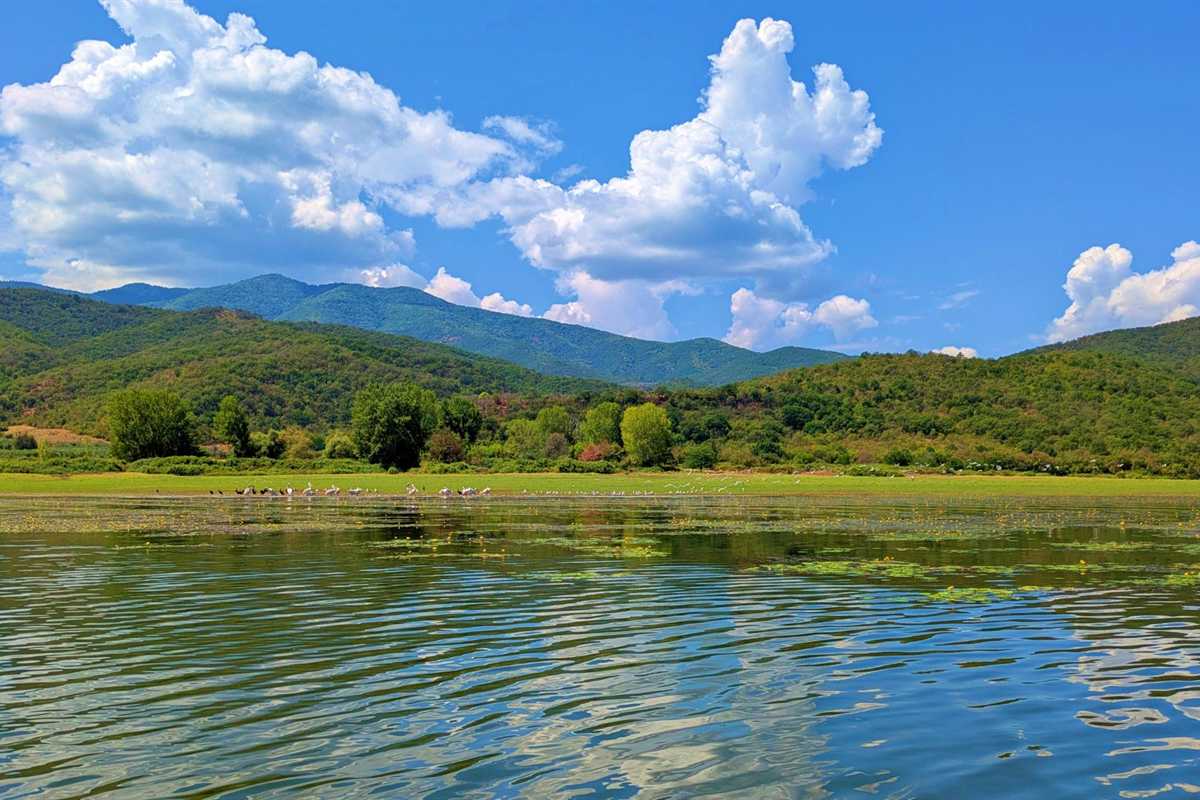
A Lake Kerkini tour visits the wetland lake in the Serres regional unit of northern Greece, with its pelicans, cormorants and water buffalo below Mount Belles. The tour is one of the Greece Tours on Greece Ville, listed with the other Northern Greece tours and day trips from Thessaloniki.
This post covers the formats on sale, the lake and the Strymonas, the birds, the water buffalo, the mountains and villages around the lake and the questions that come up before booking.
What does a Lake Kerkini tour visit?
A Lake Kerkini tour visits an artificial reservoir in the Serres regional unit of Central Macedonia. A dam on the Strymonas created the lake in 1932 over a marshland, and the wetland now ranks among the premier birdwatching sites in Greece.
The Serres regional unit forms part of the Region of Central Macedonia. Its capital is the city of Serres, and its population reaches just over 150,000. Arable land covers 41 per cent of the unit.
Before 1932, irregular marsh lakes spread along the Strymon. One of them carried the name Podkova, a word meaning horseshoe. Embankments on the eastern and western banks and a dam near Lithotopos then formed the reservoir.
The lake lies on the migratory flyway for birds bound for the Aegean Sea, the Balkan region, the Black Sea and the Hungarian steppes. The reservoir provides a habitat for thousands of waterfowl.
Riverside forests, broad beds of water-lilies and a variety of fish fill the wetland. The surrounding land is flat and semi-mountainous, and the surface of the lake varies from 54 km2 to 72 km2.
- Region: Every Lake Kerkini tour heads to the Serres regional unit in Central Macedonia.
- Origin: A dam near the village of Lithotopos started functioning in 1932.
- Water source: The Strymon feeds the lake, with extra water from the Kerkinitis river.
- Wildlife: The surrounding area holds at least 10 amphibian species and 19 reptile species.
Each Lake Kerkini tour pairs the reservoir with the wetland around it. The sections below cover the formats on sale, the river and the dam, the birds, the buffalo and the nearby villages.


Which Lake Kerkini tour formats are on sale?
A Lake Kerkini tour on sale comes in six formats: a day trip from Thessaloniki, a private day trip, a day trip with a boat tour, a bird watching experience, a private trip adding Ano Poroia and a day tour from Sofia.
The standard listing carries the title Day Trip to Lake Kerkini From Thessaloniki. A second listing, From Thessaloniki: Private Day Trip to Kerkini Lake, sells the same destination as a private outing.
The boat format appears as From Thessaloniki: Lake Kerkini Day Trip with Boat Tour. A separate title, Lake Kerkini Bird Watching Experience from Thessaloniki, puts the birds of the wetland at the centre of the day.
Two private titles add the village of Ano Poroia to the lake. They run as Thessaloniki: Lake Kerkini & Ano Poroia Private Day Trip and as Kerkini Lake and Ano Poroia Private Tour from Thessaloniki.
One listing starts outside Greece. From Sofia: Lake Kerkini, Greece Nature & Culture Day Tour links Sofia with the lake and frames the day around nature and culture on the Greek side of the border.
- Day trip: The standard Lake Kerkini tour leaves Thessaloniki for the lake.
- Boat tour: One day trip from Thessaloniki includes a boat tour by name.
- Private trips: Three private titles cover the lake alone or the lake with Ano Poroia.
- From Sofia: A nature and culture day tour sets out from Sofia.
A Lake Kerkini tour leaves the city for the countryside, and a Thessaloniki walking tour fits another day. The tour cards and availability boxes on this page list live dates for each format.
How do the dam and the Strymonas shape a Lake Kerkini tour?
A Lake Kerkini tour follows water that the Strymonas carries from Bulgaria into a reservoir held back by a dam. A new dam began operating in 1982, and the Ramsar Convention on Wetlands protects the habitat around the lake.
The Struma, called the Strymonas in Greek, runs for 415 kilometres through Bulgaria and Greece. It rises on Vitosha Mountain in Bulgaria and enters Greece near the village of Promachonas in eastern Macedonia.
In Greece the river serves as the main waterway feeding and leaving Lake Kerkini. Its Greek course lies entirely within the Serres regional unit and ends in the Strymonian Gulf of the Aegean near Amphipolis.
The first dam near Lithotopos started functioning in 1932. Over time, silt from the Strymon reduced the capacity of the lake. The embankments were raised, and a new dam started operating in 1982.
The Ramsar Convention takes its name from the city of Ramsar in Iran, where the treaty was signed in 1971. Every Lake Kerkini tour enters a wetland under its protection.
- River length: The Struma runs for 415 kilometres, 290 of them in Bulgaria.
- Protection: Lake Kerkini and the river mouth both rank as national parks in the Natura 2000 network.
- Greek sites: Greece counts ten Ramsar sites covering 1,635 square kilometres.
- Valley: The Greek part of the Strymonas valley ranks as the fourth-biggest valley in Greece.
A Lake Kerkini tour on the water crosses a reservoir that the river both fills and drains. The lake also serves as a technical work of great agricultural use for the farmland around it.
Which birds does a Lake Kerkini tour look for?
A Lake Kerkini tour looks for birds in a wetland that hosts 227 kinds of birds. Pelicans, cormorants and flamingos rank among the waterbirds whose ranges include Greece, and a great white pelican was released at the lake in January 2016.
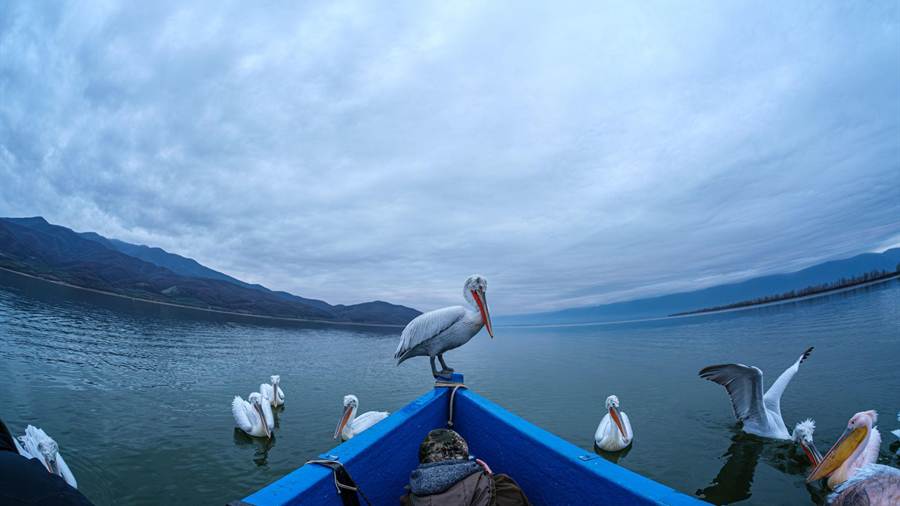
The Dalmatian pelican is the largest member of the pelican family. Its wingspan ranges between 2.7 and 3.2 metres, and curly nape feathers, grey legs and silvery-white plumage set it apart.
In Greece, artificial nesting platforms and floating rafts support breeding Dalmatian pelicans. The largest known colony lies at Small Prespa Lake, which Greece shares with Albania, and holds around 1,600 pairs.
The great white pelican ranks second in size among pelicans. The Mediterranean basin holds only two of its breeding colonies, and one of them, with 50 to 100 pairs, lies in northern Greece.
The pygmy cormorant breeds in south-eastern Europe, and Greece falls within its largest distribution. The greater flamingo, the largest flamingo species, also occurs in Greece and resides in mudflats and shallow coastal lagoons.
- Dalmatian pelican: The species builds crude nests of vegetation on islands or dense mats of plants.
- Great white pelican: The Attica Zoological Park released one at Lake Kerkini in January 2016.
- Pygmy cormorant: The bird measures 64 to 78 centimetres and perches in trees between fishing trips.
- Greater flamingo: Pinkish-white plumage, red wing coverts and black flight feathers mark the species.
A Lake Kerkini tour by boat shares the water with sensitive birds. In Greece, heavy disturbance from powerboats carrying tourists has been linked to feeding disruption among Dalmatian pelicans.
Why does a Lake Kerkini tour pass water buffalo?
A Lake Kerkini tour passes the water buffalo herd of the wetland area, one of the features that sets the lake apart. Breeders raise the animals around the lake, and their meat and dairy feed into products of the Serres region.
The water buffalo is a large domesticated bovine from South and Southeast Asia. It descends from the wild water buffalo, Bubalus arnee, and its own scientific name is Bubalus bubalis.
Two types of domestic water buffalo exist. The river buffalo spread west as far as the Balkans, Egypt and Italy, while the swamp buffalo spread to Southeast Asia and the Yangtze Valley.
River buffaloes prefer deep water. During floods, the animals graze underwater on reeds, sedges and marsh grasses. They need wallows, rivers or splashing water to control body heat.
Conservation scientists use water buffaloes to control vegetation in and around wetlands. Their grazing opens clogged water bodies for waterfowl and wetland birds, and they cope with wet ground better than cattle.
Greek Macedonian cuisine includes meat dishes with buffalo, and the animals behind these products are raised chiefly around Lake Kerkini. Buffalo in the gastra appears among the dishes of Serres.
- Origin: The domestic water buffalo comes from South and Southeast Asia.
- Type: The river buffalo is the type that reached the Balkans.
- Diet: In floods, the animals feed on aquatic plants such as reeds and sedges.
- Local produce: Breeding at Lake Kerkini yields meat and dairy products.
A Lake Kerkini tour shows farm animals and wild birds side by side. A Vergina day trip fills another day of the same stay.
Which mountains and villages surround a Lake Kerkini tour?
A Lake Kerkini tour unfolds below Mount Belles, also called Belasica or Kerkini, a range shared by Greece, North Macedonia and Bulgaria. Ano Poroia stands at its foot north of the lake, and Sidirokastro stands near the fertile Strymonas valley.
The highest point, Radomir or Kalabaka, reaches 2,031 m. The borders of all three countries meet at Tumba Peak. Since ancient times, Greeks have called the range Orbelos, from a toponym meaning shining mountain.
Ano Poroia, meaning Upper Poroia, sits at the foot of Mount Belles at an altitude of 380 m, with Lake Kerkini to its south. Two private Lake Kerkini tour titles add the village.
The village keeps Macedonian architecture brought by Aromanians from Epirus and Western Macedonia. Cobbled streets, a forest of plane trees and the painted chapels of Agios Georgios and Agios Dimitrios mark the settlement.
Sidirokastro lies 25 km northwest of Serres, on the Krousovitis River. Its name means iron castle, after the Issari Fort of Emperor Basil II, which rises 155 metres over the northwest side of the town.
- Mount Belles: The range became a euroregion in 2003.
- Ano Poroia: The area offers hiking, horse riding, mountaineering and 4×4 routes.
- Sidirokastro: Hot springs north of the town reach a temperature of 45 °C.
- Distance: Ano Poroia lies 30 km west of Sidirokastro and 55 km northwest of Serres.
A Lake Kerkini tour keeps to the lake, the foothills and the valley of Serres. A Meteora day trip from Thessaloniki suits a separate day out of the city.
What do travellers ask about a Lake Kerkini tour?
A Lake Kerkini tour raises four recurring questions: the starting point, the boat ride, the birds and the nature of the lake itself. The answers below draw on the tour titles on sale and on published sources about the lake.
Does a Lake Kerkini tour leave from Thessaloniki?
Yes. Every Lake Kerkini tour title on sale except one starts in Thessaloniki. This covers the standard day trip, the private day trip, the day trip with a boat tour, the bird watching experience and both private trips with Ano Poroia. The exception, From Sofia: Lake Kerkini, Greece Nature & Culture Day Tour, sets out from Sofia.
Is a boat ride part of a Lake Kerkini tour?
One format includes it by name. The title From Thessaloniki: Lake Kerkini Day Trip with Boat Tour adds a boat tour on the reservoir to the day trip. The other titles on sale do not mention a boat, so the tour cards on this page carry the details of each programme.
Which birds is a Lake Kerkini tour known for?
The lake hosts 227 kinds of birds, and 76 of them appear in the National Red Catalogue. Waterbirds with ranges in Greece include the Dalmatian pelican, the great white pelican, the pygmy cormorant and the greater flamingo. The saker falcon and the eastern imperial eagle have also been observed at the lake and the river mouth.
What kind of lake does a Lake Kerkini tour visit?
Lake Kerkini is an artificial reservoir in Central Macedonia, Greece. It was created in 1932 on the site of an extensive marshland and redeveloped in 1980. The Strymon serves as its main water source, and the surface of the lake varies from 54 to 72 square kilometres.