
Meteora tours visit the rock towers of Thessaly, crowned by monasteries such as the Great Meteoron, Varlaam, Roussanou, Saint Stephen and Holy Trinity, a UNESCO World Heritage Site reached from Athens and Thessaloniki. The page is part of the Greece Tours on Greece Ville.
This page covers what Meteora tours are, how the rocks formed, the monasteries, dress rules, the routes from Thessaloniki, sunset light, the link with Delphi and the area around Trikala and Metsovo. Common questions come last. Each section links to the Greece Ville posts on single tours.
What are Meteora tours?
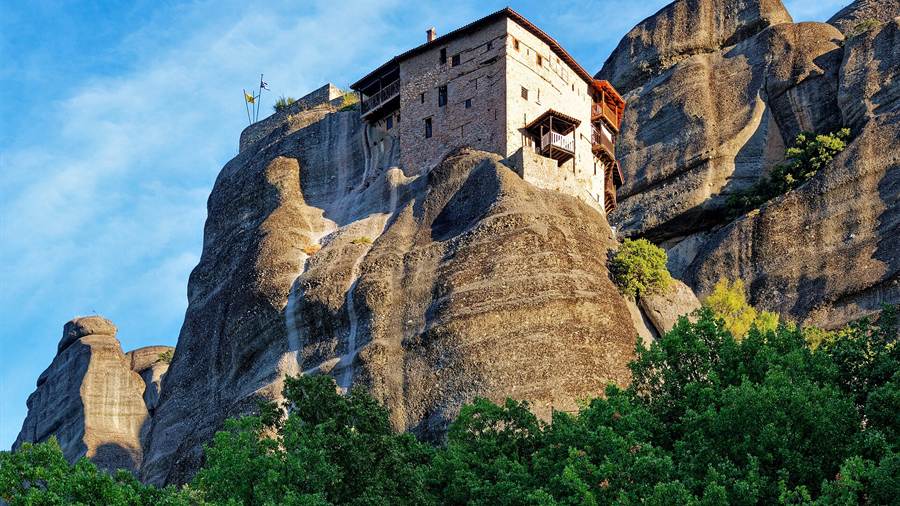
Meteora tours visit the rock pillars of Meteora in the Trikala regional unit of Thessaly, central Greece, where monasteries stand on the summits. The base towns are Kalabaka and the village of Kastraki, set below the pillars on the plain.
Thessaly is a region of northern central Greece with its capital at Larissa. Since 1987 it has formed one of the country’s thirteen regions, divided into five regional units and twenty-five municipalities.
The region takes its name from the Thessaloi, an ancient Greek tribe. The region was called Aeolia before the Greek Dark Ages, and the name occurs in the Odyssey of Homer.
Larissa ranks fifth by population among Greek cities, with 148,562 residents in the city proper in 2021. It stands on the Pineios river and links to Thessaloniki and Athens by road and rail.
The regional unit of Trikala became a prefecture in 1882. Four municipalities share it today: Farkadona, Meteora, Pyli and Trikala, and Meteora tours cross the second of these.
- Region: Macedonia lies to the north of Thessaly, Epirus to the west and the Aegean Sea to the east.
- Relief: The southeast of Trikala belongs to the Thessalian Plain, while the Pindus range dominates the west.
- Northern ranges: The Chasia and Antichasia mountains make up the forested and barren north of the unit.
- River: The Pineios is the major river of the unit and flows to the south and east.
Meteora tours therefore begin on flat farmland, with the Pindus to the west and the Chasia range to the north, before the pillars of Meteora tours come into view.
How did the rocks of Meteora tours form?
Meteora tours cross pillars of sandstone and conglomerate, two sedimentary rocks. Conglomerate holds rounded gravel pieces called clasts inside a finer matrix, and sandstone is made of sand grains cemented together, so water and wind wore the mass into columns.
A conglomerate needs at least 30 percent of its pieces larger than 2 mm, the size of granules, pebbles, cobbles and boulders. Silt, sand and clay fill the space between them.
Calcium carbonate, iron oxide, silica or hardened clay cement the clasts and the matrix. Conglomerates are thought to make up less than 1 percent by weight of all sedimentary rocks.
Sandstone is a clastic rock of sand-sized silicate grains. It forms about 20 to 25 percent of all sedimentary rocks, and its beds can form highly visible cliffs.
Burial compacts the sand. Mechanical compaction takes place at depths of less than 1,000 metres, and cementation happens chiefly at depths of 2,000 to 5,000 metres.
An alluvial fan forms where a steep mountain valley meets a flat plain and the flow slows. Fanglomerates, poorly sorted conglomerates, come from debris flows on such fans.
- Clasts: The larger fragments in a conglomerate are called clasts, and the finer sediment around them is the matrix.
- Quartz: Sandstone is mainly quartz or feldspar because these minerals resist weathering best at the surface.
- Breccia: A breccia resembles a conglomerate, but its fragments are angular instead of rounded.
- Colour: Impurities tint sandstone tan, brown, yellow, red, grey, pink, white or black.
Meteora tours pass this mixed rock at close range, where each pillar shows the same pebbly stone that the rivers once laid down.
What do Meteora tours show at the Great Meteoron and Varlaam?
Meteora tours include the Great Meteoron and Varlaam, the two largest monasteries on the rocks. Each stands on its own pillar above the Pineios valley, and each keeps a church, a museum or relics that visitors can see.
The first founder of the Great Meteoron had a hermitage, a small building cut into the rock. Its kitchen, called the hestia, is a dome-shaped building near the refectory.
The word refectory comes from Late Latin and means a place one goes to be restored. A refectory is a dining room, especially in monasteries, where the monks gather for meals.
Three old chapels stand within the monastery. One is the aisle-less church of Saints Constantine and Helen, with a large vault, and another is a chapel of the Virgin Mary in a cave.
Varlaam is reputed to have housed the shoulder blade belonging to Saint Andrew and the finger of Saint John. Its museum holds relics and ecclesiastical treasures, and ladders scale the north side of its rock.
The Meteora day trip from Athens post covers the road from the capital and the history of these two monasteries, and Meteora tours from Athens follow that same road.
- Hermitage: The first founder had a hermitage at the Great Meteoron, a small building carved into the rock.
- Chapels: The Great Meteoron has three old chapels, one of them cut into a cave.
- Relics: Varlaam keeps relics and ecclesiastical treasures in a museum open to travellers.
- Access: A series of ladders climbs the north side of the Varlaam rock.
Meteora tours reach both monasteries on foot or by steps cut into the rock, and each visit shows how monks lived on a single pillar.
What do Meteora tours show at Roussanou, Saint Stephen and Holy Trinity?
Meteora tours also reach Roussanou, Saint Stephen and Holy Trinity. Each stands on its own rock: Roussanou in the middle of the site, Saint Stephen on a plateau-like rock, and Holy Trinity apart from the main group to the south.
The name Roussanou is believed to come from the first group of monks who settled on the rock, who came from Russia. Its church was decorated in 1540.
From Roussanou, visitors see the other monasteries and the ruins of the Monastery of Saint John the Baptist and the Pantokrator. Saint Stephen and Holy Trinity lie further south.
The grounds of Holy Trinity include a garden of 0.8 hectares at the summit. To the northeast stands a chapel dedicated to Saint Athanasius of Tzertzi, set apart from the church.
The church of Holy Trinity has a cruciform plan and a dome carried on two columns. A pseudo-trefoil window opens in the apse, and white columns and arches meet rose-coloured tiles.
The broad esonarthex barrel vault was built in 1689 and embellished in 1692. A fresco of Saint Sisois and the skeleton of Alexander the Great adorns the walls.
- Roussanou: Its name is linked with monks from Russia, and its church was decorated in 1540.
- Saint Stephen: The monastery stands on a plateau-like structure, apart from the main group.
- Holy Trinity: A garden of 0.8 hectares lies at its summit.
- Chapel: Saint Athanasius of Tzertzi is honoured in a chapel to the northeast.
Meteora tours reach three separate pillars here, because the monasteries sit on different rocks and show different styles of church building.
How do monastery visits and dress rules fit Meteora tours?
Meteora tours enter working monasteries, so every visit follows monastic custom, including the dress rules that the monastery dress code post explains. Monks and nuns still live in these houses, and the visit takes place beside their daily routine.
Simeon Stylites, an ascetic of Syria, lived for 37 years on a pillar close to Aleppo. A monastery was later founded around the column where he had lived.
Saint Catherine’s Monastery below Mount Sinai was built by order of Emperor Justinian I between 527 and 565. Monks have inhabited the site ever since, and hermits lived there from the early days of monasticism.
Around the year 800, Saint Theodore the Studite became abbot of the Studium, a monastery founded at Constantinople in the fifth century. His constitutions regulated daily life and spread to other Eastern monasteries.
A religious habit is a distinctive set of clothing worn by members of a religious order. The monastery dress code post covers the rules at the gate, from clothing to behaviour inside.
- Habit: A habit marks the members of a religious order or congregation by what they wear.
- Hermits: Hermits wore plain garb that carried no uniform style.
- Investiture: Where an order marks the start of the novitiate, a ceremony of investiture clothes the candidate in the habit.
- Manuscripts: Fine penmanship and the copying of manuscripts were held in honour in Byzantine monasteries.
Meteora tours work best when visitors treat each monastery as a place of prayer first, with the same care that its monks and nuns give to dress and conduct. The Meteora monasteries tickets post covers entry to each monastery and its dress and conduct rules.
How do Meteora tours run from Thessaloniki by rail and road?
Meteora tours from Thessaloniki use the rail line through Larissa or the roads south through Thessaly. Thessaloniki is the second-largest city in Greece, and Larissa station is served by express services to Kalambaka, the town below the rocks.
Thessaloniki railway station stands in the Xirokrini quarter on Monastiriou Street. It was inaugurated on 12 June 1961 and covered 90 acres, which made it one of the largest stations in the Balkans.
In 2022 Hellenic Train ran long-distance trains from the station to Athens, Alexandroupolis, Larissa and Florina. The Thessaloniki Regional Railway serves commuters and regional passengers in and around Thessaly and Western Macedonia.
Larissa station is served by InterCity trains between Athens and Thessaloniki and by regional services to Volos. Since 2008 it has been the southern terminus of a regional line to Thessaloniki.
Greek National Road 6 passes through Larissa, Trikala and Kalabaka, and it meets the EO15 at Kalampaka. West of Trikala the road is mountainous and passes through the Pindus.
- Station: The Thessaloniki terminal is the largest and busiest railway station in Greece.
- Gorge: The Vale of Tempe is a gorge ten kilometres long, between Olympus and Ossa, as narrow as 25 metres in places.
- Cliffs: The cliffs of the Vale of Tempe rise nearly 500 metres, and the Pineios river flows through them.
- Motorway: The A1 motorway passes near Katerini, Larissa and Lamia on its way from Thessaloniki to Athens.
The Meteora day trip from Thessaloniki post covers the journey from the northern city, and Meteora tours from there follow these same corridors.
How do Meteora tours treat the sunset light on the rock towers?
Meteora tours at sunset meet the golden hour, when daylight turns redder and softer than at midday. The low sun throws longer shadows across the plain, so the rock towers stand out against the sky as the light changes.
In photography the golden hour is the period shortly before sunset, when daylight is redder and softer than when the sun is higher in the sky, and Meteora tours at sunset fall in that period.
Low sunlight crosses a longer path through the atmosphere. More blue light scatters, so the sun looks more reddish, and the low angle of the sun also produces longer shadows.
Contrast is lower in this light, so shadows are less dark and highlights keep more detail. In the middle of the day a bright overhead sun creates strong highlights and dark shadows.
After sunset comes the blue hour, when the sun lies about 3 to 10 degrees below the horizon. Residual light takes on a blue shade, and sharp shadows disappear.
The Meteora sunset tour post covers the evening light on the rocks, the long shadows and the mountains that ring the plain below them.
- Colour: The warm colour of the low sun is considered desirable in landscape photography.
- Duration: The word hour is figurative, because the effect has no clearly defined length.
- Season: The effect varies with the season and the latitude of the place.
- Film: The cinematographer Almendros described the time between sunset and nightfall as lasting only about twenty minutes a day.
Meteora tours at sunset therefore depend on the season, and the same sandstone looks warmer, redder or bluer as the sun drops.
How do Meteora tours combine with Delphi on one route?
Meteora tours link with Delphi on one route that runs north through Central Greece into Thessaly. The A1 motorway passes Lamia, the capital of the Central Greece region, and Larissa before the road turns west toward Trikala and Kalabaka.
Lamia lies on the slopes of Mount Othrys. Archaeological excavations show that the site has been inhabited since at least the Bronze Age, in the third millennium BC.
In the Middle Ages the city was called Girton under Frankish rule after the Fourth Crusade. Later, when the Catalan Company of mercenaries controlled it, the name was El Cito.
In the late fifth century BC Larissa adopted its own coinage. The obverse showed the nymph of the local spring, Larissa, and the reverse showed a horse in different poses.
Larissa takes its name from a Pelasgian word for fortress. In Greek myth the city was founded by Acrisius, who was accidentally killed by his grandson Perseus, the hero of that tale.
- Horse: The horse was an apt symbol of Thessaly, a land of plains well known for its horses.
- Farmland: The area around Larissa was extremely fruitful and agriculturally important in antiquity.
- Cities: The A1 also passes near Chalcis, Thebes and Katerini on its route, so Meteora tours on this road pass a string of towns across the central mainland.
- Mountains: Mount Olympus and Mount Kissavos rise north-northeast of Larissa, on the far side of the plain.
The Delphi Meteora tour post covers both stops together, and Meteora tours in this form cross the whole of Central Greece in one run.
What do Meteora tours add around Trikala, the Pindus and Metsovo?
Meteora tours extend west from Trikala into the Pindus, where the Katara Pass leads to Metsovo. Trikala is the capital of its regional unit on the Lithaios river, and Metsovo is a mountain town in Epirus between Ioannina and Meteora.
In Trikala, a twin Ottoman bath of the 16th century now serves as a museum. The Tsitsanis Museum occupies the upper floor of the same building, which is attributed to the architect Mimar Sinan.
The old town of Trikala has two districts, Varousi and Manavika. Varousi was a Christian district under Ottoman rule and lies at the foot of the fortress, while Manavika leads to the central square.
The Katara Pass lies at about 1,705 m, among the highest in the nation. Since the A2 motorway opened with tunnels further south, traffic on the old road has sharply declined.
Metsovo is the largest centre of Aromanian life in Greece. Its economy rests on agriculture and tourism, and tourism flourishes in winter. National Road 6 and the A2 serve the town.
The Metsovo tour post covers the town and its mountain setting, and the Elati Pertouli post covers the two forest villages above Trikala, so Meteora tours can reach both.
- Resorts: In recent decades villages of the Pindus such as Metsovo have grown into tourist resorts with ski facilities.
- Park: The Vikos and Aoos gorges and the valley of Valia Kalda form the National Park of Northern Pindos.
- Pass: The Katara Pass is also called the Metsovo Pass.
- Road: National Road 6 crosses the pass between Trikala and Metsovo.
Meteora tours that continue west leave the plain for the Pindus, cross the Katara Pass towards Epirus, and then return to Kalabaka.
Why are Meteora tours a visit to a UNESCO World Heritage Site?
Meteora tours visit a place listed under the World Heritage Convention, a treaty that the General Conference of UNESCO adopted on 16 November 1972. The listing gives legal protection to sites of outstanding cultural or natural importance to humankind.
Since 1972, 196 states have ratified the convention, which makes it a widely recognised international agreement. The treaty protects sites that otherwise face risk from uncontrolled access or neglect.
The World Heritage Committee decides which sites enter the list. It is made up of representatives from 21 states parties, who are elected by the General Assembly of States Parties.
The idea grew from a campaign in 1960 to save the monuments of Nubia from the waters of the Aswan High Dam. The temple complexes of Abu Simbel and Philae were moved to higher ground.
The Committee meets once a year for an ordinary session. It discusses the management of existing sites and accepts nominations from countries, while extraordinary meetings need a request from two-thirds of its members.
The UNESCO World Heritage Sites post covers the Greek sites in turn, and Meteora tours form one stop on that list of protected places.
- Nomination: The host country nominates a site, and the Committee then judges it.
- Protection: A site needs a sufficient system of legal protection to be listed.
- Vote: Each state member of the Committee has one vote, and decisions need a simple majority.
- Campaign: The Nubia campaign ended in 1980 and was considered a success.
Meteora tours therefore sit inside a global system of protection, and the Committee reviews each listed site under the treaty.
What do travellers ask about Meteora tours?
Meteora tours prompt questions about the base town, the founders, the regional unit and the road west. The answers below describe the town of Kalabaka, the ruler who sponsored the monasteries, the Trikala area and the routes that leave the plain.
Where do Meteora tours begin?
Meteora tours begin in Kalabaka, the northwestern terminal of the old Thessaly Railways. Express services run from Larissa to Kalambaka, and the town lies between the Pineios river and the foot of the rock pillars on the Thessalian plain, near the Pindus mountains.
Who founded the monasteries seen on Meteora tours?
Meteora tours follow monasteries that Simeon Uros sponsored in the second half of the 14th century. Wikipedia calls him a self-proclaimed Emperor of Serbs, Greeks and Albanians, and he ruled the local area from the nearby town of Trikala, where his court stood during the founding years.
Which regional unit holds the sites of Meteora tours?
Meteora tours stay in the Trikala regional unit, which includes the town of Kalampaka, the Meteora monastery complex, the towns of Pyli and Farkadona and the mountain range of south Pindus. Its capital is the city of Trikala, and the plain covers its southeast.
Which road leads from Meteora tours to Metsovo?
Greek National Road 6 runs from Kalabaka through Mourgkani and the Katara Pass to Metsovo and Ioannina. The A2 motorway does the same between Malakasi and Igoumenitsa, so Meteora tours can continue west by either road and cross the Pindus into Epirus.