
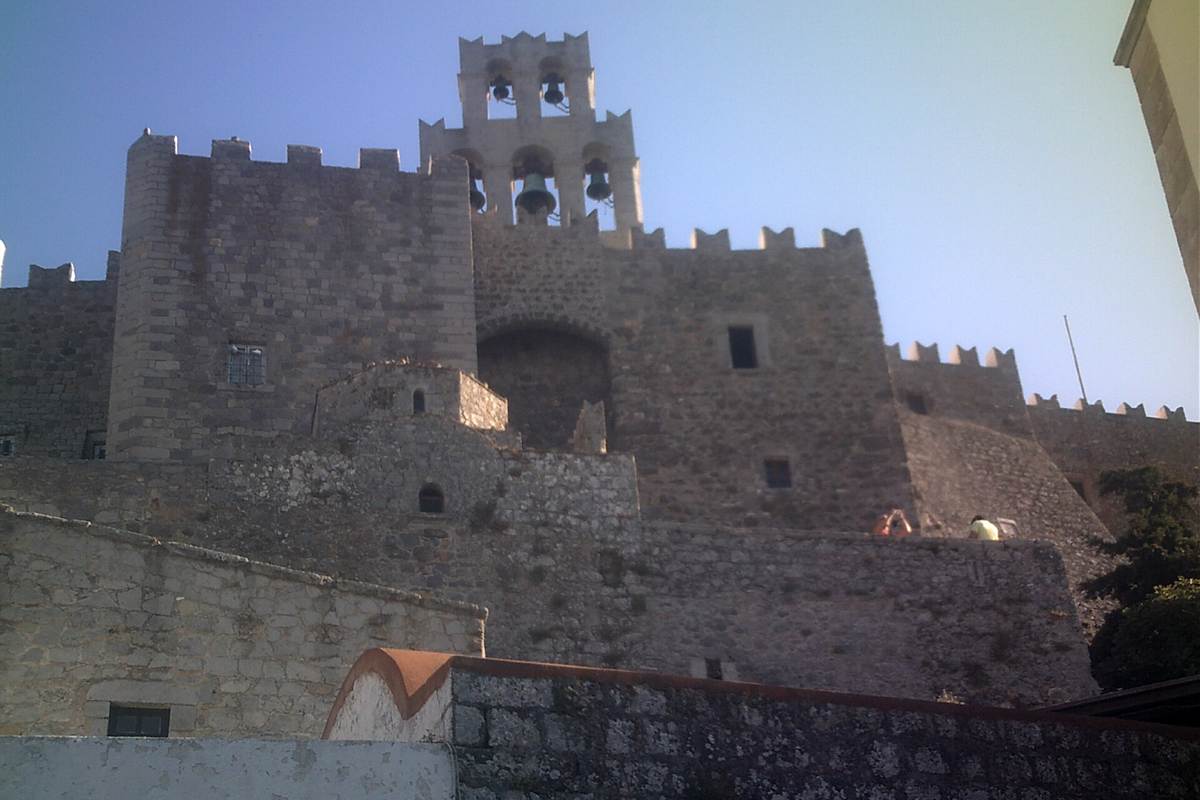
The monastery dress code in Greece asks visitors to cover shoulders and legs and to keep a quiet manner inside working Orthodox monasteries, from Meteora to Patmos. The post is part of the Greece Tours on Greece Ville, listed under the Meteora tours.
This post covers the dress code and where it comes from, behaviour and photos inside, Mount Athos, then the monasteries visitors meet one by one. Common questions come last.
Each section ends with tours that can be booked online. The linked Greece Ville posts cover the trips to Meteora, Patmos, Arkadi and Mystras in depth, with the departure points, the formats on sale and the other sites that each trip reaches on the way. A visit to a working monastery fits inside a day trip, a boat trip or a longer tour, and the same dress code applies in each case.
What is the monastery dress code in Greece?
The monastery dress code in Greece is the set of clothing customs that visitors meet at Orthodox monasteries, and it grows out of the black habit of monks and nuns. The sources here describe that habit but record no printed visitor rule.

Orthodox monasteries stand on the rock pillars of Meteora in Thessaly and on the Athos peninsula. Both host communities of monks or nuns, and the monastery dress code in Greece grows out of that shared life.
Wikipedia describes the monastic habit at length but lists no fixed wardrobe for visitors. This post therefore treats the habit as the root of the custom and names no rule that a source does not state.
The habit is essentially the same throughout the Orthodox world, and its normal colour is black. A traveller who sees black robes at a Greek monastery is looking at a worldwide pattern, not a local fashion.
At Meteora the monasteries that still work are open to visitors, and Holy Trinity is one of them. The monastery dress code in Greece therefore meets travellers at active religious houses, not at empty museums.
- Setting: Meteora and Mount Athos are the best-known monastic places in Greece.
- Colour: The Orthodox habit is black and follows one pattern worldwide.
- Visitors: Holy Trinity at Meteora is recorded as open to visitors.
- Scope: No visitor rule appears in this post unless a source states it.
The sections below move from the roots of monasticism to the habit, the covering of shoulders, legs and heads, the gate, conduct inside, photographs and the special case of Mount Athos.


Where does the monastery dress code in Greece come from?
The monastery dress code in Greece comes from Orthodox monasticism, which began with hermits in the Egyptian desert and grew into shared communities, so the habit worn by monks and nuns shapes what each house expects visitors to respect today.
Anthony the Great, who lived from 251 to 356, is named the founder of monasticism in the Eastern tradition. He belonged to the Desert Fathers, who left the world for the silence of the Egyptian desert.
Pachomius, who lived from about 292 to 348, is regarded as the founder of cenobitic monasticism. In that form all monks live a common life in one place under a single abbot, first at Tabennisi.
Basil the Great, who lived from about 330 to 379, is a main influence on Byzantine monasticism. He wrote the Asketikon for the monastery he founded about 356 beside the Iris river in Cappadocia.
Monks reached the Athos peninsula early. Wikipedia states that monks have certainly lived there since the fourth century, and that the monastery dress code in Greece therefore sits on a very long chain of practice.
- Anthony: Named the founder of monasticism, he lived from 251 to 356.
- Pachomius: Regarded as the founder of cenobitic monasticism, he started it at Tabennisi.
- Basil: His Asketikon served the monastery he founded in Cappadocia.
- Theodore of Egypt: A disciple of Pachomius, he founded the skete, a group of dwellings around a common church.
Each of these founders shaped the monastic life that the habit expresses, and the habit is the base of the monastery dress code in Greece.
What does the monastery dress code in Greece take from the monastic habit?
The monastery dress code in Greece takes its colour and its covered cut from the monastic habit, which is black, identical for monks and nuns except for a veil, and bestowed in degrees as a monastic advances in the spiritual life.
The normal monastic colour is black, described as symbolic of repentance and simplicity. A visitor who wears dark, plain clothes at a monastery therefore echoes the colour that the community itself wears.
The habits of monks and nuns are identical, and nuns add a scarf called an apostolnik. The habit is formally bestowed at the ceremony of tonsure, which Greek calls koura.
Wikipedia counts four degrees: the novice, the Rassaphore, the Stavrophore and the Great Schema. Each degree adds items, so the monastery dress code in Greece reads differently from rank to rank.
The Eastern Orthodox Church has no separate religious orders like those of the Catholic Church. The habit is essentially the same throughout the world, which is why monasteries in Greece look alike in dress.
- Belt: It is normally leather and is described as symbolic of the vow of chastity.
- Outer rason: Among the Greeks it is worn by readers and all higher clerics.
- Paramand: A cloth square on a wooden cross, it is described as symbolic of the yoke of Christ.
- Apostolnik: This is the extra scarf that nuns wear.
The habit explains the plain, dark look of monastic life and gives the monastery dress code in Greece its starting point.
How does the monastery dress code in Greece treat shoulders and legs?
The monastery dress code in Greece, as far as the sources show, follows the covered cut of the habit: the analavos covers the shoulders and the mandyas cape covers the monk from neck to foot, while no source lists a visitor rule.
The analavos is the distinctive dress of the Great Schema, worn only by schemamonks and schemanuns. Made traditionally of leather or wool, it covers the shoulders and falls in front and behind in a cross.
The analavos comes down to the knees or lower and carries embroidery of the cross and the instruments of the Passion. Shoulders and knees are therefore the parts of the body that this robe covers.
The mandyas is a long cape that completely covers the monk from neck to foot. The paramand is worn under it, so the monastery dress code in Greece starts from a habit that leaves little visible.
No saved source gives a length, a cut or a fabric for visitors’ clothes. Any request a house makes about shoulders or legs follows the same idea of coverage, but the sources record no list.
- Analavos: It covers the shoulders and forms a cross at the front and back.
- Length: The analavos reaches the knees or lower.
- Mandyas: This cape covers the monk from neck to foot.
- Visitor rule: No source states one, so none is given here.
The covered cut of the robes is the best-sourced clue to the monastery dress code in Greece, and the post goes no further than the clue.
How does the monastery dress code in Greece treat heads and veils?
The monastery dress code in Greece treats the head through the black kalimavkion and veil of monks and the veil of nuns, while no source sets a headscarf rule for visitors, so only the monastic head coverings are described here.
The kalimavkion is a stiff cylindrical head covering without a brim. Wikipedia states that it came into use after the reforms of Patriarch Nikon in the 1600s, and that it is worn during services.
In the Greek tradition monks wear a simple black kalimavkion covered by a black veil called the epanokalimavkion. Ordained clergy wear a kalimavkion with a flattened conical brim at the top.
At other times the softer skufia takes its place. This brimless cap is received when a monastic first becomes a novice or is tonsured, and the Greek style is flat and pleated.
Greek nuns do not normally wear a kalimavkion and wear the veil alone. The monastery dress code in Greece therefore keeps the head covered for both monks and nuns, in forms that differ by rank.
- Kalimavkion: A stiff cylindrical hat, worn during services.
- Epanokalimavkion: The black veil that covers a monk’s kalimavkion.
- Skufia: A soft brimless cap worn at other times.
- Nuns: In the Greek tradition they wear the veil without a kalimavkion.
Head coverings mark rank and role inside the community, and they form the headwear side of the monastery dress code in Greece, as the sources describe it.
What happens at the gate under the monastery dress code in Greece?
The monastery dress code in Greece applies from the gate onward, and the plan of the church marks the next step: lay people visiting a monastery stand in the narthex, the entrance area, while the monks or nuns stand in the nave.
The narthex is the area reached after opening the church doors, and it connects the church with the outside world. Wikipedia states that in monastic churches the lay visitors stand there during services.
The saved sources describe no wraps or loan garments at the gate, so none are named in this post. The monastery dress code in Greece is described here only through the habit and the church plan.
Great Meteoron stands on the Broad Rock, and the monks there had complete control of the entry to the monastery. Access once ran by a long ladder, which they drew up when a threat appeared.
The katholikon is the major church of a monastery. A visit to a working monastery therefore leads to one central building, and the monastery dress code in Greece is read in front of it.
The Meteora day trip from Athens post covers the rock monasteries that stay open to visitors, which is the setting where this entry order applies to travellers at the church door.
- Narthex: The entrance area of the church, between the doors and the nave.
- Nave: The main body of the church, where the monks or nuns stand.
- Katholikon: The main church building of a monastery.
- Wraps: No saved source describes them, so no claim is made.
The church plan shows where lay visitors stand, and it adds a physical layer to the monastery dress code in Greece.
How does behaviour inside follow the monastery dress code in Greece?
The monastery dress code in Greece goes with quiet behaviour inside the church, where the building has three parts, the nave has no pews, and in certain traditions sitting during sermons was judged disrespectful, according to the architecture sources.
An Orthodox church is divided into three main parts: the narthex or vestibule, the nave or temple proper, and the sanctuary. The sanctuary is also called the altar or holy place.
The altar lies in the eastern part of the church, whatever its shape. The sanctuary is therefore the end point of the plan, and the monastery dress code in Greece ends at its edge.
A major difference from Western churches is the absence of pews in the nave. In certain ethnic traditions of Orthodoxy it was deemed disrespectful to sit during sermons, so the nave stands open.
The cupola in place of a flat ceiling symbolises the sky, and the dome of a centralised church symbolised heaven. The shape of the building thus supports a restrained manner of behaviour.
- Three parts: The narthex, the nave and the sanctuary.
- Altar: It sits in the eastern part of the church.
- Pews: Traditional Orthodox churches have none in the nave.
- Dome: It is described as a symbol of heaven.
The Delphi Meteora tour post covers a route that reaches Meteora, where this church plan can be seen in the working monasteries, with the narthex, the nave and the sanctuary in order.
How do photographs fit the monastery dress code in Greece?
The monastery dress code in Greece has no photograph rule in the saved sources, so this section records only what the sources show about images in monastic churches: mosaics at Daphni, and photographs that preserve the lost old monastery of Agios Dionysios.
The saved Wikipedia texts do not state any rule on cameras, flash or tripods at Greek monasteries. This post therefore gives none, in line with its policy of repeating only what a source says.
The Daphni Monastery near Athens is noted for its gold-ground mosaics. Christ Pantocrator watches from the crown of the dome, and the monastery dress code in Greece is worn by visitors who stand beneath that image.
The Monastery of Agios Dionysios on Mount Olympus was founded in 1542 and was destroyed by the German Wehrmacht in April 1943. A museum there holds framed black-and-white photographs of the old monastery.
A German soldier named Karl Faber took those pictures secretly just before the destruction and sent them to the monastery years later. They show how photographs became the record of a place that no longer stands.
- Rule: No saved source states a photograph rule for monasteries.
- Daphni: The church is noted for its interior gold-ground mosaics.
- Agios Dionysios: The old monastery was founded in 1542.
- Faber photographs: They hang near the entrance of the museum.
Images in a monastery belong to the community that keeps them, and that fact sits behind the monastery dress code in Greece as much as any garment does.
Why does the monastery dress code in Greece differ for women at Mount Athos?
The monastery dress code in Greece differs at Mount Athos because Greek law and religious tradition prohibit women from entering the area run by the monastic community, and the word avaton marks the parts of monasteries open only to monks or male visitors.
Mount Athos is governed as an autonomous region in Greece by its monastic community, under the direct jurisdiction of the Ecumenical Patriarch of Constantinople. By Greek law and religious tradition, women cannot enter that area.
Access requires a special permit known as a diamonitirion. Entry is limited to male visitors and regulated by the monastic authorities with the Greek state, so the monastery dress code in Greece begins with a permit.
The peninsula protrudes 50 km into the Aegean at a width of between 7 and 12 km. Visitors arrive by boat from Ouranoupoli, which serves as the main gateway to the monastic community.
The ancient Greek word adyton meant an innermost sanctuary, literally not to be entered. The term abaton, modern Greek avato, means inaccessible and marks parts of monasteries open only to monks or male visitors.
- Law: Greek law and religious tradition bar women from the monastic area.
- Permit: The diamonitirion is the special entry permit.
- Gateway: Ouranoupoli is the main departure point by boat.
- Word: Avato means inaccessible in modern Greek.
Mount Athos is the one place where the monastery dress code in Greece becomes a rule of access. The Mount Athos cruise post covers the Athos coast and its monasteries as seen from the water.
Where does the monastery dress code in Greece meet the Great Meteoron?
The monastery dress code in Greece meets the Great Meteoron, the oldest and largest of the Meteora monasteries. Its community is still living, so the visit enters a working religious house rather than a museum, and its history shapes the setting.
Saint Athanasios the Meteorite began the build with a church dedicated to the Mother of God. A second church, dedicated to the Transfiguration, gave the Great Meteoron its other title, the Holy Monastery of the Transfiguration.
Saint Athanasios later added small cells for monks to live and concentrate atop the rock formations. His successor, Saint Joasaph, built more cells and a hospital. In the sixteenth century, over three hundred monks lived there.
Each building belongs to a living community, which is why the monastery dress code in Greece matters on this rock. As of 2015, three monks were in residence at the Great Meteoron, according to Wikipedia.
A catalogue by N. Veis recorded 1,124 codices at the six Meteora monasteries. Of these, 610 were recorded at the Great Meteoron, which holds the largest manuscript collection at Meteora.
- Katholikon: It is dedicated to the Transfiguration of Jesus and was the first church of the monastery.
- Hermitage: The hermitage of the first founder is a small building carved in rock.
- Baptist chapel: The Chapel of Saint John the Baptist lies next to the sanctuary of the katholikon.
- Cave chapel: The chapel of the Virgin Mary is situated in a cave.
Readers who study the monastery dress code in Greece before a Meteora visit meet the Great Meteoron first, and the next rocks hold Varlaam, Rousanou and Saint Nicholas Anapausas.
How does the monastery dress code in Greece reach Varlaam, Rousanou and Saint Nicholas Anapausas?
The monastery dress code in Greece reaches three more Meteora houses: Varlaam, the second largest monastery, Rousanou, which lies in the middle of the site, and Saint Nicholas Anapausas, a former monastery set on a narrow rock above the valley.
Varlaam is also known as Agion Panton, meaning All Saints. The name comes from a monk called Varlaam, who scaled the rocks in 1350 and began construction. He built three churches by hoisting materials.
Today the monastery is reached through a series of ladders on the north side of the rock. Its museum is open to travellers and holds relics and ecclesiastical treasures. Seven monks remained there as of 2015.
Rousanou is believed to date from the fourteenth century, and its cathedral from the sixteenth. The cathedral was decorated in 1540. The name is believed to come from the first monks to settle on the rock, who came from Russia.
Saint Nicholas Anapausas stands on a narrow rock about eighty metres high and is the first monastery that pilgrims meet on the way to Meteora. Its name, Anapausas, means resting, because it served as a resting place for pilgrims.
- Floors: An interior staircase joins the floors, because the rock is so narrow.
- Katholikon: It stands on the second floor, where Saint Nicholas is honoured.
- Frescoes: The third floor holds the Holy Table and walls decorated with fourteenth-century frescoes.
- Restoration: The monastery was restored in the sixteenth century and again in the 1960s.
Wikipedia lists Rousanou and Saint Nicholas Anapausas as extant but inactive, while Varlaam is one of four occupied houses. Anyone checking the monastery dress code in Greece for Meteora meets that difference on the ground.
What does the monastery dress code in Greece meet at Holy Trinity and Saint Stephen?
The monastery dress code in Greece meets two southern Meteora houses, Holy Trinity and Saint Stephen, which stand apart from the main group to the north. Saint Stephen has the largest number of inhabitants of any Meteora monastery, 31 nuns.
Before the twentieth century, Holy Trinity was very difficult to reach. Access required crossing a valley and climbing through the rock outcrop, and provisions rose in baskets drawn up by rope-ladders, which a winch now replaces.
At one time fifty monks lived at Holy Trinity, but by the early twentieth century only five remained. Two monks decorated the main church with frescoes in 1741. A small chapel is carved into the rock.
A visit that respects the monastery dress code in Greece also passes workrooms at Saint Stephen for painting, embroidery, incense-making and needlework. Wikipedia adds that the monasteries were bombed heavily during the world wars.
- Holy Trinity height: The monastery is sited 570 metres above sea level.
- New katholikon: Saint Stephen built it in 1798, making it the newest of all the Meteora structures.
- Treasury: A small skeuophylakion, a chamber for sacred furnishings, was built at Holy Trinity in 1684.
- Wartime: Treasures in the Holy Trinity chapel were looted during World War II, when the Germans occupied it.
Both houses lie south of the main group and count among the four occupied monasteries of Meteora, so the monastery dress code in Greece belongs to a living landscape there.
How does the monastery dress code in Greece connect with Patmos and the Monastery of Saint John?
The monastery dress code in Greece connects with Patmos through the Monastery of Saint John the Theologian in Chora, founded by Saint Christodoulos. The house has served as a pilgrimage site and a place of Greek Orthodox learning and worship since its founding.
Regular ferry services link Patmos to Agathonissi, Mykonos and Paros, among other ports. Its municipality includes the offshore islands of Arkoi, with 44 people, and Marathos, with five.
The island enters the story through exile. In the first century under Domitian, followers of Christ were persecuted and sent to Patmos. Banishment was a common punishment for crimes such as practising magic or astrology.
Disputes among the monks, together with incursions by Turkish forces, eventually compelled Christodoulos to leave Patmos. Visitors who follow the monastery dress code in Greece on the island meet a foundation that began under pressure.
Wikipedia lists three patriarchs among the notable people of Patmos: Jeremias III of Constantinople, Neophytus VI of Constantinople and Jacob of Alexandria. It also names Amphilochios (Makris) of Patmos, a twentieth-century saint.
- Settlements: Besides Chora and Skala, Grikou and Kampos are the other settlements.
- Artist: Teddy Millington-Drake, an English artist, appears on the list of notable people.
- Novelist: Emmanuel Carrere, a French novelist, appears on the same list.
- Journalist: Laurence de Cambronne, a French journalist, appears there too.
The Patmos day trip post covers the monastery, the cave and the town. It sits beside the monastery dress code in Greece as the island chapter of the same subject.
What does the monastery dress code in Greece meet at Arkadi Monastery on Crete?
The monastery dress code in Greece meets Arkadi Monastery on a fertile plateau south-east of Rethymno, a fortified Greek Orthodox house that became a national sanctuary after the Cretan revolt, when people sheltered inside its thick and high wall.
Arkadi served the region as a school and a library. From 1833 to 1840 the monastery invested 700 Turkish piastres in schools, and documents mention its capacity to feed local people and hide fugitives.
The monastery kept growing in the seventeenth century. A stables was built in 1610 and a refectory in 1670. Its territory ran from the sea in the north to the top of Mount Ida, and agriculture supported it.
The stables mattered again in 1866. The commander Panos Koronaios advised destroying them so the Ottomans were unable to use them, but the plan was ignored. During the attack, the Ottomans placed two heavy cannons there.
Visitors who follow the monastery dress code in Greece at Arkadi enter a site that Wikipedia describes as a place of science and art as early as the sixteenth century.
- Cannons: One of the two heavy cannons brought from Rethymno was called Koutsahila.
- Messengers: Two Cretans left by ropes through the windows, disguised as Turks, to seek help.
- Roads: All access roads were blocked, so reinforcements were unable to arrive in time.
- July raid: Ottoman troops left after destroying icons and other sacred objects in July.
The Arkadi Monastery tour post covers the siege, the church and the formats on sale, while the monastery dress code in Greece frames how visitors approach a place of remembrance.
Which Mystras churches matter for the monastery dress code in Greece?
The monastery dress code in Greece reaches Mystras through Hagia Sophia and the Peribleptos Monastery, two Byzantine churches on the slopes above Sparta. Both stand among the late Byzantine foundations of a fortified town on the World Heritage List.
Hagia Sophia was converted into a mosque under Ottoman rule. It was made back into a Christian church when Greece achieved independence in the early nineteenth century, according to Wikipedia.
The plan of Hagia Sophia has a chapel with an underground crypt to the east of the north portico. A former two-storey altar stands to the north-west, and three southern chapels are later additions.
The Peribleptos Monastery is built into the side of a cliff, with a cave supporting the structure. Wikipedia calls this the Mystras style, which resembles a castle and uses squared stones with inlaid tiles.
Its frescoes are connected with the Cretan and Macedonian art schools. Annie Labatt says they treat space and movement with a Western feel. Visitors who follow the monastery dress code in Greece enter a church covered in paintings.
- Name: Peribleptos is named after one of the celebrated monasteries of Byzantine Constantinople.
- Baptism fresco: A fresco shows Saint John the Baptist in a scene of the Baptism of Christ.
- Virgin Mary: Dedication to the Virgin Mary is a prominent focus of religious art in the Mystras churches.
- Masonry: Hagia Sophia is built in the brick-enclosed rhythm.
The Mystras tour post covers the fortified town and its churches on the slope above Sparta, where the monastery dress code in Greece also applies.
How do Hozoviotissa and Panagia Tourliani fit the monastery dress code in Greece?
The monastery dress code in Greece also reaches two Cyclades monasteries: Panagia Hozoviotissa on the steep south coast of Amorgos, built on a cliff, and Panagia Tourliani at Ano Mera on Mykonos, dedicated to the Dormition of the Theotokos, the Virgin Mary.
The name Hozoviotissa is a corruption of Hozivitissa or Kozivitissa. It comes from the place name Hozeva or Koziva, today Wadi Qelt, where the orthodox monastery of Saint George was located.
The catholicon of Hozoviotissa is a single chamber with an arched roof. It holds the two inscribed icons of Panagia Hozoviotissa and the iron chisel of the archmaster of the building.
Urgent maintenance works followed the landslide of 1975. They included underpinning the first basement, fixing the cracked walls and reconstructing the reinforced concrete roof of this cliff house.
Panagia Tourliani is described as the leading monastery of Mykonos. It stands in Ano Mera and is dedicated to the Dormition of Theotokos, with the central aisle of the catholicon given the same dedication.
- Left aisle: It is dedicated to the Nativity of the Theotokos.
- Right aisle: It is dedicated to Saint Ignatius the Bearer.
- Iconographer: Ioannis from Corfu made the icons of the iconostasis.
- Icon: It belongs to the Holy Metropolis of Syros and stays in a Chora parish church until the Saturday of Lazarus.
The Cyclades tours post covers the island group that holds both Amorgos and Mykonos, which joins these houses to the mainland monasteries under the monastery dress code in Greece.
What do travellers ask about the monastery dress code in Greece?
The monastery dress code in Greece raises questions about where visitors meet working monasteries: at Meteora in Thessaly, on Patmos in the Dodecanese, at Arkadi on Crete, in Mystras in the Peloponnese, and on the Cyclades islands of Amorgos and Mykonos.
Which Meteora monasteries are occupied, under the monastery dress code in Greece?
Four Meteora monasteries are occupied: the Great Meteoron, Varlaam, Holy Trinity and Saint Stephen, which is a convent of nuns. Rousanou and Saint Nicholas Anapausas are extant but inactive. Together the six make up the World Heritage Site named Meteora.
Where do Patmos and Arkadi fit the monastery dress code in Greece?
Patmos holds the Monastery of Saint John the Theologian, founded by Christodoulos in Chora. Arkadi stands on a plateau south-east of Rethymno on Crete and is commemorated as a national sanctuary on 8 November. Both are Greek Orthodox monasteries with long histories.
Which island monasteries belong to the monastery dress code in Greece?
Two Cyclades monasteries belong to it: Panagia Hozoviotissa on the steep south coast of Amorgos, and Panagia Tourliani at Ano Mera on Mykonos. Hozoviotissa is built on a cliff, while Tourliani is dedicated to the Dormition of Theotokos.
Does the monastery dress code in Greece reach Byzantine churches such as Mystras?
It reaches Mystras, a fortified town on the World Heritage List. Hagia Sophia there was converted into a mosque under Ottoman rule and became a church again after independence. The Peribleptos Monastery is built into a cliff and has a cave supporting the structure.
Featured photo: Odysses, CC BY-SA 3.0, via Wikimedia Commons.