
Naxos food tour is a tasting outing on Naxos, built around Naxos potatoes, the cheeses graviera and arseniko, citron and kitron, Naxian wine, the town of Chora and the village of Apiranthos. The tour is one of the Greece Tours on Greece Ville, listed with the other Cyclades tours and Greece food tours.
This post covers what the tour is, Naxos potatoes, the cheeses, the citron behind kitron, Naxian wine, Chora, Apiranthos and the formats on sale. Common questions come last.
What is a Naxos food tour?
A Naxos food tour is a tasting route through the farm produce of Naxos, where cheese, potatoes, honey, citron liqueur and wine come from fields, mountain villages and the harbour town of Chora, and a local host explains each product at the table.
A Naxos food tour starts with farmland. No Cyclades island is more fertile than Naxos, whose ample water supply stands out in a region short of water.
Agriculture is an important economic sector on Naxos, with vegetable and fruit crops beside cattle breeding. No other Cyclades island is more self-sufficient, and a Naxos food tour tastes that independence on the plate.
Naxos is well known within Greece for Arseniko Naxou cheese, potatoes, kitron and honey. Naxian honey comes mainly from the nectar of thyme. The four names give a Naxos food tour its backbone.
In Eastern Mediterranean cuisines, meze are small dishes that serve as appetisers. A meze can be one course of a longer meal or a meal in itself. Evening formats follow that pattern.
The Greek food to try post covers the dishes of the whole country. A Naxos food tour narrows that wider table to one island, its farms and its harbour town.
- Water: A good supply keeps the fields of Naxos productive in a dry region.
- Crops: Vegetable and fruit crops grow across the island.
- Cattle: Cattle breeding sits beside the crops in the island economy.
- Meze: Small shared dishes suit tasting formats.
The next sections follow the products one by one, from the potato to wine, then walk through Chora and climb to Apiranthos. Each stop on a Naxos food tour rests on a source that can be checked.
Why do Naxos potatoes belong on a Naxos food tour?
A Naxos food tour tastes a crop that began far from the Aegean. The cultivated potato has a single origin in southern Peru and northwestern Bolivia, where farmers domesticated it 7,000 to 10,000 years ago, and Naxos grows it today.
The potato is a stem tuber, not a root. Each tuber forms on a thickened rhizome at the end of a long, thin stolon, and the plant uses it to store nutrients.
The earliest verified potato remains come from Ancon, a coastal site in central Peru, and date to 2500 BC. A Naxos food tour serves a crop with that distant record as a local product.
Cooks sort potatoes by starch content. Floury baking potatoes hold 20 to 22 percent starch, while waxy boiling potatoes hold 16 to 18 percent, and the split decides how a host cooks them.
The Naxos cooking class post covers the cooking side of the island’s potatoes, cheese and herbs. A Naxos food tour tastes the finished result at the table, without the work of the stove.
The English word potato derives from Spanish patata, itself taken from the Taíno batata, a word for the sweet potato. The plant now called simply potato borrowed the name of a different crop.
- Range: Wild potato species grow from the southern United States to southern Chile.
- Lake: Farmers first domesticated the crop around Lake Titicaca.
- Varieties: More than 5,000 varieties exist after centuries of selective breeding.
- Eyes: The eyes on a tuber protect the buds from which the stems grow.
In short, the Naxos potato is an American crop with an island home. The next stop on a Naxos food tour is the cheese board, where graviera and arseniko wait.
Which cheeses does a Naxos food tour taste, graviera or arseniko?
A Naxos food tour tastes graviera and arseniko, two cheeses of Naxos that follow the basic craft of cheesemaking. Milk is curdled, the solid curds are separated from the liquid whey, and the curds are pressed into the finished cheese.
Over a thousand types of cheese exist. Their styles depend on the origin of the milk, the animal’s diet, the butterfat content and the ageing time. A Naxos food tour tastes two of them.
Gruyère, the Swiss cheese that gave graviera its name, takes its own name from the town of Gruyères in the canton of Fribourg. A Naxos food tour tastes a Greek relative of that cheese.
Aged from five months to a year, Gruyère grows small cracks and a slightly grainy texture. A host on a Naxos food tour explains how age changes a cheese.
Hard cheeses such as Cheddar and Parmesan last longer than soft cheeses such as Brie. Graviera belongs to the hard group, and a Naxos food tour tastes it.
Graviera is sold at large grocery stores, Greek and ethnic markets and specialty cheese shops outside Greece, as well as online. A Naxos food tour tastes it at the source instead.
- Curds: The solid part of curdled milk consists of proteins and milkfat.
- Whey: The liquid part is separated from the curds.
- Rennet: The enzymes of rennet, or similar bacterial enzymes, make the protein casein coagulate.
- Storage: Cheese is more compact than milk and keeps longer.
Cheese ends the dairy part of the route. The next glass on a Naxos food tour holds kitron, the citron liqueur of the island, and the fruit behind it has a long history.
What is the citron behind the kitron on a Naxos food tour?
A Naxos food tour pours kitron, a liqueur distilled on Naxos from the citron, a large fragrant citrus fruit with a thick, coarse rind that looks like a lemon but grows larger and counts among the original citrus fruits.
All other citrus types developed from the original citrus fruits through natural hybrid speciation or artificial hybridisation. Lemons were created using citrons. A Naxos food tour meets the parent fruit.
The citron is thought to have been native to the southeast foothills of the Himalayas. Its name Citrus medica refers to Media, the kingdom of the Medes, where it was once believed to originate.
Writers credit Alexander the Great and his armies with carrying the citron west to Greece and Italy. Theophrastus, who succeeded Aristotle as curator of the botanical garden in Athens, described the fruit.
The Greek citron variety, kitria, belongs to the etrog type. It was grown near Corfu and shipped to Trieste, and Corfu etrogim began to reach the rest of Europe in 1785.
Citron was cultivated in Sumer as early as the third millennium BC. Victor Loret said he had identified it on the walls at Karnak, from the time of Thutmosis III about 3,500 years ago.
- Rind: The fruit has a thick, coarse rind.
- Size: The citron resembles a lemon but is larger.
- Uses: It appears in Asian and Mediterranean cuisine, perfume and religious rituals.
- Name: The Latin name Citrus medica gives the fruit its place in botany.
The citron explains why a liqueur of Naxos tastes of citrus and leaf. A Naxos food tour turns next from the distillery to the vine and the old tales of wine.
How does Naxian wine fit into a Naxos food tour?
A Naxos food tour pours wine on an island that Greek myth places under the protection of Dionysus, the god of wine. Ancient Greek poets also named Naxos among the places whose wines they frequently cited as good quality.
In Greek myth Theseus abandoned Ariadne on Naxos after she helped him kill the Minotaur. Dionysus, who protected the island, met her there and fell in love with her.
The name Dia, which means heavenly or divine, passed to Naxos itself because Naxos was thought, more widely than any other island, to be the wedding isle of Dionysus.
Wine in ancient Greece was almost always diluted with water, or with snow when it was served cold. The Greeks believed that only barbarians drank unmixed wine and that undiluted wine can kill the drinker.
In Mycenaean Greece a festival called the feast of the wine celebrated the month of the new wine. Linear B tablets list wine, vineyards, wine merchants and an early allusion to Dionysus.
Retsina is a traditional Greek wine flavoured with pine resin. It became the national beverage in the 1960s, when growing tourism made it a worldwide symbol of Greece.
- Protector: In myth Dionysus watched over the island.
- Opera: Richard Strauss set the Naxos part of the Ariadne myth in an opera of 1912.
- Poets: Chios, Kos, Lesbos and Thasos stand beside Naxos in the poets’ list of good wines.
- Mixing: Wine was diluted before drinking.
Wine completes the island’s products. The route now turns to Chora, the harbour town where a Naxos food tour meets the shops and restaurants of the seafront.
What does a Naxos food tour find in Chora?
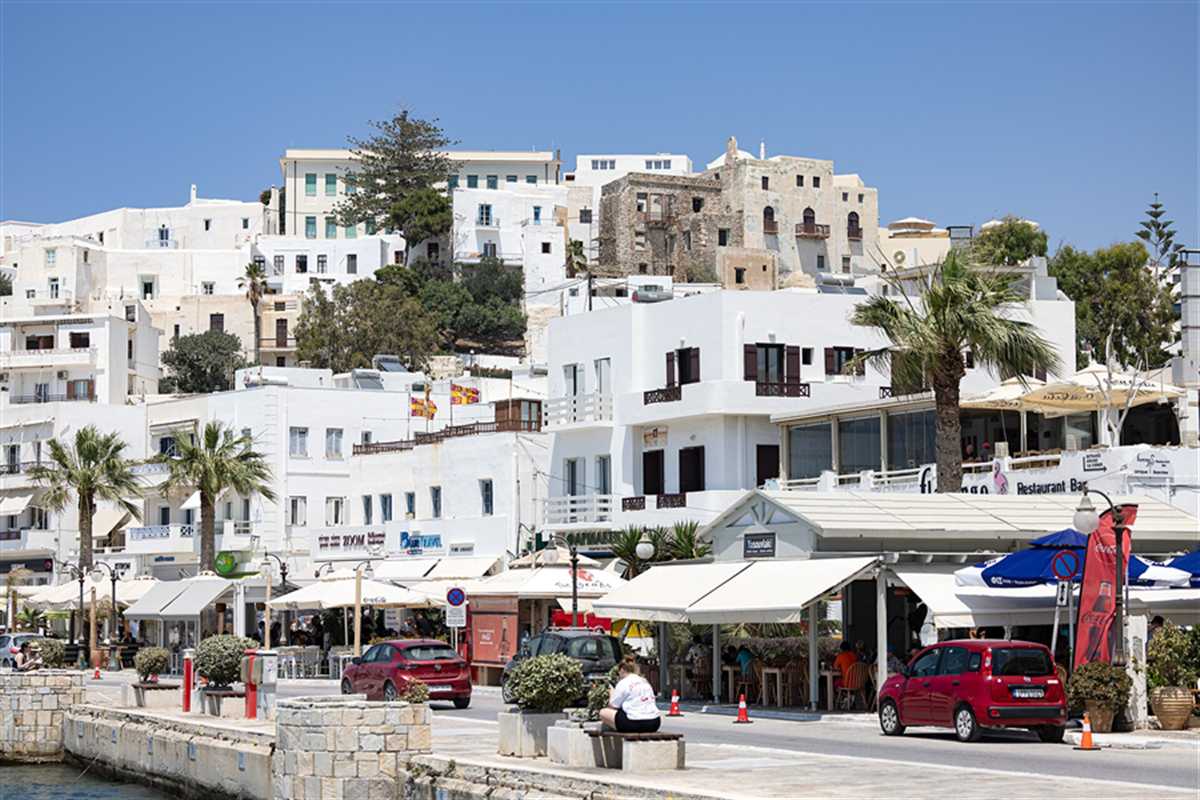
A Naxos food tour in the harbour town of Chora covers the Paralia, the seafront promenade whose pedestrian street is lined with shops and restaurants, and the old market and narrow lanes of the Old Town behind it.
During the summer months the asphalt road along the Paralia is closed to traffic at night and opens to pedestrians. Protopapadaki Street carries the shops and restaurants of the seafront.
Bourgos, north of the castle, was traditionally home to merchants and artisans. Its houses stand close together on narrow winding streets with dead ends, a layout likened to a labyrinth.
The layout is believed to have been built in part to disorientate intruders, especially pirates. Every road in or out of Bourgos leads to the castle or the sea.
The Kastro is a fortified circular fortress on the hill of the ancient acropolis, with a main gate called Trani Porta, meaning Great Gate, and a secondary gate called Paraporti.
The Naxos tour post covers the history of the town and the island in full. A Naxos food tour uses that setting for its tastings and for the walks between them.
- Port: The harbour has a breakwater and piers, and it docks smaller vessels such as fishing boats.
- Nio Chorio: This district south of the Kastro holds homes, shops, restaurants and churches.
- In-Situ museum: An underground museum below the square of the Orthodox cathedral shows remains of the ancient city.
- Agios Georgios: The beach of St George marks the western edge of the newer districts.
Chora supplies the setting for the seafront tastings. The route now leaves the harbour for Apiranthos, a village of the interior, where a Naxos food tour reaches the mountains.
Why does a Naxos food tour visit Apiranthos?
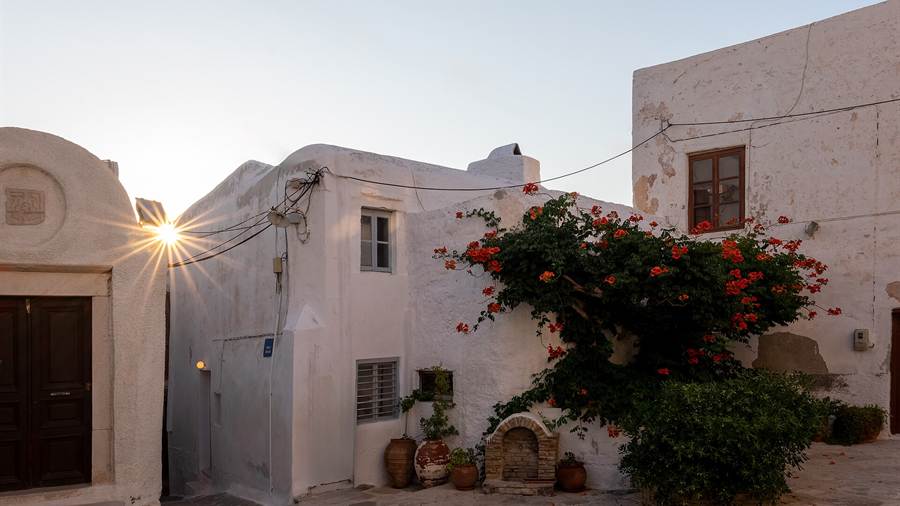
A Naxos food tour visits Apiranthos, one of the main villages of Naxos, set in the mountains of the interior beside Koronos, which stands at 630 metres on the northeast slopes of the second tallest mountain of the island.
Koronos lies in the northeast part of the island, on the slopes of the Koronion Oros. That mountain is the second tallest on Naxos, and the village has the second highest altitude of the island’s villages.
Six villages are named as the main villages of the island: Filoti, Apiranthos, Vivlos, Agios Arsenios, Koronos and Glynado. A Naxos food tour that crosses the interior passes one or more of them.
Inland areas of Naxos are much wetter and cooler in winter, owing to their higher elevation. Apiranthos and Koronos stand inland, which places them in the cooler and wetter part of the island.
Across the Cyclades the soil is not very fertile, with the exception of Naxos. The produce of the island group includes wine, fruit, wheat, olive oil and tobacco, and a Naxos food tour tastes the exception.
Thyme is a culinary herb of the mint family, native to Mediterranean countries in North Africa, the Levant and southern Europe. The ancient Greeks burnt it as incense in their temples.
- Altitude: Koronos stands at 630 metres above sea level.
- Mountain: The Koronion Oros is the second tallest mountain on Naxos.
- Villages: Six villages count as the main villages of the island.
- Herb: Thyme belongs to the mint family.
Apiranthos closes the places of the route. The formats on sale below turn these stops into booked days, so that a Naxos food tour can match a cheese, a farm or a meze table.
Which formats of a Naxos food tour are on sale?
A Naxos food tour is on sale as a town tasting walk, a morning cheese and coffee walk, an evening meze and wine experience, a farm cooking class, a cheesemaking class and a full-day private tour of the villages.
The town formats stay in Chora. One Naxos food tour pairs tastings with wine in the town, and another is a local food tour of the Old Town that centres on tradition.
A food walk with a cooking class adds a meal and drinks. A morning food walk adds Greek coffee and a cheese tasting, and an evening meze and wine experience is run by a local host.
The farm formats leave Chora. One Naxos food tour reaches a farm in Melanes for a cooking class on a wood fire, and another combines a farm visit, a cooking class and Greek dancing.
Cheese and oil formats follow. One class covers traditional cooking and cheesemaking, another joins cheesemaking and wine tasting with brunch, and a third tastes olive oil and honey with a farm breakfast.
Three more listings complete the set. A full-day private tour reaches the local villages, a cooking class includes pick-up, and an olive oil tasting in Naxos Town joins baking with a full meal.
- Town: Tastings and wine in Chora, or a food walk through the Old Town.
- Evening: A meze and wine experience with a local host.
- Farm: Cooking on a wood fire in Melanes, or a farm day with Greek dancing.
- Class: Cheesemaking and cooking, with brunch or a full meal.
The tour cards and availability boxes on the page list live dates for each format. A Naxos food tour is best confirmed there before a day is planned.
What do travellers ask about the Naxos food tour?
A Naxos food tour raises questions about the products, the places and the origins of the food. The answers below restate the facts of every stop in brief, from the potato and the cheese to kitron, wine, Chora and Apiranthos.
Where does the potato on a Naxos food tour come from?
The cultivated potato has a single origin in southern Peru and northwestern Bolivia, where farmers domesticated it 7,000 to 10,000 years ago. The Spanish word patata came from the Taíno batata, which named the sweet potato. Naxos is well known within Greece for its potatoes.
Which cheeses are on a Naxos food tour?
A Naxos food tour tastes graviera, a hard cheese, and Arseniko Naxou, the other cheese for which Naxos is known. Graviera shares its name with the Swiss gruyère, which takes its own name from the town of Gruyères. Over a thousand types of cheese exist.
What is kitron on a Naxos food tour?
Kitron is a liqueur produced on Naxos from the citron, a large citrus fruit that looks like a lemon. The citron is one of the original citrus fruits, and lemons were created using it. Its Latin name, Citrus medica, refers to Media.
Which places does a Naxos food tour visit on the island?
A Naxos food tour covers Chora, where the Paralia promenade has shops and restaurants and the Kastro has a main gate called Trani Porta. It also climbs to the mountain village of Apiranthos, one of six main villages of Naxos.
Featured photo: Tsui, CC BY-SA 4.0, via Wikimedia Commons.