
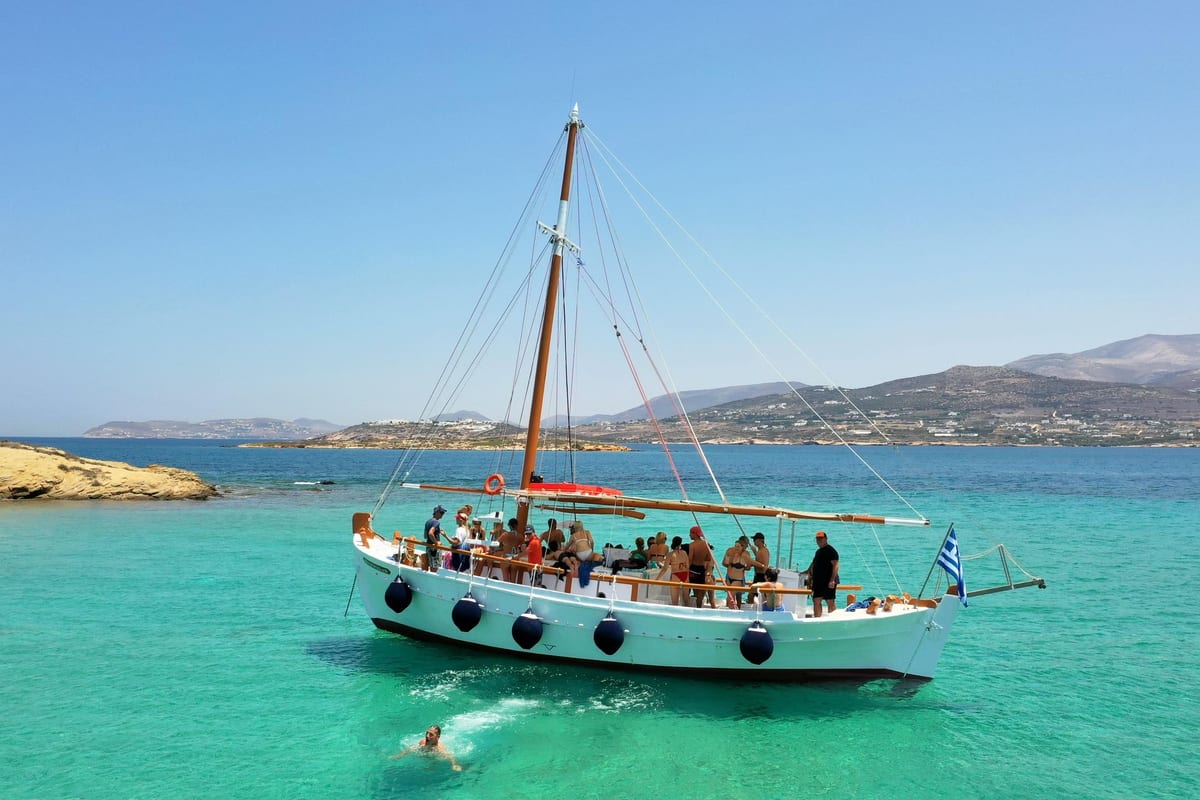
Paros snorkeling means swimming with mask, snorkel and fins over the clear seabed around Paros and Antiparos in the Cyclades. The activity is one of the Greece Tours on Greece Ville.
This post covers the sea around Paros, its rocks, its seagrass meadows, sunken sites, invasive fish and protected shellfish.
Light under water, the body in the sea, water quality, the story of the gear, the best months and common questions come last. The sections include Paros snorkeling trips that can be booked online.
What is Paros snorkeling?
Paros snorkeling takes place inside a large EU bird site, GR4220025. It covers 25,698.74 hectares around the Paros islets and southern Antiparos. About nine-tenths of it is sea, not land. Greece classified it as a Special Protection Area in 2002.

Its land part takes in north and east Paros, the rocky islets, southern Antiparos, Despotiko and Strongylo. Its sea zone wraps the south coast of Paros. It runs from Cape Voreino in the east to Agios Nikolaos in the west.
On Paros snorkeling trips in the north, the zone reaches out 1 nautical mile. It rings the islets of Filidi, Foinisses, Fourlos and Gaidouronisi. It covers the sea along the west, south and east sides of Antiparos too.
European shags breed along the rocky coasts and on the bulk of the nearby islets. After breeding, groups of shags gather in the coastal waters of Paros and Antiparos.
On Paros snorkeling trips, shearwaters feed close by. Cory’s and Yelkouan shearwaters both feed in large numbers around Paros and Antiparos. The site holds a leading Cory’s shearwater colony of the Cyclades, and mixed colonies nest on two islets.
The Key Biodiversity Area of Paros, Antiparos and the surrounding islets covers 317.2317 km² of land and sea. Its boundary was pushed out to sea in October 2012. Protected areas cover 80.97% of it.
- Tetartonisi: The bird zone follows a northern arm of Paros to this islet in Kefalos Bay.
- Despotiko: The Despotiko and Strongylo site, sea zone included, became an EU Special Area of Conservation in 2011.
- Law: It was designated under Greek Law 3937.
- 1996: The site was first proposed for the EU nature network that year.


Which rocks shape Paros snorkeling?
Paros snorkeling runs over rocks shaped by a detachment, a major low-angle fault that dips north. It separates surface rocks on Naxos and Paros from rocks once buried deep. Rocks below it rose at an estimated 1.8 to 9.5 mm a year.
The fault began, by one estimate, at a fairly gentle slope of about 35°. Crustal stretching in the Lower Miocene created two north-facing detachment faults on Paros. Two domes of gneiss rose under them, the NW Paros Dome and the Main Paros Dome.
On Paros snorkeling trips along the north coast, the deepest rocks show. The Monastiri to Naoussa coast is a tectonic window into the middle to lower crust. Granite-like rocks in north-west Paros formed when gneiss and amphibolite melted, about 21 million years ago.
The Paros pluton is a Miocene leucogranite, a pale granite rich in tourmaline and lithium-bearing mica. Its magma was emplaced at about 700 °C under a pressure of 4 to 5 kilobars.
At Agios Georgios on Antiparos, silver-bearing lead ore fills quartz veins in marble. Hot fluids from the Paros leucogranite, about 12 km away, are thought to have carried it.
On Paros snorkeling trips, beachrock is a common sight in the shallows. Beachrocks of Paros and Naxos formed in the middle intertidal zone, where sea and fresh water mixed equally. Their cement is high-magnesium calcite.
- Offshore: Beachrock lies close offshore, parallel to the coast, with older layers farther out.
- Size: Slabs can reach 300 m wide and stand 30 cm to 3 m high.
- Speed: Beachrock can harden within years.
- Reefs: Rocky reefs cover 74.7053 hectares of the Despotiko and Strongylo site.
Underwater and half-flooded sea caves cover 2.4158 hectares of the same site.
Which seagrass meadows line Paros snorkeling?
Paros snorkeling crosses seagrass beds of Posidonia, which cover 595.4128 hectares of the Despotiko and Strongylo site. The EU site form gives them grade A for conservation. Upright Posidonia rhizomes grow only 0.1 to 4 cm a year.
Woody Posidonia roots up to 15 cm long anchor the plant. One set of stems grows about 150 cm down beneath the seabed. Horizontal rhizomes spread only 1 to 6 cm a year. Carl Linnaeus first described the plant in Systema Naturae, placing it in the genus Zostera.
On Paros snorkeling trips, the Greek picture matters. A satellite study mapped 2,510.1 km² of Posidonia in Greek seas, between 0 and 40 m deep. It combined 1,045 Sentinel-2 images with a sharpness of 10 m.
Greece’s EU habitat report puts its Posidonia beds at 2,300 to 2,600 km². Of these, 2,012 to 2,275 km² were judged in good condition, and 288 to 325 km² were not.
Greece rated their conservation status as unfavourable, with a worsening trend. High-ranked pressures include fishing that disturbs the seabed, fish farm pollution and beach works for tourism.
On Paros snorkeling trips, boats are part of the story. Motorboat propellers can cut seagrass when boats pass over shallow meadows. Shipping lanes and anchorage works rank as medium pressures on Greek beds.
- Alien algae: Caulerpa, Acrothamnion preissii and Womersleyella setacea also threaten Greek beds.
- Monitoring: The bulk of Greek data comes from the Hellenic Centre for Marine Research.
- Accuracy: Field checks put the satellite map’s accuracy at 72%.
- Carbon: A meadow in north-east Spain stored 198 g of carbon per square metre each year.
Which sunken sites lie near Paros snorkeling?
Paros snorkeling passes sunken antiquities, from cemeteries to harbour works and buildings. An underwater survey in Paroikia Bay found an ancient mole, a stone harbour wall. It runs about 100 m long, 2 to 3 m down. Its age is still unknown.
No dating clues were found at the mole. In 1979, remains of a Roman building turned up 1 m offshore, only 0.5 m below the surface. The archaeologist Rubensohn had reported a sunken Roman building in the bay as early as 1901.
On Paros snorkeling trips around Paroikia, the shoreline has moved. The ancient writer Scylax said Paros had two harbours, one closed inside the city walls. The town’s ancient cemetery was in use for over a thousand years. It ran from the end of the 8th century BC to the 3rd–4th century AD.
That cemetery now lies about 30 to 40 cm below sea level. Unless the water is drained all the time, the dig turns into a swamp within hours.
On Paros snorkeling trips, drowned notches tell the story. Wave-cut grooves mark three old shorelines at 35 cm, 170 cm and 230 cm below today’s sea. Notches at different depths point to sudden sinking of the land, possibly from earthquakes.
Partly drowned trenches off north-east Antiparos are thought to be Hellenistic vine trenches. In Hellenistic times, the sea there still sat more than 1 m lower than today. On Neolithic Saliagos, tuna made up the bulk of the diet. Tuna are no longer common in this part of the Aegean.
John Davies Evans and Colin Renfrew excavated Saliagos in 1964 and 1965. They found more than 25,000 obsidian artefacts, including over 1,100 blades. Its obsidian points are read as harpoon parts, not arrows.
- Mycenaean bowl: A deep bowl from Koukounaries on Paros shows a ship upside down. It is a rare picture of a shipwreck.
- Express Samina: Rocks of the Portes islets tore a hole 6 m long and 1 m wide.
- Doors: The ferry sank because nine of its eleven watertight doors were open.
- Wreck law: Since 2003, the Ephorate of Underwater Antiquities has controlled all wrecks over fifty years old.
Which invasive fish reach Paros snorkeling?
Paros snorkeling can meet Red Sea fish that entered the Mediterranean through the Suez Canal. The canal is 162.5 km long and 10 to 15 m deep. The common lionfish, one of these arrivals, grows up to 35 cm long.
The salty Bitter Lakes inside the canal blocked Red Sea species for decades. That changed once their salt level matched the Red Sea. In the five years after the 2020 fish atlas, 18 more Red Sea species turned up. They came from 12 families.
On Paros snorkeling trips, lionfish hunt chiefly at sunset and sunrise. A lionfish either sits and waits or uses its wing-like fins to push small fish against rocks. When a diver provokes it, it points its venomous spines at the intruder.
In Greek seas, lionfish live on sand, mud, rock and seagrass. They prefer rock, down to 150 m. Spear-gun fishers say lionfish now fill crevices where groupers used to shelter.
A lionfish sting can cause extreme pain, vomiting and breathing trouble, so fast medical care is strongly advised. The bluespotted cornetfish, another Red Sea arrival, has been shown to eat lionfish.
On Paros snorkeling trips, the silver-cheeked toadfish needs care. It has fused jaw teeth that are very sharp. It prefers squid, cuttlefish and octopus, and fishers report big drops in those catches where it thrives.
- Poison: Toadfish poisoning starts with pins and needles in the lips and tongue.
- Timing: Symptoms start within 30 minutes of eating the fish as a rule. They can take up to four hours.
- No antidote: No antidote is approved for people. Doctors keep the victim alive until the toxin wears off.
- Spinefoot: When threatened, the dusky spinefoot raises its fins in a ring of venomous spines.
Fishers say spinefoots damage nets, take a long time to untangle and fetch low prices.
Which shellfish are protected on Paros snorkeling?
Paros snorkeling crosses the habitat of the noble pen shell. The first confirmed mass deaths in the Aegean came in 2018. Surveys from 2022 to 2023 counted 4,348 pen shells in Greek seas, and 87.3% were dead.
The noble pen shell lives 0.5 to 60 m deep, set in soft sand or mud. By 2019, die-offs had reached Greece, Croatia, Turkey, Tunisia, France and Morocco.
On Paros snorkeling trips, a live pen shell is now a rare find. The only Greek survivors lived in two closed gulfs. They were Amvrakikos in the Ionian Sea and Kalloni in the Aegean. In summer 2023, Kalloni lost 81% of its live pen shells in about three months.
Healthy pen shells now survive chiefly in refuges such as coastal lagoons and estuaries. The rough pen shell, Pinna rudis, grows 25 to 30 cm and prefers rock crevices. Young noble pen shells look yellowish, while rough pen shells are brown or pink-orange with large scales.
On Paros snorkeling trips, the date mussel is another protected animal. Its name, Lithophaga, comes from Greek words for stone and eating. Date mussels live chiefly in wave-battered rock, but they can reach depths of 125 to 200 m.
The giant tun, a large sea snail, is protected under the Bern Convention. The Barcelona Convention protocol protects it too. When disturbed, it squirts saliva that holds 2 to 5% sulfuric acid.
- Limpets: Greek rules let an amateur take up to 30 limpets a day, or 60 per boat.
- Closed month: Amateur fishing and spearfishing are banned in Greece for one month in late spring.
- Undersized: Taking undersized fish or other sea creatures is an offence that brings a fine.
- Buoy: Spearfishing without a marker buoy also brings a fine.
How does light change under water on Paros snorkeling?
Paros snorkeling changes how the eye sees. From above, refraction makes the seabed look higher, so the water appears shallower than it is. Isaac Newton wrote water’s refraction as a ratio of 529 to 396, nearly 4 to 3.
A spearfisher on the surface must aim lower than a fish appears, because of this apparent depth. From under water, objects above the surface look higher than they are. On 27 April 1850, Léon Foucault confirmed that light travels faster through air than water.
On Paros snorkeling trips, the mask shapes the view. Flat masks add pincushion distortion and thin colour fringes. Double-dome masks restore natural-sized vision and field of view. A narrow field of view greatly reduces depth judgement and hand-eye coordination.
Within arm’s reach in clear water, distances look shorter than they are. Farther out, they tend to look longer, more so in murky water.
On Paros snorkeling trips, colour also fades. It fades sideways through water as well as with depth. Distant subjects look colourless even in clear water. A number of underwater photographers count more than about one metre from the subject as too far.
Moken children of South-East Asia showed underwater sharpness of sight twice that of untrained European children. The European children matched it after one month of training. Trained eyes narrow the pupil under water, while untrained eyes widen it.
- Adaptation: Divers largely adapt to distance errors with practice.
- Filters: Linear polarizing filters reduce underwater visibility, because they cut ambient light.
- Low visibility: NOAA defines it as the point when visual contact with the dive buddy is lost.
- Zero visibility: A diver must then hold a light against the mask glass. Only then can it be seen to be on.
How does the body react on Paros snorkeling?
Paros snorkeling starts a reflex as soon as the face gets wet. The trigeminal nerve signals the brain, and the vagus nerve then slows the heart. The diving response grows stronger as the water gets colder.
Human babies show the diving reflex up to 6 months old. Edmund Goodwyn first described the slowing heart of a dive in 1786. Paul Bert described it again in 1870. Extra, irregular heartbeats are common during breath-hold dives.
On Paros snorkeling trips, floating also moves blood around the body. Water pressure shifts blood from the limbs into the chest. The body then holds back the hormone vasopressin, so the kidneys make more urine. This is called immersion diuresis.
Breath-holding brings its own risk. Normal breathing already keeps arterial blood 98 to 99% saturated with oxygen, so over-breathing adds very little. Deep breathing, cleansing breaths and workup breaths are other names for hyperventilation.
On Paros snorkeling trips, hyperventilating before a dive is dangerous. Strong hypocapnia causes dizziness and tingling fingers, but feeling nothing does not prove carbon dioxide is safe. Breath-hold blackout chiefly strikes fit, strong male swimmers under 40.
Blackout victims drown quietly and are found on the bottom. Ascent blackout follows dives of ten metres or more and strikes within the top three metres. Oxygen from the first breath can take over 15 seconds to reach the brain.
- Watch: Safety monitors watch surfaced divers for at least 30 seconds.
- Neutral: A resting person feels neutral at about 28 °C in air but about 35 °C in water.
- 29 °C: In water at 29 °C the body barely shivers, so the core can cool unnoticed.
- Moving: Without insulation, a swimmer who keeps moving loses heat faster than one staying still.
The Haenyeo women divers of Jeju, South Korea, show a strong slowing of the heart. They also show great cold tolerance.
How clean is the water for Paros snorkeling?
Paros snorkeling enjoys clean water. The European Environment Agency lists 18 bathing waters on Paros for the 2023 season. All 18 rated excellent that year. Antiparos has one listed site, Psaralyki, rated excellent in every season from 2017 to 2023.
Twelve Paros sites rated excellent in every season from 2013 to 2023. Among them are Paroikia, Logaras and Kolymbithres. Alyki, Monastiri and Santa Maria rated excellent in each season from 2017 to 2023.
On Paros snorkeling trips, newer sites look just as good. Agia Eirini and Parasporos Megalos carry ratings only from 2021, excellent in each of those seasons. In 2023, 1,659 of Greece’s 1,680 assessed bathing waters rated excellent.
In 2023, 17 Greek bathing waters rated good, 4 sufficient and none insufficient. Greek monitoring takes one sample before each season starts, then the rest during the season.
On Paros snorkeling trips, Blue Flags are another sign. In 2022 Paros flew Blue Flags at five beaches: Livadia, Logaras, Golden Beach, Pounta and Tserdakia. In 2023 the flag at Tserdakia was withdrawn.
For a Blue Flag, E. coli must stay at or below 250 colony forming units per 100 ml. The limits apply to the 95th percentile. A beach that fails either bacterium cannot win the flag.
- New beaches: A beach without four years of results needs at least 20 samples first.
- Timing: Each Blue Flag sample is taken within four days of its planned date.
- Faults: A minor fault gives a Blue Flag beach 10 days to fix it. The flag stays lowered meanwhile.
- Enterococcus: The name joins the Greek words entero, intestine, and kokkos, granule.
Enterococci survive from 10 to 45 °C, at pH 4.6 to 9.9, and in high salt levels.
How did snorkel gear develop for Paros snorkeling?
Paros snorkeling gear has ancient roots. Herodotus tells of the Greek swimmer Scyllis, who breathed through a hollow reed around 500 BC. He used it while cutting Persian ships loose. Aristotle wrote that divers used breathing tools like an elephant’s trunk.
Evidence suggests sponge divers on Crete used hollow reeds as breathing tubes about 5,000 years ago. Persian divers wore goggles with windows of polished tortoiseshell in 1300 or earlier.
On Paros snorkeling trips, the snorkel is a 20th-century tool. Barney B. Girden filed the first patent for a swimmer’s breathing tube on 9 December 1929. It was granted in 1932. In 1938, French naval officer Yves Le Prieur introduced the Nautilus, a full-face mask.
In December 1939, Alexandre Kramarenko filed a French patent. It covered a tube worn at the side of the head. In November 1940, Charles H. Wilen filed a mask with two valve-topped breathing tubes, granted as an American patent in 1943.
Kramarenko and Wilen set up the United Service Agency in Nice, making masks with built-in snorkels for spearfishers. Raymond Pulvénis showed his breathing tube, the Tuba, in a 1940 French book. French swimmers still say un tuba.
On Paros snorkeling trips, fins finish the kit. In April 1933, Louis de Corlieu patented his fins as number 767013. The set also had two spoon-shaped fins for the hands. American and British frogmen used Churchill fins before the 1944 Normandy landings.
- Lillywhites: In 1946 the shop imported about 1,100 pairs of swimfins into Britain. They sold out within 3 months.
- Ferraro: Luigi Ferraro invented a hinged gamma valve for snorkel masks in 1954. It won an American patent in 1957.
- Nautilus: Le Prieur’s full-face mask of 1938 had hoses that ended in a ball valve.
- EN 1972: The European snorkel standard sets a breathing effort limit of 10 mbar, in and out.
Its first edition, from July 1997, allowed tubes up to 480 mm for competitive finswimming. In 1957, Consumer Reports said snorkel-masks had a degree of value at the surface. It did not recommend them for dives into the blue.
Which months suit Paros snorkeling?
Paros snorkeling suits the long, dry summer. July averages 334.9 hours of sunshine at the Paros station, and August 335.1 hours. Both months average only 1.0 day with at least 1 mm of rain. The station sits on Paros itself.
The station, number 16766, stands 36 m above sea level, with records from 1 October 2004. Average daily highs reach 30.3 °C in July and 29.2 °C in August.
On Paros snorkeling trips in high summer, heat builds. July averages 13.0 days that reach 30 °C or more, out of 37.1 such days a year. In August, an average 28.7 nights stay at 20 °C or warmer.
The hottest July day on record reached 39.2 °C, on 31 July 2021. August’s record high is 35.3 °C, set on 1 August 2021. On 6 August 2021, the night never fell below 28.8 °C, the warmest low on record.
On Paros snorkeling trips in autumn, warmth lasts. September has reached 34.3 °C, on 19 September 2021. October has reached 33.2 °C, on 7 October 2020.
Wind is the main catch. The strongest gust in the Paros record reached 124.1 km/h, on 29 June 2022. August’s strongest gust reached 111.1 km/h, on 3 August 2019.
- Coldest: The lowest reading in the record is 1.0 °C, on 13 March 2022.
- June sun: June averages 328.0 hours of sunshine.
- January sun: January gets only 97.2 hours.
- Rain days: January averages 11.2 days with at least 1 mm of rain.
What do visitors ask about Paros snorkeling?
Paros snorkeling raises questions about full-face masks, fogging, boats, life jackets, fins and cameras. An unusually high number of snorkeling deaths in Hawaii in 2019 raised a suspicion. Full-face masks can trap carbon dioxide. Such masks can be tested against EN 136.
Are full-face masks safe on Paros snorkeling?
EN 136 allows 1% carbon dioxide at 50 litres per minute for masks with nose-and-mouth pockets. Full-face masks are easy in calm water, so untrained users can skip learning quick removal. They can panic if one floods.
How do snorkelers stop a mask fogging on Paros snorkeling?
One old snorkel-mask design kept the eyes and nose in separate compartments to reduce fogging. Certain plastics carry anti-fog additives that slowly move from inside the material to its surface. Tougher anti-fog coatings are applied during complex manufacturing.
How close do boats come on Paros snorkeling?
A snorkeler can surface right under a boat. Only a handful of places mark small-craft areas apart from snorkeling areas. In Greece, a spearfisher’s float must be visible from at least 300 metres. Spearfishing stays within 50 metres of it.
What life jacket suits Paros snorkeling?
An inflatable life jacket has air chambers over the chest and shoulders. Another wraps around the back of the head. A trigger pill that dissolves in water also works in shallow water. Foam buoyancy aids need little care and are cheap to mass-produce.
Which fins fit Paros snorkeling?
Full-foot fins as a rule have toe openings for comfort and drainage. A larger full-foot fin fits over thicker neoprene socks or thin-soled booties. If a blister forms, its fluid cushions the tissue underneath while it heals.
Which gadgets survive Paros snorkeling?
A depth mark on a water-resistant watch comes from one pressure test. It covers only a small sample of new watches. Diver’s watches are tested at 125% of their rating, so a 200-metre watch passes a 250-metre test. Certain phone housings link by Bluetooth, so the case needs only one opening.