
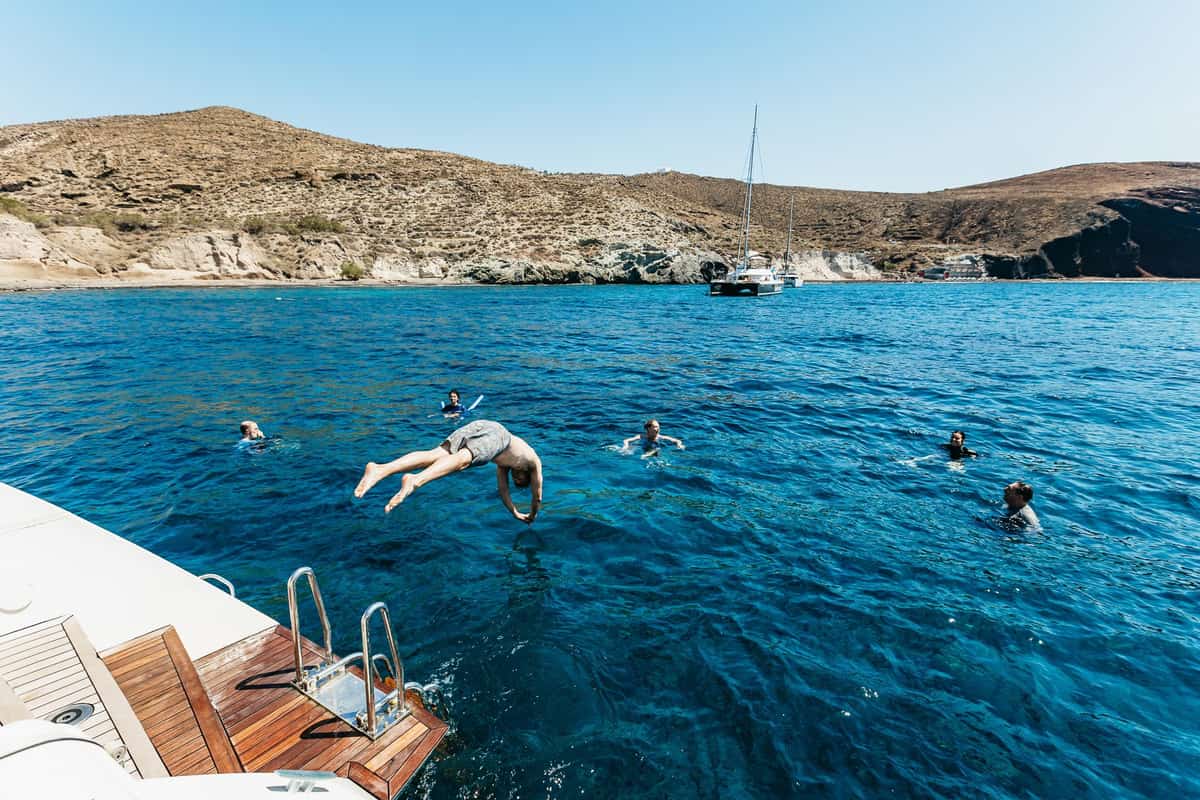
Santorini snorkeling means swimming with a mask and snorkel over the volcanic seabed around Santorini, from its beaches or from a boat. It is one of the Greece Tours on Greece Ville.
This post covers what it is, the beaches that suit it, how the volcano shaped the seabed, the fish, the life on the rocks, the clarity of the water and the hot springs.
The sea temperature, the gear, the rules that protect the sea, the best months and common questions come last. The sections include Santorini snorkeling trips that can be booked online.
What is Santorini snorkeling?
Santorini snorkeling means swimming face-down with a mask and snorkel along the island’s coasts. The Municipality of Thira has seven official bathing sites. They are Kamari, two at Perissa, Riva on Thirasia, Ammoudi, Vlychada and Monolithos. Vlychada joined the list only in 2018.

Snorkels come in two layouts: front-mounted over the face, or side-mounted beside the head. Front-mounted snorkels were popular in Europe until the late 1950s. Side-mounted snorkels then took over.
Front-mounted snorkels came back a decade later for pool training and finswimming races. Breathing out through the nose now and then cuts carbon dioxide build-up.
Tucking the snorkel under the mask strap can cause discomfort, leaks or a lost snorkel. Under stress, a snorkeler who breathes easily in calm water can run short of air. That can lead to panic.
Dry snorkels with float valves must be equalised on a dive down. That uses up part of the breath. Official records note no strong tides around Kamari.
- Finswimming: Snorkeling is the basis of the two surface disciplines of this underwater sport.
- Other sports: Snorkels also serve in underwater hockey and underwater rugby.
- Rescue: Search and rescue teams use snorkels for water searches.
- Balos: This small cove north-west of Akrotiri village was the area’s port in the 19th century.
Santorini snorkeling at Balos starts with a hard walk, because the old path is not maintained.


Which beaches suit Santorini snorkeling?
Santorini snorkeling at Red Beach takes place under retreating cliffs. Drone surveys over a decade show them moving back about 0.45 m a year. A collapse in winter 2019 pushed the cliff back by more than 1 m at once.
Researchers mapped over 1,200 scarps, rock deposits and cracks on the Red Beach cliffs. Rockfall there follows the seasons and is linked to strong storm surges and coastal erosion.
At Kamari, both the shore and the seabed are sandy, with jet-black sand and black pebbles. Breakwaters and beach-business platforms have changed its natural shoreline. Ruins of ancient Oia now lie under the sea off Kamari.
On Santorini snorkeling trips, Perissa shows arms of natural boulders built to protect the beach from erosion. At Riva on Thirasia, the 60 m beach has rock on both shore and seabed.
At Ammoudi, a boat pier lies ten metres south of the beach. Anchored boats lie scattered 15 m to the east. A sailing club sits 30 m from the shore, so the bay sees heavy sailing traffic.
Treated wastewater leaves Kamari through a 500 m undersea pipe. Its outlet lies at the centre of the bathing area.
- Seagrass: Piles of dead seagrass lay along Kamari’s waterline during the official site visit.
- Monolithos: Dead seagrass also lay scattered along its shore on the official visit.
- Blue Flag: Kamari received a Blue Flag award for 2014.
- Pets: Pets are allowed on Vlychada beach.
Tour boats leave the Ammoudi pier for other nearby beaches.
How did the volcano shape the seabed for Santorini snorkeling?
Santorini snorkeling swims over a seafloor still shaped by the Late Bronze Age eruption. Its marks run from the northern strait to wrinkled pyroclastic flow deposits. Loose rock still slides downslope. The caldera floor’s flat top layer is rock fallen from the cliffs.
Faulting, volcanism and underwater landslides are more active east of Santorini than in the western Christiana Basin. In that basin, researchers found the Proteus Knoll, thought to be an older volcano of the arc.
Before the Minoan eruption, an older caldera in the north held a lagoon. Travertine, stromatolites and remains of brackish and marine animals show it. The drill ship JOIDES Resolution cored up to 300 m into the seafloor around the caldera.
No Minoan eruption deposits came up in any core from inside the caldera. Witnesses of the 726 eruption wrote that the sea boiled as if heated by a furnace. Wind carried its floating pumice to Asia Minor and Macedonia.
On Santorini snorkeling trips, the 726 eruption lies hidden below. It took place largely underwater, leaving almost no deposits on land. Drill cores revealed a grey pumice and ash layer up to 40 m thick.
Nea Kameni’s lava flows rest on steep slopes of loose pumice and ash, which makes its flank unstable. Laser and sonar maps revealed three underwater lava flows, two east of Nea Kameni and one north.
- Age: The northern underwater flow is younger than the 1707–1711 lavas but older than the 1925–1928 flows.
- Strength: Lava that flowed underwater became about twice as strong as lava on land.
- Rate: Four historic eruptions pushed out lava at about 2 to 3 cubic metres per second.
- Scale: The 726 eruption was 30 times smaller than the Minoan eruption.
Which fish live in the water of Santorini snorkeling?
Santorini snorkeling reveals fish that a 2012 survey counted off the south coast. Divers recorded 14,659 fish from 38 species and 16 families. Damselfish, all of one species, Chromis chromis, were the commonest family. Wrasses had the widest range, with 9 species.
The survey covered 2.5 km of rocky coast at Perissa Rock and 6.5 km along the Akrotiri peninsula. The bulk of the fish were small. At 5 m, 81% measured under 10 cm.
Top predators were scarce, small and missing at half the sites, a sign of overfishing. Fish of the species that fishers target were mainly juveniles.
Three alien fish from the Red Sea appeared: the dusky spinefoot, the marbled spinefoot and the bluespotted cornetfish. At 5 m, spinefoots made up 44% of all fish weight.
Surveys in July 2008 found only the dusky spinefoot. By October 2012, marbled spinefoots also swam there in large schools. Large groupers are known to eat spinefoots in the eastern Mediterranean.
In a 2021 dive survey, Chromis chromis made up 22.06% of the fish counted at Santorini. The dusky and marbled spinefoots each made up 10.21%. White seabream made up 6.97%.
- Picarel: The blotched picarel made up 5.27% of the 2021 count.
- Top five: Those five species formed 54.72% of all fish counted.
- Lionfish: Santorini lionfish matched those of Samos and the Dodecanese in numbers and size.
- Alike: Santorini’s dive stations shared 71.12% of their fish life, the closest match of any region.
Santorini snorkeling at 5 m meets the spinefoots, which measured chiefly 10 to 15 cm.
What grows on the rocks of Santorini snorkeling?
Santorini snorkeling passes rocks where thick, leathery Cystoseira seaweeds covered 42.8% of the top metre. Short turf algae covered 20% of that zone. The stiff, chalky seaweed Jania covered 18.8%. Crusts of the red alga Lithophyllum covered 6.9%.
The alien green alga Caulerpa cylindracea covered only 0.1% of that rock. At 5 m, turf algae covered 61.4% and bare rock 9%. Tall canopy seaweeds covered just 6.7%, a sign of heavy fish grazing.
On the south coast of Nea Kameni, turf algae and Laurencia seaweeds almost alone covered the rock. Rich seaweed beds grew beside volcanic seeps there in 2007.
Surveyors listed 92 kinds of seabed invertebrates, 12 of them protected by international rules. Sponges led with 27 species, ahead of 23 molluscs and 12 echinoderms.
Santorini snorkeling along the steep caldera coasts meets coralligenous reefs, drop-offs and overhangs. The alien crab Percnon gibbesi was common, but only inside the caldera.
Posidonia seagrass grew only between 5 m and 22 m deep, in patches. On the ridge from Akrotiri Cape to Aspronisi, meadows reached 25 m. They averaged 461 shoots per square metre.
- Sponges: Crambe crambe, Spirastrella cunctatrix, Agelas oroides and Chondrosia reniformis turned up everywhere.
- Sea slug: Peltodoris atromaculata was always found on Petrosia ficiformis sponges.
- Corals: The stony corals Balanophyllia europaea and Madracis pharensis were fairly common.
- Triton: Dead shells showed that the protected Triton’s trumpet, a night-active snail, lives there.
The survey also recorded the sea anemone Condylactis aurantiaca.
How clear is the water for Santorini snorkeling?
Santorini snorkeling enjoys very clear water, because the sea around it is poor in plankton. Satellite data put year-round surface chlorophyll on the Cyclades plateau at just 0.069 mg per cubic metre. In a 2016 survey of 31 Aegean reefs, visibility never fell below 20 m.
Chlorophyll on the plateau peaks at only 0.095 mg per cubic metre, between 27 February and 5 March. Plankton grows there for about 161 days, from early November to mid-April.
The Cretan Sea, south of the Cyclades, is poorer still, averaging under 0.07 mg. After strong winter mixing in 2008, the plateau’s first recorded spring bloom reached 0.52 mg at 100 m.
Greek scientists rate coastal water under 0.1 µg/L of chlorophyll as oligotrophic, the high status class. Water above 2.21 µg/L counts as eutrophic, or bad status.
On Santorini snorkeling trips, Kamari’s bathing water scored excellent in every season from 2019 to 2022. Ammoudi, the rocky cove below Oia, scored excellent too. Riva, the port beach of Thirasia, did the same.
An official visit found Kamari’s water clear, with no tar, oil or household rubbish. Vlychada and Monolithos looked cloudy on their visits because of light waves.
- Perissa: No sudden algae or plankton growth has been recorded in its bathing water.
- Sampling: Greek officials sample bathing water every year from 1 June to 31 October.
- Caldera: Earlier surveys described a nutrient-poor caldera sea, largely free of organic or chemical pollution.
- Seaweed index: It rated 83.3% of shallow rocky stations good or high.
Santorini snorkeling in calm weather therefore gives the clearest views.
Which hot springs change the water of Santorini snorkeling?
Santorini snorkeling around Palea Kameni reaches a shallow hot-spring bay that scientists call Iron Bay. Iron oxide settles out of its water at an exceptionally high rate. It settles over 60 times faster than in iron-rich fresh waters.
Radiocarbon dates show mud began building up in the Palea Kameni bay around 50 AD. In the Nea Kameni bay, the same kind of mud only started around 1900 AD.
Metals pile up faster in these two bays than in any other dated hot-spring mud. Only the Atlantis II Deep in the Red Sea beats them. Nea Kameni mud is chiefly rusty iron oxyhydroxide and goethite.
Palea Kameni mud is chiefly diatom ooze with pyrite. Manganese builds up toward the bay’s outer, open-sea end. An arsenic-rich iron sediment in the shallow hot-water zone measured 20 to 40 °C.
Robot surveys of the caldera floor have never found high-temperature vents. A low-temperature vent field in the north-east of the northern basin holds hundreds of bacterial mounds.
On Santorini snorkeling trips, Kolumbo lies far below reach. Its vent field sits between 492 and 504 m deep. Clear fluids of up to 70 °C and carbon dioxide bubbles seep from its iron mats.
- Flakes: Below 250 m, Kolumbo’s crater water is clouded with reddish-orange and white flakes.
- Thallium: Kolumbo’s spires average 510 mg of thallium per kg.
- Microbes: The commonest microbe in its iron mats grows on ammonia and carbon dioxide.
- No animals: No animal life was found at Kolumbo’s vents.
How warm is the sea for Santorini snorkeling?
Santorini snorkeling enjoys relatively low maximum sea temperatures, as satellite maps show over the Cyclades. Navy sea records show one start date for the warm-sea season across the Aegean. Only Kavala, in the north, warms slightly earlier than Thira.
At any one station, that start shifts by no more than 15 days from year to year. The study found no trend in the start date. In the caldera, sea level rises and falls 5.74 cm a year as the water warms and cools.
At the Taxiarhis station on the Kameni islands, that seasonal sea level peaks in September.
In winter, sudden cooling events strike the caldera floor as cold water flows in. It is thought to enter between Thirasia and the northern end of Thera.
In the Aegean, the rise in average sea temperature comes mainly from milder winter lows. In 2020, very long Aegean marine heatwaves ran from January to March and from autumn into December. They lasted 84 to 99 days.
In 2020, southern Aegean heatwaves peaked more than 2.5 °C above normal. Over 1982 to 2020, the southern Aegean showed no significant trend in heatwave strength.
- Depth: In summer and autumn, heatwave warmth in the Aegean reached as deep as 800 m.
- Heatwave days: Mediterranean sub-regions logged 18 to 51 heatwave days a year from 1982 to 2020.
- Wetsuit rules: Elite triathletes can wear wetsuits below 23 °C on swims of 3000 m or more.
- Compulsory: Wetsuits become compulsory below 16 °C on those long swims.
What gear does Santorini snorkeling need?
Santorini snorkeling needs a mask, a snorkel and fins, and each has its own standards. EN 1972 first sized snorkels by user height, split at 150 cm, in 1997. Its 2015 edition used lung capacity instead.
Snorkel standards have raised the maximum inner width of the tube from 18 to 25 mm.
A drain valve opens when breath pressure beats the water pressure outside, pushing trapped water out. Once breath bubbles past the water, the valve loses much of its effect. Its benefit has not been clearly proven.
Old snorkels with a ping-pong ball in a cage are unreliable. A French decree of 2 August 1989 suspended the making and sale of ball-valve snorkel-masks. Dick Bonin introduced the exhaust valve that eases snorkel clearing in 1980.
On Santorini snorkeling trips, mask skirts come in silicone or gum rubber. A 1977 report on allergies pushed makers toward those hypoallergenic materials. Silicone withstands ozone, sunlight and heat, but tears easily.
Mask compensators let a diver pinch the nose, through an outer nose pocket or inner finger wells. Swimming goggles cannot be equalised, so they do not suit diving down.
- Big masks: Large-volume half masks tend to float up against the nose and grow painful.
- Fin standards: Seven standards cover swimfins, from MIL-S-82258 of 1965 to EN 16804 of 2015.
- Thrust: A diver’s sustainable fin kick measured 64 N, and a 20-second burst reached 192 N.
- Stiffness: Stiff paddle fins proved more economical for men, flexible ones for women.
Side-mounted snorkels sit on the left as a rule, since a scuba hose runs over the right shoulder.
Which rules protect the sea of Santorini snorkeling?
Santorini snorkeling takes place in a sea with protected zones around it. The sea around Kolumbo, an underwater volcano off north-east Santorini, is Natura 2000 site GR4220036. It covers just over 5,010 hectares, all of it at sea.
Seabed structures built by leaking volcanic gas, a protected EU habitat, cover 1,002 hectares of the Kolumbo site. Sandbanks just under the surface cover 4,008 hectares. No ecological assessment of the area has been made yet.
The Christiana islets, south-west of Santorini, became bird protection site GR4220022 in 2001. Its listed birds include Eleonora’s falcon, the peregrine falcon and the Mediterranean shag.
A wildlife refuge on the caldera, named after the Akrotiri lighthouse and Oia, covers 8.65 km². Under Greek Law 3028/2002, all archaeological finds dated before 1453 belong to the state. That includes anything a snorkeler spots on the seabed.
In Greece, a speargun must be loaded and unloaded only under the surface. Rules ban using one with an underwater torch or with nets. A spearfisher’s float is yellow as a rule, with a yellow flag showing a red diagonal.
- Ephorate: The Ephorate of Underwater Antiquities covers all of Greece, with offices in Thessaloniki and Heraklion.
- Flag letters: The flag carries the Greek letters ΥΔ, for underwater activity.
- Date mussel: It is listed in CITES Appendix II, so trade across borders needs permits.
- Fan mussel: Fishing, trawl nets, boat anchors and shrinking seagrass pushed it towards extinction.
Site GR4210011 became a Special Area of Conservation in 2011.
Which months suit Santorini snorkeling?
Santorini snorkeling suits the warm months, when July and August share the warmest mean daily high, 29.7 °C. That figure comes from HNMS normals for 1991-2020. September averages 24 °C. Late spring brings the lightest winds of the year at the station.
April averages 16.4 °C and November 16.7 °C in those normals, so the two months feel alike. November still averages 6 hours of sunshine a day.
On Santorini snorkeling trips in spring, male black-faced blennies turn yellow with a black head. They spawn from mid-March until June.
The Mediterranean cardinalfish breeds from June to September. In winter, it appears to move to deeper water. The ornate wrasse spawns in spring, and its eggs drift in open water.
In the Gulf of Tunis, white seabream spawned as the water warmed from 15 to 18 °C. The further south they live, the longer their spawning season lasts. Salema off Italy spawn twice a year, in spring and again from late September to November.
- Rainbow wrasse: In the Balearic Islands, it breeds from late spring to July.
- Sex change: Between August and December, rainbow wrasse change from female to male.
- Annular seabream: In the Gulf of Gabes, it spawns from March to June, peaking in late spring.
- Jellyfish: Young fried egg jellyfish can be seen from late spring to August.
Santorini snorkeling in July meets the first young blennies back on the rocks.
What do visitors ask about Santorini snorkeling?
Santorini snorkeling raises questions about fogging masks, full-face masks, ear pressure, swimmer’s ear, water quality and sunburn. Middle ear barotrauma causes nearly half of all reported diving injuries. Full-face masks raised carbon dioxide more than a standard snorkel in one study.
Why do masks fog on Santorini snorkeling trips?
Very humid air condenses on surfaces only slightly cooler than the air itself. In full-face masks, an inner nose-and-mouth pocket keeps warm, wet breath off the window. Detergent used as an anti-fog film draws criticism, because it dissolves and smears the glass.
Are full-face masks safe for Santorini snorkeling?
In an Auckland study, 20 people tested two full-face masks and a standard snorkel. During light exercise, 45% of full-face runs stopped for high carbon dioxide, against 20% with a snorkel. Every full-face wearer breathed back used air.
How does ear pressure change during Santorini snorkeling?
A descent of 10 m doubles the pressure on the body compared with the surface. The Eustachian tubes lock shut at about 3 m of extra pressure. No equalising move then works until the diver rises.
What causes swimmer’s ear after Santorini snorkeling?
Swimmer’s ear, or otitis externa, affects 1 to 3% of people a year. About 10% get it during their lives. It is commonest in children aged seven to twelve and in older people. The bulk of cases come from Pseudomonas aeruginosa and Staphylococcus aureus.
How is the water graded for Santorini snorkeling?
Excellent coastal bathing water holds no more than 100 intestinal enterococci per 100 ml. It also holds no more than 250 E. coli. Good water allows up to 200 and 500.
Who burns fastest on Santorini snorkeling trips?
On the Fitzpatrick scale, type 1 skin always burns and never tans. The minimal erythema dose is the UV energy that causes visible redness 24 hours after exposure. UV at 295 nm causes almost 100 times more sunburn than UV at 315 nm.