
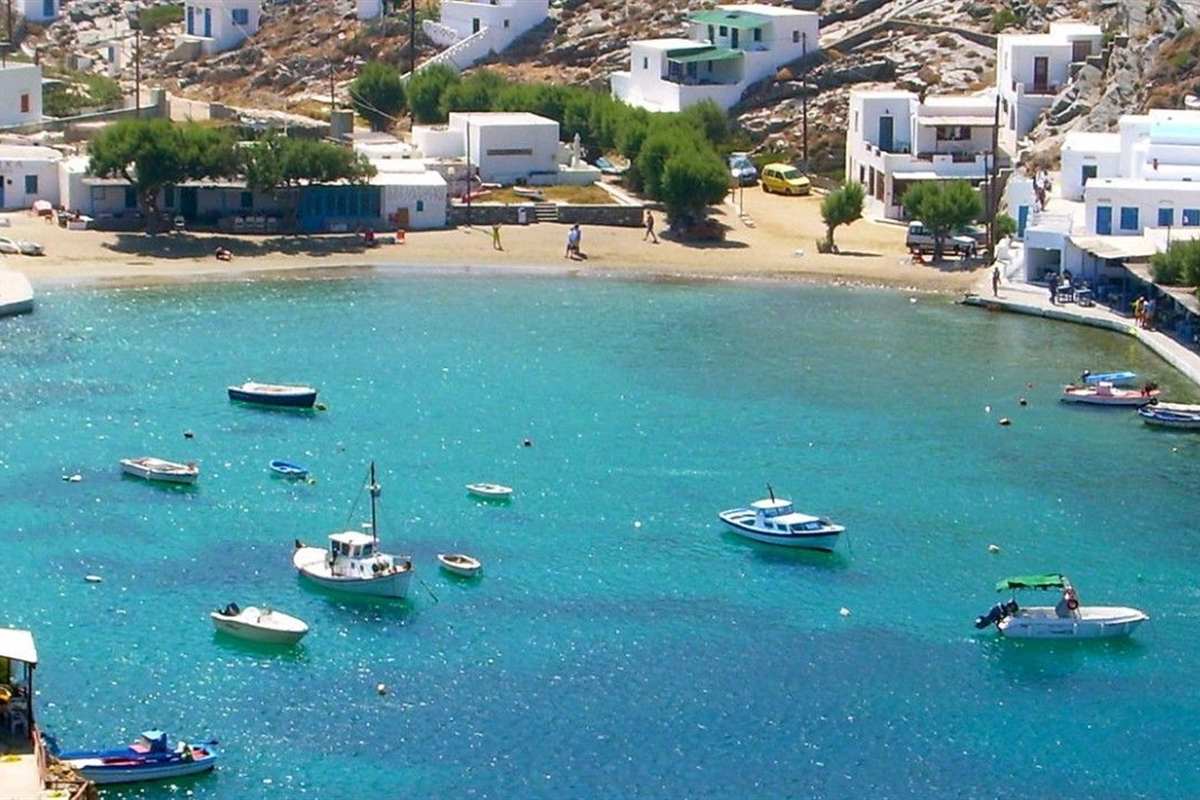
A Sifnos boat trip sails the coast of Sifnos in the western Cyclades and out to the islet of Poliegos, past Kastro on its rock and the bays below the island villages. The trip is one of the Greece Tours on Greece Ville, listed with the other Cyclades tours.
This post covers the formats on sale, the island and its villages, Kastro, the ancient mines, the Siphnian Treasury, Tselementes and the potters, Poliegos and the islands around Sifnos.
What is a Sifnos boat trip in the western Cyclades?
A Sifnos boat trip is a speedboat outing along the coast of Sifnos, an island of the western Cyclades set between Serifos and Milos, or a private crossing to Poliegos, the uninhabited islet known in Greek as Polyaigos, near Milos and Kimolos.
Sifnos sits to the west of both Delos and Paros. The island stands about 130 km from Piraeus, the port of Athens, a distance equal to 80 nautical miles.
The island has a shoreline of 70 km, and that figure sets the frame for any Sifnos boat trip along the coast. Settlements on that edge include Vathy, Faros, Platys Gialos and Cherronisos.
Two named destinations lead the offer. One is the south coast of Sifnos itself, and the other is Poliegos, an uninhabited island close to Milos and Kimolos and part of the Kimolos community.
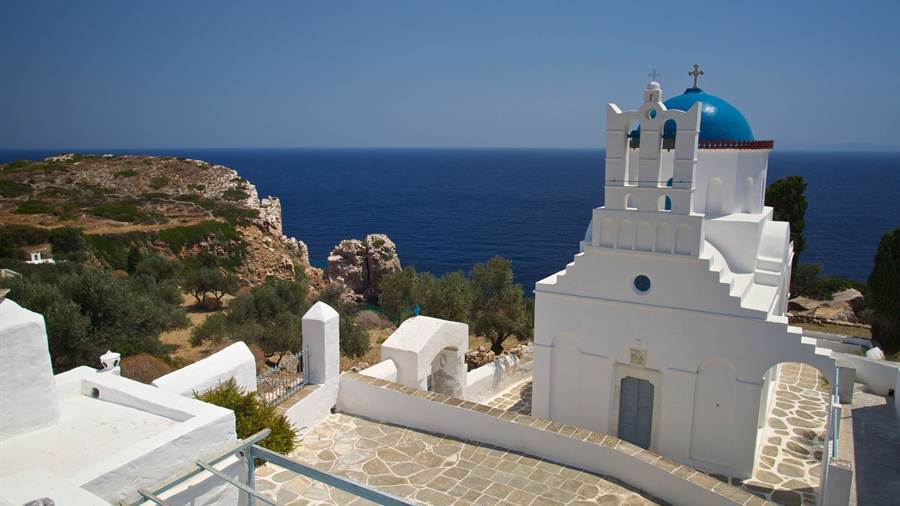
The south-east coast holds the Panagia Chrysopigi, a former monastery on a promontory 400 metres long and 100 metres wide, linked to the rest of Sifnos by a bridge over a narrow gap.
- Neighbour: Serifos lies to the north-west of Sifnos and belongs to the western Cyclades.
- Patron: The Panagia Chrysopigi became the patron of Sifnos in 1964.
- Goat island: The name Polyaigos refers to goats, the only animals that live on the islet.
- Old port: Faros, a fishing settlement near the Chrysopigi, is thought to have been the main port of the island in the past.
A Sifnos boat trip thus covers two kinds of ground: the coast of an inhabited island with its villages and chapels, and the empty shore of a goat island near Kimolos.


Which Sifnos boat trip formats are on sale?
A Sifnos boat trip on sale today comes as a private speedboat trip to Poliegos or a private speedboat cruise along the south coast, while the wider list adds a photoshoot, two ferry links, a car tour and a boat tour from Paros.
The first Sifnos boat trip format starts from Sifnos and runs as a private speedboat trip to Poliegos. The group on board crosses open water to the uninhabited islet, which belongs to the community of Kimolos.
The second Sifnos boat trip format stays closer to home. It is a private speedboat cruise along the south coast of Sifnos, with the whole boat reserved for one party.
Two fast ferry routes reach the island. One links Piraeus port, the harbour of Athens, with Sifnos, and the other runs between Milos and Sifnos, joining two islands of the western Cyclades.
Two private formats complete the list. A historical car tour crosses Sifnos by road, and a private boat tour sails from Paros to Sifnos and to Despotiko, an uninhabited islet west of Antiparos.
- Poliegos: A private speedboat trip leaves Sifnos for the goat island near Kimolos.
- South coast: A private speedboat cruise follows the southern shore of Sifnos.
- Ferries: Fast ferry links connect Sifnos with Piraeus and with Milos.
- Ashore: A historical car tour and a photoshoot in Apollonia and Kastro keep to land.
The tour cards and availability boxes on this page list live dates for each format, and a Milos boat tour covers the island at the other end of the ferry link.
Where does a Sifnos boat trip begin, and which villages make up the island?
A Sifnos boat trip begins on an island municipality of 73.942 square kilometres, where ferries dock at Kamares on the west coast, the capital Apollonia sits on three hills inland, and Artemonas ranks as the second largest village on the island.
Apollonia, also called Stavri, is the capital and largest village, home to 918 people at the 2021 count. It holds the folklore museum in its central square and the library of the island.
The name is thought to come from a temple of Apollo on the site of the church of Panayia Yeraniofora. Artemonas is thought to take its name from a temple of Artemis at Panayia Kokhi.
Kamares is the main port and lies on a natural harbour on the west side. Its buildings form a U-shape around the bay, with shops along the water and houses on the hill above.
Visitors arriving by ferry use the terminal in the Kamares harbour, and a nearby bus service connects the port with the other villages of Sifnos, Apollonia and Artemonas among them.
- Size: The island measures 15 km by 7.5 km and has a permanent population of 2,625.
- Apollonia district: It takes in Vathy, Kamares, Kastro, Kato Petali, Platys Gialos, Faros and Chrysopigi.
- Artemonas district: It covers Agia Marina, Troulaki and Cherronisos besides Artemonas itself.
- Churches: Sifnos counts 237 churches, and religious festivals fill almost every month of the year.
A Sifnos boat trip therefore sets out from a compact island, where buses tie the port at Kamares to the hill villages of the interior.
What does a Sifnos boat trip show of Kastro, the old capital on the east coast?
A Sifnos boat trip on the east side passes below Kastro, a village on a steep hill at 80 metres that served as the island capital from ancient times until 1836, the year the role of capital passed to Apollonia, inland.
Kastro sits near the eastern coast, above a small bay that once served as the port of the settlement and that a Sifnos boat trip on this side passes. The 2021 census counted 124 inhabitants.
Kastro is thought to date from the 14th century. The House of Coruña took Sifnos from the Byzantines in 1307 and kept power on the island for over a hundred years.
Despotikos, the ruined residence of the local lord, holds an inscription of 1365 naming Giannoulis da Coruña. Around 1440, power passed by marriage to the Gozzadini, a family from Bologna who ruled until 1617.
The first known mention of Kastro appears in the Isolario of Cristoforo Buondelmonti, dated 1420. By the early 17th century, estimates put the population of the village at 5000 residents.
- Museum: The Archaeological Museum of Sifnos opened in Kastro in 1986, inside a building of the medieval core.
- Collections: Exhibits run from the early Bronze Age to the late Byzantine period, and the bulk are local finds.
- Roman stone: Three Roman sarcophagi remain in the streets of the village.
- Coins: A set of 80 Byzantine coins in the museum points to a continued population in that era.
A Sifnos boat trip on the east coast thus frames a village that held the seat of power for centuries before the capital moved inland to Apollonia.
How did gold and silver mines shape the island seen on a Sifnos boat trip?
A Sifnos boat trip passes an island that grew rich from gold and silver, mined there as early as the 3rd millennium BCE, and that ranked among the first places in Greece to strike its own coins, from around 600 BCE.
People lived on Sifnos from at least 4000 BCE. Finds place the island within the mainstream of Cycladic culture in the Late Neolithic and Early Bronze Age, long before the Archaic boom.
Herodotus credits the people of Siphnos with enormous wealth from their silver and gold mines in the Archaic period. Remains of the mines survive, and the best known lie at Ay. Sostis.
Pausanias reports that floods wiped out the mines, and tradition blamed the islanders for holding back their tribute out of greed. Modern scholars offer a plainer account of the same loss.
In that view, shafts dug below sea level flooded, while the bulk of the mines, far from the sea, ran out of ore. A Sifnos boat trip along the coast passes ground once worked for metal.
- Settlers: Ionian Greeks from Athens settled the island during the Greek migrations, which began as early as the 12th century BCE by one estimate.
- Persian Wars: In the fifth century BCE Sifnos joined the Greek defensive alliance against Persia.
- Liberation: Persians held the island briefly in the following century, until a fleet sent by Alexander the Great freed it.
- Mint: Coin output on Sifnos stayed small, even though minting began early.
A Sifnos boat trip therefore traces the shore of an island whose silver and gold once paid for a marble building at Delphi.
How does a Sifnos boat trip connect to the Siphnian Treasury at Delphi?
A Sifnos boat trip connects to Delphi through the Siphnian Treasury, a building the islanders raised with a tithe of their mining income, the first religious structure made entirely of marble, dated on the leading view to around 525 BC.
The treasury stood on the Sacred Way through the Sanctuary of Apollo and housed the offerings of the polis of Siphnos. Votive gifts stored inside went to the priests for presentation to Apollo.
Dating rests on Herodotus: the Siphnians had recently founded a temple at Delphi when Samians came to seek help against Polycrates, who ruled during the reign of Cambyses II, about 530 to 522 BC.
The building measures 8.27 metres long and 6.09 metres wide. Two korai, carved maidens, support the architrave in place of columns, a form that points ahead to the Caryatids of the Erechtheion in Athens.
One reading points back to the island a Sifnos boat trip circles. The scholar Neer sees Artemis drawing a bow on the west frieze, a goddess the Siphnians worshipped as Artemis Of the Disembarkation.
- East pediment: In Greek myth, Heracles and Apollo struggle over the Delphic tripod while Zeus stands between them.
- North frieze: The battle of gods and Giants faced the Sacred Way, in full view of pilgrims on the ascent.
- Colour: Green, blue, red and gold paint once covered the reliefs, and only red shows to the naked eye today.
- Display: The sculpture and a reconstruction of the building stand in the Delphi Archaeological Museum.
A Sifnos boat trip covers the island end of this story, and a Delphi day trip from Athens reaches the sanctuary where the marble building once stood.
Which food and pottery traditions sit behind a Sifnos boat trip?
A Sifnos boat trip lands on the home island of Nikolaos Tselementes, a chef of the early 20th century whose surname became a Greek word for cookbook, and on a place whose clay veins made it a capital of pottery in the Aegean.
Tselementes was born in 1878 in Exabela, a village on Sifnos, and grew up in Athens. He worked first as a notary clerk, then cooked in the restaurant of his father and uncle.
Back in Greece in 1932, he opened a small school of cooking and confectionery. His recipe book, the first complete cookbook in Greek, ran to over fifteen official reprints in the following decades.
Island cooking keeps its own clay. Mastelo is goat or lamb marinated in red wine and dill, then baked in a clay pot of the same name in a wood-fired oven.
Revithada, a chickpea soup, cooks overnight in clay pots called skepastaria inside a wood-fired oven, and tradition serves it after Sunday church services. Locally, the word Sifnios served as a variant word for potter.
- Pottery output: Island potteries turned out ashtrays, cooking and food vessels, masteles and foufoudes, a kind of chimney.
- Modern dishes: Tselementes created the modern versions of mousaka, pastitsio and anginares alla polita.
- French touch: Greek home cooks learned of béchamel sauce, pirozhki and bouillabaisse through his work.
- English book: In 1950 he published Greek Cookery, his only book in English.
A Sifnos boat trip thus returns to an island whose clay pots and whose native chef, Tselementes, both left a mark on Greek cooking.
Which islands surround a Sifnos boat trip to Poliegos?
A Sifnos boat trip to Poliegos reaches Polyaigos, an uninhabited island of about 18 square kilometres near Kimolos and Milos, part of the Kimolos community, held to a great extent by the Greek Orthodox church and grazed only by goats.
Polyaigos stretches 6 km along its longest axis and 4.3 km across its shortest. Two mountains rise over the island: Stroggylo at 330 metres and Psilo Vouno at 370 metres.
Kimolos lies 2 km to the north-west, and Milos lies 6.2 km to the west. Polyaigos ranks as the largest uninhabited island of the Aegean and reaches half the size of Kimolos.
A Sifnos boat trip to Poliegos meets bare slopes, since goats keep the island barren. Beaches lie mainly on the southern part, and sea caves shelter a dwindling population of Mediterranean monk seals.
The church sublets parts of the island to herdsmen from Milos and Kimolos. In antiquity, Ptolemy, Pliny the Elder and Pomponius Mela each mentioned the island in their geographies.
- Kitriani: This uninhabited island lies about 350 metres off the south coast of Sifnos.
- Serifos: In Greek myth, Danaë and the infant Perseus washed ashore on this neighbour to the north-west.
- Kimolos: In the Middle Ages the island went by Argentiera, after the silver-coloured rocks of its southern coast.
- Despotiko: On clear days the view from this islet takes in Sifnos, Serifos, Kimolos and Ios, among others.
A Sifnos boat trip to Poliegos therefore links an inhabited island of villages and potteries with an empty goat island, while Kimolos and Milos rise close by.