
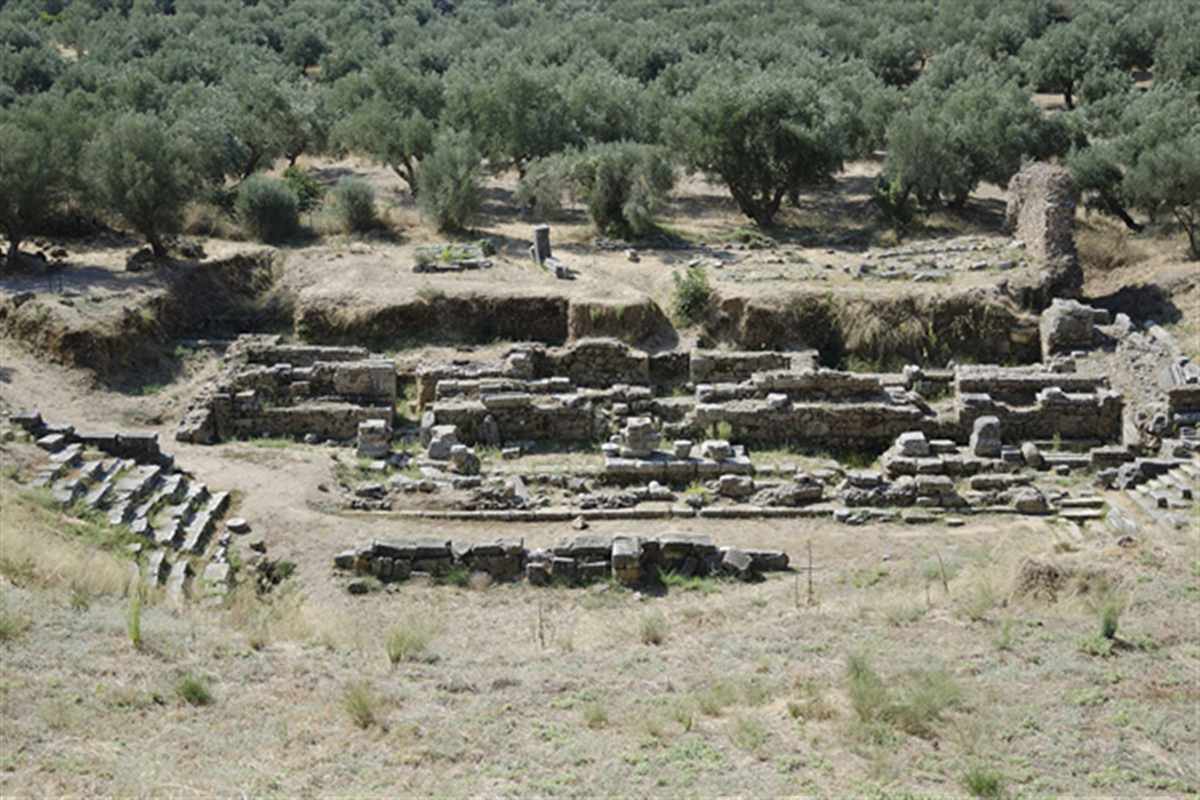
Sparta day trip visits the remains of ancient Sparta in the Peloponnese: the acropolis, the theatre, the sanctuary of Artemis Orthia, the monument to Leonidas and the nearby Menelaion and Vaphio. The trip is one of the Greece Tours on Greece Ville, listed with the other Peloponnese tours and day trips from Nafplio.
This post covers what the trip is, the ancient acropolis, the theatre, the sanctuary of Artemis Orthia, the monument to Leonidas, the Menelaion and Vaphio and the formats on sale. Common questions come last.
What is a Sparta day trip?
A Sparta day trip is a one-day outing to the Eurotas valley in Laconia, where the modern city of Sparta stands on the site of its ancient namesake. The Sparta day trip joins ruins, a shrine, a monument and a museum.
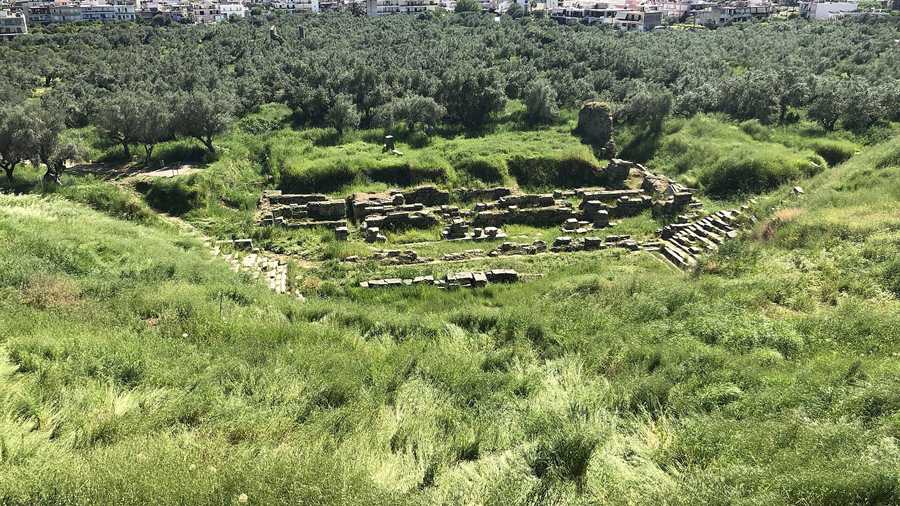
Ancient Sparta was built on the banks of the Eurotas, the largest river of Laconia. The valley worked as a natural fortress, bounded by Mount Taygetus to the west and Mount Parnon to the east.
Hilly uplands separate Laconia from Arcadia in the north. Sparta itself had no coast, though it kept a vassal harbour at Gytheio on the Laconian Gulf. A Sparta day trip therefore stays inland, on the valley floor.
The modern town received its present name late. The municipality was officially declared the Municipality of Sparta in 1845. Wide streets and squares lined with trees give the centre an open, planned look today.
Visitors came to Sparta even in antiquity. After the Roman conquest of Greece in 146 BC the city regained a measure of autonomy and became a tourist destination, so a Sparta day trip follows a very old habit.
- Region: Sparta lies in Laconia, in the south-eastern Peloponnese.
- Museum: The Archaeological Museum of Sparta was founded in 1875 and counts among the oldest archaeological museums in Greece.
- Display: Seven rooms of about 500 square metres show only a small part of the collection.
- Range: The collection runs from the Neolithic period to the late Roman era.
The sections below follow the sites in the usual order of a Sparta day trip: the acropolis, the theatre, the sanctuary of Artemis Orthia, the monument to Leonidas, and two Bronze Age sites outside the city.
What does a Sparta day trip show on the ancient acropolis of Sparta?
A Sparta day trip climbs the ancient acropolis of Sparta, where the sanctuary of Athena of the Brazen House once stood. The Sparta day trip reads the hill through its inscription, its city wall and its late Roman fortifications.
In 1907 excavators fixed the position of the sanctuary of Athena Chalkioikos, the goddess of the Brazen House, on the acropolis immediately above the theatre. The temple itself is almost completely destroyed.
The spot gave up the longest archaic inscription still known in Laconia. It also produced bronze nails and plates, together with a large group of votive offerings left for the goddess.
The city wall went up in stages from the 4th to the 2nd century BC. Its circuit measured 48 stades, nearly ten kilometres, according to Polybius. A later Roman wall enclosed the acropolis itself.
Part of that Roman wall is dated from the years after the Gothic raid of 262 AD. The round building on the hill proved to be a semicircular retaining wall of Hellenic origin, partly restored in Roman times.
- Digs: The American School at Athens made a partial excavation of the round building in 1892 and 1893.
- Start: Excavations began in Sparta itself in 1906.
- Decline: Sparta was sacked in 396 AD by the Visigothic king Alaric, and a long decline followed.
- Move: In the medieval period much of the population relocated to nearby Mystras.
The Mystras tour post covers the Byzantine hill town above the plain, and other routes add it to the outing.
What remains of the ancient theatre on a Sparta day trip?
A Sparta day trip shows the ancient theatre of Sparta as a ruin of retaining walls below the acropolis. The Sparta day trip uses the theatre as a landmark for the hero cult of Leonidas and for the festivals of Roman Sparta.
Until the early 20th century the theatre ranked among the chief ancient buildings at Sparta. Even then little of it showed above ground, apart from portions of the retaining walls that held the slope.
A hero cult of Leonidas survived in Sparta until the Antonine era in the 2nd century AD. The Leonideia were solemnities held every year in his honour, and only Spartans were allowed to take part.
The contest was held opposite the theatre. Two sepulchral monuments stood there, one for Pausanias and one for Leonidas. The ruined theatre thus ties the visit to the memory of the Persian wars.
Another festival belongs to the city’s story, the Gymnopaedia, the Festival of Nude Youths. Young women as well as young men are thought to have taken part, and the city allowed girls to exercise freely.
- Walls: Only retaining walls showed above ground before the digs of the early 20th century.
- Cult: The Leonideia honoured Leonidas every year until the 2nd century AD.
- Monuments: Pausanias and Leonidas each had a sepulchral monument opposite the theatre.
- Dress: Spartan women wore a peplos slit up the side, which allowed freer movement.
Roman visitors added to the life of the theatre. After 146 BC the city became a tourist attraction for the Roman elite, who came to observe exotic Spartan customs, and a Sparta day trip echoes that visit.
What is the sanctuary of Artemis Orthia on a Sparta day trip?
A Sparta day trip reaches the sanctuary of Artemis Orthia, an archaic shrine on the south bank of the Eurotas. The Sparta day trip shows the altar, the temple foundations and the theatre-like building that the Romans raised around them.
The cult of Orthia was shared by the four villages that formed Sparta: Limnae, where the sanctuary stands, Pitane, Cynosura and Mesoa. The oldest pottery fragments date from the late Dark Ages, and the first sanctuary was built about 700 BC.
Floods in the 6th century BC damaged the site, so builders raised it with a blanket of river sand. A second temple followed about 570 BC. It was rebuilt entirely in the 2nd century BC, except for the altar.
Shortly before the site was abandoned in the 3rd century AD, the Romans built a theatre around the temple and altar. It received visitors to the diamastigosis, the ritual flogging of Spartan youths.
In that rite cheeses were piled on the altar and guarded by adults with whips, and the young men tried to seize them. The British School at Athens dug the site from 1906 to 1910 under R. M. Dawkins.
- Discovery: The unexcavated site looked like a ruined Roman theatre, pillaged after the foundation of modern Sparta in 1834.
- Offerings: More than 100,000 lead offerings are now held in Liverpool.
- Prize: Young men won a sickle in the dances, which points to an agricultural ritual.
- Museum: Room II of the Archaeological Museum of Sparta holds finds from the shrine.
Pausanias called the wooden image Orthia and also Lygodesma, the willow-bound, because it was found in a thicket of willows. That story belongs to the altar.
What is the monument to Leonidas on a Sparta day trip?
A Sparta day trip includes the monument to Leonidas I, the Spartan king who led the Greek force at Thermopylae. The Sparta day trip finds a statue erected in 1969 and the so-called Tomb of Leonidas, a structure of immense stone blocks.
The statue in Sparta carries the words Molon labe, meaning Come and take them. Tradition holds that Leonidas gave this answer when Xerxes offered to spare the Spartans if they gave up their arms.
Another bronze statue with the same words was erected at Thermopylae in 1955. The Sparta statue followed in 1969, so a Sparta day trip meets the king at his home city.
Leonidas belonged to the Agiad dynasty, a royal house that claimed descent from Heracles. His wife Gorgo is well documented. Herodotus records that as a small girl she advised her father to resist a bribe.
She was also said to have read a hidden warning of a Persian invasion. Generals failed to decode a wax-covered wooden tablet until she ordered the wax cleared away, which revealed the message beneath.
- Words: Molon labe is the laconic reply attributed to Leonidas.
- Tomb: The Tomb of Leonidas is a quadrangular building with two chambers.
- Name: The tomb is a possible temple, and it took the king’s name in the 19th century.
- Abroad: A monument rose in Brunswick, a Melbourne suburb, in November 2009.
The Thermopylae tour post covers the pass in central Greece where the king fell, and a Sparta day trip is the home-city companion to it.
What do the Menelaion and Vaphio add to a Sparta day trip?
A Sparta day trip can add the Menelaion and Vaphio, two Bronze Age places outside the city. The Sparta day trip then moves from classical Sparta back to the Mycenaean world of Menelaus, Helen and a princely tholos tomb.
The Menelaion stands on a ridge about five kilometres from Sparta. This hill complex of Therapne has four hills: the Northern hill, the Menelaion, Profitis Ilias and Aetos.
Ludwig Ross excavated there in 1834 and recognised the heroon of Menelaus and Helen. The British School at Athens opened the first systematic dig in 1909 and found a Late Mycenaean building of raw brick.
Hector Catling later traced three mansions. The first, built about 1450 BC, had a central megaron and was soon destroyed, possibly by an earthquake.
Vaphio lies on the right bank of the Eurotas, about eight kilometres south of Sparta. Christos Tsountas excavated its beehive tomb in 1889. A walled approach of about 30 metres leads to a vaulted chamber.
- Dedications: A bronze vessel records that Deinis offered a gift to Helen, wife of Menelaus.
- Stele: A blue limestone stele of the early 5th century BC names Euthykrenes as donor to Menelaus.
- Chamber: The vaulted chamber at Vaphio measures about ten metres across, with the grave cut in its floor.
- Restoration: Conservation in 1962 raised the walls to a height of about six metres.
The tomb pottery dates to about 1500 to 1450 BC. Gold, silver, amber and crystal objects from Vaphio add the Mycenaean side to a Sparta day trip.
Which formats of the Sparta day trip are on sale?
A Sparta day trip is on sale as a day outing from Athens or Kalamata and as a longer route across the Peloponnese. The Sparta day trip appears alone, with Mystras, with Monemvasia or with Nemea wine country.
Two day trips leave from Kalamata. One joins the UNESCO-listed town of Mystras with Sparta, and a private version visits the Acropolis of Sparta alone.
From Athens, one day trip pairs ancient Sparta with Nemea wine country. A private day trip joins Sparta and Mystras, and a plain Sparta tour from Athens is also listed.
A tour of castles and legends links Monemvasia and Sparta and adds food and beer. The Monemvasia tour post covers the rock town in more detail.
Longer routes start in Athens. A multi-day trip joins Sparta, Monemvasia and the Diros Caves, and a private multi-day tour covers Sparta, Mystras and Monemvasia.
Two more private routes cross the Peloponnese over a longer span, one through Argolis with Sparta and Mystras, the other through Corinth with the same two stops.
- Kalamata: Two day trips pair Sparta with Mystras or visit the acropolis.
- Athens: Day trips pair Sparta with Mystras or with Nemea wine country.
- Combined: One day tour joins Olympia, Kaiadas, Apollo, Sparta and Mycenae.
- Longer: Multi-day routes add Monemvasia, the Diros Caves, Argolis or Corinth.
The tour cards and availability boxes on the page list live dates for each Sparta day trip, so the format and the departure city can be matched to a free date.
What do travellers ask about a Sparta day trip?
A Sparta day trip raises questions about the places covered, the link with Mystras, the summer heat and the museum. The Sparta day trip answers below rest on archaeological and historical records of the city, its sanctuaries and its museum.
Which places does a Sparta day trip cover?
A Sparta day trip covers the acropolis with the sanctuary of Athena, the ruined theatre, the sanctuary of Artemis Orthia and the monument to Leonidas. Longer versions add the Menelaion and the Vaphio tholos tomb outside the city.
Why does a Sparta day trip pair with Mystras?
A Sparta day trip pairs with Mystras because the two places share a history. From the 13th century the political and cultural centre of Laconia shifted to Mystras, while the settlement on the ancient site survived among the ruins.
How hot is a Sparta day trip?
A Sparta day trip meets a Mediterranean climate. January highs are around 15 degrees Celsius, while July and August highs pass 36 degrees in the city. On average Sparta records 6 days a year above 40 degrees.
Does a Sparta day trip include the museum?
A Sparta day trip can include the Archaeological Museum of Sparta, founded in 1875. Room II holds finds from the Artemis Orthia shrine, and Room VI holds architectural parts of the Temple of Apollo at Amyclae. In July 2020 plans for a new museum were approved.
Featured photo: Peulle, CC BY-SA 4.0, via Wikimedia Commons.