

A Zakynthos island tour circles Zakynthos, an island of the Ionian Sea also known as Zante, mostly by road. Stops include the town, hill villages, farms and viewpoints. The tour is one of the Greece Tours on Greece Ville, listed with the other Ionian Islands tours and Greece shore excursions.
This post covers the island, its rocks and faults and the rebuilt town. It also covers the writers, painters and music of Zakynthos.
The patron saint, Venetian and British rule, the farms, nature, the best months and common questions follow. The sections include Zakynthos island tours that can be booked online.
What is a Zakynthos island tour?
A Zakynthos island tour is a day trip around the island, mostly by road. Zante is the Venetian name for Zakynthos. It is the eleventh-largest island in Greece. It lies farthest south of the main Ionian Islands, except Kythira.
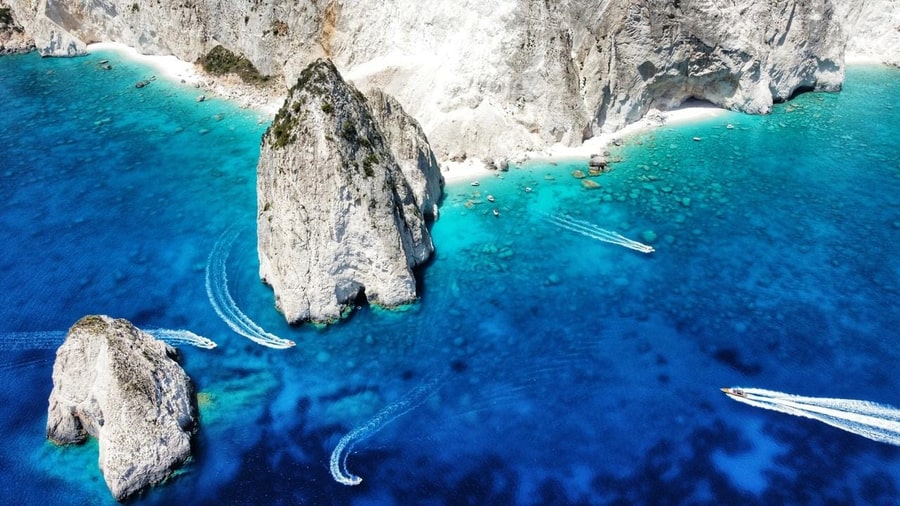
In Greek, that name takes the form Tzante. In Latin, the name was traditionally spelled Zacynthus. Homer’s Odyssey describes the island as wooded. Island people call themselves Zakynthioi or Zakynthinoi.
A Zakynthos island tour crosses a crowded island. The 2011 census counted 40,759 people. Among the Ionian Islands, only Corfu had more, with 104,371. Each square kilometre holds 100.5 people.
In 2010, the Kallikratis reform of local government renamed the Prefecture of Zakynthos, a county-like district. It became a regional unit, with unchanged borders. Greece counts 74 regional units today.
- Mayor: Georgios Stasinopoulos won the 2023 municipal election.
- Region: The Ionian Islands region dates from 1987.
- Census high: Population peaked in 1896.
Before the reform, Zakynthos was one of 51 prefectures in Greece. Its capital also goes by Chora, meaning the Town. Greeks use this word where island and town share a name.


What rocks and faults shape a Zakynthos island tour?
A Zakynthos island tour crosses the Pre-Apulian zone, the outermost belt of western Greece’s folded mountains. Its rocks date from the dinosaur age to the Ice Age. The Kefalonia Transform Fault, a crack in the crust, causes strong quakes.
The zone also spans part of Kefalonia and Lefkada, and all of Paxos. The Ionian thrust, where one rock mass rides over another, moved into place early in the Pliocene age.
On a Zakynthos island tour, western-edge limestone holds rudists, extinct reef-building clams. Younger layers studied along the south-east include marls, clays, mudstones and sandstones. Marl is a limy clay rock.
The ground of a Zakynthos island tour shifts about 50 millimetres a year. The Kefalonia fault slips tens of millimetres yearly. Scientists rank it the riskiest quake zone in Greece.
- 1840: A 30 October quake reached extreme intensity X.
- 1893: A 17 April quake destroyed 2,000 of 4,500 buildings.
- Lake Keri: It dries out every summer.
Around 440 BC, Herodotus described natural pitch, a black tar, in pools near Keri. The largest pool measured seventy feet across and twelve feet deep. The pitch smelled like asphalt.
How was the town rebuilt on a Zakynthos island tour?
A Zakynthos island tour sees a capital rebuilt after the 1953 earthquakes. A fire burned for days. The rebuilding kept traditional forms, unlike Kefalonia and Ithaca. Arched walkways on Rouga and Strata Marina streets recall the lost town.
On 11 August, a magnitude 6.8 quake north-west of the island badly damaged the town. In the later fire, the church of the Virgin Faneromeni burned but did not collapse.
The School of Ammos, the Sarakinis mansion and the National Bank building withstood the quake. On 14 August, the prime minister ordered wooden huts as temporary shelter for quake victims.
Rebuilding the town of a Zakynthos island tour followed a law of 27 July 1954. Its committee picked who got money for quake-resistant houses. A revised quake code became official in 1959.
- Homes: The three islands gained 27,394 homes.
- Lady of the Angels: This 1687 church reused its materials.
- Saint Charalambos: The 1729 church copies its pre-quake form.
Saint Mark’s Catholic church, first built in 1518, fell in the quake. Rebuilt in the 1960s, it kept much of its outer look. Its floor reuses the old church’s marble slabs.
Which writers came from the island of a Zakynthos island tour?
A Zakynthos island tour crosses the home island of the poets Ugo Foscolo, Andreas Kalvos and Dionysios Solomos. The novelist Grigorios Xenopoulos grew up there. Elisavet Moutzan-Martinegou, among the first Greek women writers, was born there in 1801.
A Zakynthos island tour recalls Ugo Foscolo, born on 6 February 1778. His father was Venetian; his mother was Greek. He wrote the novel The Last Letters of Jacopo Ortis.
A Zakynthos island tour recalls Andreas Kalvos. In 1812 Foscolo hired him to copy texts. In 1826 Kalvos published Lyrica, ten Greek poems. He died in Louth, England, in 1869.
Grigorios Xenopoulos was born in Constantinople on 9 December 1867. His town house on Gaita Street holds his museum upstairs. A children’s library named after him fills the ground floor.
- Grave: Foscolo rests in Santa Croce, Florence.
- Law: Solomos earned a Pavia law degree in 1817.
- Magazine: Xenopoulos founded Nea Estia in 1927.
The Museum of Solomos and Eminent Zakynthians holds a mausoleum, or tomb hall. Since 1968 it has kept the bones of Kalvos and Solomos. The museum calls it the only mausoleum in Greece.
Which painters worked on the island of a Zakynthos island tour?
A Zakynthos island tour crosses a home of the Heptanese, or Ionian Islands, school of painting. Nikolaos Koutouzis and his pupil Nikolaos Kantounis were priests and painters there. Nikolaos Doxaras, son of Panagiotis, lived there in the 1750s.
Panagiotis Doxaras, born in Mani in 1662, learned icon painting from the Cretan Leos Moskos. His son painted the Faneromeni church ceiling in Zakynthos in 1753–1754. The 1953 earthquake destroyed it.
Nikolaos Koutouzis was born on the island of a Zakynthos island tour in 1741. He is credited with 136 paintings. A 1770 attack over his mocking poems scarred his face.
Nikolaos Kantounis joined the Filiki Etaireia, a secret society for Greek independence. In 1821 he was exiled to Dia, near Cephalonia. There he painted his own version of The Last Supper.
- Method: Oil on canvas replaced Byzantine egg-yolk paint.
- Portraits: Pictures of middle-class townspeople outnumbered religious scenes.
- End: Kallivokas and Tsokos count as the school’s last painters.
The National Gallery of Greece holds a self-portrait by Kantounis. Its inscription calls him self-taught. The Zakynthos Museum keeps his paintings from the churches of the Virgin Pikridiotissa and Ayioi Anargyroi.
What music does a Zakynthos island tour hear?
A Zakynthos island tour hears kantades, songs named after the Latin cantare, to sing. It also hears arekia, Zakynthian songs sung by human voices alone. The opera composer Pavlos Carrer was also born on the island in 1829.
The name arekia seems to come from the Italian a orecchio, meaning by ear. Arekia on a Zakynthos island tour have four voices, from lead tenor, or primo, to bass.
Pavlos Carrer studied music in Milan from 1850. His opera Dante e Bice opened there in 1852. He returned in 1857 and worked on the island as a conductor and teacher.
His opera Markos Botsaris opened in Patras in 1861. It became the favourite Greek opera of its time, with over 45 stagings. The island’s Apollon theatre staged his Kyra Frosyni in 1868.
- Origin: Arekia began as work songs.
- Tavern: Arekia were sung in the potega, a wine tavern.
- Style: Ionian kantades sound more folk-like than Athenian ones.
The composer Dimitris Lagios was born on Zakynthos on 7 April 1952. He researched and taught works of the Ionian music school. His ashes were scattered over Zakynthos and Cyprus.
Which saint guards the island on a Zakynthos island tour?
A Zakynthos island tour meets Saint Dionysios, the guardian saint of Zakynthos town. He ranks among the best loved saints of modern Orthodoxy. He was born at Aigialos, the town’s seaside strip. His parents were Moukios and Pavlina.
A teacher named Kairofylas gave the boy his early lessons. A surviving letter by the saint comments on Gregory the Theologian. Its detailed notes show a broad knowledge of theology.
At 20, the saint of a Zakynthos island tour gave his brother his property. The gift provided for his sister. Bishop Theophilos of Kefalonia and Zakynthos ordained him a priest.
Hard work and a strict monk’s life wore down his health. In 1579 he resigned as bishop. He wrote to Patriarch Jeremias in Constantinople, asking to return to his island.
- Right hand: Simonopetra Monastery on Mount Athos keeps it.
- Andros: Panachrantou Monastery holds part of a hand.
- Pyrgos: His namesake monastery’s branch there keeps a fragment.
Believers call him a walking saint who leaves his casket to help those who pray. His slipper soles wear out and get replaced. Old pairs are cut up for pilgrims.
What did Venetian and British rule leave on a Zakynthos island tour?
A Zakynthos island tour crosses land once ruled by Venice and later by Britain. From Venetian times come guardhouses where guards lit fires to warn of pirates. Under British rule, Greek became the sole official language in 1852.
A provveditore, the Venetian governor, ran the island with a pair of councillors. The Great Council chose him for about two years. He handled taxes, church affairs and raid defence.
In 1578, a Small Council of 150 seized control of the Community Council’s membership. In 1683, membership was limited to 93 families. The republic never gave these nobles official recognition.
The island of a Zakynthos island tour used the obol coin from 1819 to 1863. The British issued it. One obol equalled a halfpenny, so 480 made a pound sterling.
- Coins: Venetian money for the islands read CORFU, CEFALONIA, ZANTE.
- Schools: Italian was taught in schools beside Greek and English.
- Parliament: The 1817 constitution created a Senate and an Assembly.
After taking Lefkada in 1810, John Oswald became governor of the island group. He ran it from the island of a Zakynthos island tour. Richard Church succeeded him in 1811.
What grows on the farms of a Zakynthos island tour?
A Zakynthos island tour passes currant vines on 16,700 stremmas, or 16.7 square kilometres of land. That zone covers 10 per cent of the island’s farmland. Olive groves include Koroneiki, a Greek variety with small fruit.
Researchers tested 47 oils of this variety from the Ionian Islands. Zakynthos supplied 17, picked from October to December 2017. Heptanal, a scent compound, appeared only in the island’s oils.
Islanders call this olive variety Koroni, though parts of the island use Kritikia or Ladolia. Figures for 1766–70 show 113,161 olive trees on the island of a Zakynthos island tour.
Currant vines along a Zakynthos island tour grow without irrigation, in straight rows. Growers prune each vine into a cup shape. A practice called charaki scores the bark of the trunk.
- Grape: Only Vitis corinthica, the Corinthian vine, is used.
- Size: Dried berries measure 4 to 8 millimetres.
- Moisture: Water stays at 18 per cent or less.
Pickers harvest the bunches by hand once the berries turn dark violet. The same day, the grapes dry in the sun on permanent threshing floors. No chemical speeds the drying.
Which wild plants and animals does a Zakynthos island tour pass?
A Zakynthos island tour passes scrub, pine woods, farmland and sea cliffs. Rare wild pinks and Ionian onions grow there. Lizards, snakes and bats live on the land. Songbirds of the Mediterranean nest in the low evergreen bush.
A Zakynthos island tour crosses Important Bird Area GR086. The area rises from sea level to 431 metres. Hard-leaved evergreen scrub covers 60% of it, and native pine woods 15%.
Eight of the 21 European birds that breed only in Mediterranean habitats nest here. The rock partridge stays all year. The olive-tree warbler and the black-headed bunting also breed here.
A rare wild pink, Dianthus fruticosus, lines a Zakynthos island tour. Allium ionicum, a wild onion, was described in 1994 from the Ionian Islands. Bee orchids grow there as well.
- Lizard: Male Greek algyroides here have yellow flanks.
- Sea daffodil: Another name is lily of St. Nicholas.
- Bats: European free-tailed bats are common here.
Natura 2000 site GR2210002, a protected European nature site, holds wild olive and carob woods on dry land. Golden orioles and collared flycatchers gather on the island’s coasts during migration.
Which months suit a Zakynthos island tour?
A Zakynthos island tour meets the hottest and driest weather in July. April and October bring milder days for the roads between villages. The first heavy rain returns in October. Two village feasts fall in July and August.
Weather for a Zakynthos island tour is measured at the airport station. July averages a high of 30.7 °C there. The record high of 42.2 °C also fell in July.
Rain almost stops in midsummer. July averages 5.0 mm of rain, on 0.5 rainy days. September gets 25.4 mm, but October jumps to 146.5 mm. The year totals 943.3 mm.
Clear skies mark a summer Zakynthos island tour. July cloud cover averages 0.6 oktas, a scale of sky cover in eighths. Thunder is heard on 34.7 days in a year.
- Spring: April highs average 18.9 °C.
- Autumn: October highs average 23.0 °C.
- Humidity: July air is driest, at 59.3%.
Agia Marina, a hill village 13 km west of the town, holds its feast on 17 July. Suburban Gaitani shows the preserved body of Saint Joseph Samakos every 29 August.
What do travellers ask before a Zakynthos island tour?
A Zakynthos island tour raises four practical questions before the trip. Travellers ask where the hospital stands. They ask which museum and which university study local nature. They also ask which phone and postal codes mark the island.
Where is the hospital on a Zakynthos island tour?
The General Hospital of Zakynthos stands in a suburb northwest of the town. It gives primary and secondary care, from basic to specialist treatment. It moved there from the old hospital in summer 2012. Greece uses 166 for an ambulance.
Which museum explains nature on a Zakynthos island tour?
The Helmis Natural History Museum presents the natural heritage of Zakynthos. It stands in a hill village on the eastern slopes of Mount Vrachionas. It has a room for films and sound, plus a library. It also runs educational programmes.
Which university studies nature on a Zakynthos island tour?
The Ionian University based its School of Environment on Zakynthos in October 2018. A Greek law notice of 3 August 2018 created it. The university first opened to students on Corfu in 1985. It now teaches on four Ionian islands.
Which codes help on a Zakynthos island tour?
Phone numbers on the island use the area code 2695. Cars registered on Zakynthos carry number plates starting with ZA, the Greek letters zeta and alpha. Postal codes there follow the pattern 29x xx, where x stands for a digit.