
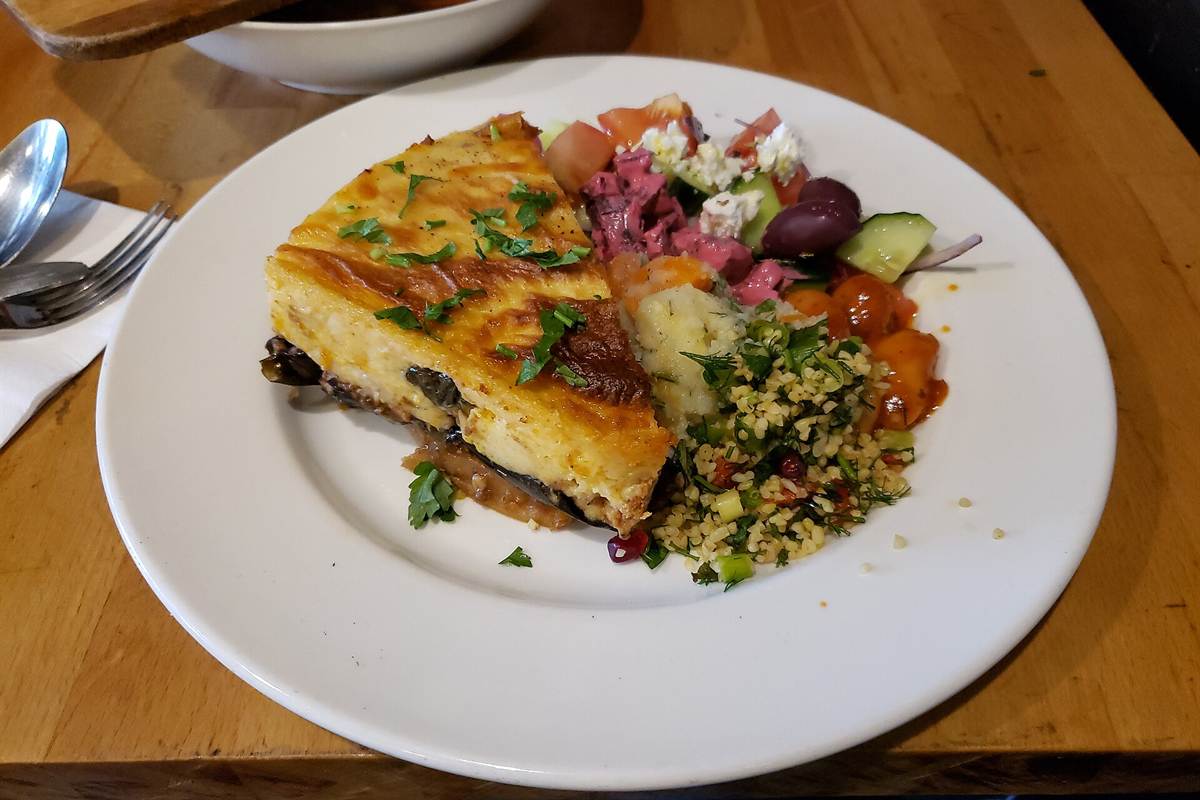
Greek food to try runs from dips, pies and salads to grills, oven dishes, fish, sweets and coffee, with dishes that change from island to island and region to region. The post is part of the Greece Tours on Greece Ville, listed with the other Greece cooking classes.
This post covers starters, salads, dips, pies and cheese, then main dishes and pulses, then sweets, breads, drinks and regional dishes. Common questions come last.
What is Greek food to try at a first meal in Greece?
Greek food to try means the small dishes that open a Greek meal: salads, dips, pies and cheese. Together they form the meze, a spread of shared plates that works as a first course or as a whole meal.
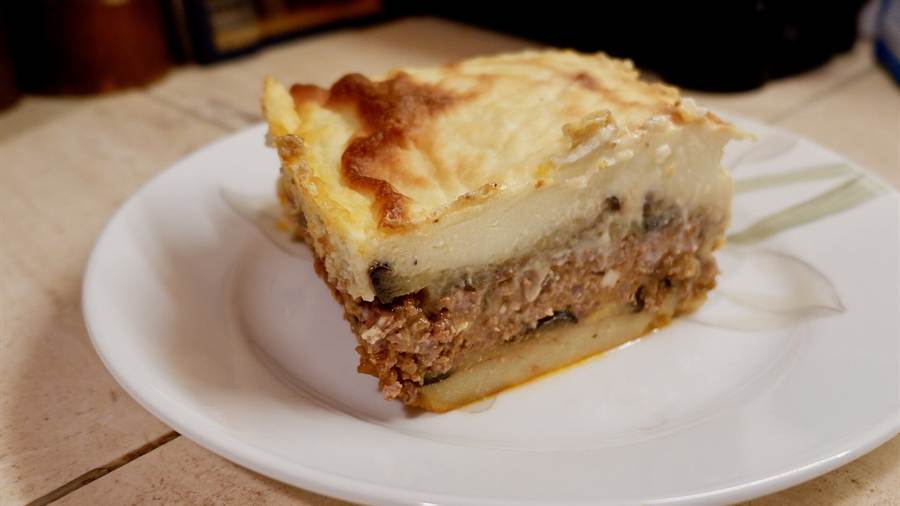
The word meze reached Greek from Turkish, where it means appetiser. Turkish took it from the Persian maze, which meant taste or relish. Greek food to try therefore begins with a borrowed word.
The meze tradition began in the Byzantine Empire and developed in Ottoman Greek houses and tavernes. Small dishes were served alongside strong spirits, and that custom still shapes how Greek tables fill with plates.
Meze is similar to Spanish tapas and Italian stuzzichini. Each is a set of small plates meant for sharing. Diners reach into the middle of the table instead of eating one fixed portion alone.
Common meze items include cubes of cheese, olives, fried vegetables, grilled octopus and sliced hard-boiled eggs. This part of the menu holds the Greek food to try first, because every plate is small and easy to share.
- Origin: The meze tradition began in the Byzantine Empire and grew in Ottoman Greek homes.
- Word: Meze comes from the Turkish word for appetiser, which came from a Persian word for taste.
- Cousins: Spanish tapas and Italian stuzzichini are the closest relatives of the meze table.
- Contents: Cheese cubes, olives, grilled octopus and boiled eggs all appear among common meze dishes.
The next sections take the salads, dips, pies and cheeses in turn. The Greece food tours post covers tasting trips that bring these starters together across Greek towns and islands.


Which salads count as Greek food to try, from horiatiki to dakos?
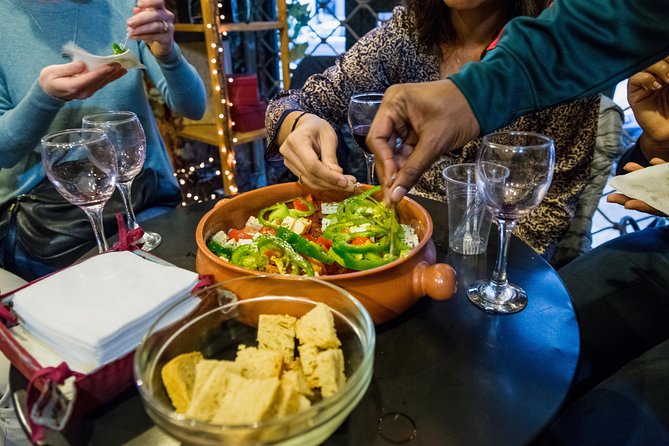
Greek food to try among salads starts with horiatiki, the village salad of tomatoes, cucumbers, onion, feta and olives, and with dakos, the Cretan rusk salad. Both lean on ripe vegetables and olive oil instead of a dressing.
Horiatiki is imagined as a farmer’s breakfast or lunch, because its ingredients match what a Greek farmer holds on hand. The name translates as peasant salad or village salad.
Regional touches set one plate apart from the next. Cooks add caper berries on the Cyclades islands, and mint or parsley as decoration in Northern Greece. Lemon juice and green pepper are common extras.
Juice from the tomatoes and olive oil pool on the plate once the vegetables are eaten. In informal settings, diners dip bread into that mixture, so nothing on the plate goes to waste.
Dakos is Greek food to try from Crete, a horiatiki also called koukouvagia, the Greek word for owl, and kouloukopsomo. Writers compare it with Italian panzanella and with the Catalan pa amb tomaquet.
- Cut: Tomatoes come in wedges and the other vegetables in thin slices.
- Extras: Caper berries mark the Cyclades, and mint or parsley marks the north.
- Dakos names: Koukouvagia means owl, and kouloukopsomo joins the words for puppy and bread.
- Olives: Dakos is topped with olives such as the Koroneiki, Lianes and Tsounates varieties.
Salads set the tone for the rest of the table, since fresh produce and olive oil carry the flavour. The Greek food to try after the salad bowl is the set of dips served beside bread.
Which dips are Greek food to try, such as tzatziki and skordalia?
Greek food to try in the dip group includes tzatziki, a cold mix of strained yogurt, cucumber and garlic, and skordalia, a thick garlic puree made with potatoes, nuts or stale bread. Both accompany fried or grilled food.
Tzatziki combines salted strained yogurt with cucumbers, garlic, salt and olive oil. Red wine vinegar, lemon juice and herbs such as dill, mint, parsley and thyme appear in different recipes.
It is served as a cold appetiser, as a side dish and as a sauce for souvlaki and gyros sandwiches. Tzatziki is Greek food to try at both the meze table and the street-food stand.
The word entered modern Greek from the Turkish cacik. The earliest known recipe, in a 10th-century cookbook from Baghdad, mixed yogurt with onion, garlic, herbs and cucumbers, so the dish has a long record.
Skordalia is the modern equivalent of ancient skorothalmi. Cooks beat garlic into potato, walnuts, almonds or soaked stale bread, work in olive oil and add vinegar to finish the smooth emulsion.
Skordalia is served mainly with batter-fried salt cod, especially during Lent and on the Greek national holiday of 25 March. Fried eggplant, zucchini and boiled beets also go well with it.
- Tzatziki base: Salted strained yogurt carries the cucumber, garlic and olive oil.
- Sauce role: Tzatziki tops souvlaki and gyros as well as sitting on the meze table.
- Skordalia base: Potato, walnuts, almonds or stale bread hold the garlic.
- Ionian style: In the Ionian Islands, cod stock and lemon replace vinegar, and skordalia becomes a main dish.
Both dips show how Greek cooks build strong flavour from plain ingredients. The next Greek food to try is a spread made from fish roe.
Why is taramasalata Greek food to try with bread?
Greek food to try in the spread group includes taramasalata, a meze with a long record in the tavern culture of Istanbul. Diners scoop the creamy dip onto bread, and the roe at its heart comes from fish such as carp.
Cooks make this Greek food to try from the salted and cured roe of cod, carp or grey mullet. Almonds sometimes replace bread or potatoes as the starchy base, which sets certain recipes apart from the usual spread.
The name comes from the Greek taramas, a borrowing from the Turkish tarama, which means soft roe. The Greek spelling is taramosalata, while English writers favour the form with the final a.
Traditional makers use a pestle and mortar, which gives a slightly grainy texture. Commercial versions are very smooth. The colour runs from creamy beige to pink, depending on the roe and any colourings used.
By the late 19th century, tarama was among the meze sold in the meyhane culture of Istanbul. Carp roe became the main ingredient after Sephardic Jewish merchants popularised carp in the Balkans in the 16th century.
- Roe: Cod, carp or grey mullet roe forms the heart of the dip.
- Name: The word comes from taramas, a Greek borrowing from the Turkish word for soft roe.
- Colour: The shade runs from creamy beige to pink, depending on the roe.
- Variants: Garlic, spring onions or peppers can join the roe.
Taramasalata is served as a meze with ouzo in Greek tavernes. That pairing makes it Greek food to try with a glass in hand, beside olives and bread.
Which stuffed and baked starters are Greek food to try?
Greek food to try among stuffed and baked starters includes dolmades, stuffed peppers, stuffed sardines and gigantes plaki, giant white beans baked in tomato sauce. Rice, herbs and olive oil feature across these plates, and each shares well across the table.
Dolmades is the Greek name for stuffed vine leaves. Food writer Claudia Roden suggests the dish was adopted from the Greeks, although she notes that stuffed vegetables began as court cuisine for a wealthy class.
Stuffed peppers are filled with rice, herbs, onions, currants and, optionally, raisins. The dish is popular in Armenia, Greece and Turkey, and Greek cooks serve it as a baked starter.
Stuffed sardines are filled with kasseri cheese, tomato, onion, basil and parsley. In Greece they appear on meze platters at traditional tavernas, so they suit diners who want fish among the small plates.
Gigantes plaki is Greek food to try as a main dish or as a meze. The large white beans bake in tomato sauce with olive oil, vegetables and herbs.
Cooks soak and boil the beans until tender, then mix them with sauteed aromatics and bake the dish until the top layer browns. It is served warm or at room temperature.
- Peppers: Rice, herbs, onions, currants and raisins fill the hollowed peppers.
- Sardines: Kasseri, tomato, onion, basil and parsley form the filling.
- Gigantes: The dish is vegan, so it suits Orthodox Christian fast days.
- Season: Gigantes plaki is particularly popular in autumn and winter, with feta and bread alongside.
These baked starters are Greek food to try for diners who want a cooked dish. The pies in the next section carry that skill into pastry.
Which pies are Greek food to try, from tiropita to kolokythopita?
Greek food to try in the pie group includes tiropita, spanakopita and kolokythopita, which are layers of buttered phyllo around cheese, spinach or zucchini. Each is baked as a large pie and cut into portions, or shaped as single servings.
Tiropita is Greek food to try in pastry form: buttered phyllo layers filled with a cheese and egg mixture. When it is made with kasseri cheese it is called kasseropita, and with spinach and cheese it becomes spanakotiropita.
Spanakopita is a savoury spinach pie, named from spanaki, spinach, and pita, pie. The traditional filling holds chopped spinach, feta, onions or scallions, egg and seasoning, with dill, mint or parsley for flavour.
Cooks bake the filled phyllo in a large pan and cut individual servings, or roll it into triangles. In northern Greece the cheese version is called spanakotiropita, and in the south spanakopita covers it.
Kolokythopita is a savoury pie of phyllo stuffed with zucchini and feta. The name joins kolokythi, zucchini, with pita. It is served as a snack or as an hors d’oeuvre.
- Tiropita: Buttered phyllo wraps a cheese and egg filling.
- Kasseropita: The name marks a tiropita made with kasseri cheese.
- Spanakopita: Spinach, feta, onion and egg make the traditional filling.
- Kolokythopita: Zucchini and feta fill the phyllo.
The Athens food tour post covers tasting stops in the capital, where bakeries and cafes sell these pies. They are easy Greek food to try on the move.
Why is feta the Greek food to try among cheeses?
Greek food to try among cheeses begins with feta, a white brined cheese made from sheep milk or from a mix of sheep and goat milk. It is soft, crumbly, tangy and salty, and it appears in salads, pies and cooked dishes.
Feta is Greek food to try with legal protection. Since 2002, European Union rules have limited the name to cheese made the traditional way in mainland Greece and Lesbos. The milk is sheep milk, or sheep milk with up to 30% goat milk.
The Greek word feta comes from the Italian fetta, meaning slice, which derives from the Latin offa, morsel. The word became widespread as a name for the cheese only in the 19th century.
The same cheese carries different names within Greece. In Thessaloniki it is called tyri, which is the general word for cheese in the south. The Thessaloniki food tour post covers tasting in that northern city.
Producers sort feta into firm and soft types. The firm type is tangier and rated higher, while the soft type is almost spreadable and fills pies. Slicing leaves trimma, a crumble used in pies.
High-quality feta has a creamy texture and aromas of ewe’s milk, butter and yoghurt. The finish recalls pepper and ginger. Outside the European Union, cheeses sold as feta are made partly or wholly of cow milk.
- Milk: Sheep milk, or sheep milk with up to 30% goat milk, defines the protected cheese.
- Area: Mainland Greece and Lesbos are the protected production zone.
- Types: Firm feta is tangier, and soft feta suits pies.
- Uses: Cooks add feta to salads, spanakopita, tyropita, omelettes and sandwiches, or serve it grilled.
Feta is the cheese against which the others are judged, and it is the first Greek food to try on a cheese board. Harder cheeses follow.
Which hard cheeses and saganaki are Greek food to try?
Greek food to try among hard cheeses includes graviera, kefalotyri and the fried cheese dish saganaki. All three melt, grate or fry well, which gives cooks a range of uses, from a fried snack to a grated topping for pasta.
Graviera is a hard cheese made in Crete, Lesbos, Naxos and Amfilochia. Cooks slice it, fry it as saganaki, grate it over pasta, bake it in a casserole or cube it into salads.
Graviera is widely available outside Greece. Shoppers find it at large grocery stores, Greek or ethnic markets, specialty cheese shops and online, so a taste at home is easy to arrange.
Kefalotyri is a hard, salty white cheese of sheep or goat milk, with roots in the Byzantine era. Young cheeses ripen in two to three months, and an aged wheel of a year or more is drier and stronger.
Saganaki is Greek food to try fresh from a small frying pan, and the best-known is fried cheese. The cheese melts until it bubbles and is served with lemon juice and pepper, then eaten with bread.
Cooks use graviera, kefalograviera, halloumi, kasseri, kefalotyri or sheep feta for saganaki. Regional versions use formaela in Arachova and vlahotiri in Metsovo. Shrimp and mussels also appear in feta-based saganaki with spicy tomato sauce.
- Uses: Graviera is sliced, fried, grated over pasta or cubed into salads.
- Sale: Grocery stores, ethnic markets and specialty shops stock graviera outside Greece.
- Aged kefalotyri: A wheel of a year or more is eaten as a meze with ouzo or grated.
- Pan: Saganaki is named after the small two-handled frying pan used to cook it.
Hard cheeses add a salty, nutty note that feta lacks. This Greek food to try works fried, sliced or grated.
Which soft and spicy cheeses are Greek food to try beyond feta?
Greek food to try beyond feta includes manouri, a creamy whey cheese, and kopanisti, a peppery cheese from the Cyclades. Both hold protected status, but they differ in texture, salt and spice. Together they show how wide the Greek cheese range runs.
Manouri is a semi-soft, fresh white cheese made from goat or sheep milk. It is a mixed milk and whey cheese, produced as a by-product after the making of feta.
Cooks use manouri in salads and pastries, and serve it as a dessert cheese. It can replace cream cheese in dishes such as cheesecake. Mizithra is a drier sheep cheese with a very similar flavour.
Kopanisti is Greek food to try with a kick, a peppery cheese made on islands of the Cyclades in the Aegean Sea. Its sharp taste comes from the rapid breakdown of fat and protein during ripening.
The name is the Greek word for something beaten, a reference to the kneading used in its preparation. Ripening takes 30 to 40 days, and the finished cheese tastes salty and sharp.
Makers add red chili peppers and salt to the thickened and dried milk mixture. The cheese then finishes its ageing in containers that are traditionally made of earthenware.
- Manouri origin: It forms from the whey left after feta is made.
- Manouri use: It works in salads, pastries and desserts.
- Kopanisti name: The word means beaten, after the kneading of the cheese.
- Kopanisti heat: Red chili peppers and salt season the mixture.
Manouri and kopanisti sit at opposite ends of the cheese plate, one mild and creamy, the other sharp. Both are Greek food to try beyond the white block.
Which main dishes count as Greek food to try?
Greek food to try among the main dishes spans skewers, spit roasts, oven bakes, clay-pot stews, grilled fish and bean soups. Each group rests on olive oil, lemon, herbs and local ingredients, so every plate tastes of its own region.
Among European Union nations, Greece leads in sheep meat eaten per person, at 12.3 kg, in the OECD and FAO outlook. Lamb therefore sits at the centre of Greek food to try.
Fish dishes are common in coastal regions and on the islands. Seafood takes a full share of Greek food to try, from grilled octopus to fried anchovy and cuttlefish cooked in a pan.
Pulses fill the gaps between feasts. Bean soups, baked giant beans and chickpea dishes carry the frugal tradition of the country, and a fair list keeps a place for each of them.
The sections below start with grills, then move to spit and pit roasts, oven bakes, clay pots, seafood and pulses. Each section names the dishes and says what goes into them.
- Grills: Souvlaki and gyros bring grilled pork, sliced or on a stick, to the table.
- Roasts: Kleftiko and Easter lamb cook slowly in a pit, an oven or over charcoal.
- Bakes: Moussaka and pastitsio layer sauce over aubergine, meat or pasta.
- Sea and pulses: Octopus, anchovy, giant beans and chickpeas fill out the list.
This section is the map for the rest of the list. The next section takes the simplest dish first, the skewer, which a traveller meets before any other main course of Greek food to try.
How does souvlaki fit among Greek food to try?
Greek food to try starts with souvlaki, small pieces of meat and sometimes vegetables grilled on a skewer. In Greece and Cyprus the meat is pork, and the skewer comes with lemon, tomato, onion, fried potatoes or a rolled pita.
The word souvlaki is a diminutive of the Medieval Greek souvla, meaning skewer, a word itself borrowed from Latin subula. Souvlaki is also the common name for the dish in Macedonia and northern Greece.
In Athens the same skewer is called kalamaki, and souvlaki there names any pita wrap. Thessaloniki reverses the habit, so souvlaki on a northern menu means the skewer and not the wrap.
Souvlaki is eaten straight off the skewer while still hot. It also arrives inside a rolled pita, with lemon, sauces, sliced tomato, onion and fried potatoes, a quick meal of Greek food to try.
A kalamaki on a plate comes with tomato, peppers, onion, a sauce and lemon wedges. Pork is the usual meat in Greece, but chicken and lamb appear on skewers too.
- Name: Souvla means skewer, and the ending -aki marks a small piece.
- Meat: Pork leads in Greece and Cyprus, with chicken or lamb as alternatives.
- Wrap: The pita is lightly grilled and holds tomato, onion and tzatziki.
- Plate: The same meat is served on a plate with potatoes, vegetables and quartered pita.
Souvlaki sets the pattern: plain meat, lemon and bread. The next entry in Greek food to try turns the same meat on a spit.
Why does gyros belong among Greek food to try?
Greek food to try includes gyros, meat cooked on a vertical rotisserie, sliced thin and wrapped in pita with tomato, onion, fried potatoes and tzatziki. In Greece the meat is traditionally pork, and chicken is used as an alternative.
The name comes from the Greek word gyros, meaning circle or turn, and it copies the Turkish doner, from a verb that also means turn. The rotating spit gave the dish its label.
Greece once used the name doner too, spelled in Greek letters. Critics objected to the Turkish word, gyros was proposed as the replacement, and the new name then took over on menus.
Cooks stack thin, flat slices of seasoned meat on a tall spit, with fat trimmings between them, to form an inverted cone. The cone turns slowly in front of the heat and bastes itself.
The outside is sliced vertically into thin, crisp shavings. Cooks adjust the heat, the distance and the speed of the spit, so the cook sets the pace for this Greek food to try.
- Meat: Pork is the traditional Greek choice, and chicken is the alternative.
- Spices: Cumin, oregano, thyme and rosemary season the stacked slices.
- Wrap: An oiled, lightly grilled pita is rolled around tomato, onion and fried potatoes.
- North: Northern Greece sometimes tops the wrap with ketchup or mustard instead of tzatziki.
Gyros and souvlaki share a pita and a sauce, but the cooking differs: one turns on a spit, the other sits on a stick. Both belong on any list of Greek food to try.
Which spit and pit roasts are Greek food to try?
Greek food to try includes roasts cooked slowly in a covered pit, in an oven or on a spit, led by kleftiko and the Easter lamb. Charcoal or covered cooking gives each roast its character, and lamb stays the favourite.
Kleftiko is a slow-roasted, marinated meat dish, traditionally lamb or goat but also pork, cooked en papillote and served with potatoes. Peppers, onions and cheese join it in certain recipes.
The name comes from the klephts, Greek guerrillas and outlaws of the Ottoman period. They cooked meat on coals in a covered hole or underground pit to avoid detection.
Arni souvlas is a whole lamb on the spit, cooked over flaming charcoals or on a rotisserie. It follows the culinary tradition of Greek Orthodox Easter Sunday and is a centrepiece of Greek food to try.
Milk-fed lambs are especially prized for Easter in Greece, when they are roasted on a spit. Souvla, large pieces of meat on a long skewer over charcoal, is also a cooking technique.
- Kleftiko: Leg or shoulder of lamb bakes in parchment with potatoes, peppers, onions and feta.
- Marinade: Olive oil, lemon juice, garlic and rosemary flavour the roast meat.
- Antikristo: This traditional technique of cooking meat belongs to Crete.
- Paidakia: The word names ribs, including the well-known lamb chops.
Pit and spit roasts need time and a fire, which is why they belong to feasts. The next group of Greek food to try moves indoors to the oven.
Which oven bakes are Greek food to try?
Greek food to try in the oven starts with moussaka and pastitsio, layered bakes finished with a creamy topping. Moussaka builds on aubergine and minced meat, while pastitsio builds on pasta, and both arrive hot in a square slice.
Moussaka is an aubergine- or potato-based dish, with minced meat, found across the Balkans and the Middle East. The Greek version layers meat and aubergine, tops them with a white sauce and bakes the whole dish.
The base is sautéed aubergine and tomato with minced meat, mostly lamb. Variants swap in courgette slices, part-fried potato slices or sautéed mushrooms, so a tray of this Greek food to try is never quite fixed.
A fast-day version uses neither meat nor dairy products. Ground aubergine replaces the ground meat, and the layers are tomato sauce and bread crumbs, a dish that suits Orthodox fasting periods.
Pastitsio is a baked pasta dish with ground meat and a white sauce, from the Ionian Islands. A common main course, it is served with a salad, and the white sauce carries nutmeg or allspice.
The Crete cooking class post covers lessons in preparing Greek home dishes on the island. Travellers can match the bakes above with the sauces and pastas that those lessons teach.
- Moussaka: Lamb, aubergine and white sauce form the Greek version.
- Elsewhere: Albania, Bulgaria and Romania use potatoes in place of aubergine.
- Pastitsio: Grated cheese is sprinkled over the top of the white sauce.
- Papoutsakia: Stuffed aubergines under white sauce earn the name little shoes.
Layered bakes reward a shared dish. The next Greek food to try cooks in a single clay pot or pan.
Which clay-pot and pan dishes are Greek food to try?
Greek food to try from the pot and pan includes giouvetsi, spetsofai, sofrito and soufiko, each a one-vessel dish built on tomato, olive oil and slow cooking. They show how island and mainland kitchens turn simple ingredients into full plates.
Giouvetsi is made with chicken, lamb or beef and pasta, either kritharaki, an orzo, or hilopites, small square noodles, in tomato sauce. The name comes from the Turkish guvec, a clay pot.
Spetsofai uses spicy country sausages, sweet peppers, onion, garlic and olive oil in a rich tomato sauce. A pan on the stove is enough for this Greek food to try.
Sofrito from the island of Corfu is beef rump lightly fried with plenty of garlic in a velvety sauce. Soufiko from the island of Ikaria is a vegetable stew of peppers, squash, aubergines and tomatoes.
Biftekia are Greek burger patties of ground pork, beef or lamb, mixed with onions, breadcrumbs, eggs, parsley and oregano. Cooks grill, bake or fry them, so the same name covers three textures.
- Giouvetsi: Allspice, cinnamon or cloves spice the tomato sauce in the clay pot.
- Spetsofai: Sausages, peppers and tomato simmer together in one pan.
- Moshari kokkinisto: Stewed veal comes with onions, garlic, olive oil and tomato sauce.
- Soufiko: Vegetables cook slowly with olive oil and herbs on Ikaria.
One pot, one sauce and a long simmer define this group. The sea supplies a different set of dishes, and the next section of Greek food to try turns to it.
Which fish and seafood dishes are Greek food to try?
Greek food to try from the sea includes grilled octopus, fried anchovy, red porgy on the grill, fried cod with skordalia and cuttlefish. Fish dishes are common in coastal regions and on the islands, so the sea shapes the menu.
On the Greek islands, octopuses hang in the sunlight from a rope, like laundry on a clothesline. Fishers catch them by spear fishing close to the shore and pound the flesh against stone to tenderise it.
Once dried, the octopus is served grilled, either hot or chilled in a salad. A common preparation uses olive oil, garlic cloves, oregano, pepper and lemon juice, which keeps this Greek food to try simple.
Octopus is considered a superb meze, especially alongside ouzo. Htapodi ksidato is octopus marinated in vinegar, and stifado, the onion stew, is made with octopus in place of meat in one version.
Gavros tiganitos is fried anchovy, and gopes tiganites are fried boops boops, a small sea fish. Fagri sti schara is red porgy on the grill, and xifias is a species of swordfish that appears on Greek menus.
- Octopus: It is dried, grilled and dressed with olive oil, oregano and lemon.
- Anchovy: Gavros tiganitos is the Greek name for fried anchovy.
- Cod: Bakaliaros arrives fried, with skordalia and potatoes.
- Swordfish: Xifias is the Greek name for a species of swordfish on menus.
The Chania food tour post covers the foods of the Cretan port town, including its fish and seafood. Seafood closes the dishes cooked over heat before the pulses.
Which bean and egg-lemon soups are Greek food to try?
Greek food to try in a bowl includes fasolada, the white bean soup, and avgolemono, the egg-lemon soup, with kakavia, a Greek fish stew, close behind. Bean soup carries the frugal tradition, while egg and lemon turn broth into something richer.
Fasolada is a Greek and Cypriot soup of dry white beans, olive oil and vegetables. Recipes vary, and certain cooks add meat, while lima beans replace the white beans in other kitchens.
The soup has counterparts across the Mediterranean and beyond: Italian fagiolata, Portuguese and Brazilian feijoada, Spanish fabada and Turkish kuru fasulye. Each pairs dry beans with a local flavour.
Avgolemono means egg-lemon. It is a family of sauces and soups made with egg yolk and lemon juice, mixed with broth and reduced, and it thickens soups and stews alike.
The soup starts with chicken broth, though lamb, fish or vegetable broths also work. Rice, orzo, pastina or tapioca cook in the broth before the egg and lemon go in.
The starch from the rice or pasta helps hold the mixture together. Cooks use whole eggs, or just yolks, and the soup ranges from near-stew to near-broth, depending on the kitchen.
- Fasolada: Dry white beans simmer with olive oil, tomatoes and vegetables.
- Avgolemono: Egg yolk and lemon juice join the hot broth.
- Yuvarlakia: Rice and meatballs cook in broth that avgolemono then thickens.
- Kakavia: The name belongs to a Greek fish stew.
Soups sit between a starter and a main course, which makes them easy to add to any meal. The last group of Greek food to try looks at the beans and chickpeas themselves.
Which beans and chickpeas are Greek food to try?
Greek food to try among the pulses includes gigantes plaki, giant white beans baked in tomato sauce, fava, a warm purée of split peas, and chickpea dishes. They cost little to make, yet a taverna table treats them with respect.
Gigantes plaki is a Greek dish of large white beans baked in a tomato sauce. It is served as a main dish or as a meze, with olive oil, tomatoes, vegetables and herbs.
The dish is particularly popular in the autumn and winter. Cooks serve it with feta cheese and bread, and add sausages or cubed smoked pork in one version.
Gigantes are served at room temperature as part of a meze. Large lima beans are substituted when the giant runner bean is missing, which shows how flexible this Greek food to try is.
Fava can be eaten warm or cold, and it also works as a dip, much like hummus. The Santorini food tour post covers the island version and the foods that grow in its volcanic soil.
Chickpeas have a long record in Greece. Cultivation was established in present-day Greece by the late Neolithic era and spread to Crete in the Bronze Age, and Theophrastus wrote about their varieties.
- Gigantes: Cooks soak and boil the beans, then bake them in tomato sauce.
- Accompaniments: Feta and bread are the usual partners for baked beans.
- Chickpeas: The Greek word erebinthos for the pea appears in the Iliad.
- Varieties: Theophrastus named the rams and vetch-like chickpeas.
Pulses end the list of main dishes where it began, with olive oil, tomato and patience. A meal built from these dishes covers the full range of Greek food to try.
Which Greek food to try among the syrup pastries and sweets?
Greek food to try in a pastry shop starts with baklava, a layered filo dessert of chopped nuts sweetened with syrup or honey, and bougatsa, a baked phyllo pie with a custard or cheese filling. Galaktoboureko completes the trio of Greek pastry classics.
Baklava layers filo pastry with chopped nuts and finishes with syrup or honey. Its modern form took shape in the imperial kitchens of the Topkapi Palace, and a 15th-century poem holds the earliest known mention.
Bougatsa is a Greek breakfast food, and it also works as a mid-morning or midday snack. Hand-made phyllo dough wraps the filling, which can be sweet or savoury, so the same name covers very different pies.
The taste changes from city to city. Veria serves a very sweet cream filling, Thessaloniki a crunchy cream that is not that sweet, and Chania a local mizithra cheese filling sprinkled with sugar and cinnamon.
Galaktoboureko adds a third pastry to the table. The earliest known references to the dessert date to the Byzantine period, which shows how old the link between milk, semolina and sweet pastry is.
- Baklava: Filo, chopped nuts and syrup or honey build the layers.
- Bougatsa: A phyllo pie filled with cream or cheese, sweet or savoury.
- Galaktoboureko: Custard and layers of filo dough, covered in syrup.
- Veria and Chania: Two cities that fill bougatsa in very different ways.
A pastry shop rewards a short stop with a clear plan. The Greek food to try in this group suits breakfast or an afternoon pause, and it pairs well with the coffee drinks covered later.
Which Greek food to try among fried dough, spoon sweets and sesame sweets?
Greek food to try among the small sweets includes loukoumades, fried yeast dough served with honey, spoon sweets made from preserved fruit, and sesame treats such as halva and pasteli. Each of these sweets is easy to share and quick to eat.
Loukoumades are leavened dough balls fried in hot oil and served with honey and sometimes cinnamon. The Greek name comes from the Arabic luqma, meaning morsel, mouthful or bite, which also gave the Turkish word lokma.
The explorer Ibn Battuta met a version of the dish in the 14th century at a dinner in Multan, in medieval India. Traditionally the batter used yeast, but modern cooks sometimes use baking powder.
Spoon sweets are sweet preserves made from bergamot, apricots, quinces, cherries and other fruits, and even from green walnuts or rose petals. Watermelon uses its rind, because the flesh is too delicate.
Sesame sweets have a long record. Athenaeus described sesamidios, a spherical cake of honey, roasted sesame seeds and oil, which tradition links to sesame halva. Herodotus also mentions sweet cakes of sesame and honey.
- Loukoumades: Honey-soaked fried dough served hot from the pan.
- Spoon sweets: Sweet preserves of fruit, nuts or petals served by the spoon.
- Halva: A sesame and honey sweet with ancient Greek roots.
- Byzantine halva: Halva was also eaten in the Byzantine Empire, where it is well attested.
The Kalamata food tour post covers pasteli, diples and honey from the Peloponnese city. A short taste of each type works better than one large order of Greek food to try.
Which Greek food to try at Easter, Christmas and New Year?
Greek food to try during the holiday calendar includes tsoureki, the sweet enriched bread of Easter, vasilopita, the New Year cake with a hidden coin, and melomakarona, the egg-shaped honey cookies of the Christmas season in Greece.
Tsoureki takes its name from a Turkish word meaning round bread. The same dough has other uses in Greece, and a New Year cake called vasilopita is made from tsoureki in certain families.
Vasilopita hides a coin or trinket that brings good luck to the person who finds it. It belongs to Saint Basil’s Day on 1 January across Greece, though certain regions tie it to Epiphany or Christmas.
Not every vasilopita is a cake. Families can bake it from a custard base called galatopita, and in Thessaly a pork-filled phyllo pie with a hidden coin is made for the New Year, known as chronopita.
Melomakarona are made mainly from flour, olive oil and honey and dipped in cold syrup after baking. One account places their origin in ancient Phoenicia, another says athletes ate them in 776 BC.
- Tsoureki: A sweet holiday bread made from enriched dough.
- Vasilopita: A bread, cake or pie that hides a coin for good luck.
- Galatopita: A custard-based version of the New Year cake, named for milk.
- Melomakarona: Egg-shaped cookies of flour, olive oil and honey, topped with walnuts.
Holiday sweets appear in bakeries around the season they belong to. Visitors outside that season find the Greek food to try in the next sections easier to match, since breads, coffee and drinks follow.
Which Greek food to try among breads, rusks and breakfast rings?
Greek food to try from the bakery includes koulouri, the sesame bread ring eaten at breakfast, and paximadia, the hard rusks baked from whole wheat, chickpea or barley flour. Both are plain foods with a long history behind them.
Koulouri is a ring of bread coated in sesame seeds, a Greek relative of the simit found across the former Ottoman lands. English speakers sometimes call it a Turkish bagel, or simply koulouri.
Wheat bread is ubiquitous in Greece, while barley is used above all for paximathia. Byzantine soldiers and thrifty priests ate the rusk too, and Greek cuisine counts paximadi among the foods that began in Byzantium.
Greek farmers ate paximathia in the fields after soaking them in water and olive oil, beside homemade cheese and olives. Paximadia was also a staple food for the inhabitants of Crete.
Bakers cut baked bread into thick wedges and dried it again, which preserved it. Today paximathia are baked overnight in bakers’ ovens that have been turned off, a method that suits Greek food to try.
- Koulouri: A sesame bread ring that English calls a Turkish bagel.
- Cretan koulouri: A ring-shaped rusk drizzled with olive oil and topped with oregano and grated tomato.
- Eptazymo: A bread or rusk prepared with chickpeas.
- Pita: In Greece the word names pies and cakes such as spanakopita and karydopita.
Bread is the quiet part of a Greek meal. The Greek food to try here suits a morning stop, and the next section turns to the coffee that goes with it.
Which Greek food to try alongside coffee, from frappé to freddo?
Greek food to try with coffee starts with the frappé, a foam-covered iced drink made from instant coffee, water, sugar, ice and milk, and the freddo espresso, a foam-topped iced coffee made from espresso that is commonplace in Greece.
The frappé is a Greek iced coffee made from spray-dried instant coffee. Its name comes from French and means punched, or figuratively shaken, and cooks prepare it in a cocktail shaker.
Frappés rank among the popular forms of coffee in Greece and Cyprus, and they became a hallmark of postwar outdoor coffee culture. Christos Lenzos, a coffeehouse owner in Pangrati, is credited with his own version.
The freddo espresso is mixed with sugar and ice in a frapiera, a drink mixer. The mixer cools the espresso and builds a foam from the oils of the coffee.
Coffee also sits at the centre of a traditional Greek breakfast. Greek coffee and frappé coffee share the table with rusks, bread, butter, honey, jam, strained yogurt, bougatsa and tiropita.
- Frappé: Instant coffee, water, sugar, ice and milk, shaken to a foam.
- Freddo espresso: Espresso, sugar and ice mixed in a frapiera.
- Greek coffee: A fixture of the traditional breakfast table.
- Film link: A comedy of 1951 already refers to frappé coffee made with a shaker.
Coffee in Greece is a reason to sit, and pastries or rusks can come beside it. The Greek food to try in the next section moves from the cup to the glass.
Which Greek food to try for drinks, from tsikoudia to retsina?
Greek food to try in the glass includes tsikoudia, the Cretan grape spirit, tsipouro, its mainland cousin, ouzo, the dry anise aperitif, and retsina, the pine-resin wine that Greece has made for at least 2,000 years.
Tsikoudia is a fragrant pomace brandy of Cretan origin with 40% to 65% alcohol by volume. It is distilled once, which keeps more grape flavour, and restaurants serve it chilled from a freezer after the meal.
Village distilling of tsikoudia runs for two to three weeks in late October and early November. Tsipouro is made on the mainland, and its anise-flavoured version is a relatively new variation introduced during the 1900s.
Ouzo is a dry anise-flavoured aperitif that turns cloudy white when mixed with water. A small plate of mezes comes with it, and in October 2006 Greece won the right to label ouzo as exclusively Greek.
Retsina is a white or rosé wine with Aleppo pine resin added to the must. Savatiano is the traditional grape, with Assyrtiko and Rhoditis blended in, and Athiri is the main grape on Rhodes.
- Mavrodaphne: A dark wine from Achaea with caramel, chocolate, raisin and plum notes.
- Chios Mastiha: A mastic liqueur that must reach at least 15% alcohol and is served cold.
- Aged tsipouro: A barrel-aged bottle that drinkers compare to whiskey.
- Home stills: Cretan villages make tsikoudia at home, so strength varies by producer.
Spirits in Greece are social drinks, served with meze. The Greek food to try in the glass fits best at the table, beside the meze and the sweets described above.
Which Greek food to try as a regional speciality outside Athens?
Greek food to try by region includes the placenta cake of Lesbos, the almond cookies of the Cyclades, the cheese and vegetable pies of Crete and the syrup pastry diples of the Peloponnese, each tied to one place on the map.
Lesbos keeps a dessert called placenta, a pancake of two dough layers filled with cottage cheese. Cooks cover the cake with honey before baking, and a similar cake is a possible classical ancestor of bougatsa.
Amygdalota are almond cookies of the Cyclades, and the name means almond pears. They are small enough to eat in one bite. The Mykonos food tour post covers cheeses, almond sweets and pies.
Cretan cuisine lists kolokythopita, marathopita and mizithropita among its pies. Fresh fruit, pulses, wild herbs and coarse cereals formed the base of the diet, with poultry and fish eaten weekly in moderate amounts.
Diples come from the Peloponnese and use thin sheet-like dough. Cooks fry and fold the dough in hot oil and dip it in sugar or honey syrup. Families serve it at weddings and New Year celebrations.
- Lesbos fillings: Chocolate or apples can replace the cottage cheese in placenta.
- Amygdalota names: Regional names include rozethes, ergolavoi and troufes.
- Sarikopita: A Cretan cheese pie twisted into the shape of a traditional headwear.
- Cretan desserts: Amygdalopita and portokalopita appear in the island’s cuisine list.
Regional food rewards a trip beyond the capital, because each place keeps its own versions. The Greek food to try on any route depends on the island or town, so a local menu is the best starting point.
What do travellers ask about Greek food to try?
Greek food to try is a question of season, region and meal, since sweets, breads, coffee and spirits each belong to a different moment of the Greek day. The answers below cover the points that travellers raise before a trip.
Which Greek food to try for breakfast?
Greek food to try at breakfast includes koulouri, bougatsa, tiropita, strained yogurt, honey and jam, with Greek coffee or frappé coffee in the cup. Bougatsa comes sweet with cream or savoury with cheese, and its filling changes from city to city.
Which Greek food to try with an afternoon coffee?
Greek food to try beside a frappé or a freddo espresso includes baklava, galaktoboureko and loukoumades, all sweets in syrup or honey. Paximadia, the hard rusks, suit a plainer snack with a hot drink, and each pastry shop sells its own versions.
Which Greek food to try during Easter, Christmas and New Year?
Greek food to try at the holidays includes tsoureki bread, vasilopita with its hidden coin on 1 January, and melomakarona, the egg-shaped honey cookies of the Christmas season. Bakeries make these items around their feast, so the date of a trip decides what is on offer.
Which Greek food to try as an evening drink?
Greek food to try in the evening glass includes ouzo with mezes, tsipouro straight from the fridge, tsikoudia in Crete and retsina, the pine-resin wine. Mavrodaphne, a dark fortified wine, and Chios Mastiha, a cold mastic liqueur, suit the end of a meal.
Featured photo: Andy Li, CC0, via Wikimedia Commons.