
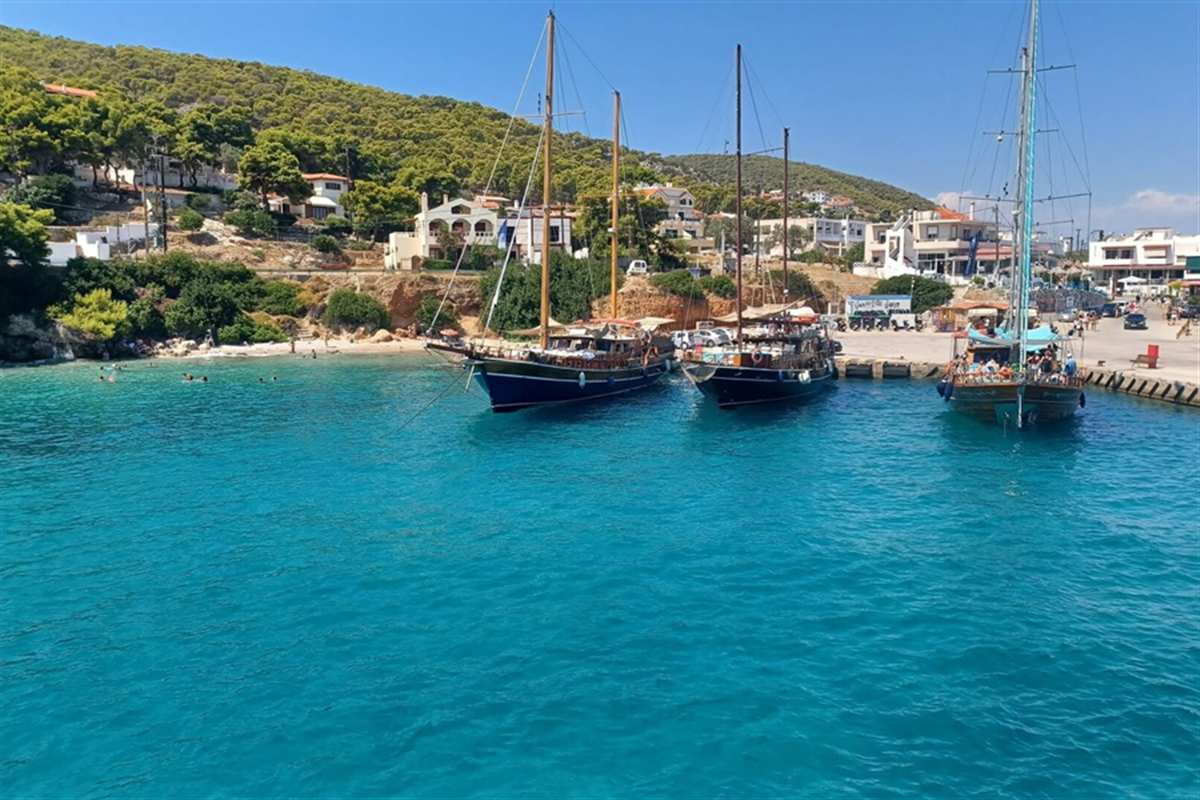
Agistri boat trip crosses the Saronic Gulf to a small pine-covered island, with the villages of Skala, Megalochori and Limenaria, the islet of Dragonera and the beaches of Aponisos and Chalikiada. The trip is one of the Greece Tours on Greece Ville, listed with the other Saronic islands tours and Greece boat tours.
This post covers what the trip is, the Saronic Gulf, Skala, Megalochori, Limenaria, Dragonera, the pine forests, the Arvanites, the beaches and the formats on sale. Common questions come last.
What is an Agistri boat trip?
An Agistri boat trip is a sea outing to Agistri, a small populated island and municipality in the Saronic Gulf, and it joins the crossing with swimming, a meal ashore and a walk between the small settlements before the return to the mainland.
Agistri appears in English texts as Agistri, Angistri and Agkistri. All three spellings name the same island, so an Agistri boat trip is listed under any of them on maps, ferry tables and tour cards.
Tourism is the primary industry on the island. Hotels and restaurants stand in both Skala and Megalochori, and an Agistri boat trip lands in a place whose economy rests on visitors.
Agriculture also forms part of the local economy beside tourism. A visit on an Agistri boat trip therefore meets a working island as well as a seaside one, with farming alongside the hotels and beach cafes.
The day trips from Athens post lists the other sea outings and land tours that leave the capital, and so shows the wider choice of departures from the capital and the coast.
This post follows the island in order: the gulf, the three settlements, Dragonera, the pine forest, the Arvanites and the other beaches. It then covers the boat formats on sale and the traveller questions.
- Names: Agistri, Angistri and Agkistri are spellings of one island.
- Status: Agistri is a small populated island and a municipality.
- Industry: Tourism is the primary industry of the island.
- Economy: Agriculture forms part of the local economy as well.
An Agistri boat trip is a short outing set in the Saronic Gulf, and the sections below explain what each settlement, each forest and each stretch of coast adds to the day.
Where does an Agistri boat trip sail in the Saronic Gulf?
The Agistri boat trip sails in the Saronic Gulf, a sea known to ancient writers, and it reaches an island that lies very close to Aegina and that has been associated with Kekryphaleia, a small island named in the First Peloponnesian War.
Kekryphaleia was a small island in the Saronic Gulf between Aegina and the coast of Epidaurus. An Agistri boat trip crosses the same waters that lie between those two places.
The precise identification of Kekryphaleia remains uncertain. It has been associated with the islets of Kyra and Spalathronisi, as well as with the island of Angistri, which is the island of this post.
The Aegina boat trip post covers the neighbouring island of Aegina, its ports and the sea routes across the gulf, and it sets out how boats link the two islands for passengers.
Pliny the Elder calls the island Cecryphalos and places it opposite Epidaurus, six miles distant from the mainland. He still distinguishes Pityonesos, his name for Angistri, from Cecryphalos.
Stephanus of Byzantium is the only ancient source to describe Kekryphaleia as a promontory of Aegina or Argolis. His account adds a third possibility to the debate over where the island stood.
- Ancient island: Kekryphaleia lay between Aegina and the coast of Epidaurus.
- Candidates: Kyra, Spalathronisi and Angistri have all been linked with it.
- Pliny: He names Angistri as Pityonesos and keeps it apart from Cecryphalos.
- Stephanus: He alone describes Kekryphaleia as a promontory.
An Agistri boat trip is therefore a crossing of a gulf with a long written record, ending at a smaller Saronic island whose ancient name scholars still debate.
What does an Agistri boat trip find in Skala?
An Agistri boat trip finds in Skala the settlement that holds the bulk of the tourist facilities and hotels of the island, a seaside place on the northern coast that a coastal road links with Milos, the main village of Agistri.
Skala is one of the three settlements of Agistri, and it is the one where tourist facilities and hotels gather. Visitors who stay or eat ashore after an Agistri boat trip therefore look to Skala first.
A coastal road links Skala with Milos, the main village. The two settlements share the northern shore, and each of them has a beach of its own on that coast.
Skala is a name shared with other places in Greece. Skala on Patmos is the main port of that island, and Skala in Cephalonia is a resort in the Ionian Islands.
Two more places called Skala exist, a municipality in Laconia and a settlement in Xanthi. An Agistri boat trip goes to none of them, so tickets pair the village name with the island name.
Local transport on Agistri includes a bus and taxis. An Agistri boat trip that ends in Skala can use them to reach the other settlements along the coast.
- Facilities: The tourist facilities and hotels of the island gather in Skala.
- Position: Skala lies on the northern coast beside Milos.
- Beach: The beach of Skala is one of the beaches in the north.
- Namesakes: Patmos, Laconia, Xanthi and Cephalonia each have a place called Skala.
Skala is the settlement that an Agistri boat trip meets first for services, and the next section turns to Megalochori, which holds the larger share of the population.
Why does an Agistri boat trip include Megalochori?
An Agistri boat trip includes Megalochori, also called Milos, the main and largest village of the island, where the majority of the population lives and where hotels, restaurants and a beach stand beside the sea on the northern coast of Agistri.
Milos, also written Megalochori, is the main village of Agistri. The majority of the island’s population lives there, which makes it the largest of the three settlements on the island.
Hotels and restaurants stand in Megalochori as well as in Skala. A beach lies on the northern coast beside the village, so an Agistri boat trip can pair a swim with a meal.
The name Megalochori is common in Greece. Villages with that name stand on the Methana peninsula, on Lesbos, on Santorini, in the Serres regional unit and in the Trikala regional unit.
Only one of these six places lies on Agistri, and an Agistri boat trip reaches that one. The others sit far from the Saronic Gulf, in other parts of the country.
Megalochori and Skala are neighbours on the same northern shore, joined by the coastal road. An Agistri boat trip can therefore include both settlements without a long transfer across the island.
- Other name: The village is also called Milos.
- Population: The majority of the people of Agistri live in this village.
- Shore: Megalochori lies on the northern coast with a beach of its own.
- Namesakes: Five other places in Greece are also called Megalochori.
Megalochori gives an Agistri boat trip its largest village, and the next section leaves the northern shore for Limenaria, the small village on the other side of the island.
What does an Agistri boat trip show at Limenaria?
An Agistri boat trip shows at Limenaria the quietest of the three settlements, a very small village on the other side of the island from Skala and Megalochori, where tourism stays very limited compared with the northern coast.
Limenaria is a very small village on the other side of Agistri, away from Skala and Megalochori. It has very little tourism, so it offers a contrast with the two northern settlements.
The name Limenaria belongs to a second village, on Thasos in northern Greece. The census of 2021 counted 2,428 residents there, and it is the second largest settlement on that island.
The Greek word behind the Thasos name is given as covelets. That village has a beach 1.2 km long, called Stelakis Beach, with smaller coves and pebbly beaches to the west.
The Thasos village has been a popular tourist destination since the 1960s, while the Agistri village has very little tourism. The two share only a name, and an Agistri boat trip reaches the small one.
Limenaria completes the set of three settlements on Agistri. An Agistri boat trip that visits all three covers the busy northern shore and the quiet side of the island.
- Size: Limenaria is a very small village.
- Tourism: The village has very little tourism.
- Position: It lies on the other side of the island.
- Namesake: A larger Limenaria stands on Thasos in northern Greece.
Limenaria shows the slower side of the island, and an Agistri boat trip that reaches it adds a village where the pace differs from the hotels of Skala.
What is Dragonera on an Agistri boat trip?
An Agistri boat trip reaches Dragonera as a popular beach on the western coast of Agistri, and the same name belongs to a separate islet in the Balearic Islands, an uninhabited natural park off the coast of Mallorca in Spain.
Dragonera is a popular beach on the western coast of Agistri, and Aponissos lies on the same coast. Beach days on an Agistri boat trip centre on this western shore.
Sa Dragonera is an uninhabited islet in the Balearic Islands, just off the west coast of Mallorca. It is a natural park and a different place from the beach on Agistri.
The Balearic name means dragon island. The silhouette of the mountain range on that islet vaguely resembles a dragon, which gave the place its name, and the Agistri beach has no such origin in these sources.
The Balearic islet is about 3,200 metres long and has a maximum width of 500 metres. Its highest hill, Pico Popi, is only 360 metres high, yet the relief of the islet is abrupt.
Two lighthouses, Tramuntana in the north and Llebeig in the southwest, began to operate there in 1910. In 1995 the Balearic government declared the islet a natural park.
- Agistri beach: Dragonera is a popular beach on the western coast.
- Companion beach: Aponissos lies on the same western coast.
- Balearic islet: Sa Dragonera is uninhabited and lies off Mallorca.
- Park: The islet received natural park status in 1995.
An Agistri boat trip lands on the beach, not on the islet, and the shared name is a reminder to read the island name on every ticket and map.
What do the pine forests add to an Agistri boat trip?
An Agistri boat trip meets the Aleppo pine, Pinus halepensis, a Mediterranean conifer with orange-red bark and paired needles, and it meets the chukar partridge and the peafowl, two ground-living birds that share the pine woods of the island.
Pinus halepensis reaches a height of 15 to 25 metres, and its trunk measures up to 60 centimetres across. The bark is orange-red and deeply fissured at the base, and thin and flaky in the upper crown.
The needles are 6 to 12 cm long and grow in pairs. The cones ripen to red-brown after 24 months and open slowly, and heat from forest fires speeds the opening of the cones.
The botanist Philip Miller named the species in 1768. Its seeds are 5 to 6 millimetres long with a wing of 20 mm, and the wind carries them. The resin flavours the Greek wine retsina.
The chukar partridge is 32 to 35 cm long, with a white face, a black gorget, red legs and a coral red bill. Its name comes from its noisy call, chuck-chuck-chukar.
The peafowl lives mainly on the ground in open forests, where it forages for berries and grains. It also preys on snakes, lizards and small rodents, and its loud calls warn of a predator.
- Height: The Aleppo pine reaches 15 to 25 metres.
- Bark: The bark is orange-red and fissured at the base.
- Needles: They are 6 to 12 cm long and grow in pairs.
- Chukar: The partridge is 32 to 35 cm long with red legs.
The forest gives an Agistri boat trip its shade and its birds, and the pine itself links the island with the retsina made across Greece.
Who are the Arvanites met on an Agistri boat trip?
An Agistri boat trip reaches an island whose community descends from Arvanites, a population group in Greece of Albanian origin, whose Arvanitika dialect belongs to the Tosk group of Albanian and is now endangered as speakers shift to Greek.
Arvanites are a population group in Greece of Albanian origin. Their name rests on the root arb or alb, an old ethnonym once used by all Albanians, and the Greek historian Polybius records the place-name Arvon.
Arvanites were the dominant population element in parts of the Peloponnese, Attica and Boeotia until the 19th century. Groups from these communities later moved on to Italy, where their descendants form the Arbereshe community.
Arvanitika belongs to the Tosk dialect group of Albanian and preserves elements of medieval Albanian, with strong influence from Greek. It is almost wholly spoken today, and the Greek-based Arvanitic alphabet is rarely used.
The role of the Arvanites in the Greek War of Independence and their shared Orthodox Christian faith led to their acceptance as part of the Greek nation. Today almost all of them identify as Greeks.
Younger members of the community largely no longer speak Arvanitika, so an Agistri boat trip meets a language in decline. The Hydra day trip post covers a sea outing to the island of Hydra.
- Name: The name rests on the old root arb or alb.
- Dialect: Arvanitika belongs to the Tosk group of Albanian.
- Script: The Greek-based Arvanitic alphabet is rarely used.
- Identity: Almost all Arvanites identify as Greeks.
The Arvanites give an Agistri boat trip its human history, and the community still lives on the island that the boat reaches.
Which beaches does an Agistri boat trip offer at Aponisos and Chalikiada?
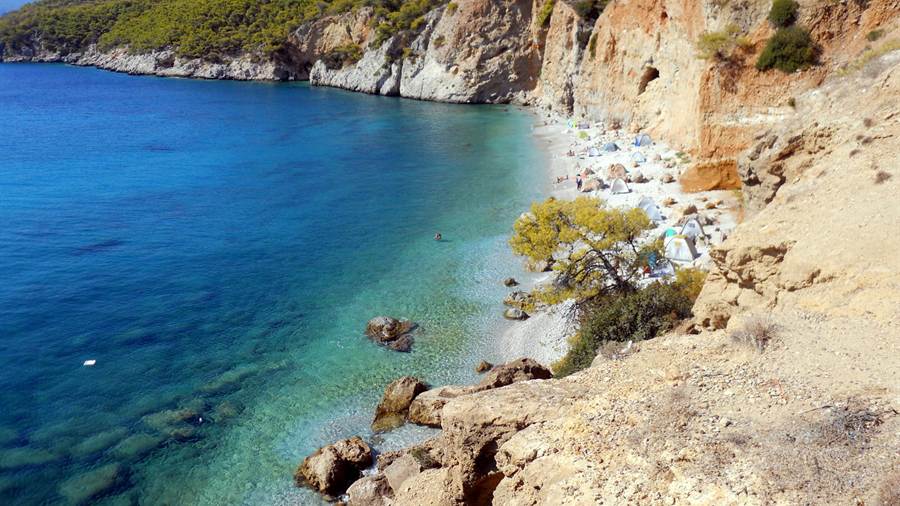
An Agistri boat trip offers beaches on every side of the island, and Chalikiada, spelt Halikiada in English texts, is the beach on the eastern coast that is popular for naturism, while Aponisos lies on the western coast.
Chalikiada lies on the eastern coast of Agistri and is popular for naturism. That use sets it apart from the beaches of the two northern villages, where hotels and restaurants stand nearby.
Aponisos, also written Aponissos, lies on the western coast. The beaches of Megalochori and Skala lie in the north, beside the hotels and restaurants of those two villages on the shore.
The island has a long history of free camping, a practice that the rule on forest tents now limits. An Agistri boat trip lands on a coast that has long drawn visitors.
On neighbouring Aegina the beaches are also a popular tourist attraction, so beach time on an Agistri boat trip belongs to a wider habit of island days in the Saronic Gulf.
Popular beaches ring the island on the west, north, south and east. Mariza lies in the south and Skliri in the east, so an Agistri boat trip has a choice of shores.
- Chalikiada: It lies on the eastern coast and is popular for naturism.
- Aponisos: It lies on the western coast of the island.
- Northern shore: The beaches of Megalochori and Skala lie in the north.
- Camping: The island has a long history of free camping.
The beaches complete the picture of an Agistri boat trip, because the island has swimming places on all four of its coasts.
Which formats of an Agistri boat trip are on sale?
An Agistri boat trip is on sale as plain ferry tickets, as group cruises with lunch and swimming stops, as sailing yacht cruises and as a two-day sailing trip, and each format links Agistri with Aegina, Moni or Metopi.
Three ferry formats cover the plain crossing: a ferry boat ticket to and from Agistri Island, ferry journeys between Athens and Agistri Island, and ferry journeys connecting Aegina and Agistri Islands.
A cruise to Agistri, Moni and Aegina with lunch is the three-island format, and a similar cruise adds drinks. A one-day four-island cruise adds Metopi and Salamina to Agistri and Aegina.
The swimming cruises include an official Aegina, Agistri and Metopi swimming cruise, an Agistri, Moni or Metopi and Aegina day cruise with swimming, and a similar swimming cruise with lunch.
Sailing formats include an Agistri, Moni and Aegina sailing yacht cruise and a two-day Aegina, Moni and Agistri sailing trip. A cruise with meals and drinks also visits Agistri, Metopi and Aegina.
A small-group half-day cruise leaves from Perdika for Moni and Agistri. That format keeps the group small and the outing short, and it starts from Aegina instead of the capital.
- Ferry: Ferry tickets and ferry journeys cover the plain crossing.
- Group cruise: The cruises combine Agistri with Aegina, Moni or Metopi.
- Sailing: Sailing yacht cruises and a two-day sailing trip are listed.
- Small group: A half-day cruise from Perdika serves Moni and Agistri.
The tour cards and availability boxes on this page list live dates for every Agistri boat trip format, so the current choices appear there rather than in this text.
What do travellers ask about an Agistri boat trip?
An Agistri boat trip raises four steady questions about the settlements, the pine woods, the Arvanites and the formats on sale, and the answers below draw on the sections above to give clear short replies for each question.
Which settlements does an Agistri boat trip reach?
An Agistri boat trip reaches the island of three settlements: Milos, also called Megalochori, Skala and Limenaria. Milos is the main village, Skala holds the tourist facilities and hotels, and Limenaria is a very small village with very little tourism. Each one differs in size and in pace.
What wildlife does an Agistri boat trip meet?
An Agistri boat trip meets Aleppo pine woods, where the cones open in the heat of forest fires, and two birds. The chukar partridge has red legs and a noisy call, and the introduced peafowl forage on the ground for berries and grains. The pine itself shapes the forest that all of them share.
Who lives on the island of an Agistri boat trip?
An Agistri boat trip reaches an island whose community descends from Arvanites, a Greek population group of Albanian origin. Their Arvanitika dialect belongs to the Tosk group of Albanian, and almost all Arvanites identify today as Greeks. Younger members of the community largely no longer speak the dialect.
Which formats of an Agistri boat trip are on sale?
An Agistri boat trip is on sale as ferry tickets between Athens, Aegina and Agistri, as group cruises with lunch and swimming, as sailing yacht cruises and as a small-group half-day cruise from Perdika to Moni and Agistri. Each format carries its own list of stops.
Featured photo: Sarah Samoraj, CC BY 4.0, via Wikimedia Commons.