
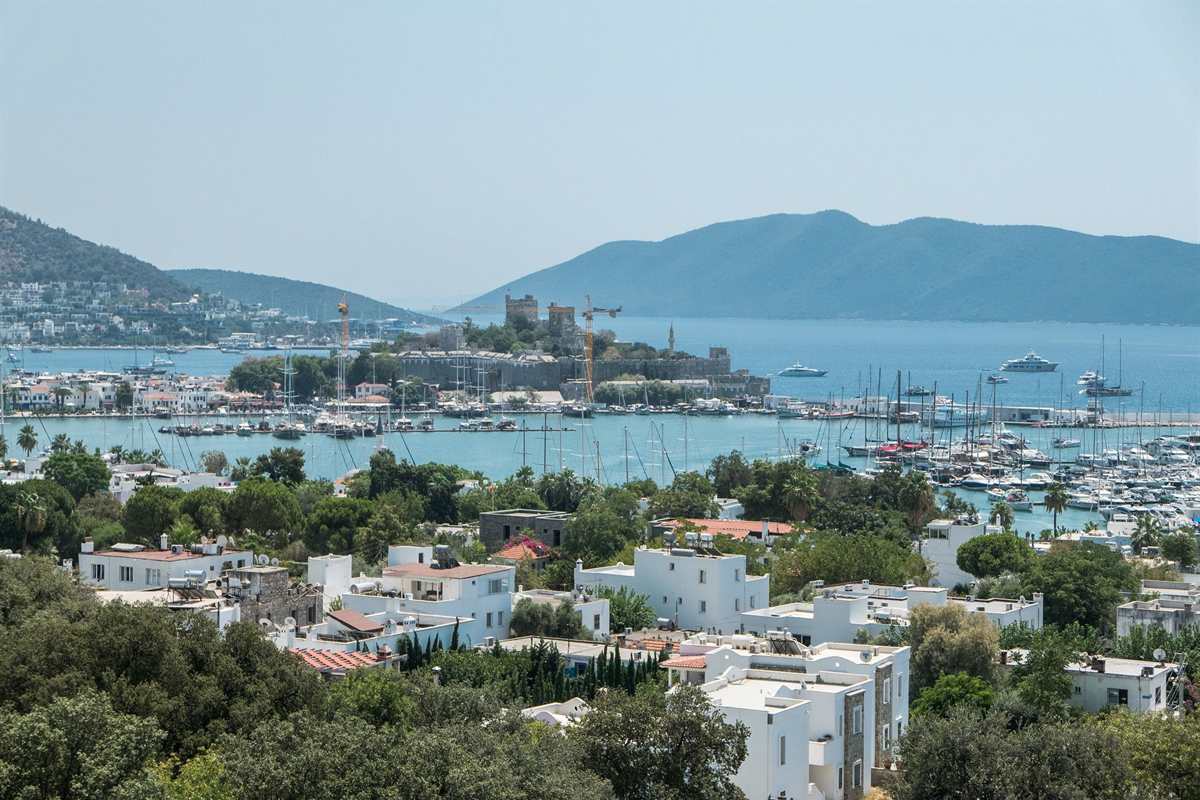
A Kos to Bodrum day trip crosses from Kos, the third largest island of the Dodecanese, to Bodrum on the Turkish coast and returns the same day. Bodrum stands on the site of ancient Halicarnassus, home of the Mausoleum and of Herodotus. The trip is one of the Greece Tours on Greece Ville.
This post covers the papers for Turkey, the crossing, the formats on sale, the links between Kos and Halicarnassus, Kos town, Bodrum Castle and its underwater museum, the Uluburun wreck, the Mausoleum, Herodotus, the sponge divers, modern Bodrum and the questions that come up before booking.
What is a Kos to Bodrum day trip?
A Kos to Bodrum day trip is a same-day sea crossing from Kos, the third largest island of the Dodecanese, to Bodrum on the Turkish coast and back. Bodrum stands on the site of ancient Halicarnassus, a major city of Caria.
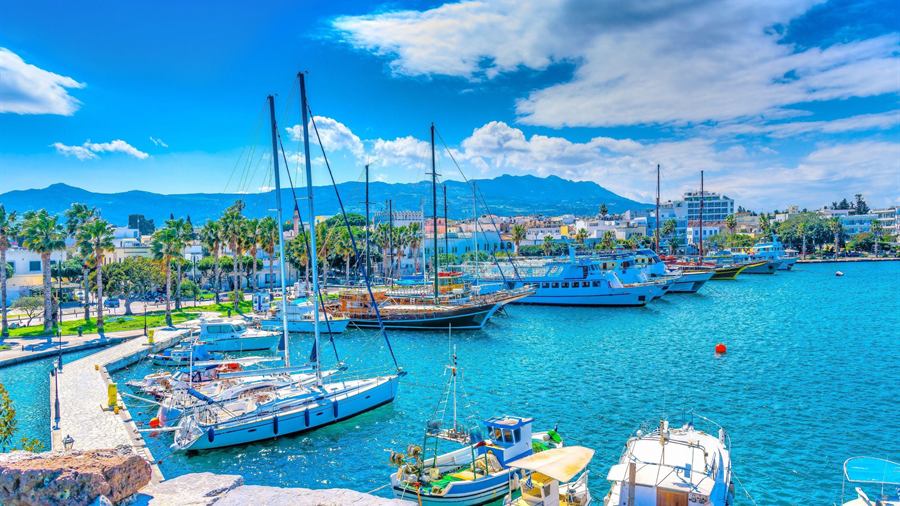
Kos is the third largest island of the Dodecanese, after Rhodes and Karpathos. With 37,089 residents at the 2021 census, only Rhodes has more people in the group.
Bodrum is a town and district of Muğla Province in Turkey. Its port has ferries to nearby Turkish and Greek ports and islands, and Kos is the main one of those links.
In classical antiquity Bodrum was Halicarnassus, a major city of Caria. A Kos to Bodrum day trip therefore crosses from one ancient Greek city to the site of another.
Two airports serve Bodrum, Milas–Bodrum Airport and Kos International Airport. The airport on the Greek island counts as one of the main air links of the Turkish town across the water.
- Start: Kos town, the main port of the island.
- Arrival: Bodrum, a town and district of Muğla Province in Turkey.
- Ancient name: Halicarnassus, a major city of Caria.
- Main sights: Bodrum Castle, its underwater archaeology museum and the site of the Mausoleum.
The sections below cover the papers, the crossing, the formats on sale and each sight that a Kos to Bodrum day trip reaches in the Turkish town.


Which papers does a Kos to Bodrum day trip need for Turkey?
A Kos to Bodrum day trip needs a passport valid for at least 60 days beyond the maximum stay, or an identity card for citizens of listed countries. Visitors from outside the visa-exempt list need a visa or an e-Visa.
Turkey asks visitors to obtain a visa from a Turkish diplomatic mission. The exceptions are citizens of visa-exempt countries and citizens who qualify for an e-Visa.
Ordinary passports must stay valid for at least 60 days beyond the maximum length of stay. British citizens, for example, receive up to 90 days within any 180 days, so their passports need at least 150 days of validity.
Citizens of Greece, Germany, Italy, France, Belgium, the Netherlands, Poland, Portugal, Romania, Spain, Switzerland, Bulgaria, Hungary, Luxembourg, Malta and Liechtenstein can visit Turkey with an identity card instead of a passport.
Citizens of Belgium, France, Luxembourg, Portugal, Spain and Switzerland can also enter with a passport that expired less than five years earlier. A Kos to Bodrum day trip for German citizens accepts a passport or identity card expired for less than one year.
- Passport validity: At least 60 days beyond the maximum stay.
- Identity card: Accepted for citizens of a listed set of European countries.
- Visa: Needed by citizens outside the visa-exempt and e-Visa lists.
- Expired documents: Accepted within set limits for six listed countries and Germany.
Turkey uses the lira, with the sign ₺, the code TRY and the abbreviation TL, so a Kos to Bodrum day trip also crosses into a different currency.
How does a Kos to Bodrum day trip cross to Bodrum port?
A Kos to Bodrum day trip leaves from Kos town, the main port of the island, and lands in Bodrum. Tours on sale name a same-day return ferry ticket from the castle port and a ticket from the Bodrum cruise port.
Kos town is the main port and population centre on the island. It is also a tourist and cultural centre, with whitewashed buildings, hotels, restaurants and a row of nightclubs known as the “bar street”.
The port of Bodrum has ferries to nearby Turkish and Greek ports and islands. Kos is the main destination of these ferries.
Listings for this crossing name two Bodrum ports. One ticket runs from the castle port, and another ticket runs from the Bodrum cruise port for the return to Kos.
Bodrum is a port town at the entrance to a long gulf of the Aegean Sea, and Kos lies along the entry into the same gulf. A Kos to Bodrum day trip therefore crosses the mouth of that gulf.
- Kos side: Kos town, the main port of the island.
- Bodrum side: The castle port and the cruise port.
- Main link: Kos is the main ferry destination from Bodrum.
- Air links: Milas–Bodrum Airport and Kos International Airport.
Shorter sea outings around Kos itself are covered in the Kos boat trip post, alongside the crossing to Turkey.
Which Kos to Bodrum day trip formats are on sale?
A Kos to Bodrum day trip comes as an independent day trip from Kos with ferry tickets included, or as a day exploration of Bodrum with a hotel transfer. Ferry day trips with hotel transfers also run the other way, from Bodrum to Kos.
The independent format from Kos covers the return crossing and leaves the visit in Bodrum to the traveller. The return ferry tickets are part of the listing, which appears under the same name on two booking platforms.
A second listing from Kos offers a day exploration in Bodrum with a hotel transfer. It suits travellers who prefer one booking for the transfer, the crossing and the day in the Turkish town.
Listings from Bodrum to Kos run the same route in the opposite direction, with ferry tickets and hotel transfers or pickups. They show that the crossing serves visitors on both sides of the border.
Same-day return tickets leave from the castle port and the cruise port of Bodrum. A Kos to Bodrum day trip in every format follows the Turkish entry rules set out above, so the passport or identity card stays with the traveller.
- Independent day trip: Return ferry tickets from Kos, with a free day in Bodrum.
- Day exploration: A day in Bodrum with a hotel transfer from Kos.
- Reverse trips: Day trips from Bodrum to Kos with ferry and hotel transfer.
- Same-day tickets: Return tickets from the castle port and the cruise port of Bodrum.
The tour cards and availability boxes on this page list live dates for each Kos to Bodrum day trip format, with the departure points named in each listing.
What links Kos and Halicarnassus on a Kos to Bodrum day trip?
A Kos to Bodrum day trip joins two members of the ancient Doric Hexapolis, a league of six cities that included Kos, Halicarnassus, Cnidus, Lindos, Kameiros and Ialysos. Halicarnassus later lost its place in the league over a prize tripod.
The early history of Kos as a member of the Doric Hexapolis is obscure. The league joined Kos with Lindos, Kameiros and Ialysos on Rhodes, with Knidos and with Halicarnassus on the mainland.
Halicarnassus was expelled from the league after one of its citizens, Agasicles, took home the prize tripod he had won at the Triopian games. Custom asked winners to dedicate the tripod to the Triopian Apollo.
In Turkish, Kos is known as İstanköy. The name, like the older Romance forms Stancho, Stanchio and Stinco, comes from a reading of the Greek words for “to Kos”.
Modern sponge diving took hold in Bodrum after Koan and Cretan immigrants settled in the town in the early 1920s. A Kos to Bodrum day trip thus links two towns that shared people as well as a sea.
- League: The Doric Hexapolis of six cities, Kos and Halicarnassus among them.
- Expulsion: Halicarnassus left the league after Agasicles kept a prize tripod.
- Turkish name: İstanköy, from the Greek words for “to Kos”.
- Settlers: Koan and Cretan immigrants who brought sponge diving to Bodrum.
The villages and ancient sites of Kos are covered in the Kos island tour post, for the days before or after the crossing.
What does Kos town show before a Kos to Bodrum day trip?
A Kos to Bodrum day trip starts in Kos town, whose Hellenistic growth brought a theatre, a new market with stoas and the expansion of the Asclepeion. In 240 BC three kings guaranteed the Asclepeion of Kos as an asylum.
In the 3rd and 2nd centuries BC, Kos built a theatre, a new market with multiple stoas, a temple of Apollo at Alisarna and richly decorated houses. Fortification works at Alisarna date from the same period.
The Asclepeion was built and expanded in the same centuries. In 240 BC Ziaelas of Bithynia, Seleucus II Callinicus and Ptolemy III Euergetes guaranteed its change into an asylum.
Kos first became a centre of learning under the Ptolemaic dynasty. Hippocrates, the painter Apelles and the poet Philitas came from the area, and possibly Theocritus as well.
A Hellenistic medical school stood on the island. The theory that Hippocrates founded this school in the Classical age is an unwarranted extrapolation.
- Theatre and market: Built in the 3rd and 2nd centuries BC.
- Asclepeion: Expanded in the Hellenistic age and made an asylum in 240 BC.
- Learning: A centre under the Ptolemies, home of Hippocrates and Apelles.
- Villages: Kardamena, Kefalos, Tigaki, Antimachia, Mastihari, Marmari and Pyli.
A Kos to Bodrum day trip begins at the harbour of this town, and boat outings from Kos to a volcanic island nearby are covered in the Nisyros volcano tour post.
Who was Hippocrates of Kos on a Kos to Bodrum day trip?
A Kos to Bodrum day trip leaves the island of Hippocrates of Kos, the Greek physician of about 460 to 370 BC called the “Father of Medicine”. His school set medicine apart from theurgy and philosophy and made it a profession.
Hippocrates of Kos is also known as Hippocrates II, after his grandfather Hippocrates I. He was a physician and philosopher of the classical period and one of the leading figures in the history of medicine.
His title “Father of Medicine” comes from his use of prognosis and clinical observation and from his systematic grouping of diseases. The humoral theory linked with his name was later discredited.
The works linked with his name form the Hippocratic Corpus. These texts summed up the medical knowledge of earlier schools and set out acceptable practices for physicians.
Little is known for certain about what Hippocrates himself thought, wrote and did. His achievements were mixed over time with those of later practitioners of Hippocratic medicine and the writers of the Corpus.
- Dates: About 460 to 370 BC.
- Title: “Father of Medicine”.
- Methods: Prognosis, clinical observation and the grouping of diseases.
- Texts: The Hippocratic Corpus.
A Kos to Bodrum day trip thus links the home of the father of medicine with the home town of the father of history on the Turkish coast.
How did Kos pass to Greece before a Kos to Bodrum day trip?
A Kos to Bodrum day trip starts on an island that was Ottoman until 1912, Italian from 1912, German-occupied until 1945, a British protectorate after that, and part of the Kingdom of Greece from 1947 under the Paris Peace Treaty.
The Ottoman census of 1881/82 to 1893 counted 12,965 people in the kaza of İstanköy, as Kos was called. There were 10,459 Greeks, 2,439 Muslims and 67 Jews.
The Kingdom of Italy occupied the island in 1912 and took it over after the Italo-Turkish War. In Italian the island is known as Coo.
In the Second World War the island stayed under Axis control as an Italian possession until the Italian surrender. German troops then held Kos until 1945.
In 1945 Kos became a protectorate of the United Kingdom. Britain ceded it to the Kingdom of Greece in 1947, following the Paris Peace Treaty, so a Kos to Bodrum day trip crosses a border that dates from that year.
- Ottoman census: 12,965 people, 10,459 of them Greeks.
- Italian rule: From 1912.
- German occupation: Until 1945.
- Greece: From 1947, after the Paris Peace Treaty.
Kos and Bodrum both lay inside the Ottoman Empire until 1912, and a state border has separated them since.
How did the Knights tie Kos to a Kos to Bodrum day trip?
A Kos to Bodrum day trip follows a link made by the Knights Hospitaller, who held Kos, then known as Lango, and built Bodrum Castle from 1402 as a stronghold on the mainland. Their headquarters stood on the island of Rhodes.
Under the rule of the Knights Hospitaller of Rhodes, Kos was known as Lango, a name taken from the length of the island. The Knights held the island while paying a rent to the Genoese republic.
Two towers rose in the south-east and south-west sections of the castle of Kos during the raids of Yıldırım Bayezid between 1391 and 1396. Kos faced its first serious Ottoman attack in 1455.
Facing the Ottoman Sultanate, the Knights needed a further stronghold on the mainland. They began Bodrum Castle, the Castle of Saint Peter or Petronium, from 1402 onwards.
During the conquest of Rhodes in 1522, Kos passed to the Ottomans under the terms of the agreement. Bodrum Castle followed in 1523, when the Ottoman Empire took it over.
- Kos name: Lango, under the Knights Hospitaller of Rhodes.
- Kos towers: Built during raids between 1391 and 1396.
- Bodrum Castle: Built from 1402 as a stronghold on the mainland.
- Ottoman rule: Kos in 1522 and Bodrum Castle in 1523.
The headquarters of the same order on Rhodes are covered in the Rhodes old town tour post, the third point of the triangle that a Kos to Bodrum day trip opens.
What does Bodrum Castle show on a Kos to Bodrum day trip?
A Kos to Bodrum day trip reaches Bodrum Castle, begun in 1404 under the German knight architect Heinrich Schlegelholt. Four towers carry the names of the nations that built them, the English, French, German and Italian towers, and seven gates lead inside.
Each langue of the Order had its own tower, built in its own style. The castle was a transnational effort, and the tower names still record which nation of the Order was responsible for each part.
The architect used the latest ideas in castle design. The passages to the gates are full of twists and turns, so attackers found no cover against arrows, stones and heated projectiles.
Above the gates and on the walls the Knights placed hundreds of painted coats of arms and carved reliefs. A Kos to Bodrum day trip passes these marks on the way through the seven gates.
The three-storey English tower was finished in 1413 and was reachable only by a drawbridge. A relief on the tower gave it a second name, the Lion Tower.
- Start of work: 1404, under Heinrich Schlegelholt.
- Towers: English, French, German and Italian.
- Gates: Seven, reached through twisting passages.
- English tower: Three storeys, finished in 1413, also called the Lion Tower.
The Knights also built Bodrum Castle with squared green volcanic stone and with marble columns and reliefs taken from the nearby Mausoleum of Halicarnassus.
How did Bodrum Castle change over the centuries of a Kos to Bodrum day trip?
A Kos to Bodrum day trip sees a castle that changed hands and uses: its chapel rose around 1406, its first walls closed in 1437, Spanish Knights rebuilt the chapel in 1519 and 1520, and the Ottomans took the castle in 1523.
The chapel was among the first inner buildings, completed around 1406 or 1407. The first walls of the castle followed in 1437, three decades after the start of work.
Spanish Knights of Malta rebuilt the chapel in the Gothic style in 1519 and 1520. Their names appear on two cornerstones of the façade of the chapel.
The castle started a new phase of building in the late 15th century, only to pass to the Ottoman Empire in 1523. The Ottomans turned the chapel into a mosque and added a minaret.
The castle stood empty after the First World War. In the early 1960s it became the home of the Bodrum Museum of Underwater Archaeology, which a Kos to Bodrum day trip visits inside the walls.
- Chapel: Around 1406 or 1407, rebuilt in Gothic style in 1519 and 1520.
- First walls: Completed in 1437.
- Ottoman era: From 1523, with the chapel turned into a mosque.
- Museum: Since the early 1960s.
The castle therefore holds two layers of history: the fortress of the Knights and the museum of finds from the sea.
What does the Museum of Underwater Archaeology hold on a Kos to Bodrum day trip?
A Kos to Bodrum day trip inside the castle reaches the Bodrum Museum of Underwater Archaeology, home of the Uluburun shipwreck, a Late Bronze Age ship of the late 14th century BC found in 1982 near the east shore of Uluburun.
Mehmed Çakir, a local sponge diver from Yalıkavak, a village near Bodrum, found the wreck in the summer of 1982. His sketch of “metal biscuits with ears” pointed to oxhide ingots.
Oğuz Alpözen, Director of the Bodrum Museum of Underwater Archaeology, sent a team of the museum and of the Institute of Nautical Archaeology to find the site. The team located copper ingots 50 metres from the shore.
The Institute of Nautical Archaeology began the excavation in July 1984. The work ended in September 1994, after ten years of diving on the wreck.
Since then the conservation, study and sampling of the finds have continued in the conservation laboratory of the Bodrum museum. A Kos to Bodrum day trip meets the results of that work in the halls of the castle.
- Date of the ship: Late 14th century BC, in the Late Bronze Age.
- Discovery: 1982, by a sponge diver from Yalıkavak.
- Excavation: From July 1984 to September 1994.
- Clue: Oxhide ingots, sketched as “metal biscuits with ears”.
The museum fills the castle that the Knights built, so one visit covers the fortress and the finds from the sea floor.
Where was the Uluburun ship heading, as shown on a Kos to Bodrum day trip?
A Kos to Bodrum day trip to the museum tells the story of a ship that sailed from a Cypriot or Syro-Canaanite port towards the west of Cyprus. Rhodes and the Mycenaean palaces of mainland Greece are both proposed as its final port.
The cargo points to a start in a Cypriot or Syro-Canaanite port. The ship was sailing to the region west of Cyprus when it sank off the Turkish coast.
The final destination is known only from where objects like those on board turn up. A port in the Aegean Sea is the proposal that the finds support.
Rhodes, an important redistribution centre for the Aegean at the time, is one suggested destination. The excavators named one of the Mycenaean palaces of mainland Greece as the probable final port.
Peter Kuniholm of Cornell University tried to date the ship by its timber rings. He later warned that the poor quality of the sample does not allow an especially strong date.
- Start: A Cypriot or Syro-Canaanite port.
- Course: Towards the region west of Cyprus.
- Possible end: Rhodes or a Mycenaean palace in mainland Greece.
- Dating: Tree-ring work by Peter Kuniholm, with a cautious result.
The proposed route links the wreck with Rhodes and the Aegean, the same sea that a Kos to Bodrum day trip crosses between the two coasts.
What cargo did the Uluburun ship carry, as shown on a Kos to Bodrum day trip?
A Kos to Bodrum day trip to the museum shows the cargo of the Uluburun ship: ten tons of raw copper in 354 oxhide ingots and 121 bun and oval ingots, about one ton of tin, glass beads and jars of terebinth resin.
The ten tons of copper came as 354 oxhide ingots, rectangular with handholds at each corner, plus 121 bun and oval ingots. Lead-isotope analysis traces the copper to Cyprus.
About one ton of tin travelled with the copper, enough to make about 11 tons of bronze. In 2022 one third of the tin was traced to the Mušiston mine in Uzbekistan.
The ship was built with planks and a keel of Lebanese cedar, joined with oak tenons. Lebanese cedar grows in the mountains of Lebanon, southern Turkey and central Cyprus.
A gold scarab engraved with the name of Nefertiti shows that the ship sank no earlier than her time. Jars on board held glass beads, olives and Pistacia resin, an ancient type of turpentine.
- Copper: Ten tons, from Cyprus.
- Tin: About one ton, part of it from Uzbekistan.
- Hull: Lebanese cedar with oak tenons.
- Date clue: A gold scarab with the name of Nefertiti.
A Kos to Bodrum day trip meets this cargo in the castle halls, where the conservation laboratory of the museum keeps working on the finds.
What remains of the Mausoleum on a Kos to Bodrum day trip?
A Kos to Bodrum day trip reaches the site of the Mausoleum at Halicarnassus, the tomb built between 353 and 351 BC for Mausolus and his sister-wife Artemisia II. Antipater of Sidon listed it among the Seven Wonders of the Ancient World.
Mausolus was an Anatolian from Caria and a satrap in the Achaemenid Persian Empire. With Artemisia he ruled from Halicarnassus over the surrounding territory for 24 years.
The tomb stood about 45 metres high. Four Greek sculptors decorated its four sides with reliefs: Leochares of Athens, Bryaxis of Halicarnassus, Scopas of Paros and Timotheus.
Mausolus died in 353 BC, and Artemisia ruled alone for only two years after his death. According to Pliny the Elder, the craftsmen stayed on to finish the work after the death of their patron.
The fame of the tomb turned the name of Mausolus into a word. A Kos to Bodrum day trip ends at the source of the term mausoleum, now used for any stately tomb above ground.
- Built: Between 353 and 351 BC.
- Height: About 45 metres.
- Sculptors: Leochares, Bryaxis, Scopas and Timotheus.
- Fame: One of the Seven Wonders listed by Antipater of Sidon.
Scopas, one of the four sculptors, also supervised the rebuilding of the Temple of Artemis at Ephesus.
How was the Mausoleum lost before a Kos to Bodrum day trip?
A Kos to Bodrum day trip finds only the site of the Mausoleum, because successive earthquakes destroyed it between the 12th and 15th centuries. It was the last of the six destroyed wonders to fall, and the Knights reused its stones for Bodrum Castle.
The Mausoleum lasted longer than every other lost wonder of the ancient world. Successive earthquakes from the 12th to the 15th century brought it down, one stage after another.
When the Knights of Saint John arrived in 1402, they recorded the Mausoleum as already in ruins. They used its stones to fortify their castle at Bodrum and decorated the new building with its reliefs.
In 1846 Lord Stratford de Redcliffe obtained permission to remove the reliefs from the castle. A Kos to Bodrum day trip therefore meets the Mausoleum in pieces, part in the castle walls and part removed from the castle in 1846.
The site of the tomb was first pointed out by Professor Donaldson and later found for certain by Charles Newton. An expedition sent by the British government followed his discovery.
- Cause of loss: Earthquakes from the 12th to the 15th century.
- Record: The last surviving of the six destroyed wonders.
- Reuse: Stones and reliefs built into Bodrum Castle by the Knights.
- Rediscovery: The site identified by Charles Newton.
A Kos to Bodrum day trip that pairs the castle with the site of the tomb sees both ends of this story, the source of the stones and the walls that took them in.
How did Halicarnassus grow before a Kos to Bodrum day trip?
A Kos to Bodrum day trip walks over Halicarnassus, a Dorian colony founded by settlers from the Peloponnese on what was first an island. The island joined the mainland over time, and the city absorbed Salmacis, an older town of the Leleges and Carians.
The traditions on the founding of Halicarnassus differ, but they agree that it was a Dorian colony. Its coins, with the head of Medusa, Athena or Poseidon or a trident, point to Troezen and Argos as mother cities.
The name is thought to come from Carian, a Luwic language spoken alongside Greek in the city. Its Carian form appears in inscriptions as alos k̂arnos, according to a tentative reading.
Hecatomnus became king of Caria, then part of the Persian Empire, and ruled from 404 to 358 BC. His son Mausolus moved the capital from Mylasa to Halicarnassus.
The builders of Mausolus raised a fortified palace on one side of the harbour, with views out to sea and inland to the hills. They also built walls, watchtowers, a Greek-style theatre and a temple to Ares.
- Founders: Dorian settlers from the Peloponnese.
- Site: An island that joined the mainland and absorbed Salmacis.
- Language: Carian spoken alongside Greek.
- Capital: Moved from Mylasa to Halicarnassus by Mausolus.
The modern town of Bodrum stands on the site of this ancient city, so a Kos to Bodrum day trip lands where Halicarnassus once stood.
Who was Herodotus of Halicarnassus on a Kos to Bodrum day trip?
A Kos to Bodrum day trip reaches the home town of Herodotus, the Greek historian and geographer from Halicarnassus whom Cicero called “The Father of History”. His Histories give a detailed account of the Greco-Persian Wars and the rise of Cyrus.
Herodotus came from Halicarnassus, then under Persian control in the 5th century BC. He later became a citizen of Thurii, a city in modern Calabria in Italy.
The Histories cover the rise of the Achaemenid dynasty of Cyrus and the lives of prominent kings. They also describe the battles of Marathon, Thermopylae, Artemisium, Salamis, Plataea and Mycale.
Lygdamis, the tyrant of Halicarnassus, had the poet Panyasis put to death and forced Herodotus to leave his native city. Herodotus is possibly the best known citizen that Halicarnassus produced.
In the early 5th century BC Halicarnassus was under Artemisia I of Caria. She made herself famous as a naval commander at the battle of Salamis, one of the battles that Herodotus described.
- Herodotus: Historian from Halicarnassus, “The Father of History”.
- Work: The Histories, on the Greco-Persian Wars.
- Exile: Forced out by the tyrant Lygdamis.
- Artemisia I: Naval commander of Halicarnassus at Salamis.
A Kos to Bodrum day trip thus crosses to the city that produced both the historian of the Persian Wars and a commander at one of the battles he described.
How did Bodrum turn from sponge diving to tourism on a Kos to Bodrum day trip?
A Kos to Bodrum day trip visits a town that lived from fishing and sponge diving until the 20th century. Between 1945 and 1965 about 150 boats dived for sponges from Bodrum, before tourism became the main industry in the late 20th century.
Bodrum was a quiet town of fishermen and sponge divers until the early 20th century. Naked sponge diving in the Aegean goes back at least 3,000 years.
Modern sponge diving spread in Bodrum after Koan and Cretan immigrants settled in the town in the early 1920s. They came after the population exchange between Greece and Turkey.
In the golden age of the trade, between 1945 and 1965, about 150 boats worked in sponge diving from Bodrum. Sponge diseases, artificial sponges and a ban on sponge diving later ended the trade.
After the 1950s a circle of intellectuals formed around the writer Cevat Şakir Kabaağaçlı. He wrote under the pen name Halikarnas Balıkçısı, “The Fisherman of Halicarnassus”, and tourism followed as the new income.
- Old economy: Fishing and sponge diving.
- Golden age: About 150 sponge boats between 1945 and 1965.
- End of the trade: Disease, artificial sponges and a ban.
- Writer: Cevat Şakir Kabaağaçlı, “The Fisherman of Halicarnassus”.
The sponge diver who found the Uluburun wreck came from Yalıkavak near Bodrum, so the old trade of the town also gave the museum the Uluburun find.
What does modern Bodrum show on a Kos to Bodrum day trip?
A Kos to Bodrum day trip lands in a district of Muğla Province whose municipality covers the whole Bodrum Peninsula, an area of 689 square kilometres with 215 kilometres of coast. Bodrum became an Ottoman sub-district in 1871 and a district in 1872.
Bodrum Municipality works with 18 directorates and subsidiary units across the peninsula. The province of Muğla belongs to the Aydın Subregion of the Aegean Region of Turkey.
Farming brought little reward on the dry peninsula, which stopped the rise of a class of large landowners. The Bodrum City Museum, a small museum in the centre, presents the general history of the peninsula.
In the 1923 population exchange, the Greeks of Bodrum moved to Nea Alikarnassos on Crete, in exchange for Muslims of Crete.
The house of the artist Zeki Müren, who spent his last years in Bodrum, became the Zeki Müren Art Museum. It opened to the public on 8 June 2000 by order of the Ministry of Culture.
- Peninsula: 689 square kilometres with 215 kilometres of coast.
- Status: Ottoman sub-district in 1871, district in 1872.
- Museums: The Bodrum City Museum and the Zeki Müren Art Museum.
- Exchange of 1923: Greeks of Bodrum resettled in Nea Alikarnassos, Crete.
Quad and off-road outings on the Greek side of the crossing are covered in the Kos ATV tour post, for the days that a Kos to Bodrum day trip leaves free.
What do travellers ask about a Kos to Bodrum day trip?
A Kos to Bodrum day trip raises the same questions before booking: which papers Turkey accepts, which currency Bodrum uses, which ports the ferries use and which sights fit into one day. The answers draw on the entry rules, the ports and the castle.
Can a Kos to Bodrum day trip go ahead with an identity card?
Yes, for citizens of Greece, Germany, Italy, France, Belgium, the Netherlands, Poland, Portugal, Romania, Spain, Switzerland and a short list of other countries. Other visitors need a passport valid for at least 60 days beyond the maximum stay.
Which currency does a Kos to Bodrum day trip use in Bodrum?
Turkey uses the lira, with the sign ₺, the ISO code TRY and the abbreviation TL. The lira is the official currency of Turkey and the money in use across Bodrum.
Which port does a Kos to Bodrum day trip use in Bodrum?
Ferry listings name the castle port and the cruise port of Bodrum for same-day return tickets. The port of Bodrum has ferries to nearby Turkish and Greek ports and islands, with Kos as the main destination.
Which sights fit into a Kos to Bodrum day trip?
Bodrum Castle and its Museum of Underwater Archaeology share one site. The site of the Mausoleum, the home town of Herodotus and the Zeki Müren Art Museum complete the main sights of the town.