

A Lesbos tour crosses the island of Lesbos in the north-east Aegean, from Mytilene and its castle to the hill town of Molyvos, the petrified forest in the west and the villages of the olive groves. The tour is one of the Greece Tours on Greece Ville.
This post covers the formats on sale, the island and Mytilene, the castle, Molyvos and Petra, the petrified forest, Sigri and Eresos, Agiasos, Plomari and ouzo, Theophilos, Lesbian wine, Sappho, Alcaeus, Theophrastus, the history of the island and the questions that come up before booking.
What does a Lesbos tour cover on the island in the north-east Aegean?
A Lesbos tour is a day out on Lesbos, also written Lesvos, the third-largest island in Greece, set in the north-east Aegean and parted from the Turkish coast by the narrow Mytilini Strait, with Mytilene as its capital and port.
A Lesbos tour unfolds on an island in the far east of the Aegean that faces the Turkish coast and the Gulf of Edremit. At its narrowest the Mytilini Strait is about 5.5 km wide.
The island ranks eighth in size in the Mediterranean and has about 400 km of coastline. Its capital, Mytilene, also serves as the capital of the wider North Aegean region.
That region also takes in Chios, Ikaria, Lemnos and Samos. Lesbos counted 83,755 residents in 2021, and a third of them live in the capital, with the rest spread across small towns and villages.
The largest of those towns are Plomari, Agia Paraskevi, Polichnitos, Agiasos, Eresos, Gera and Molyvos. In Modern Greek the letter beta is spoken as v, which explains the second spelling of the island’s name.
- Poets: Sappho and Alcaeus, two of the nine lyric poets of the ancient Greek canon, came from Lesbos.
- Other name: In Greece the whole island is commonly called Mytilene, after its capital.
- Geopark: The entire island has formed a geopark in the European network since 2000 and in the global network since 2004.
- Rule: The Ottoman Empire took Lesbos in 1462 and held it until the First Balkan War of 1912.
A Lesbos tour thus moves across a settled island of olive groves, harbour towns and old fortresses, where a single outing reaches only one part of the map.


Which Lesbos tour formats are on sale?
A Lesbos tour on sale comes as a full-day highlights tour, a petrified forest, Sigri and Eresos day, a Molyvos castle and Eftalou outing, a farm and monastery day, a private boat or custom day, an e-bike ride or a cruise.
The first Lesbos tour format is a full-day highlights tour across the island. A second leaves Molyvos or Petra for the petrified forest, Sigri and Eresos, and a third pairs Molyvos castle with Eftalou beach.
A fourth format also starts from Molyvos or Petra and calls at a farm, a monastery and a fishing village, while a private boat tour sails to Panagia Krifti.
A custom private day with a local lets one party set its own route. A Lesbos tour on two wheels takes the form of a mountain e-bike tour from Plomari, the island’s second largest town.
Two further listings start from Mytilene, the capital. One is a cruise to Korakaki with a barbecue, and the other is a Lesbos tour of the west side of the island.
- Forest: The ground between Eresos, Antissa and Sigri is dense in fossilised trunks and is a protected natural monument.
- Finds: The finds include a 19.5 metre tree with roots, branches and leaves, plus 150 fossilised logs.
- Sigri: The castle and settlement of Sigri were set up in the mid-18th century to guard the west coast from pirates.
- Eresos: The town is the birthplace of the poet Sappho.
The tour cards and availability boxes on this page list live dates for each format, and a Chios tour covers a neighbour in the same North Aegean region.
What does a Lesbos tour show of the two gulfs, the mountains and the villages?
A Lesbos tour crosses a forested and mountainous island cut deeply by the gulfs of Kalloni and Gera, where Mount Lepetymnos and Mount Olympus dominate the north and centre and eleven million olive trees cover 40% of the land.
The outline of Lesbos is roughly triangular. The Gulf of Kalloni opens on the southern coast, and the Gulf of Gera cuts in from the south-east, with Mytilene lying north and east of it.
On a Lesbos tour the two peaks stand out: Mount Lepetymnos rises to 968 m and Mount Olympus reaches 967 m. This Olympus is a separate summit from the one in Thessaly on the Greek mainland.
The island has a volcanic origin, shown in its hot springs and in the two gulfs. Neogene volcanic rock dominates the central and western parts, and lava and ash once buried the forests of the west.
Forests of pine, chestnut and oak take up another 20% of the land. The green cover has earned Lesbos the name Emerald Island, and its flora is more varied than its size suggests.
- Agiasos: The town stands on the slopes of Mount Olympos at a height of 475 metres, 26 km from Mytilene.
- Kalloni: Sardines from the Bay of Kalloni are among the exports shipped from Mytilene.
- Birds: Lesbos ranks among the best places in the world for birdwatching.
- Climate: The mean annual temperature is 18 °C, and Lesbos is one of the sunniest islands in the Aegean.
A Lesbos tour of the gulfs and hill villages can sit beside a Thassos boat trip on a wider route through the islands of the northern Aegean.
What does a Lesbos tour find in Mytilene, the capital?
A Lesbos tour in Mytilene reaches the capital and port of the island on its south-east edge, a city founded in the 11th century BC that hosts the seat of the North Aegean Region and the headquarters of the University of the Aegean.
The ancient town first stood on a small offshore island that was later joined to Lesbos. The join created a north and a south harbour, linked by a channel 700 m long and 30 m wide.
A Lesbos tour in the capital passes neoclassical public buildings, mansions and the old City Hall. The Baroque church of Saint Therapon dominates the port, and Sappho Square holds a statue of the poet.
The ancient theatre stands on a hill on the western side of town. Plutarch records that it inspired the theatre of Pompey in Rome, the first permanent stone theatre in that city.
One of the two archaeological museums occupies an old mansion by the south harbour. The newer one stands 200 m further north and holds mosaics, among them the late Roman floor from the House of Menander.
- Population: The municipal unit of Mytilene had 41,379 residents in 2021.
- Ferries: The port links Lesbos with Lemnos, Chios, Piraeus and Thessaloniki, and with Ayvalık in Turkey.
- Ouzo: The city produces ouzo, and more than 15 commercial producers work on the island.
- Scholars: Aristotle lived in Mytilene from 337 to 335 BC with Theophrastus, a native of Lesbos.
A Lesbos tour that starts in Mytilene therefore begins among harbours, museums and old streets before it heads inland or along the coast.
What does a Lesbos tour see at the Castle of Mytilene?
A Lesbos tour at the Castle of Mytilene reaches a fortress on a hill between the northern and southern ports of the town, one of the largest castles in the Mediterranean, with Byzantine, Genoese and Ottoman work spread over three sections.
The fortress covers 60 acres and rises over the ancient acropolis. The first castle on the site is thought to date from the reign of Justinian I, who ruled from 527 to 565.
The Byzantine emperor John V Palaiologos gave Lesbos to the Genoese Francesco Gattilusio, who married the emperor’s sister Maria. Francesco made the first major changes to the fortress in 1373.
Ottoman forces bombarded and captured the castle in 1462. In 1501 Sultan Bayezid II repaired the damage from the Ottoman-Venetian War, added two large round towers with cannon and built new walls.
A Lesbos tour inside the walls crosses three parts. The Upper Castle holds the high ground to the north, the Middle Castle is largely Genoese, and the Lower Castle was added by the Ottomans in 1644.
- Queen’s Tower: A square stone tower in the Upper Castle bears the coats of arms of the Gattilusi and the Palaiologoi.
- Ottoman works: A madrasa, an imaret, a bath-house, a gunpowder store, a cistern and a fountain survive inside the walls.
- Sanctuary: Digs from 1984 to 1994 found a sanctuary of Demeter and Kore with five altars and thousands of oil lamps.
- Later use: After 1912 the walls supplied stone for refugee housing, and the castle now hosts summer festivals.
A Lesbos tour at the castle thus covers ancient cult, Genoese rule and Ottoman artillery works on one hill above the harbours.
What does a Lesbos tour find in Molyvos (Mithymna) and Petra on the north coast?
A Lesbos tour on the north coast reaches Molyvos, officially Mithymna, a town crowned by a Genoese fortress, and Petra, a beach town 6 km to the south, both part of the municipality of West Lesbos since the 2019 reform.
As Methymna, the town was once the second city of Lesbos. Under the Gattilusi it took the name Molyvos, from Mont d’olives, and that name stayed official until 1919 and remains in common use.
A Genoese fortress crowns the hill in the middle of Molyvos. The agora lines the uphill road to the fortress, with historic shops, cafés and restaurants, and both stand in view of the town beach.
Molyvos Beach holds Blue Flag status. A Lesbos tour that stops there finds a pebbled shoreline, while the seabed is soft sand and stays shallow for a considerable distance.
Petra, whose name means rock in Greek, lies in north-western Lesbos. Its municipal unit of olive groves, low pine forest, coppice oak and cypress had 3,029 residents in 2021.
- Siege: An Ottoman fleet of 150 ships under the admiral Ismael took Molyvos in 1458, after the town drove off an earlier force in 1450.
- Wine: The physician Galen ranked the wine of Methymna first on Lesbos, ahead of Eresos and Mytilene.
- Villages: The Petra unit also takes in Skoutaros, Stypsi, Lafionas, Ypsilometopo, Petri and Anaxos.
- Church: The church of Agios Nikolaos in Petra was among twelve island churches on a 2008 watch list of endangered sites.
A Lesbos tour of the north coast thus links a castle town and a beach town 6 km apart, the ground of the Molyvos, Petra and Eftalou formats.
What is the petrified forest that a Lesbos tour reaches in the west?
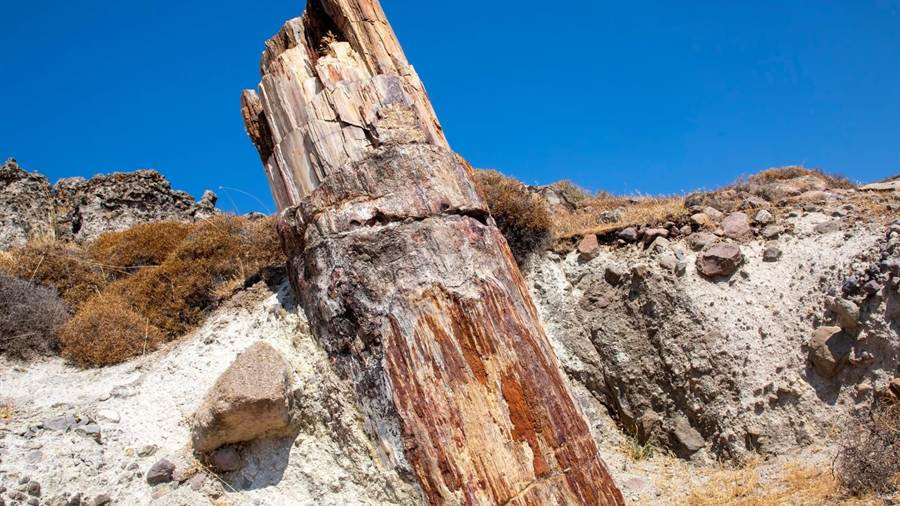
A Lesbos tour to the west reaches the Petrified Forest of Lesbos, a field of fossilised trees between the villages of Eresos, Antissa and Sigri. Successive volcanic eruptions between 17 and 20 million years ago buried the trees in lava and ash.
The fossils record a forest that grew under subtropical conditions, unlike the Mediterranean plants on the island today. The Sigri pyroclastic formation is tied to the process that turned the wood to stone.
Finds seen on a Lesbos tour of the site include a tree 19.5 metres long that still carries part of its roots, branches and leaves. A further 150 fossilised logs have also come to light.
The Natural History Museum of the Lesvos Petrified Forest was founded in 1994. Its first hall traces the evolution of plants and presents the flora of the forest through more than forty species.
A second hall, called Evolution of the Aegean, covers the geology of the Aegean basin over the last 20 million years. A Lesbos tour stop there also shows earthquakes recorded live by the Sigri seismological station.
- Geopark: The whole island forms Lesvos Geopark, a member of the European Geoparks Network since 2000 and the Global Geoparks Network since 2004.
- IUGS: In October 2022 the International Union of Geological Sciences listed the Lesvos Early Miocene Petrified Forest among its 100 geological heritage sites.
- UNESCO: As of 2014, the forest stood proposed for the UNESCO Tentative List of World Heritage Sites.
- Rocks: Neogene volcanic rocks such as andesites, dacites, rhyolites and ignimbrite dominate the centre and west of the island.
The Sigri museum tells the story of fossils and rocks; for ancient art, National Archaeological Museum tickets open the main collection in Athens before or after a Lesbos tour.
Which western villages does a Lesbos tour visit, from Sigri to Eresos?
A Lesbos tour in the west visits Sigri, a small fishing village near the western tip of the island, and Eresos with its twin beach village of Skala Eresou. Bare rocky hills of volcanic origin dominate the area around them.
The name Sigri comes through Greek from the Venetian word siguro, meaning safe, after its safe harbour. The long island of Nissiopi lies across the mouth of the bay and shields it from the wind.
An Ottoman-era castle built in 1746 looks over the bay. The castle and the settlement were set up in the mid-18th century to guard the western coast of Lesbos against pirate attacks.
A Lesbos tour finds the west dry and thinly farmed, yet its beaches hold more sand than any others on the island. Six clothes-optional sandy beaches lie within walking distance of Sigri.
Tradition names Eresos as the birthplace of the poet Sappho around 620 BCE. Theophrastus, the father of botany, was born there about 371 BC and later succeeded Aristotle as head of the Peripatetic school.
- Skala Eresou: The name means the pier of Eresos, and its dark grey volcanic beach runs for almost three kilometres.
- Blue Flag: The beach of Skala Eresou received the Blue Flag in 2006 for the cleanliness of its water and sand.
- Move inland: Near the end of the 17th century, residents left the coast for the present village, about four kilometres from the beach, to escape pirate raids.
- 1821: Early in the Greek Revolution, Dimitrios Papanikolis used a fireship to destroy an Ottoman two-deck frigate anchored near Eresos.
A format on sale links the Petrified Forest, Sigri and Eresos from Molyvos or Petra, and the tour cards and availability boxes on this page list live dates for this Lesbos tour.
Why does a Lesbos tour climb to Agiasos, the mountain village?
A Lesbos tour climbs to Agiasos, a small town on the slopes of Mount Olympos at a height of 475 metres. It lies 26 kilometres from Mytilene and ranks among the largest settlements on the island outside the capital.
The mountain above the town is the Olympus of Lesbos, which rises to 967 metres. It is a different peak from the Mount Olympus of Thessaly on the Greek mainland.
Mount Lepetymnos in the north stands one metre higher, at 968 metres. On a Lesbos tour the two peaks frame the island, since they dominate its northern and central sections.
Forests of Mediterranean pines, chestnut trees and oaks cover 20 percent of Lesbos. Olive groves claim a larger share, with eleven million trees spread over 40 percent of the land.
A Lesbos tour explains why the island carries the name Emerald Island. Its flora is richer than its size suggests, and its volcanic origin shows in hot springs and in the gulfs of Kalloni and Gera.
- Church: The Church of Panagia Agiasos appears on the list of landmarks of Lesbos.
- Neighbours: Agiasos shares the municipality of Mytilene with Evergetoulas, Gera, Loutropoli Thermis, Mytilene and Plomari.
- Climate: Lesbos has a hot-summer Mediterranean climate, with a mean annual temperature of 18 °C.
- Rain: Mean annual rainfall on the island reaches 750 millimetres, and snow is rare.
Plomari lies south of the same mountain, so a Lesbos tour can link the slopes of Agiasos with the southern coast on one loop around Mount Olympos.
What does a Lesbos tour find in Plomari, the town of ouzo?
A Lesbos tour in the south reaches Plomari, the second largest town on the island and the only sizable coastal settlement in the south. The town is known for its ouzo distilling industry, and local brands are served in traditional kafenia.
The Plomari municipal unit is the southernmost on Lesbos, with 122.452 square kilometres of land. The 2021 census counted 4,852 residents, and the largest villages include Plagia, Palaiochori, Megalochori and Akrasi.
For a Lesbos tour in summer, the festival season in Plomari opens in mid-July with an ouzo festival. It peaks near the end of the month with feasts for Agios Haralambos, including horse races.
Modern ouzo distilling took off after Greek independence. The first ouzo distillery opened in Tyrnavos in 1856 under Nikolaos Katsaros, and in 1932 producers developed the copper-still method that is now standard.
Production starts with a rectified spirit of 96 percent alcohol, flavoured with anise and at times fennel, mastic, cardamom, coriander, cloves or cinnamon. The result is known as ouzo yeast.
- Museums: Plomari holds two ouzo museums, one named The World of Ouzo, along with a soap museum.
- Strength: Finished ouzo ranges from 42.0 to 55.0 percent alcohol, and the legal minimum is 40.5 percent.
- Blend: Where cheaper flavoured alcohol goes in, Greek law keeps the ouzo yeast at no less than 20 percent of the product.
- E-bike: A mountain e-bike format on sale starts from Plomari.
Samos sits in the same North Aegean region as Lesbos, so a Samos boat trip extends a Lesbos tour to another island of the region.
Who was Theophilos, the painter a Lesbos tour recalls in Vareia?
A Lesbos tour recalls Theophilos Hatzimihail, a folk painter born between 1867 and 1870 in Vareia, a village outside Mytilene. His works show Greek characters, traditional folklore and history, and he became a major contributor to modern Greek art.
His father, Gabriel Kefalas, was a shoemaker, and his mother, Pinelopi Hatzimihail, was the daughter of an iconographer. As a boy he learned the basics of painting from his grandfather.
People mocked him for wearing the fustanella in public. At 18 he left home and worked as a gate-keeper at the Greek consulate in Smyrna, before settling in Volos in about 1897.
He returned to Mytilene in 1927 and painted village murals for little pay, at times a plate of food and a cup of wine. Ageing and damage by owners erased a share of this work.
The art critic and publisher Tériade, a native of Mytilene, discovered Theophilos there, though the fame that followed came after his death. The painter died in Mytilene in March 1934.
- Louvre: In 1961 his works went on show in the Louvre as an example of a genuine folk painter of Greece.
- Museum: In 1965 Tériade gave 86 works painted on textile, with a building in Vareia that became the Theophilos Museum.
- Tériade Museum: A museum named after the publisher opened in Vareia in 1979 and shows his books in sixteen rooms over two floors.
- Volos: The house of his protector there, the landholder Giannis Kontos, is today a second Theophilos Museum.
Vareia is a southern suburb of Mytilene, so a Lesbos tour of the capital can add both museums, one for the painter and one for the publisher who made his name known.
Which ancient wine does a Lesbos tour recall, from Homer to Rome?
A Lesbos tour recalls Lesbian wine, made on the island since at least the 7th century BC, when the works of Homer mentioned it. In that era the island competed with the wines of Chios for the Greek market.
The Pramnian was the leading Lesbian wine, and today it draws comparison with the Hungarian Eszencia. Its grape varieties are unknown, yet the method behind it survives in the written record.
Grapes hung on the vine until fully ripe, like a late harvest wine. Piled in large containers, the upper clusters crushed the grapes below and released free-run juice without a wine press.
The juice was thick, described as a kind of nectar. The must was high in sugar, so even after a brief fermentation it kept high residual sugar and gave a viscous, honeyed wine.
An apocryphal account names a brother of the poet Sappho as a merchant of Lesbian wine at Naucratis, a Greek colony in Egypt. Under Rome the wine kept its value beside those of Chios, Thasos and Kos.
- Homer: Homer called the island Macaros edos, the seat of Macar.
- Decline: Phylloxera and the turn toward ouzo stalled wine production on Lesbos from the beginning of the 19th century.
- Revival: Bottled wine returned in 1997 in the village of Chidira, made from the revived Chidiriotiko grape.
- Soil: The Chidiriotiko vines grow on the sulfuric lava that also formed the petrified forest.
Chidira belonged with Sigri to the former municipality of Eresos-Antissa in the west, so a Lesbos tour of the petrified forest passes the volcanic ground of the revived local grape.
Who was Sappho, the poet at the heart of a Lesbos tour?
A Lesbos tour begins with Sappho, an ancient Greek poet from Eresos or Mytilene on Lesbos. She lived from around 630 to around 570 BC. She wrote lyric poetry to be sung with music, and ancient sources called her the Tenth Muse.
Sappho came from a wealthy family on Lesbos. Ancient sources give her three brothers, named Charaxos, Larichos and Eurygios. Two of them appear in the Brothers Poem, which came to light in 2014.
The Parian Chronicle alone records her exile to Sicily, between 604 and 595 BC. One explanation ties it to her family’s part in the conflicts among political elites on Lesbos.
Estimates put her output at around 10,000 lines, and only about 650 lines survive. The Ode to Aphrodite is the single complete poem. Other lines survive on papyrus, parchment and potsherds.
She wrote in the Aeolic dialect. Later readers found it hard, and in the second century AD the Roman author Apuleius remarked on its strangeness. A Lesbos tour crosses the dialect’s home island.
- Canon: Scholars of Hellenistic Alexandria placed her among the Nine Lyric Poets.
- Daughter: Fragments 98 and 132 mention Cleïs, traditionally identified as her daughter.
- Instrument: She is linked above all with the barbitos, a deep-pitched string instrument like a lyre.
- Coins: Coins from Mytilene and Eresos showed her between the first and third centuries AD.
The English words sapphic and lesbian derive from her name and her home island. Readers tracing ancient Greek poetry and religion on the mainland can continue with a Delphi day trip from Athens.
Who was Alcaeus of Mytilene, the second poet of a Lesbos tour?
A Lesbos tour also recalls Alcaeus of Mytilene, a lyric poet who lived from around 625 or 620 to around 580 BC. He was born into the aristocratic governing class of Mytilene and is credited with inventing the Alcaic stanza.
In his time Mytilene was the strongest city-state on Lesbos. By the end of the seventh century BC it led the North Aegean Greek cities, with a strong navy and colonies in the Hellespont.
Three tyrants shaped his political life. A faction that included his brothers and Pittacus overthrew Melanchrus between 612 and 609 BC. Alcaeus was then too young to take part.
The poet, his brothers and Pittacus then plotted against Myrsilus, but Pittacus betrayed them. Alcaeus went into exile and later wrote a drinking song to mark the tyrant’s death.
Before 600 BC, Mytilene fought Athens for Sigeion. Herodotus reports that Alcaeus threw away his shield to escape and then wrote a poem about it. A Lesbos tour passes through Mytilene, his home city.
- Pittacus: The assembly of Mytilene voted him supreme power, and he allowed Alcaeus to return home.
- Books: Alexandrian scholars collected his poems into ten books with commentaries in the third century BC.
- Genres: His works fall into political songs, drinking songs, hymns, love songs and miscellaneous pieces.
- Brother: His older brother Antimenidas appears to have served as a mercenary for Nebuchadnezzar II.
Alcaeus described his contemporary as holy, honey-smiling Sappho. Later Greek critics assumed the two poets were lovers. Both names stay central to a Lesbos tour.
Who was Theophrastus of Eresos, the naturalist linked to a Lesbos tour?
A Lesbos tour reaches Eresos, home of Theophrastus, a Greek philosopher and naturalist who lived from around 371 to around 287 BC. He succeeded Aristotle as head of the Lyceum in Athens and is called the father of botany.
His given name was Tyrtamos. Tradition holds that Aristotle gave him the nickname Theophrastus, meaning divine speaker, for the grace of his conversation. He first studied philosophy on Lesbos under one Alcippus.
Aristotle moved to Mytilene on Lesbos in 345/4 BC, and his move is linked to the urging of Theophrastus. The two men appear to have begun their research into natural science on the island.
On Lesbos, Aristotle studied animals and Theophrastus studied plants. Aristotle began systematic zoological investigations there. A Lesbos tour therefore crosses ground tied to both men and their early research.
His Enquiry into Plants first ran to ten books, and nine survive. On the Causes of Plants had eight books, of which six survive. Both treatises shaped Renaissance science.
- Lyceum: He presided over the Peripatetic school for 35 years, according to Diogenes, and died at 85.
- Students: Diogenes states that the school had more than 2,000 students at one period.
- Characters: His Characters holds thirty short outlines of moral types, the first recorded attempt at systematic character writing.
- Funeral: Athens honoured him with a public funeral, and Strato of Lampsacus succeeded him at the Lyceum.
Theophrastus also opposed eating meat, holding that animals can reason, sense and feel as humans do. His home town of Eresos lies in West Lesbos, on the route of one Lesbos tour.
Which ancient cities does a Lesbos tour explore, from Mytilene to Mithymna?
A Lesbos tour explores an island whose classical cities formed a pentapolis of Mytilene, Methymna, Antissa, Eresos and Pyrrha. Lesbos has been inhabited since at least 3000 BC, and Hittite texts of the Late Bronze Age call it Lazpa.
Thermi held an extensive settlement from 3000 to 1000 BC. The largest early site lies at Lisvori, dating from 2800 to 1900 BC, and part of it sits under shallow coastal water.
Later Greek writers said the Penthilidae family came from Thessaly and founded Mytilene in the 11th century BC. They ruled the city-state until a popular revolt led by Pittacus between 590 and 580 BC.
Pyrrha fell to an earthquake in 231 BC, and the Roman Republic destroyed Antissa in 168 BC. Mytilene and Methymna, today’s Molyvos, have been bishoprics since the 5th century.
For a short period the island belonged to the Athenian confederacy. Thucydides recounts its break from Athens in the Mytilenian Debate. A Lesbos tour from Mytilene starts in the city at the centre of that debate.
- Persia: The island became Persian after Cyrus the Great defeated Croesus in 546 BC.
- Rome: Lesbos passed into Roman hands in 79 BC, after rule by the successors of Alexander.
- Music: Terpander, a poet from Lesbos, invented the seven-note scale for the lyre.
- Historians: Hellanicus advanced historiography, and Theophanes, from Lesbos, recorded the campaigns of Pompey.
Three castles survive as remnants of the island’s Roman and medieval history. The novel Daphnis and Chloe is set on Lesbos, a further thread for a Lesbos tour.
How did the island of a Lesbos tour pass from Byzantine rule to Greece?
A Lesbos tour covers an island that belonged to the Byzantine Empire in the Middle Ages, passed to Genoese rule in 1354 and fell to the Ottoman Empire in 1462. It joined the Kingdom of Greece during the First Balkan War in 1912.
In 802 the deposed Byzantine Empress Irene was exiled to Lesbos and died there. In the late 9th century raids from the Emirate of Crete led the people of Eresos to leave for Mount Athos.
In 1354 Emperor John V Palaiologos granted Lesbos as a dowry and fief to the Genoese Francesco Gattilusio. The family ruled for over a century and fortified the Castle of Mytilene and Molyvos.
Sultan Mehmed II conquered the island in September 1462. Richer inhabitants were moved to Constantinople to repopulate it. Under the Ottomans the island took the name Midilli, after its capital.
Mytilene was considered the busiest Ottoman port in the Aegean Sea, and its population grew five-fold. Exports included olive oil, wheat, figs, fish, soap and leather. A Lesbos tour still crosses olive country.
- Earthquake: The earthquake of 1867 destroyed the city walls and a large part of the early Ottoman buildings.
- Sigri: The castle and settlement of Sigri were founded in the mid-18th century against pirate attacks.
- Landing: Greek naval forces under Rear Admiral Pavlos Kountouriotis landed on 21 November 1912.
- Surrender: Ottoman surrender came on 21 December 1912, and nine Greek troops died in the battle.
Local Muslims left the island in the population exchange that followed the Greco-Turkish War of 1919 to 1922. Readers following the medieval Aegean further south can continue with a Rhodes Old Town tour.
What do travellers ask about a Lesbos tour?
A Lesbos tour raises four common questions. Travellers ask whether a petrified forest tour is on sale, whether a boat tour exists, which poet came from the island and which city serves as its capital. The answers follow below.
Is a Lesbos tour to the petrified forest on sale?
Yes. One Lesbos tour in the listing visits the Petrified Forest, Sigri and Eressos, starting from Molivos or Petra. The Petrified Forest of Lesbos is a Protected Natural Monument. Its fossilised plants are silicified remnants of a sub-tropical forest from 20 to 15 million years ago.
Does a Lesbos tour by boat exist?
Yes. The listing includes a private Lesbos tour by boat to Panagia Krifti. A second listing offers a cruise from Mytilene to Korakaki with a barbecue. Both options travel by sea. Land formats on sale include a mountain e-bike tour from Plomari.
Which poet from the island does a Lesbos tour recall?
Sappho, the lyric poet, came from Eresos or Mytilene on Lesbos. Alcaeus of Mytilene, her contemporary, also came from the island, and Lesbos carries the name Island of the Poets. A Lesbos tour to Eressos reaches the town linked to her birth.
What is the capital of the island on a Lesbos tour?
Mytilene is the capital and largest city of Lesbos, on the southeastern coast. Its name also serves for the whole island. A third of the island’s people live there. Mytilene is also the capital of the North Aegean region, and one Lesbos tour by sea starts from the city.