

Santorini e-bike tour is a cycling outing across the island, with Fira, Pyrgos, Megalochori, Akrotiri, Red Beach, Vlychada, Kamari and Perissa, then Ancient Thera, Oia and Imerovigli along the caldera rim. The tour is one of the Greece Tours on Greece Ville, listed with the other Santorini tours and Greece adventure tours.
This post covers what the tour is, the villages and farmland, the south coast beaches, Akrotiri, Kamari and Perissa, Ancient Thera, Oia, Imerovigli, the caldera rim and the formats on sale. Common questions come last.
What is a Santorini e-bike tour?
A Santorini e-bike tour covers the island on electric bicycles whose integrated motor assists the rider’s pedalling, so the long climbs between the caldera rim and the southern coast demand less physical effort than a conventional bicycle requires on the same slopes.
An e-bike, or electric bicycle, is a motorised bicycle with an integrated electric motor that assists propulsion. The motor helps riders cover greater distances and climb steeper hills without needing high physical effort.
Under the European rule for pedelecs, the motor engages above 6 km/h only while the rider pedals. The assistance cuts out once the bicycle reaches 25 km/h, so the rider supplies the effort beyond that speed.
The same rule limits the maximum continuous rated power of the motor to 250 W. A bicycle that meets these conditions counts as a pedelec in the EU and is legally classed as a bicycle.
Battery range on a Santorini e-bike tour depends on the power level, the hills, the speed and the weight of bike and rider. Almost all e-bikes work as regular bikes when depleted.
- Motor: The integrated electric motor assists propulsion rather than replacing the pedals.
- Sensor: A pedal-assist system detects the pedalling speed, the pedalling force or both.
- Standard: The EN15194 standard is valid across the whole of the EU and has been adopted by the UK.
- Battery: One charge lasts between 40 km and 120 km, depending on the power level used.
A Santorini e-bike tour therefore rests on a legal bicycle, a limited motor and a rechargeable battery. The sections that follow trace the island village by village, from Fira in the west to Perissa in the south-east.
What does a Santorini e-bike tour show in Fira?
A Santorini e-bike tour in Fira enters the island’s capital, a town on the caldera rim that lies 10 km from the ferry port of Athinios, draws on its own desalination plant and saw a British raid on its barracks in 1944.
Athinios is the primary ferry port of Santorini and lies about 10 km south of Fira. It is the only port on the island with regular passenger ferry services to Piraeus, the Cyclades, Crete and Rhodes.
On 24 April 1944, Special Boat Service commandos under Anders Lassen raided the German and Italian garrison. The barracks stood in the centre of Fira, on the second floor of a building that housed a bank.
The attackers surprised the 40-strong garrison and killed the majority of its members, although the attack on the German commanding officer failed. Two commandos died during the operation, and five civilians were shot in reprisal.
A Santorini e-bike tour in Fira passes a town with a desalination plant, which has a capacity of 1,200 m3 per day. The island has only one spring and no rivers, so plants supply the water.
- Port: Athinios lies about 10 km south of Fira.
- Ferries: Athinios links Santorini with Piraeus, the Cyclades, Crete and Rhodes.
- Raid: The Special Boat Service attacked the Fira barracks on 24 April 1944.
- Water: The Fira desalination plant holds 1,200 m3 per day.
A Santorini e-bike tour in Fira therefore passes a port road, a wartime site and a water plant before the route turns east. The next stop is the hill village of Pyrgos.
Why does a Santorini e-bike tour climb to Pyrgos?
A Santorini e-bike tour climbs to Pyrgos, the hill village below its Venetian castle, and follows the island’s rulers from the Venetian settlers who formed a Catholic community to the sea captain who raised the revolutionary flag in 1821.
Under Venetian influence, Santorini became home to a sizable Catholic community, and the island is still the seat of a Catholic bishopric. The Venetian castle at Pyrgos belongs to that period of island history.
In 1810, Santorini possessed 32 ships, which gave it the seventh largest fleet among the Greek islands. Hydra had 120 ships and Kefallinia had 118, so the island ranked behind both of them.
A letter from Alexandros Ypsilantis, dated 29 December 1820, introduced the sea captain Evangelis Matzarakis to the notables of Santorini. Matzarakis came from Kefalonia and had Santorini connections.
Kefalonians living there raised the flag of the revolution on the feast day of the patron saint in 1821 and expelled the Ottoman officials. Matzarakis became governor in April 1822 but later fled the island.
A mid-drive motor applies power through the chain and uses the existing rear gears, so it works efficiently across a wider range of speeds. Such a motor suits the steep lanes on a Santorini e-bike tour.
- Bishopric: Santorini remains the seat of a Catholic bishopric.
- Fleet: The island counted 32 ships in 1810.
- Governor: Matzarakis became governor in April 1822.
- Mid-drive: The motor sits in or under the bottom bracket shell.
A Santorini e-bike tour covers these hill villages at the pace of the pedals. The Santorini ATV tour post covers the same island on quad bikes, and the route here continues to Megalochori.
What does a Santorini e-bike tour find at Megalochori?
A Santorini e-bike tour finds at Megalochori a village supplied by the Exo Gialos desalination plant, on an island of the Cyclades whose wine the Russian Orthodox Church adopted as the official Eucharistic wine of the whole church.
The Exo Gialos desalination plant has two units and a total capacity of 2,000 m3 per day. It supplies the villages of Fira, Imerovigli, Karterados, Pyrgos, Megalochori and Vourvoulos.
Santorini wine became the official Eucharistic wine of the Russian Orthodox Church. The Ottomans then let the island producers sell to Russia without restriction, even when wars between the two empires were frequent.
In the early nineteenth century, the best red wine was called Santorin, a dry and fine-tasting claret. The best-known white wine was Nykteri, or night wine, which came in two varieties, Kalliste and Elia.
Kalliste was the stronger and richer variety, and Elia was somewhat weaker. A pedal-assist model on a Santorini e-bike tour is regulated by pedalling, whereas a throttle model engages the motor by hand.
Where the EU rule applies, pedelecs are legally classed as bicycles rather than mopeds or motorcycles. That status exempts them from the stricter rules on certification and licensing that cover motorised vehicles.
- Water: The Exo Gialos plant holds 2,000 m3 per day.
- Church: The Russian Orthodox Church chose Santorini wine for the Eucharist.
- Red wine: Santorin was a dry claret of the early nineteenth century.
- Throttle: A power-on-demand motor is controlled by hand.
A Santorini e-bike tour at Megalochori thus meets a village tied to the island’s water supply and to a wine trade that reached Russia. The route next descends to the south-western peninsula.
What does a Santorini e-bike tour see around Akrotiri?
A Santorini e-bike tour around Akrotiri reaches the south-western peninsula, where a Bronze Age town lies under volcanic ash and a desalination plant with two units supplies water to a village built around a ruined castle.
The Akrotiri desalination plant has two units and a total capacity of 650 m3 per day. It serves the peninsula that a Santorini e-bike tour crosses, on an island with only one spring.
The Bronze Age civilization thrived between 3000 and 2000 BC and peaked between 2000 and 1630 BC. The site was neither a palace complex nor a warehouse, and its masonry and paintings reveal a complex community.
Archaeological evidence dated the eruption to around 1500 BC. Radiocarbon dating gave a range of 1645 to 1600 BC, and tree-ring data yielded the year 1628 BC, so the earlier chronology is questioned.
Santorini stayed unoccupied for the rest of the Bronze Age, while the Greeks took over Crete. Phoenicians founded a site on Thera, and Herodotus says they called the island Callista and lived there for eight generations.
- Plant: The Akrotiri desalination plant holds 650 m3 per day.
- Peak: The Bronze Age civilization peaked between 2000 and 1630 BC.
- Radiocarbon: Dating placed the eruption between 1645 and 1600 BC.
- Tree rings: Tree-ring data gave the year 1628 BC.
A Santorini e-bike tour approaches the excavations along the main road of the peninsula. The Akrotiri tickets post covers entry to the excavated Bronze Age town itself, including how the site is visited.
What does a Santorini e-bike tour reach at Red Beach?
A Santorini e-bike tour reaches Red Beach from Akrotiri, a volcanic sand beach whose red and black sand comes from pulverised volcanic rock of the nearby Santorini caldera, in an area prone to landslides along the slopes.
The sand at Red Beach on a Santorini e-bike tour is black and red pulverised volcanic rock from the nearby caldera. The beach can be accessed from Akrotiri, and the area is prone to landslides.
Archaeological finds of 2006 showed that the Minoan eruption expelled 61 km3 of magma and rock. An estimate of 1991 had given only 39 km3, and the eruption produced an estimated 100 km3 of tephra.
An e-bike battery charges from the mains, which on Santorini depend on a power station at Monolithos. A fire there on 13 August 2018 caused a total loss of electricity across the two islands.
Within four days, electricity had been restored to all but 10% of the consumers. Mainstream e-bikes today use lithium-ion polymer batteries, which have no memory effect and carry no penalty for partial charging.
- Sand: Black and red pulverised volcanic rock forms the beach.
- Access: Akrotiri is the village from which the beach is reached.
- Eruption: The Minoan eruption expelled 61 km3 of magma and rock.
- Battery: Lithium-ion polymer cells power the mainstream e-bike.
A Santorini e-bike tour at Red Beach therefore stands on rock from a very large eruption, with a battery that depends on the island grid. The route then turns east towards the tomato museum.
What does a Santorini e-bike tour find at Vlychada?
A Santorini e-bike tour finds at Vlychada an industrial museum in a former tomato paste factory, which records the cultivation and processing of the island’s tomato and belongs to a wider organisation called Santorini Arts Factory.
A Santorini e-bike tour at Vlychada reaches the Tomato Industrial Museum D. Nomikos, part of a wider organisation called Santorini Arts Factory. George Nomikos founded the Vlychada plant and named it after his father.
The collection includes machinery and tools, archival materials and oral histories recorded for the opening of the museum. Exhibits cover the cultivation of the tomato, its processing and the production of the paste.
Sea water had once been pumped into the factory from the nearby bay. The Independent described the triple-concentrated tomato paste of the island in 2017 as a product named among the best in the world.
As of 2016, the Nomikos family still ran tomato processing plants in Bulgaria, Greece and Turkey. A brushless hub motor, by comparison, is built into the wheel hub, with the stator fixed to the axle.
- Organisation: The museum belongs to Santorini Arts Factory.
- Archive: Oral histories were recorded for the opening of the museum.
- Sea water: The factory once pumped sea water in from the bay.
- Hub motor: The magnets of a hub motor rotate with the wheel.
A Santorini e-bike tour at Vlychada thus links an old industry to a modern machine, since both rely on a motor and a power source. The route then follows the coast to Kamari.
Why does a Santorini e-bike tour stop at Kamari?
A Santorini e-bike tour stops at Kamari, the coastal village that lies 2 km from the middle-Byzantine church of Panagia Episkopi, a former cathedral commissioned in the late eleventh century by the Emperor Alexios I Komnenos.
Panagia Episkopi stands in the northern foothills of Profitis Ilias, the highest mountain on Santorini, and Fira lies 5 km to the northwest. The church replaced a three-aisled early Byzantine basilica.
The church was dedicated to the Panagia, a Greek Orthodox appellation for the Virgin Mary, and the second part of its name, Episkopi, means episcopal. A Santorini e-bike tour thus passes a former cathedral.
The building is a beige-washed cross-in-square domed church. Its plan forms a Greek cross 14 m long and 11.1 m wide, and the roof is covered with red tiles or simply plastered.
Red, green, yellow and blue glass bricks fill the apse window and the two smaller windows beside it. A narrow bell-gable with four bells stands north of the chancel.
Mesa Gonia, long regarded as the heartland of the island’s wine industry, has a brewery that uses locally grown wheat, hops and barley. It imports malt from Bosnia, and its products carry donkey-themed names.
- Distance: The church stands 2 km from Kamari.
- Plan: The Greek cross measures 14 m by 11.1 m.
- Windows: Glass bricks of four colours light the chancel.
- Bells: The bell-gable holds four bells.
A Santorini e-bike tour at Kamari adds that church to the coast. The village also has a small autonomous drinking water unit with a capacity of 6 m3 per day.
How does a Santorini e-bike tour end at Perissa?
A Santorini e-bike tour ends at Perissa, a village 13 km southeast of Fira near the Messa Vouno rock, where the remains of an Early Christian church of Saint Irene recall the saint who gave the island its name.
The Santorini e-bike tour ends at Perissa, which lies 13 km southeast of Fira near the Messa Vouno rock. Saint Irene of Thessalonica is the patron saint of the island.
The e-bike is older than its modern image. On 31 December 1895, Ogden Bolton Jr. received a patent for a battery-powered bicycle with a hub motor mounted in the rear wheel.
An electric bicycle propelled by a double electric motor was invented by Hosea W. Libbey of Boston in 1897. Torque sensors and power controls were developed during the late 1990s, and the Zike e-bike was offered from 1992.
Over their full life cycle, e-bikes on average emit 15 g of CO2e per passenger-km, against 21 g for unmotorised cycles, because of the carbon cost of the extra food calories spent.
- Distance: Perissa lies 13 km southeast of Fira.
- Saint: Saint Irene of Thessalonica is the patron saint of Santorini.
- Patent: Ogden Bolton Jr. received an e-bike patent on 31 December 1895.
- Emissions: An e-bike emits 15 g of CO2e per passenger-km over its life cycle.
A Santorini e-bike tour finishes at Perissa after a route that crossed the island from the caldera rim to the south-eastern coast. Each stop along the way showed a different layer of the island’s history.
How does a Santorini e-bike tour handle the farmland around Emporio?
A Santorini e-bike tour rolls through Emporio, on an island where vines grow far apart in low spiral baskets and take their moisture mainly from dew, while the electric motor eases every slow climb between the fields and the road.
Vines on Santorini are planted far apart because dew is their principal source of moisture. Growers train them in low spiral baskets, with the grapes hanging inside to protect them from the winds.
The Santorini wine tour post covers the estates, grape varieties and cellars of the island. A Santorini e-bike tour passes the same fields at the pace of a bicycle.
A small autonomous unit at Emporio produces drinking water, with a capacity of 6 cubic metres per day. Units of the same size serve Kamari, Messaria and Thirasia, so Emporio shares that scale with three places.
A mid-drive motor sends its power through the chain and so uses the rear gears of the bicycle. Hub motors push less effectively when an e-bike climbs a steep hill slowly.
The hot and dry conditions give the soil of the island very low productivity, which makes winegrowing hard work, and a Santorini e-bike tour passes the fields at an easy pace.
- Vines: Growers plant them far apart and rely on dew for moisture.
- Baskets: Low spiral shapes shelter the grapes from the winds.
- Water: A small unit at Emporio makes 6 cubic metres of drinking water per day.
- Motor: A mid-drive unit works through the rear gears of the bicycle.
Emporio therefore shows the working side of the island, with dry farmland, scarce water and slow lanes where the electric motor matters. A Santorini e-bike tour treats the village as a place to see the fields.
What does a Santorini e-bike tour reveal about Mikro Profitis Ilias?
A Santorini e-bike tour runs near Mikro Profitis Ilias, a ridge by Cape Kolumbo, where nineteen British commandos landed on an easterly beach in April 1944 for a raid on the joint German and Italian garrison of the island.
The raid took place on 24 April 1944 and was conducted by the British Special Boat Service. Similar operations hit Ios, Mykonos and Amorgos, aiming at Axis naval observation posts and radio stations.
Major Anders Lassen led 19 commandos from a hideout in Balisu bay, Turkey. They sailed on 19 April in two schooners and landed near Cape Kolumbo on the night of 22 and 23 April.
The party marched toward the village of Vourvoulos and hid in a nearby cave. The two schooners sheltered in the Christiana islands, south-west of Santorini, which a Santorini e-bike tour does not reach.
On 29 April, German reinforcements from Milos surrounded Vourvoulos and arrested all local men aged 14 and older. Five men, among them the village mayor, were executed, and a monument in Vourvoulos commemorates the victims.
After the raid, General Ulrich Kleemann ordered the Aegean garrisons reinforced with 4,000 men, and those forces stayed tied down in place for the rest of the war.
- Date: The raid took place on 24 April 1944.
- Unit: The British Special Boat Service carried it out.
- Landing: The party came ashore on an easterly beach near Cape Kolumbo.
- Memorial: A monument in Vourvoulos commemorates the victims of the reprisals.
Mikro Profitis Ilias therefore carries a wartime story beside its geology. A Santorini e-bike tour that rides near the ridge passes a coast tied to those events of 1944.
Why does a Santorini e-bike tour look up at Ancient Thera?
A Santorini e-bike tour looks up at the ruins of Ancient Thera, the city that Dorian settlers founded in the ninth century BC on Mesa Vouno, a limestone hill rising 396 metres above sea level, high above the rocky coast.
Doric colonists from Sparta recognised the strategic value of a rocky ridge. In archaic times the city was a minor settlement at the southern edge of the Cyclades.
All buildings were made of limestone from the mountain itself, because wood was rare on the island. The harbour, not yet precisely located, is said to have had shipyards and lodgings for sailors and soldiers.
The Ptolemaic wartime fleet for the entire Aegean Sea was stationed in the harbour from the later part of the third century BCE. A building at the highest point of the city, at the end of a cul-de-sac, was presumably the headquarters of the fleet commander.
In 726 a layer of pumice covered the city after a relatively small eruption of the volcano. The Byzantine chronicler Theophanes reported the event, and the inhabitants gave the city up shortly afterwards.
Range on a Santorini e-bike tour depends on assistance level, battery capacity, speed, hills and the combined weight of bike and rider, and an e-bike with an empty battery works as a regular bicycle in almost every case.
- Hill: Mesa Vouno stands 396 metres above sea level.
- Stone: Local limestone built every house and public building of the city.
- Fleet: The Ptolemaic fleet for the Aegean was stationed in the harbour.
- Pumice: A layer of pumice covered the city in 726.
Ancient Thera links Spartan colonists, a Ptolemaic fleet and a volcanic ending on one hill. A Santorini e-bike tour views the hill from the road, while the motor handles the slope.
How does a Santorini e-bike tour approach Oia?
A Santorini e-bike tour reaches Oia, a village on the lip of the volcanic crater whose restored mansion museum of maritime history shows models of old and new Thiran ships and keeps a library of letters and documents.
In 1810 Santorini possessed 32 ships, the seventh largest part of the Greek fleet. Hydra had 120, Kefallinia 118, Psara and Spetsai 60 each, Ithaca 38 and Skopelos 35.
The Naval Maritime Museum occupies a restored 19th-century mansion a block from the cliff-top. Its collection also holds drawings and patterns, mastheads and models of old and new Thiran ships.
Jet ski chase scenes of the film Lara Croft Tomb Raider: The Cradle of Life were shot in and around Ammoudi, the old fishing port below Oia. A Santorini e-bike tour looks down on that harbour from the cliff top.
At the pinnacle of Oia stands the ruined castle called Fort Londsa. It was once one of the strongest fortresses of the island and now serves as a lookout point.
Kiosks in the village offer handicrafts, jewellery and souvenirs, and small art galleries stand among them. A Santorini e-bike tour finds the main street busy in the summer season.
- Fleet: Santorini held 32 ships in 1810.
- Museum: Its models show old and new Thiran ships.
- Harbour: Ammoudi is the old fishing port below the village.
- Castle: Fort Londsa was once one of the strongest fortresses.
Oia thus joins seafaring, film and defence in one cliff-top village. The motor of an e-bike carries the rider up to the lookout, and the museum explains the ships.
Why does a Santorini e-bike tour pause at Imerovigli?
A Santorini e-bike tour pauses at Imerovigli, a village on the caldera rim with 469 permanent inhabitants, where a long-range radio station supported communications between Athens and Crete before British commandos blew up the building in April 1944.
Lassen split his force into three detachments. The third targeted the radio station in Imerovigli, and time bombs blew up the building that housed the radio installation.
Thirteen civilians from Imerovigli, trying to loot German provisions in the radio building, died when the demolition charges went off. Because of its violence, the operation became known as Lassen’s Bloodbath.
Two commandos died in the operation: the Greek Lieutenant Stefanos Kazoulis, shot in Fira, and Sergeant Frank Kingston. In August 1944 Kazoulis was posthumously awarded the Greek Cross of Valour.
The Fira barracks sat above a bank, on the second floor of the same building. The attackers surprised the garrison of 40 and killed the larger part of its men, although the commanding officer fled.
The Fira to Oia hike post covers the caldera path through Firostefani, Imerovigli, Skaros and Finikia. A Santorini e-bike tour follows the same rim on two wheels with a motor to help.
- Village: Imerovigli has 469 permanent inhabitants.
- Radio: The long-range station relayed messages between Athens and Crete.
- Toll: Thirteen civilians died when the charges went off.
- Name: The operation became known as Lassen’s Bloodbath.
Imerovigli therefore holds a sober chapter of 1944 beside its views of the rim. The village is crossed by narrow, paved paths, so a Santorini e-bike tour moves slowly there.
How does a Santorini e-bike tour follow the caldera rim and the slopes of the island?
A Santorini e-bike tour follows the rim of a caldera in the southern Aegean Sea whose water reaches a maximum depth of 385 metres, and Therasia, on the opposite rim and north-west of Nea Kameni, covers 9.299 square kilometres.
The 1956 earthquake struck 30 km south of Amorgos, about 50 km from Santorini. An aftershock that began close to the island of Anafi is believed to have caused the bulk of the damage on Santorini.
Santorini lost 35% of its houses to collapse, while 45% sustained major or minor damage. In total 529 houses were destroyed, and a Santorini e-bike tour passes villages that carry those figures in their history.
Models with hub motors can use regenerative braking. The motor then works in reverse as a generator, slowing the bike before the brake pads engage and slightly recharging the battery on a descent.
Brushless hub motors are common in modern designs. The motor is built into the wheel hub, so the wheel itself is the motor, and the stator is fixed solidly to the axle.
Lithium-ion batteries have no memory effect, so partial charging carries no penalty. A Santorini e-bike tour can therefore top up the battery between stops without harming it.
- Depth: The water inside the caldera reaches a maximum of 385 metres.
- Therasia: The island covers 9.299 square kilometres.
- Houses: In 1956, 529 houses on Santorini were destroyed.
- Braking: Regenerative braking returns a little power on descents.
The rim and the outer slopes thus give a Santorini e-bike tour both climbs and descents. The motor assists the first, and on suitable bikes regenerative braking recovers energy on the second.
Which Santorini e-bike tour formats are on sale today?
The Santorini e-bike tour formats on sale today include a standard e-bike experience, an organised ride with a local expert, two private wooden e-bike options and a sunset ride across the island, each listed as a separate card on this page.
The first listing is the plain e-bike tour experience of Santorini. A Santorini e-bike tour of this kind uses pedal assist, so the rider keeps pedalling while the motor lifts the effort.
The second listing presents e-bike tours led by a local expert. The format suits riders who want commentary on the villages along the route rather than a self-directed ride.
The third listing is a private wooden e-bike tour that includes lunch or dinner. Private means that only the booked party rides together, and the meal forms part of the format.
The fourth listing is a shorter private wooden e-bike tour. Wooden frames set it apart from the standard bikes, and the private setting keeps the route within one party.
The fifth listing is an e-bike sunset tour experience. It places the ride in the evening, when the setting sun briefly colours the caldera and the white houses.
- Standard: The plain e-bike experience of the island.
- Local expert: An organised ride with commentary on the route.
- Private wooden: Two private options on wooden e-bikes, one with a meal.
- Sunset: An evening ride timed for the setting sun.
The tour cards and availability boxes on this page list live dates for each Santorini e-bike tour format, so the page always shows current departures.
What do travellers ask about a Santorini e-bike tour?
A Santorini e-bike tour raises practical questions about batteries, motors, slopes and the sights along the route. The answers below rely on how e-bikes work and on the recorded history of the places a Santorini e-bike tour passes.
What happens on a Santorini e-bike tour when the battery runs low?
With an empty battery, almost every e-bike works as a regular bicycle, so the rider keeps pedalling. Range depends on the assistance level, battery capacity, speed, hills and weight. Manufacturers give a spread, for example 20 km of continuous strong assist on steep hills and 140 km of gentle assist on slight hills.
Does a Santorini e-bike tour cope with the climbs between the villages?
The motor takes the effort out of climbs. A mid-drive motor works through the rear gears and runs efficiently across a wide range of speeds, while hub motors push less effectively up steep hills at low speed. Brushless hub motors still dominate modern designs, so the choice of bike decides the feel.
Which places does a Santorini e-bike tour connect with the history of the island?
A Santorini e-bike tour links Ancient Thera on Mesa Vouno, 396 metres above sea level, with Imerovigli, home to 469 permanent inhabitants, and with the fleet of 32 ships that the island held in 1810. Emporio adds the working vineyards, and Oia adds the maritime museum.
How does a Santorini e-bike tour differ from an ordinary bicycle ride?
E-bikes are zero-emission vehicles because they emit no combustion by-products. A pedal-assist system has a sensor that detects pedalling speed, pedalling force or both, and the motor then adds to the effort of the rider. The rider still pedals, so the bike behaves much like a conventional bicycle.
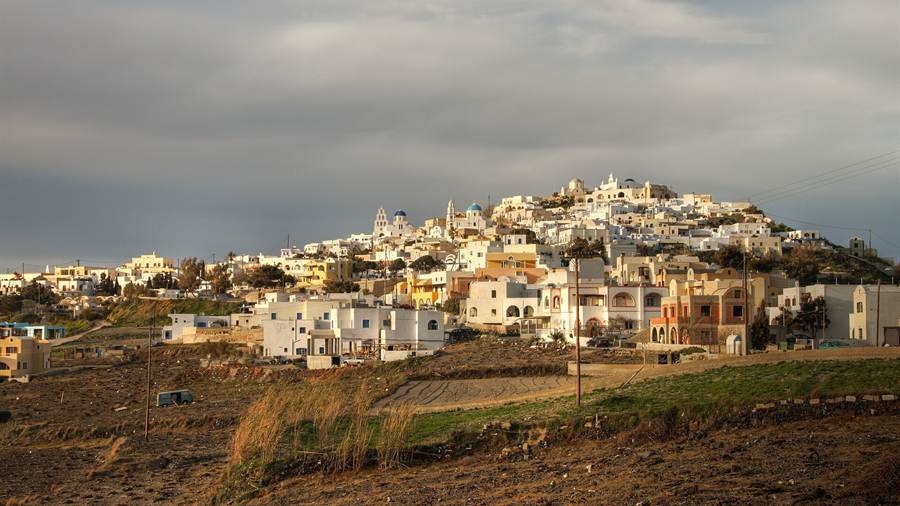
Featured photo: Balou46, CC BY-SA 4.0, via Wikimedia Commons.