
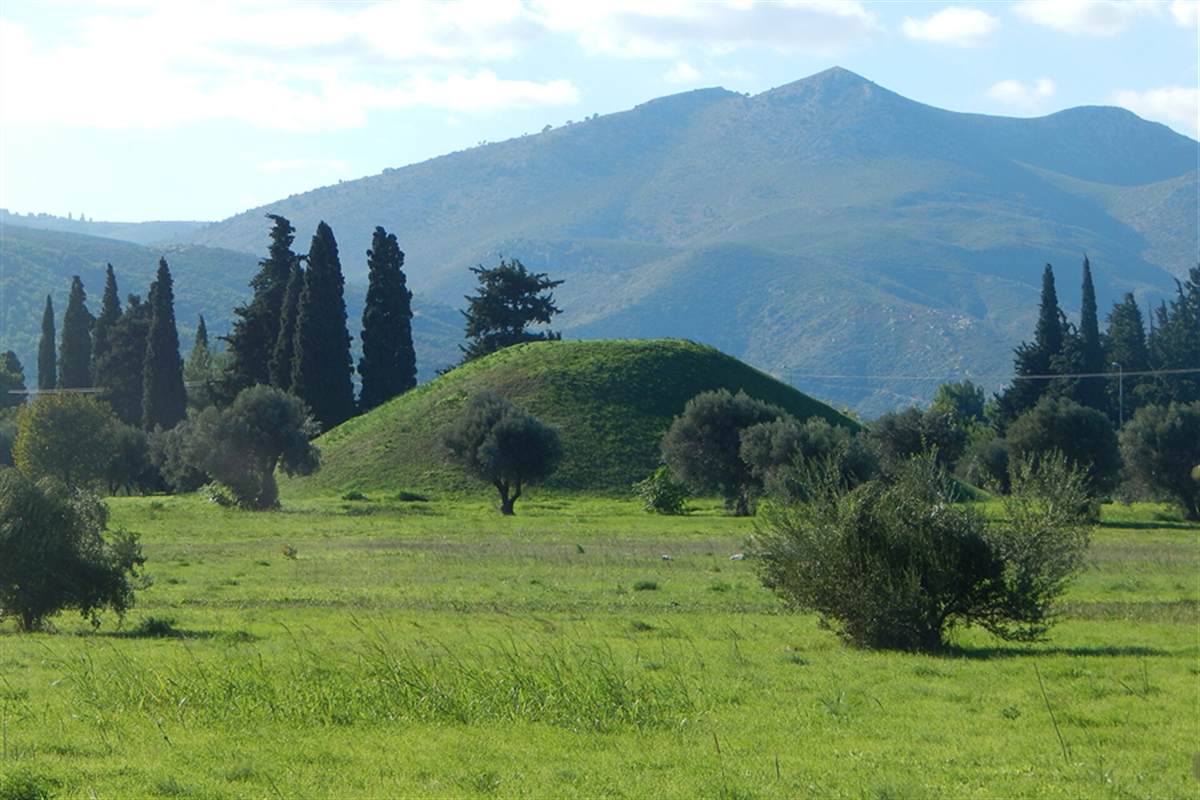
Marathon tour visits the plain where the Athenians met the Persian landing, with the Soros, the tomb of the Athenians, the Plataean tumulus, the Archaeological Museum of Marathon and Lake Marathon. The tour is one of the Greece Tours on Greece Ville, listed with the other Athens tours and Greece historical tours.
This post covers what the tour is, the Battle of Marathon and the Persian landing, the Soros and the other burial mounds, Pheidippides and the race, the museum, the lake and dam and the formats. Common questions come last.
What is a Marathon tour?
A Marathon tour visits the plain in East Attica where Athens beat a Persian army in 490 BCE. The Marathon tour covers the burial mounds, the museum and the reservoir. It is a heritage outing, never a running holiday.
Marathon is a town in the East Attica regional unit, on the outskirts of Athens. Its name comes from the herb fennel, so the name literally means a place full of fennel.
The Persian fleet landed in the bay of Marathon, about 27 kilometres north-east of Athens. A Marathon tour from the city heads north-east to the plain and the bay behind it.
The town holds a record beyond the battle. The sophist Herodes Atticus was born in Marathon, and the Olympic Rowing Centre of the 2004 Summer Olympics stands at Schinias beach, south-east of the town.
Marathon was the starting point of the marathon races at the 1896 and 2004 Summer Olympics. It is the starting point of the annual Athens Classic Marathon. Those races grew from the battle.
The Athens Riviera tour post covers the coast of Attica close to the capital, and this post stays with the battlefield, the museum and the reservoir of the plain.
- Origin: The town was named after an abundance of fennel plants in the area.
- Municipality: Grammatiko, Marathon, Nea Makri and Varnavas merged into one municipality in 2011.
- Mast: The Kato Souli radio mast, 250 metres tall, is the tallest structure in Greece.
- Economy: The town is a popular resort and a centre of agriculture.
Each section below takes one part of the Marathon tour in turn, from the landing and the battle to the dam that holds Lake Marathon.
How does a Marathon tour explain the Battle of Marathon and the Persian landing?
A Marathon tour explains a battle fought in 490 BCE between Athens, aided by Plataea, and a Persian force under Datis and Artaphernes. The Persians had crossed the Aegean and landed in the bay of Marathon on the advice of Hippias.
Darius I sent the expedition after Athens backed the Ionian Revolt and a raid burned Sardis. In Herodotus, Darius shot an arrow towards heaven and asked Zeus for vengeance on the Athenians.
A Marathon tour cites modern estimates that give the Persians 25,000 infantry and 1,000 cavalry. Athens and Plataea fielded 11,000 hoplites in total, and the Greeks blocked the two exits from the plain.
The Spartans were keeping the festival of Carneia and held that no army marched before the full moon. Plataea sent its full muster of 1,000 hoplites, and Athens elected ten generals.
Callimachus held overall command as war archon. Miltiades set the centre of the line four ranks deep and the flanks eight ranks deep, possibly so the line matched the Persian front in length.
The Athenian wings routed the Persian flanks and then turned inwards to surround the centre. The Persians broke towards their ships, and the Athenians captured seven ships. Herodotus counted 6,400 Persian dead on the field.
- Egypt: A revolt of Egyptian subjects in 486 BCE postponed a new Persian expedition against Greece.
- Gratitude: The Plataean muster won lasting Athenian gratitude toward Plataea.
- Phalanx: Marathon was the first time a hoplite phalanx faced more lightly armed troops.
- Democracy: The victory was a defining moment for the young Athenian democracy.
The Cape Sounion tour post covers the headland of that name, which the Persian fleet sailed round after the battle, and a Marathon tour keeps to the plain itself.
What does a Marathon tour show at the Soros, the tomb of the Athenians and the Plataean tumulus?
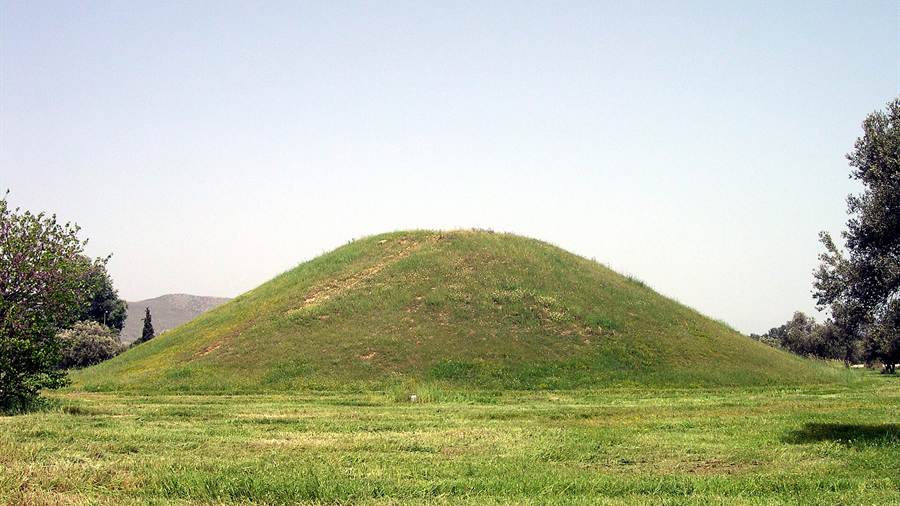
A Marathon tour stops at two burial mounds on the plain, the Soros of the Athenian dead and a smaller tumulus of the Plataeans. A victory column the Athenians raised there has collapsed and a modern replica stands in its place.
The Athenian tumulus stands about 12 metres tall. Dimitrios Philios excavated it in 1884, and Valerios Stais dug it again in 1890 and 1891. It held a large layer of ash and charred bone.
On a Marathon tour the Plataean tumulus is smaller, at about 3 metres. Professor Marinatos identified and excavated it in 1970, when he was Greek Inspector General of Antiquities. Multiple bodies lay buried in it.
Both mounds are hemispherical, and the dead lay in the hole left by the digging of the earth piled above them. Such monumental burial had been out of style in central Greece since the seventh century.
The Athenians normally buried their war dead in the Kerameikos cemetery with a stele. Scholars have suggested that the mounds were raised to evoke Homer and the burials of heroes in the Iliad.
Herodotus records that the Plataeans lost 11 men, and an epigram composed by Simonides was written on the tomb of the Athenians. The mounds stand in a park today.
- Setting: A marble memorial stele marks the Soros, and a small park surrounds it.
- Column: The modern replica of the victory column matches the original in height and general mass.
- Burial: The Athenian and Plataean dead were buried on the battlefield in two tumuli.
- Monuments: The plain holds three monuments, the two tumuli and the victory column.
These three monuments share the coastal plain, so a Marathon tour reaches them in one stop. The Plataean mound stands on the same plain.
What does a Marathon tour say about Pheidippides and the classical race?
A Marathon tour separates the story of Pheidippides from the record. Herodotus sends the runner from Athens to Sparta before the battle, while the run from Marathon to Athens and the death of the runner appear only in later writers.
Herodotus calls Pheidippides a professional long-distance runner who reached Sparta the day after leaving Athens. In his account, the god Pan met the runner on Mount Parthenium above Tegea.
The Athenians later built a shrine to Pan under the Acropolis and held an annual ceremony with a torch-race and sacrifices. The shrine sits in a grotto on the north slope of the Acropolis.
The run from Marathon to Athens first appears in Plutarch, who names the herald Thersippus or Eukles. Lucian, a century later, calls him Philippides and has him announce victory before he collapses and dies.
Magill and Moose call the run from Marathon a romantic invention, and Herodotus never mentions it. Robert Browning’s poem of 1879 joined the two accounts and made the legend popular.
Michel Bréal proposed a race for the first modern Olympic Games in 1896, and Pierre de Coubertin backed the idea. The distance later settled at 42.195 kilometres, after the first races ran around 40 kilometres.
- Sparta: Herodotus puts the run from Athens to Sparta at about 240 kilometres.
- Name: Pausanias, Plutarch and Lucian write the name of the runner as Philippides.
- Cry: The legend has the runner announce the Greek victory with a single word meaning we have won.
- Panic: Tradition holds that Pan filled the Persians with the fear that gave the word panic.
A Marathon tour is a visit to the battlefield, and the race that took its name from the plain dates from the first modern Olympic Games.
What does a Marathon tour show at the Archaeological Museum of Marathon?
A Marathon tour reaches the Archaeological Museum of Marathon, a museum that mainly houses finds from the Battle of Marathon and from an Egyptian temple built nearby. The museum stands in the town of Marathon, in East Attica.
Ancient Marathon occupied a small plain in the north-east of Attica. It formed part of a group of four places with Probalinthus, Tricorythus and Oenoe, one of the twelve districts of Attica before Theseus.
Tradition holds that Xuthus, who married the daughter of Erechtheus, reigned at Marathon. The people of Marathon claimed to be the first in Greece to pay divine honours to Heracles, who had a sanctuary in the plain.
In Greek myth, Theseus conquered the ferocious bull that devastated the plain of Marathon. Homer’s Odyssey mentions Marathon in a way that implies that it was then a place of importance.
Pausanias describes the hero Marathon, who gave the place its name, as a son of Epopeus, king of Sicyon. Plutarch calls the same hero an Arcadian who accompanied the Dioscuri into Attica.
After Theseus united Attica, Marathon was so far superior to the other three places that its name was applied to the whole district. Lucian speaks of the parts of Marathon about Oenoe.
- Finds: The museum mainly houses finds from the battle and from the Egyptian temple.
- Villagers: Arvanites inhabited the village in the nineteenth century and the start of the twentieth.
- Tribe: Marathon, Tricorythus and Oenoe belonged to the tribe Aeantis.
- Pandionis: Probalinthus belonged to the tribe Pandionis.
The museum gives the battlefield its local setting, and the mounds, the museum and the lake together make up the stops of a Marathon tour on the plain.
Why does a Marathon tour include Lake Marathon and its dam?
A Marathon tour includes Lake Marathon, a reservoir that the Marathon Dam created on the Charadros River. Builders raised the gravity dam between 1926 and 1929, and it was the sole supplier of water to Athens until 1959.
The dam of a Marathon tour stands 8 kilometres west of Marathon and 45 kilometres north-east of Athens. It is 54 metres tall and 285 metres long, with a crest 4.5 metres wide.
The reservoir holds up to 41,000,000 cubic metres, of which 34,000,000 are usable. Its surface covers 2.45 square kilometres at the height of the spillway, and its maximum depth is 54 metres.
The dam answered the growth of Athens after the Greco-Turkish War of 1919 to 1922. An estimated 1.3 million refugees were returning, and the population of Athens doubled between 1920 and 1928.
The American firm Ulen and Company built the dam under a contract signed on 22 December 1924. With 450 workers, construction continued for three years, and the Hellenic Water Company was created to manage the supply.
The dam is clad in Pentelic marble, the stone of the Parthenon, and a replica of the Athenian Treasury at Delphi stands at its base. A plaque ties the dam to the victory at Marathon.
- Quakes: Earthquakes linked to the filling of the reservoir are the earliest known example of that effect.
- Symbol: Greece saw the dam as a major symbol of modernization.
- Basin: A drainage area of 118 square kilometres feeds the lake, with average rainfall of 580 millimetres.
- Spillway: The uncontrolled chute spillway near the southern abutment discharges 520 cubic metres per second.
The dam and the lake give a Marathon tour a modern stop that still points back to 490 BCE through the marble and the replica treasury.
Which Marathon tour formats are on sale?
A Marathon tour is on sale as a shorter private battlefield tour from Athens, an Olympic run and battlefield tour, a lake and winery tour with a tasting, a longer trip with Thermopylae and a sunset cruise at Marathon.
The first format is a private battlefield tour from Athens. The title names the battlefield, so the plain, the mounds and the museum in the sections above form the subject of that tour.
A second private tour from Athens joins the Olympic run to the battlefield. Its title refers to the route of the marathon race, which began at Marathon at the 1896 and 2004 Summer Olympics.
A third private tour pairs Marathon Lake with a winery and a tasting. The lake is the reservoir behind the dam described above, and the tasting forms the second half of the title.
A fourth private trip pairs Marathon with Thermopylae, where the second Persian invasion of 480 BCE met Greek resistance. The Thermopylae tour post covers that battlefield on its own.
The last format is a sunset cruise at Marathon. Its title places the cruise there, in the bay where the Persian fleet landed in 490 BCE.
- Private: Four of the five titles describe the tour as private.
- Athens: Three titles say the tour starts from Athens.
- Tasting: One title includes a tasting.
- Cruise: One format is a sunset cruise.
The tour cards and availability boxes on the page list live dates for each Marathon tour format, so the current schedule appears there.
What do travellers ask about a Marathon tour?
A Marathon tour raises practical questions about the battle, the burial mounds, the race and the reservoir. The answers below cover what the plain commemorates, how the story of Pheidippides stands, what the Spartans did and how far the legendary route ran.
Does a Marathon tour cover the running race?
A Marathon tour covers the battlefield, not a race. The marathon race grew from the legend of Pheidippides and was proposed by Michel Bréal for the 1896 Olympic Games. The sites on the plain commemorate the battle of 490 BCE, and no run forms part of the visit.
Which side won the battle that a Marathon tour recounts?
Athens and Plataea won. Herodotus counted 6,400 Persian bodies on the field and records 11 Plataean dead. The defeat ended the first Persian invasion, and the Persian force retreated to Asia. The victory was the first time the Greeks had beaten the Persians.
Why does a Marathon tour mention the Spartans?
The Spartans arrived too late. Their army reached Marathon the day after the battle, having covered 220 kilometres in three days. The Spartans toured the battlefield and agreed that the Athenians had won a great victory, a sober judgement that the plain still records.
How far is the legendary route of a Marathon tour?
The legendary run from Marathon to Athens is put at 40 kilometres, and the modern distance of the marathon race is 42.195 kilometres. The Athenian army marched about 40 kilometres back to Athens after the battle to meet the Persian fleet sailing round Cape Sounion.
Featured photo: KAMINSKA JOANNA, CC BY-SA 4.0, via Wikimedia Commons.