
Vergina tickets open the site of Aigai, the first Macedonian capital, with the Great Tumulus, the tomb of Philip II, the tombs of Persephone and the Prince, and the palace and theatre. The post is one of the Greece Tours on Greece Ville, listed with the other Greek archaeological site tickets and Northern Greece tours.
This post covers what the tickets include and the rules of the underground museum, Aigai, the Great Tumulus, the tomb of Philip II, the other tombs and the palace and theatre. Common questions come last.
What do Vergina tickets cover, and what are the rules of the underground museum?
Vergina tickets cover the archaeological site of Aigai in northern Greece, which holds the royal tombs of Macedon inside the museum of the Great Tumulus, the monumental palace of the kings and the theatre that stood beside that palace.
The Vergina tickets of this post lead to the first capital of the Macedonian kings. Vergina itself is a small town in Imathia, in Central Macedonia, and it belongs to the municipality of Veroia.
The museum was built to house all the artifacts found at the site, and it ranks among the leading museums in Greece. Vergina tickets therefore open a store of royal finds, not only a field of ruins.
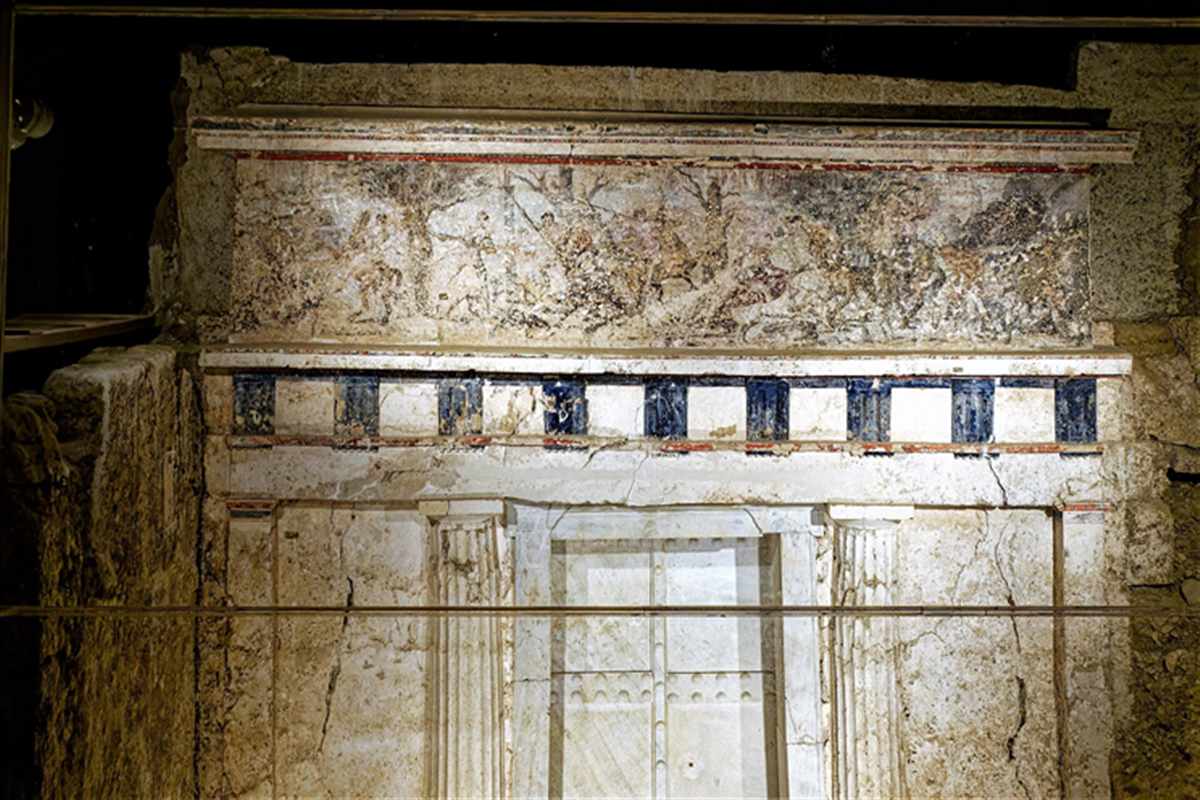
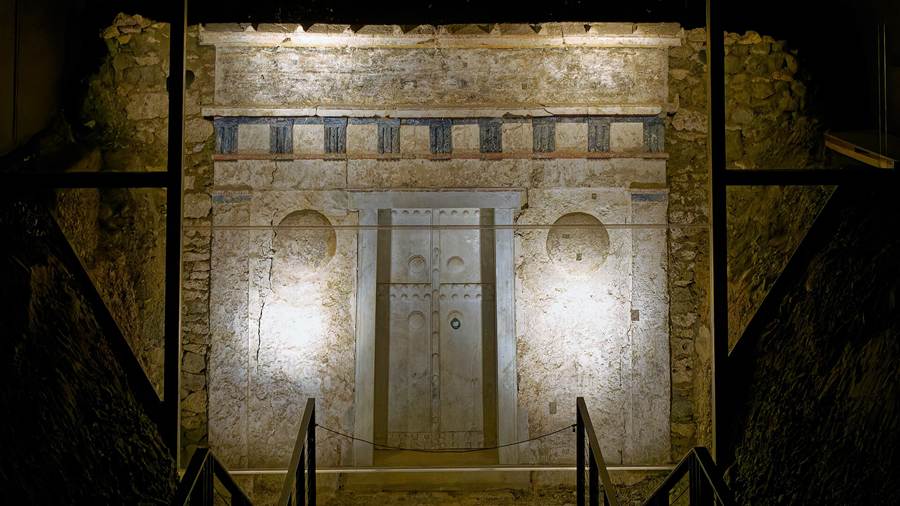
Four tombs and one small temple stand inside the museum. The temple is the heroon, built for the burial cluster of Philip II. Tomb I had been looted, while Tombs II and III were not sacked.
The town of Vergina is young. Families from Asia Minor settled it in 1922, after the population exchanges that followed the Treaty of Lausanne. The Vergina day trip post covers the whole outing to the site.
- Museum: The building shelters the main treasures of the tombs, which came from Tombs II and III.
- Heroon: The small temple served the burial cluster of Philip II.
- Palace: Excavations date its construction to the reign of Philip II.
- Theatre: The stage building belongs to the second half of the fourth century BC.
The rules of the museum are set by the staff at the entrance, so this post gives only the history of what stands inside, then the parts of the site, and last the formats on sale.
Why do Vergina tickets lead to Aigai, the first Macedonian capital?
Vergina tickets lead to Aigai, the first capital of Macedon, a royal seat where the Argead dynasty took root by the end of the sixth century BC and which stayed the sacred city of the kingdom after the capital moved away.
The dominance of the Temenids from the seventh century BC let the ancient Macedonians expand and subdue local populations. By the end of the sixth century BC they had established the dynasty at Aigai.
Herodotus says that the Argead house came from Argos, led by Perdiccas I, who fled about 650 BC. Alexander I is the first truly historic figure of the line, and Vergina tickets reach his dynasty.
The court reached unseen levels of luxury. Merchants from all over the ancient world brought perfume, carved ornaments and jewellery to Aigai, and the city wall of the fifth century BC is linked to Perdiccas II.
At the end of the fifth century BC Archelaus I brought artists, poets and philosophers to his court. Euripides wrote and presented his last tragedies at Aigai. The Pella archaeological site post covers the capital that followed.
- Dynasty: The Temenids led the Macedonians in the seventh century BC.
- Origin: Herodotus names Argos as the home of the Argead house.
- Court: Archelaus I drew poets and philosophers from all over the Greek world.
- Role: Aigai kept the cult centres, a royal palace and the royal tombs.
Aigai kept its role as the sacred city of the kingdom, and that role explains why Vergina tickets lead to burials and a palace rather than to the streets of a large town.
What do Vergina tickets show of the Great Tumulus?
Vergina tickets show the Great Tumulus, the hill that covered the royal tombs, where Gallic mercenaries of Pyrrhus looted the royal graves in 276 BC and where the long modern search for the burial place of the Macedonian kings came to an end.
Archaeologists took an interest in the burial mounds around Vergina as early as the 1850s. The French archaeologist Léon Heuzey began excavations in 1861, with sponsorship from Napoleon III.
The University of Thessaloniki resumed the digs in 1937, and the war with Italy in 1940 stopped them again. In the 1950s and 1960s the rest of the royal capital was uncovered, including the theatre.
Manolis Andronikos identified the finds in the mound as burial sites of the kings of Macedon. Vergina tickets reach that result, and the burial cluster of the queens followed from 1987.
In March 2014 five more royal tombs were discovered at Vergina. They are thought to belong to Alexander I and his family, or to the family of Cassander. The hill material also held earlier funeral stelai.
- Early dig: Heuzey worked here in 1861 for Napoleon III.
- Return: The University of Thessaloniki resumed excavation in 1937.
- Queens: Their burial cluster came to light from 1987.
- Late find: Five more royal tombs appeared in March 2014.
Scholars also read certain finds from the cemetery as shaped by Asian practices or imported from Achaemenid Persia, which fits the years of Persian sway, and Vergina tickets cover that wider setting.
What do Vergina tickets reveal about the tomb of Philip II?
Vergina tickets reveal the tomb that Andronikos tied to Philip II, a chamber of two rooms with a marble chest, a gold and ivory deathbed and silver vessels for the funeral feast, although scholars still dispute who lay inside it.
Philip was attending the wedding of his daughter Cleopatra to King Alexander of Epirus. One of his bodyguards, Pausanias, killed him as the king entered the theatre at Aigai without protection.
His funeral was the grandest ceremony of historic times held in Greece. The king lay on an elaborate deathbed of gold and ivory with his golden oak wreath, and went to the pyre like a new Hercules.
The main room of Tomb II held a marble chest. Around it lay the golden and ivory panoply of the dead, the carved bed that burned with him, and silver utensils for the feast.
The antechamber held a second chest with the bones of a woman wrapped in golden-purple cloth and wearing a diadem of flowers and enamel. Tradition names Meda, Philip’s Thracian wife, who sacrificed herself at the funeral.
In 2010 a study of the skeletons found facial asymmetry from a trauma of the cranium, which fits the history of Philip. In 2015 two scientists argued for Tomb I, and the Greek Ministry of Culture called the claim baseless.
- Wedding: The king died during the marriage of his daughter Cleopatra to Alexander of Epirus.
- Funeral: Researchers call it the grandest funeral of historic times in Greece.
- Antechamber: A second chest held a woman in golden-purple cloth.
- Dispute: The identity of the occupant of each tomb remains open to debate.
The dispute does not change what Vergina tickets open. The treasures of the tomb stay in the museum, and each room holds finds of royal rank.
Which tombs of Persephone and of the Prince do Vergina tickets open?
Vergina tickets open the tomb of Persephone, a plundered cist grave with a famous wall painting, and the tomb of the young prince Alexander IV, the son of Alexander the Great, whose chamber was not sacked and held a cremated body.
The tomb of Persephone is listed as Tomb I. It was a cist grave, built shortly before the tomb of Philip, and robbers had plundered it before archaeologists found it.
Its only wall painting shows the abduction of Persephone by the god of the underworld. Demeter stands silent, three Fates watch, Hermes leads the way and a frightened nymph sees the event.
Scholars believe that Nicomachus of Thebes painted the scene. It is among the rare surviving depictions of the ancient mystic views of the afterlife, so Vergina tickets reach a rare image.
Tomb III was discovered in 1978 near the tomb of Philip. It is thought to belong to Alexander IV, the son of Alexander the Great and Roxana, who was murdered 25 years after the assassination of Philip.
The tomb is slightly smaller than Tomb II and has two parts, but only the main room held a cremated body. A wooden couch of gold and ivory shows Dionysos with a flute-player and a satyr.
- Persephone: The painting names Demeter, the Fates and Hermes beside the abduction.
- Painter: Belief names Nicomachus of Thebes as the artist.
- Prince: Alexander IV was the son of Alexander the Great and Roxana.
- Couch: Dionysos appears with a flute-player and a satyr.
After studies proposed that Tomb II held Philip III, researchers concluded that part of the grave goods belonged to Alexander the Great, since Philip III inherited his possessions. Vergina tickets cover that open question.
What do Vergina tickets show at the palace and theatre of Aigai?
Vergina tickets show the palace of Aigai, a building of two storeys or three, with mosaic floors, painted walls and relief tiles, and the neighbouring theatre of the second half of the fourth century BC, tied closely to it.
Excavations date the palace to the reign of Philip II, even though he also had a palace in Pella. It was the place where Alexander the Great was proclaimed king.
On the north side a large gallery looked over the stage of the neighbouring theatre and the whole Macedonian plain. Vergina tickets cover both the palace and the theatre.
The palace was sumptuously decorated, with mosaic floors, painted plastered walls and fine relief tiles. The masonry and architectural members carried high-quality marble stucco.
The frieze on the southern section of the peristyle has been reconstructed, and the palace reopened to the public after a restoration of 16 years. The finished work lets Vergina tickets reach a rebuilt royal hall.
- Builder: The reign of Philip II is the date of construction.
- Gallery: It faced the stage of the theatre and the plain.
- Surfaces: Marble stucco covered the masonry.
- Frieze: The southern peristyle frieze has been rebuilt.
The theatre stands for the death of the king, and the palace stands for the proclamation of his son, so the two buildings carry the turning point of Macedonian history.
Which formats are on sale as Vergina tickets?
Vergina tickets come in twelve listed formats, from an e-ticket for the museum and royal graves of Aigai to day trips from Thessaloniki, a private road trip and a route that joins Vergina with the city of Veria.
One listing is an e-ticket for the polycentric museum and royal graves of Aigai, with audio. It is the plain entry format among the Vergina tickets.
Day trips from Thessaloniki dominate the list. Titles pair Vergina with Pella, pair Pella with Aigai, add the Pella museum to the royal tombs, or run from the port as a small-group tour of the tombs.
Private formats include a Vergina and Pella day tour in the footsteps of Alexander, a private Pella and Vergina day trip titled Macedonian Wonders, and a private road trip to Pella and Vergina.
Other titles widen the route. One adds the Agios Nikolaos Park and the Edessa waterfalls, one starts from Ohrid for ancient Macedonia, and one leads through ancient Vergina to sacred Veria. The Veria tour post covers that city.
- E-ticket: It covers the museum and royal graves with audio.
- Thessaloniki: Day trips from that city dominate the list.
- Private: Three listings are private tours or road trips.
- Wider route: Titles reach Edessa, Ohrid and Veria.
The tour cards and availability boxes on the page list live dates for each format, so the dates of Vergina tickets appear on those cards, not in the text.
What do travellers ask about Vergina tickets?
Vergina tickets prompt four common questions before a booking: what the tickets cover, whether the burials are those of Philip II, what the palace shows and which formats leave from Thessaloniki or from other cities in the region.
What do Vergina tickets include inside the site of Aigai?
Vergina tickets cover the royal tombs inside the museum of the Great Tumulus. Four tombs and the small temple called the heroon stand there. Tombs II and III were not sacked, while Tomb I had been looted. The palace and the theatre belong to the same site.
Do Vergina tickets lead to the burial of Philip II?
Vergina tickets lead to the tombs that Manolis Andronikos identified as royal. He named Tomb II as that of Philip II. Later studies disagree and give that tomb to Philip III, so the burial remains debated.
What do Vergina tickets show in the palace of Aigai?
Vergina tickets show a palace from the reign of Philip II, with mosaic floors, painted walls, relief tiles and a gallery that looked over the theatre. Alexander the Great was proclaimed king there. The palace reopened after a restoration of 16 years.
Which Vergina tickets leave from Thessaloniki?
Day trips from Thessaloniki carry Vergina tickets, among them a Vergina and Pella day trip, a Pella and Aigai trip and a small-group tour from the port. A separate e-ticket gives plain entry to the museum and the royal graves.
Featured photo: Holger Uwe Schmitt, CC BY-SA 4.0, via Wikimedia Commons.