
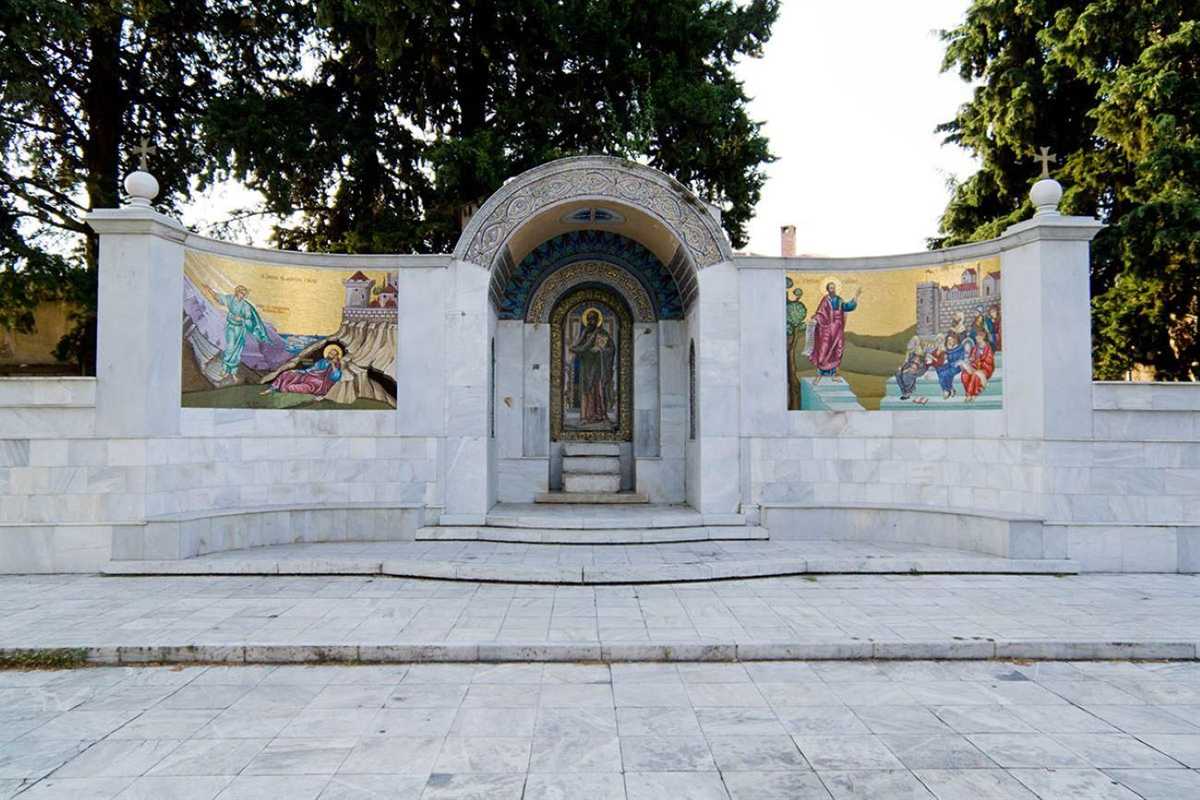
A Veria tour visits Veria, the town of ancient Beroea on the slopes of the Vermio mountains in Imathia, Central Macedonia, with the Bema of Paul, its Byzantine churches, the Barbouta quarter and its museums. The tour is one of the Greece Tours on Greece Ville, listed with the other Northern Greece tours and day trips from Thessaloniki.
This post covers the formats on sale, where Veria lies, ancient Beroea, the Bema of Paul, the Byzantine churches, the Barbouta quarter, the museums and the questions that come up before booking.
What is a Veria tour?
A Veria tour is a visit to Veria, the capital of the Imathia regional unit in Central Macedonia. The city was known as Beroea or Berea in antiquity. Its streets hold traces of Macedonian, Roman, Byzantine, Ottoman and Jewish history.

Veria lies in Macedonia, northern Greece. The city stands 511 kilometres north-northwest of Athens and 73 kilometres west-southwest of Thessaloniki, so a Veria tour from Thessaloniki crosses into Imathia from the east.
Under the Byzantine and Ottoman empires, Veria served as a centre of Greek culture and learning. Today, the city is a commercial centre of Central Macedonia and the seat of the Church of Greece.
The Ottomans called the town Karaferye, meaning black Veria. The name referred to the morning mist that marks the city during humid winters. Rice production made the Ottoman town prosperous.
Veria has one of the largest public libraries in Greece. The library won the Access to Learning Award in 2010 and grew from a single room into a four-storey building.
Each summer, the Imathiotika festivities run from 15 August to 15 September. Their cultural programme draws mainly on local tradition, so a Veria tour in late summer meets the city in festival season.
- Region: Veria is the capital of Imathia, a regional unit of Central Macedonia.
- Old names: Sources spell the ancient city Beroea or Berea, and the official form today is Veroia.
- Church role: The Catholic Church lists Berrhoea as a Latin titular see.
- Olympic link: The list of notable locals of Veria includes Demetrius Vikelas, first president of the International Olympic Committee.
A Veria tour therefore links an ancient Macedonian city, a site from the Book of Acts and a Byzantine art centre. The sections below follow those threads in order.

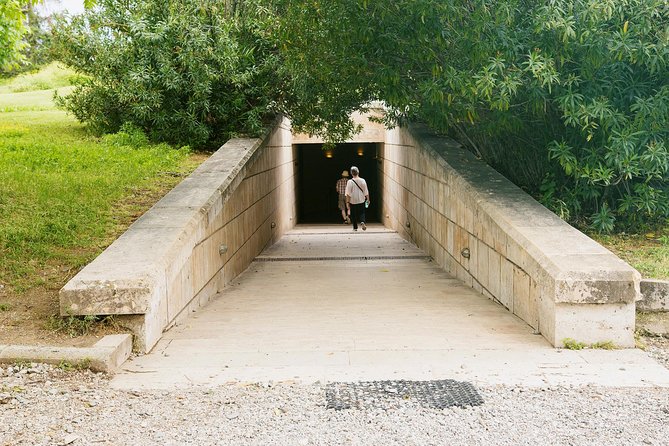
Which Veria tour formats are on sale?
A Veria tour on sale comes in seven listed formats. Five name Thessaloniki as the base and centre on Alexander the Great, Paul, Vergina, or Pella. Two further listings add a private Veria and Vergina trip and a day trip to the Macedonian kingdom.
The first format is a day trip from Thessaloniki that follows the footsteps of Alexander the Great. The listing files it under Veria, so the city sits within a wider Macedonian route.
A second Veria tour traces the journey of Paul. It links Thessaloniki and Veria in one outing and includes pickup. The theme follows the account in the Acts of the Apostles.
A third format runs from Thessaloniki through ancient Vergina and on to Veria, which the title calls sacred. It joins the royal Macedonian story with the Christian heritage of the city.
Two further formats from Thessaloniki centre on Vergina. One is a small-group visit to the royal tombs, and the other is a day trip that adds Pella to the same route.
The last two listings come from a second catalogue. One is a private tour that combines Veria and Vergina, and the other is a day trip to the Macedonian kingdom through Vergina and Pella.
- Pauline theme: One Veria tour follows the journey of Paul from Thessaloniki.
- Macedonian theme: Six formats add Vergina, Pella, or Alexander the Great to the theme.
- Private option: One listing offers a private Veria and Vergina outing.
- Group option: One Vergina format runs as a small-group tour from Thessaloniki.
The tour cards and availability boxes on this page list live dates for each Veria tour format, from the Pauline outing to the private Veria and Vergina option.
Where is Veria on a Veria tour?
A Veria tour reaches a city on a plateau at the eastern foot of the Vermio Mountains. Veria stands at the western edge of the Central Macedonia plain, north of the Haliacmon River. It serves as the capital of the Imathia regional unit.
A Veria tour finds the city at 40º31′ North and 22º12′ East. The town straddles the Tripotamos River, a Haliacmon tributary that supplies hydroelectric power to the national grid.
The Vermio Mountains, known in antiquity as the Bermion, rise between Imathia and the Kozani regional unit. Their highest point is Chamitis peak at 2,065 metres, west of Naousa.
Pliny, Strabo and Ptolemy all mention the range. Herodotus thought it impassable. Tradition held that paradise lay on its far side. In Hellenistic times the mountains formed an internal boundary of the Macedonian state.
The Haliacmon is the longest river that flows entirely on Greek soil, at 297 kilometres. Southeast of Veria it enters the central Macedonian plains before reaching the Thermaic Gulf.
Before a diversion dam rose near Aghia Varvara in the mid-1950s, the river had no permanent bed in the lowlands. Older residents of Veria and Alexandreia still recall its flood of December 1935.
- Plain: The Kampania or Roumlouki plain along the lower Aliakmonas produces peaches and strawberries.
- Viewpoint: The site of Elia gives a wide view over the Imathia plain.
- River name: The Ottomans called the Haliacmon Ince-Karasu, meaning narrow black water.
- Ancient border: Julius Caesar described the Haliacmon as the line between Macedon and Thessaly.
A Veria tour that adds the royal tombs southeast of town overlaps with the Vergina day trip described on its own page.
What ancient history does a Veria tour cover?
A Veria tour covers ancient Beroea from its first written record in 432 BC through Macedonian prosperity and Roman rule. The city hosted the Koinon of Macedonians, minted its own coins and later served as a Roman provincial capital under Diocletian.
In Greek myth, a founder named Beres, also spelled Pheres, gave the city its name. Another tradition links the name to the daughter of a king of Berroia, held to be a son of Macedon.
Thucydides records the city around 432 BC. Polybius cites an inscription from the later 4th century BC. Philip II, father of Alexander the Great, valued Veria as a key possession.
A Veria tour traces how the city prospered under the Argead kings. It peaked in the Hellenistic period under the Antigonid Dynasty, when it became the seat of the Koinon of Macedonians.
In the same era, Beroea struck its own coinage. It also staged the Alexandreia games in honour of Alexander the Great, and athletes from all over Greece came to compete.
Beroea surrendered to Rome in 168 BC after the Battle of Pydna. It was the first city of the Macedonian region to fall. Diocletian later made it one of two capitals of the province of Macedonia.
- Earliest traces: Evidence shows that people lived on the site as early as 1000 BC.
- Roman worship: Under the Roman Empire, the city became a place of worship for the Romans.
- Roman roads: Two major roads joined Thessalonica and Beroea in the 1st century.
- Recent find: In December 2021, an unfinished Roman-era marble statue of a young athletic man came to light at Agios Patapios.
A Veria tour places Beroea within the wider Macedonian kingdom, whose later royal seat appears in the Pella archaeological site article on this site.
Why does a Veria tour follow the route of Paul?
A Veria tour follows the route of Paul because the Acts of the Apostles names the city as Berea. Paul and Silas preached there to the Jewish and Greek communities in AD 50/51 or 54/55, after leaving Thessalonica.
According to Acts 17:10, Paul and Silas left Thessalonica by night and went at once to the synagogue in Berea. Timothy, a student of Paul, is also said to have joined the journey.
Acts describes the Bereans as more open to the message than the Thessalonians. They examined the Scriptures each day to test what Paul taught, and a number of prominent Greek women believed.
The account adds that opponents from Thessalonica arrived and stirred up the crowds. Local believers sent Paul to the coast, while Silas and Timothy stayed behind and later met him in Corinth.
Acts 20:4 names Sopater of Berea among the companions of Paul on a later journey. The roll of notable locals of Veria lists Sopater as a kinsman of Saint Paul.
A Veria tour meets the link in local names. Apostolos Pavlos, a former municipality, became a municipal unit of Veria in the 2011 reform, and the Old Metropolis is dedicated to Saint Paul.
- Bereans: Protestant groups later took the name Bereans for their stress on studying Scripture.
- Early bishop: The Apostolic Constitutions name Onesimus, formerly the slave of Philemon, as the first bishop.
- Early faith: Sources describe the inhabitants as among the first Christians in the Empire.
- Macedonian call: Tradition holds that a vision of a man of Macedonia drew Paul and his companions to the region.
A Veria tour on the Pauline theme links Berea with Thessalonica, and the Thessaloniki walking tour covers the city that Paul left before his night journey.
Which Byzantine churches does a Veria tour see?
A Veria tour sees the Anastasis Church, also called the Church of the Resurrection, with frescoes dated to 1315. It also reaches the Old Metropolis, an early 11th-century Byzantine basilica that served as the Hünkar Mosque during Ottoman rule.
Under Byzantine rule the city developed a large, well-educated commercial class, both Greek and Jewish. Its wealth shows in the churches built in that period, when the city served as a centre of medieval Greek learning.
The frescoes in the Church of the Resurrection are the best-known work of Georgios Kalliergis, a painter born in Thessaloniki. He belongs to a small group of Byzantine Greek painters known by name.
The Veria frescoes bear comparison with Palaiologan art in Thessaloniki and Constantinople. Kalliergis signed his paintings, and one inscription has him call himself the greatest painter in all of Thessaly.
On a Veria tour, the Old Metropolis ranks among the largest surviving middle Byzantine buildings in the Balkans. An inscription at its western entrance credits a certain Niketas, attested as bishop of the city in 1078.
After the Ottoman conquest of 1430, the cathedral became the Hünkar Mosque, and plaster hid its 13th-century frescoes. Restoration began in October 2010, and outside major holidays the building serves as a museum and archaeological site.
- Theotokos fresco: Restoration work uncovered an enthroned Theotokos above the main northern gate.
- Basilica plan: The Old Metropolis is a three-aisled basilica with reused Ionic capitals.
- Later churches: Post-Byzantine churches in the city stand on Byzantine foundations.
- Church rank: Emperor Michael VIII Palaiologos raised the local see to an archbishopric after 1261.
A Veria tour that pairs these two churches covers the arc from Palaiologan painting to Ottoman reuse. The Byzantine Museum, covered below, holds further icons and frescoes.
What is the Barbouta quarter on a Veria tour?
The Veria tour reaches Barbouta, spelled Barbuta in English sources, the protected former Jewish neighbourhood of the city. The quarter keeps a 19th-century synagogue from its Jewish past, and Veria counts among the places where a Romaniote synagogue still functions today.
A Jewish settlement existed in the city in Roman times. Acts records that Paul went straight to its synagogue, which makes the Jewish story of Veria one of the oldest threads on a Veria tour.
The Romaniotes are a Greek-speaking Jewish community and the oldest Jewish community in Europe. Their name comes from Rhomania, the endonym for the Eastern Roman Empire, and their distinct language was Yevanic.
In the 17th century, the traveller Evliya Çelebi counted 2 Jewish congregations in the city. He also recorded 4000 houses, 16 Muslim quarters and 15 Christian quarters in a town without walls.
The Ottoman census of 1881/82 to 1893 counted 393 Jews in the kaza of Veria. The same count listed 15,103 Greeks and 7,325 Muslims, for a total of 25,034.
During the Nazi occupation from 1941 to 1944, almost all of the Jewish community of Veria was deported and murdered. The 19th-century synagogue in Barbuta survives from that community.
- Barbuta mosque: A former mosque named Barbuta now serves as a private residence.
- Wider loss: The majority of the Jews of Greece were murdered in the Holocaust after the Axis occupation.
- Research: Elias Messinas published a study titled The Synagogue of Veroia in 2022.
- Survivors: After the war, a majority of Greek Jewish survivors emigrated to Mandatory Palestine, Israel, the United States, and Western Europe.
A Veria tour through Barbouta links the Roman-era synagogue of Acts with the 19th-century synagogue that still stands in the quarter.
Which museums does a Veria tour visit?
A Veria tour visits the Archaeological Museum of Veroia, with finds from the Palaeolithic to the Ottoman period, and the Byzantine Museum of Veroia. The city also has a Folklore Museum, a museum of modern Greek history and an Aromanian cultural museum.
The Archaeological Museum was established in 1965 in a building raised for the purpose in Elia. Its displays fill three halls, and the Neolithic finds come from Nea Nikomedeia.
Nea Nikomedeia is held to be the oldest known permanent settlement in Europe. The first hall shows a bronze hydria of the fourth century BC, used as a cinerary urn, from the north-east cemetery of Veroia.
The second hall holds the stela of the Gymnasiarch’s Law. Its text sets out how middle and senior education ran in the Veroia Gymnasium. Stelae of Paterinos Antigonou and Adea Kassandrou also stand there.
The third hall covers the Roman period. Its leading exhibit is an inscribed bust of the river god Olganos from the second century AD, found at Kopanos and in excellent condition.
The Byzantine Museum opened in 2002 inside the old Markos mill, a four-storey stone building of 1908 to 1911. The mill ground flour until the 1960s and burned in a fire in 1981.
- First floor: The Byzantine Museum shows icons, wall paintings, and mosaic floors from the courtyard of Agios Patapios.
- Upper floors: The second floor covers city life and the third floor covers religious worship.
- Location: The museum stands in the preserved district of Kyriotissa.
- Garden finds: Outside the Archaeological Museum stand sarcophagi, grave stelai, statues and a head of Medusa from the second century BC.
A Veria tour that adds both museums spans the record from Nea Nikomedeia to the Byzantine city. The Wine and Vine Museum in Naoussa adds to the museum list of Imathia.
What do travellers ask about a Veria tour?
A Veria tour raises four recurring questions. Travellers ask how far the city lies from Thessaloniki, what the climate is like, what stands just outside the city and which Ottoman buildings survive. A short, sourced answer follows below each question.
How far does a Veria tour travel from Thessaloniki?
A Veria tour from Thessaloniki covers 73 kilometres, as Veria lies west-southwest of that city. The Thessaloniki-Edessa railway links the two, and the A2 motorway, the Egnatia Odos, bypasses Veria to the south-east. Thessaloniki International Airport lies 88 kilometres east-northeast of Veria.
What weather does a Veria tour meet?
A Veria tour meets a Mediterranean climate that borders on a cold semi-arid type. Summers run from April to October and are hot and dry. Winters, from mid-October to March, are wet and cool, yet temperatures stay above freezing. Snow falls once or twice a season.
What lies just outside the city on a Veria tour?
Outside the city, Seli is a well-known ski resort on the Vermio slopes. The Aliakmonas River Dam stands a short distance outside Veria. Naoussa, a neighbouring city, shares the title of the Greek metropolitan of Veria. A wind farm of 174 turbines is planned for the Vermio Mountains.
Which Ottoman buildings does a Veria tour pass?
Of the thirteen mosques of the city, eight survive on a Veria tour route, among them the Orta, Mendrese and Mahmud Çelebi mosques. The Twin Hamam also survives, with late 19th-century Ottoman public buildings. The bezesten, however, burned down in the great fire of 1864.