
Mycenae tickets open the ancient citadel, with the Cyclopean walls and the Lion Gate, Grave Circles A and B, the palace megaron and cult centre, the houses outside the walls and the tholos tombs. The post is one of the Greece Tours on Greece Ville, listed with the other Greek archaeological site tickets and Peloponnese tours.
This post covers what the tickets include and the rules of a visit, the walls and Lion Gate, the grave circles, the palace, the houses, the tholos tombs and the formats on sale. Common questions come last.
What are Mycenae tickets and which rules apply to a visit?
Mycenae tickets admit visitors to the Bronze Age citadel of Mycenae, a protected archaeological site in Argolis. The ticket covers the fortified hill with its gate, graves, palace and tombs, and a legal framework sets the rules that govern every visit.
The citadel stands 19 kilometres inland from the Saronic Gulf, on a hill in the north-eastern Peloponnese. Mycenae tickets therefore belong to an inland stop on a route through the Argolid, away from the coast.
The Hellenic Ministry of Culture and Sports monitors Mycenae together with nearby Tiryns. Greek Antiquities Law No 3028/2002 governs the conservation of the ruins, and the rules of a visit rest on that law.
Ministerial Decree No 2160 of 1964 fixed the limits of Mycenae. It also extends protection to the acropolis and the wider surroundings, so the protected area is larger than the walled hill alone.
In 1999 a scientific committee for Mycenae began work on preservation and stabilisation. It laid out walkways and set up information stations at the monuments, and holders of Mycenae tickets follow those routes through the site.
- Region: Mycenae belongs to Argolis, a region of the Peloponnese.
- Study: Archaeological study at the two sites is conducted methodically and systematically.
- Tiryns: Ministerial Decrees of 1956 and 1991 protect the nearby site of Tiryns.
- Protection: A strict legal framework shields the remains from vandalism and other damage or disturbance.
The Mycenae Epidaurus day trip post covers the full route through the Argolid, which pairs the citadel with the theatre of Epidaurus. Mycenae tickets themselves cover only the citadel.
What do Mycenae tickets show of the Cyclopean walls and the Lion Gate?
Mycenae tickets include the Cyclopean walls and the Lion Gate, the main entrance of the citadel. The gate stands in the north-western side of the acropolis, and a relief of two lionesses in a heraldic pose rises above its entrance.
Pausanias credited the whole circuit, the Lion Gate included, to the Cyclopes. Modern archaeologists use the term more narrowly, since only parts of the walls are Cyclopean masonry and other parts are rectangular ashlar blocks.
Cut stone appears only in and around the gateways. At Mycenae and Tiryns the builders chose conglomerate for these dressed blocks, and Mycenae tickets show the contrast with the rough boulders.
The carver shows lionesses, not lions, because of the tuft at the end of the tail. A storage jar from Knossos carries the same scene of a goddess flanked by two lionesses.
The gate was an emblem of the Mycenaean kings and a symbol of their power to subjects and foreigners alike. It also records that lions lived in Europe and Greece before they vanished in late antiquity.
- Approach: A partly natural, partly engineered ramp leads to the gate on a north-west to south-east axis.
- Facade: The eastern side of the approach received a new facade of conglomerate.
- Granary: A building inside the gate held jars of carbonised wheat.
- Seals: A similar gate design appears on fifteenth-century BC Minoan seals and on a gem found at Mycenae.
The Royal Institute of British Architects uses a modified form of the gate sculpture as its emblem. Mycenae tickets give the original relief, set high above the entrance, at the start of the climb.
What do Mycenae tickets show of Grave Circles A and B?
Mycenae tickets lead to Grave Circle A, the royal cemetery enclosed by the citadel wall, and to the setting of Grave Circle B outside it. Both circles held shaft graves of the early Mycenaean rulers, with rich grave goods.
Pausanias recorded a local tradition that the grave of Agamemnon lay within the citadel, with his followers, his charioteer Eurymedon and the two children of Cassandra. Heinrich Schliemann followed this account.
Shaft Grave IV yielded the Silver Siege Rhyton, a silver vessel dated to about 1600 to 1500 BCE. Its relief shows an attack on a fortified town, which gives the vessel its name.
Objects in Circle A follow Minoan style, such as bulls’ heads with a double axe, although the Mycenaeans had not yet conquered Crete. Fighting and hunting scenes are Mycenaean, a blend called an international style.
Grave Circle B lies outside the walls, and a stone wall 1.55 metres thick and 1.20 metres high enclosed it. Four shafts carried stelae up to 2 metres high, and two show hunting scenes.
- Letters: Excavators gave Circle B graves Greek letters, while Circle A graves bear Latin numbers.
- Excavation: Ioannis Papadimitriou and Georgios Mylonas dug Circle B in 1952 over two years.
- Looting: Antiquity left Circle B untouched, unlike the later tholos tombs.
- Finds: Grave Nu held traces of a boar’s tusk helmet, and a wooden box held an electrum death mask.
The graves of Circle B grew larger and richer over time. Mycenae tickets set the two circles side by side, so the rise in burial wealth is plain to see.
What do Mycenae tickets show of the palace megaron and the cult centre?
Mycenae tickets climb to the palace on the summit, where the megaron was the throne room, and to the cult centre. The visible palace dates to the start of Late Helladic IIIA:2, and no other Mycenaean palace has a monumental cult centre.
Successive monumental palaces rose within the Cyclopean walls. The final one, whose remains are visible today, dates to the start of Late Helladic IIIA:2. Mycenae tickets therefore show the last stage of a long building history.
Four columns stood in a square around the central hearth and carried the roof opening. Frescoes decorated the plaster walls and the floor of the hall, and a throne stood in clear view from the entrance.
The cult centre is a later development, from the thirteenth century BC. Monumental cultic structures are absent at the other palatial centres, so Mycenae tickets reach a feature that no other palace offers.
Terracotta figures with coiled clay snakes were found in the temple at Mycenae. Larger wheelmade figures of this kind are much rarer; others came from Tiryns and from the shrines of Phylakopi on Melos.
- Deities: Linear B names Zeus, Hera, Poseidon, Athena, Hermes, Eileithyia and Dionysos.
- Clergy: Written records mention priests and priestesses responsible for specific shrines.
- Frescoes: Other Mycenaean wall paintings show hunting, bull leaping, battle scenes and processions.
- Shrines: Small shrines have been identified at Asine, Berbati, Malthi and Pylos.
The Nafplio day trip post covers the harbour town that routes pair with the citadel. Mycenae tickets cover the palace and cult centre on the hill.
What do Mycenae tickets reveal about the houses outside the walls and the Linear B tablets?
Mycenae tickets cover a site where excavated houses of Late Helladic IIIB lie outside the walls, beyond Grave Circle B. Linear B, the script of Mycenaean Greek, belongs to the same world, and its earliest examples date to around 1450 BC.
The houses beyond Grave Circle B belong to the same period as the extended walls. Scholars think they served as both residences and workshops, so life at Mycenae reached beyond the citadel.
Linear B is a syllabic script that wrote Mycenaean Greek, the earliest attested form of the Greek language. It was adapted from Linear A, which remains undeciphered, and it predates the Greek alphabet by centuries.
The script has roughly 200 signs, divided into syllabic signs and ideograms. Ideograms are symbols, not pictures: one tablet records a tripod with missing legs, yet the sign shows a tripod with three legs.
Known inscriptions total 6,058, and 170 of them sit on vessels. Stirrup jars are the main source of these markings, and they were found at Thebes, Mycenae, Tiryns and Khania.
- Use: The texts were confined mostly to administrative contexts at palatial sites.
- Scribes: Pylos shows 45 different hands in its tablets.
- Mainland: The earliest inscription from the mainland is a tablet from Iklaina, dated between 1400 and 1350 BC.
- End: The script disappeared once the palaces were destroyed.
Michael Ventris died in 1956, weeks before the publication of Documents in Mycenaean Greek, written with John Chadwick. Mycenae tickets therefore meet a script whose reading is recent.
What do Mycenae tickets show of the tholos tombs?
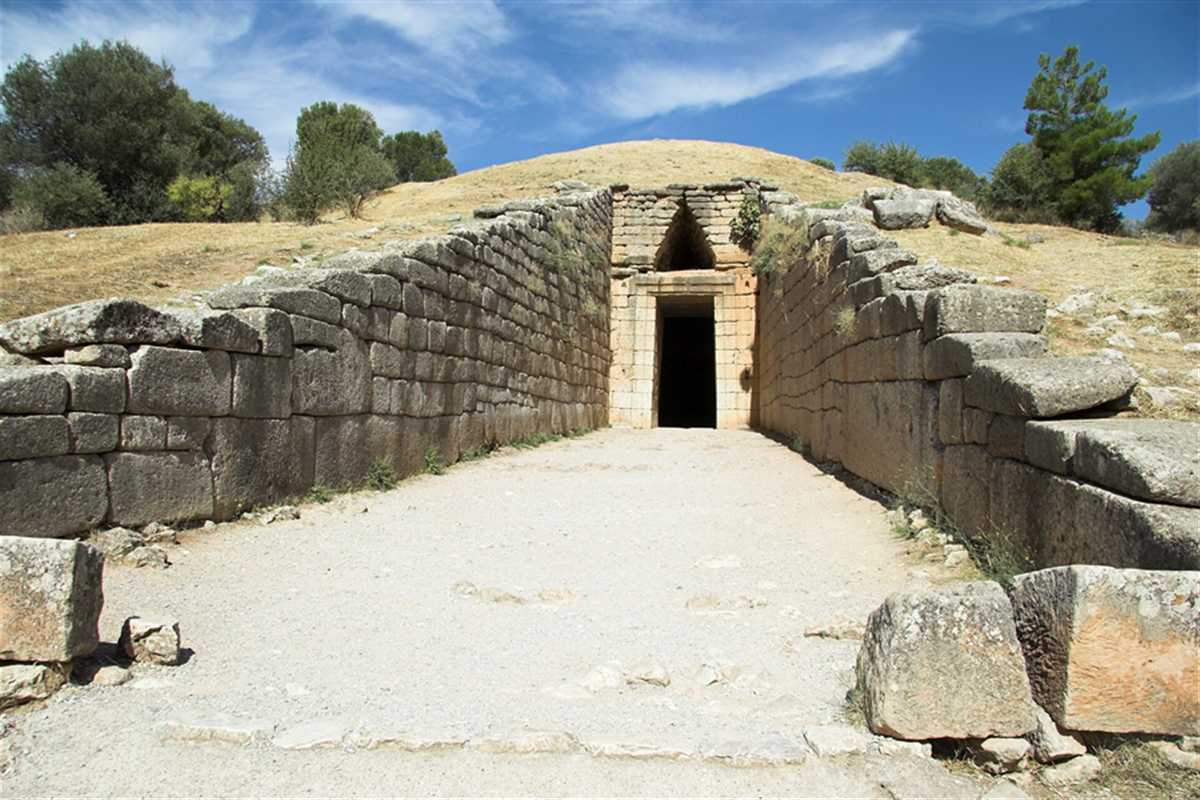
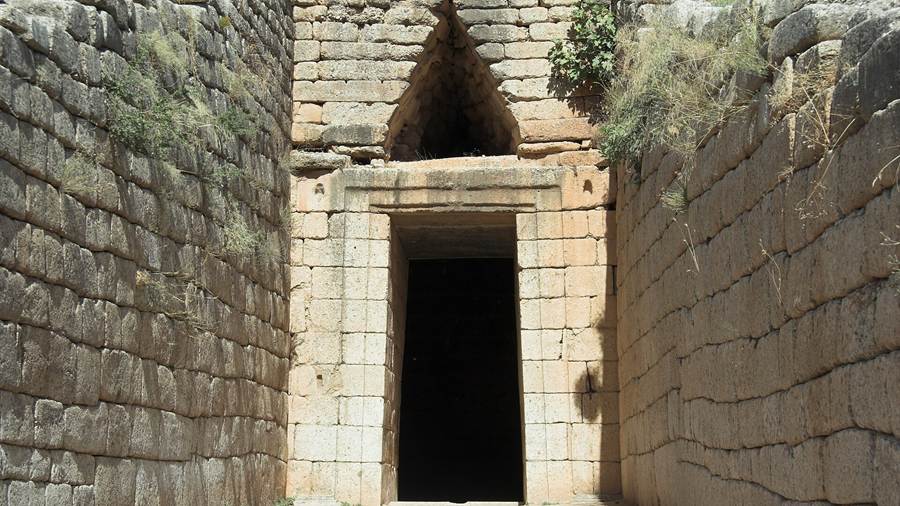
Mycenae tickets include the tholos tombs, the round beehive tombs of the royal dead after the shaft graves. The Tomb of Aegisthus was the largest of its kind in the Aegean when built, and the Tomb of Clytemnestra was the last of its type.
The Treasury of Atreus has a chamber of 33 ashlar courses, 14.5 metres across and 13.2 metres high. Traces of nails in the interior point to golden rosettes that once hung from the dome, scholars think.
The Tomb of Aegisthus lies about 70 metres from the Lion Gate and is the third-largest tholos at Mycenae. Its chamber is 13.96 metres wide, and its dome has fallen from about 13 to 8 metres.
The Tomb of Clytemnestra dates to about 1250 BC. Its chamber is 13.4 metres across, and gypsum half-columns decorated the facade. A woman’s grave in the dromos held two mirrors, ornaments and beads.
Pausanias placed the tombs of Clytemnestra and Aegisthus further from the walls, since the murder of Agamemnon made them unfit for burial within. Both chambers were found looted and empty.
- Emergence: Tholos tombs appeared in Mycenaean Greece around 1500 to 1450 BC as resting places of royal families.
- Triangle: The Tomb of Aegisthus is the earliest tholos with a relieving triangle, a feature recognised only in the 1990s.
- Lintel: The inner lintel of the Treasury weighs around 120 tons, the heaviest single block in Greek architecture.
- Excavator: Winifred Lamb first excavated the Tomb of Aegisthus in 1922.
The Ancient Corinth tour post covers the ancient city on the Isthmus to the north. Mycenae tickets cover the tombs near the citadel.
Which formats of Mycenae tickets are on sale?
Mycenae tickets are on sale as plain entry tickets, as audio tour packages and as parts of longer trips. The listed formats run from an e-ticket for the site to private tours and a multi-day route across the Peloponnese and central Greece.
The simplest listing is an e-ticket for the archaeological site with an audio tour. A second entry ticket adds optional self-led audio tours, and a third pairs entry with a virtual reality audio tour.
Day trips from Athens combine Mycenae with Epidaurus and Nafplio. They run as small-group trips, as a shared day tour and as a journey themed on Greek legends, and one adds the Corinth Canal.
Private formats include a tour with a licensed local expert and tickets, an expert-led tour of Mycenae alone, and a customisable private van tour from Athens that links Mycenae and Nafplio.
Other listings start in Nafplio, with a shared tour of Mycenae and Epidaurus, a day tour of the Argolis, or a route to Ancient Nemea with a wine tasting. One tour adds Olympia, Delphi and Meteora.
- Entry only: An e-ticket, an entry ticket with optional audio tours, and an entry ticket with a virtual reality audio tour.
- Group trips: Small-group and shared trips from Athens and from Nafplio that join Mycenae, Epidaurus and Nafplio.
- Private tours: A tour with a licensed local expert and a customisable private van tour.
- Longer routes: A tour with the Corinth Canal, a wine tasting from Nafplio, and a multi-day route to Meteora.
The tour cards and availability boxes on the page list live dates for each format, so travellers check them for current options before choosing a ticket.
What do travellers ask about Mycenae tickets?
Mycenae tickets raise questions about the rulers, the legends and the names of the people. The answers cover the reach of the realm, the way the state worked, the contest of Atreus and Thyestes and the names given to the Mycenaeans.
How important was the realm behind Mycenae tickets?
Mycenae tickets belong to the centre of a realm that scholars think ruled a territory two to three times the size of other palatial states, and they place Tiryns and Nauplion within it. Egypt knew Mukana by name in Late Helladic IIIA:1 as a capital on the level of Thebes and Knossos.
How did the state behind Mycenae tickets work?
Mycenae tickets belong to a world that Linear B evidence shows as a kingdom split into sixteen districts. A governor ran each district with a deputy, and the damos, a collective body of plot holders, held communal land. Slaves worked for the palace or for specific deities.
Which legend of the kings belongs with Mycenae tickets?
Mycenae tickets recall the contest of Atreus and Thyestes. An oracle told the people to choose a Pelopid, and Thyestes won first. The sun then appeared to set in the east, Atreus argued for reversing the choice, and he became king.
What names did others give to the people behind Mycenae tickets?
Homer used Achaeans, Danaans and Argives for the Greek besiegers of Troy, and these names passed down from the Bronze Age. A land called Danaya appears in Egyptian records from about 1437 BC, in the reign of Thutmoses III. Mycenae tickets sit within that wider world.
Featured photo: Zde, CC BY-SA 4.0, via Wikimedia Commons.