
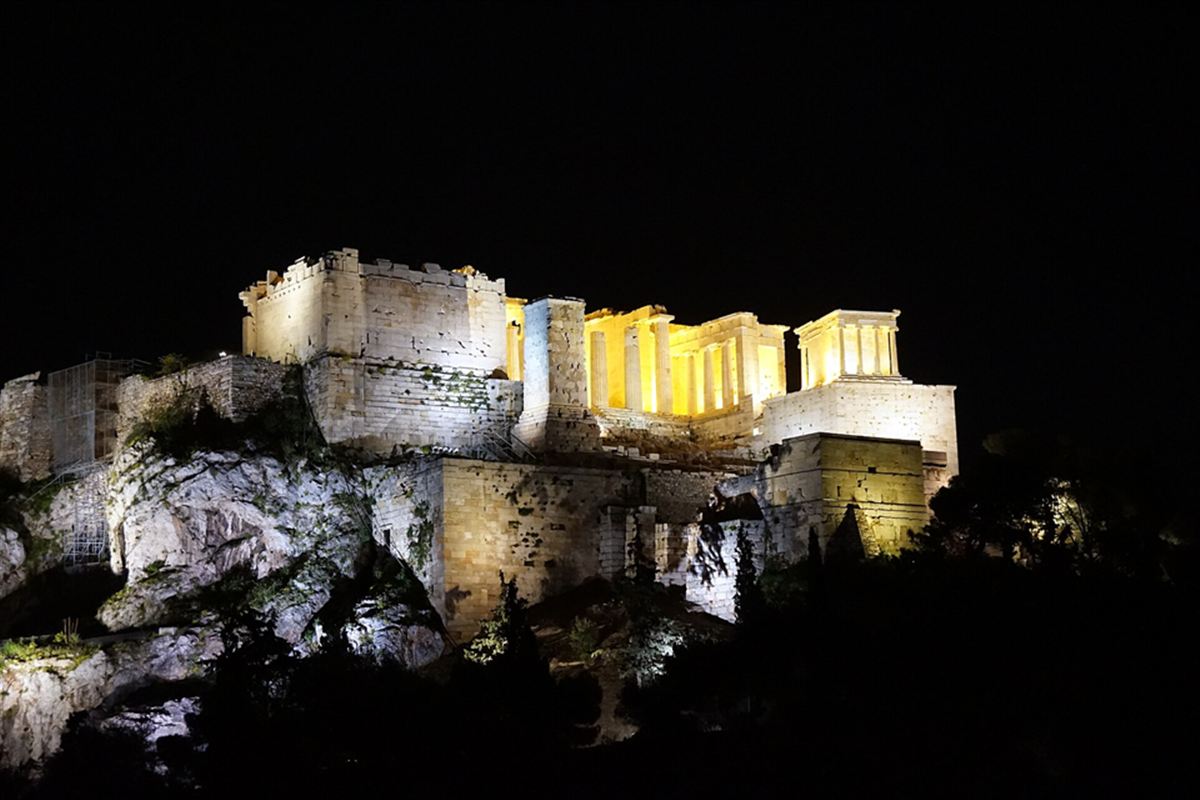
An Athens night tour is a walk, drive or food outing through the centre of Athens after dark, with the lit Acropolis above the old quarters of Plaka, Monastiraki and Psyrri. The tour is one of the Greece Tours on Greece Ville, listed with the other Athens tours.
This post covers the lit Acropolis, the lanes of Plaka and Anafiotika, Monastiraki and Psyrri, the hill of Lycabettus and late dinners, then the formats on sale. Common questions come last.
What is an Athens night tour?
An Athens night tour is an evening route through the lit centre of the Greek capital, taken on foot, by bus, by segway or by tuk-tuk. The Athens night tour joins ancient monuments, old quarters and a late table into one evening.
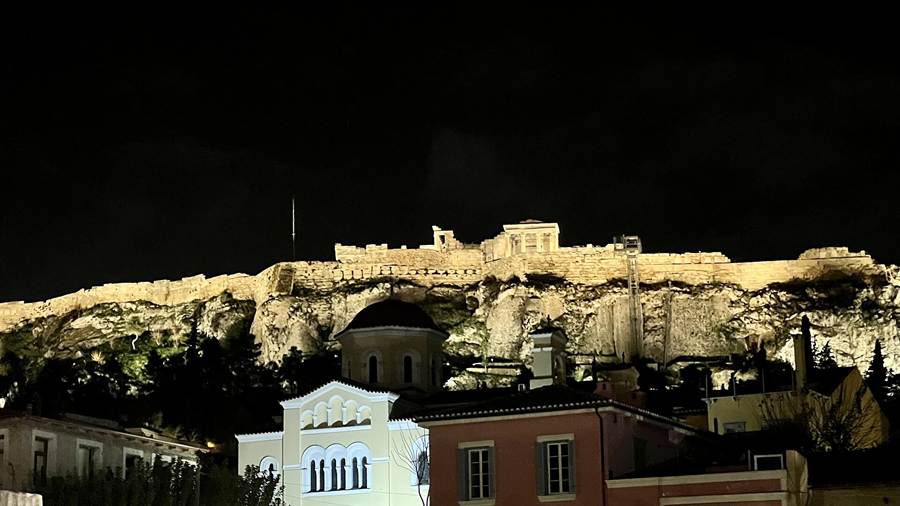
The Athens tours post sorts every Greece Ville tour of the capital by theme. An Athens night tour is the entry there for the evening, when the monuments stand lit above the streets.
Athens has a hot-summer Mediterranean climate. The city has been called the hottest city in mainland Europe, and it was the first European city to appoint a chief heat officer. An Athens night tour meets that summer climate after dark.
Athens has 148 theatrical stages, more than any other city in the world. Open-air garden cinemas add to the evening programme, so an Athens night tour passes a city with a full schedule after sunset.
The historic centre holds restaurants, tavernas and bars in Plaka and the Trigono area. The inner suburbs of Gazi and Psyrri are especially busy with nightclubs and bars. Those districts shape where an Athens night tour goes.
- Serenades: Athenian serenades, based on the kantades of the Ionian Islands, were the leading songs of the period from 1870 to 1930.
- Planetarium: The Athens Planetarium in Palaio Faliro is one of the largest and best equipped digital planetaria in the world.
- Coast: Microlimano, Alimos and Glyfada hold tavernas, beach bars and busy summer clubs along the shore.
- Cafe districts: Kolonaki, Exarchia, Kypseli, Metaxourgeio, Koukaki and Pangrati offer more of a cafe and restaurant scene.
The next sections follow the order of an evening route: the lit Acropolis first, then Plaka, Monastiraki, Psyrri and Lycabettus, with dinner last.


What does an Athens night tour show of the lit Acropolis?
An Athens night tour shows the Acropolis as a lit rock above the city, with the Parthenon at its centre. The walls, gates and temples on the rock record centuries of building, siege and repair, seen from the streets below.
The Acropolis tour post covers a climb to the rock with its monuments and site rules. An Athens night tour keeps to the lanes below and looks up at the lit walls and temples.
After the victory at Eurymedon in 468 BC, Cimon and Themistocles ordered the rebuilding of the southern and northern walls of the Acropolis. Those walls form the edge of the rock that an Athens night tour sees from below.
The roof and floor of the Propylaea were partly restored. Sections of the roof are new marble, decorated with blue and gold inserts, as in the original. The gate keeps its old colour scheme in the restored parts.
The restoration used 530 cubic metres of new Pentelic marble, with the original material reassembled where possible. That mixture of old and new stone is the surface that the lights of an Athens night tour meet.
In 1944 Greek Prime Minister Georgios Papandreou arrived on the Acropolis to celebrate liberation from the Nazis. The date ties the rock to the modern city as well as to the ancient one.
- Theatre: The remains of the Theatre of Dionysus lie south of the platform that forms the summit.
- Eleusinion: The site plan of the rock lists the Eleusinion among its sanctuaries and remains.
- Lesser Panathenaea: This annual festival placed a new robe on the statue of Athena Polias in the Erechtheum.
- Great Panathenaea: Every four years the new robe went to the statue of Athena Parthenos in the Parthenon.
The lit rock is the fixed point of an Athens night tour. Every other stop in this post stands within sight of it or on a street that leads away from its slopes.
What does an Athens night tour show in Plaka and Anafiotika?
An Athens night tour walks the lanes of Plaka, the old neighbourhood that clusters around the northern and eastern slopes of the Acropolis. Plaka holds neoclassical houses, narrow streets and the small district of Anafiotika, built in traditional Cycladic style.
The Athens walking tour post covers the same streets by day, with the museums and monuments of the old town. An Athens night tour covers those lanes after dark.
Plaka is the only neighbourhood in Athens where all utilities lie underground, in custom-made tunnels. It also lives under strict zoning and conservation regulations, which shape what an Athens night tour sees.
The name Plaka is first attested in the second half of the 17th century. At first it applied only to the area around the Choragic Monument of Lysicrates, which locals called the lantern of Demosthenes.
A fire in 1884 burned down a large part of the neighbourhood. That gave archaeologists the chance to excavate the Roman Agora and Hadrian’s Library, and excavations have continued since the 19th century.
Plaka declined from the 1950s to the 1970s, under the post-war building boom, more motor cars and the tourist boom. A preservation plan in the 1980s improved the area rapidly.
- Albanian quarter: Plaka had a sizable Albanian community until the late 19th century and served as the Albanian quarter of Athens.
- Museums: The Frissiras Museum and the Athens University Museum both stand in Plaka.
- Cinema: Greek films such as The Drunkard were shot in the area.
- Anafi: The island of Anafi lies east of Santorini and had a population of 293 in 2021.
Plaka and Anafiotika give an Athens night tour its slowest stretch, on narrow lanes under the rock. The next stretch moves toward the busier squares and bars.
How does an Athens night tour reach Monastiraki and Psyrri?
An Athens night tour moves from Plaka into Monastiraki, a district of clothing boutiques, souvenir shops and specialty stores, and on to Psyrri. Psyrri is an inner suburb that is especially busy with nightclubs and bars after dark.
Monastiraki is a major tourist attraction in Athens and Attica for bargain shopping. An Athens night tour crosses the district in the evening, when the shop fronts and the streets around them change character.
Line 1 of the Athens metro, the Green Line, is the oldest line of the network. It serves 24 stations and covers 25.6 km from Piraeus to Kifissia, with Monastiraki as one of its stops.
Gazi, the second inner suburb named for nightclubs and bars, lies close to Psyrri. An Athens night tour that wants a late stop can end in either district.
Photography and video-taking is permitted across the whole metro network, and street photographers work in the stations. The stations also show works of art and displays of the archaeological remains found during construction.
- Underground section: Line 1 is mostly overground, with an underground section between the Monastiraki and Attiki stations.
- Interchanges: The network has five interchanges, at Attiki, Monastiraki, Omonia, Piraeus and Syntagma.
- Line 3: The Blue Line meets Line 1 at Monastiraki station.
- Cafe scene: Metaxourgeio and Koukaki, near the centre, offer more of a cafe and restaurant scene.
Monastiraki and Psyrri give an Athens night tour its liveliest stretch. The next section climbs away from the noise to a hill above the city.
What does an Athens night tour show from Lycabettus?
An Athens night tour looks to Mount Lycabettus, a Cretaceous limestone hill that stands above the centre of the city. Pine trees cover its base, and a funicular railway climbs from Aristippou Street in Kolonaki toward the twin peaks.
Tradition ties the name to wolves, since lykos is the Greek word for wolf. By that account the hill is the one that wolves walk, and an Athens night tour looks up at that old name.
In Greek myth, Athena created the hill. She was carrying a limestone mountain from the Pallene peninsula for the building of the Acropolis, and she dropped it when the box holding Erichthonius was opened.
At the two peaks stand the 19th-century Chapel of St George and a theatre. An Athens night tour sees them as lights on the dark crown of the hill.
The open-air amphitheatre near the top closed in 2008 because of safety concerns. After 15 years it reopened in September 2023, and an Athens night tour passes a venue with a long concert history.
- Neighbourhood: The name Lycabettus also covers the residential neighbourhood immediately below the east of the hill.
- Spellings: The hill also appears as Lycabettos, Lykabettos and Lykavittos.
- Artists: Ray Charles, Joan Baez, Leonard Cohen and Bob Dylan have all performed at the theatre.
- Later acts: Radiohead, Bjork, Peter Gabriel and Iron Maiden are also on the list of performers.
Lycabettus is the high point of the route in two senses. It is the last climb before the descent toward dinner, which the next section covers.
How does an Athens night tour end with a late dinner?
An Athens night tour ends at a table, as Greek evenings have done for centuries. Ancient Greeks split the day into three meals, acratisma, ariston and deipnon, and the evening dinner added a second course called the epideipnis.
The Athens food tour post covers tasting stops through markets and old streets. An Athens night tour treats dinner as the closing stage of an evening route.
At a symposium, the first part was food, kept simple, and the second part was drinking. Snacks such as chestnuts, beans, toasted wheat and honey cakes were meant to absorb the alcohol.
Tables were high for normal meals and low for banquets. By the 4th century BCE the round table had become the usual form, and animal-shaped legs were a common detail. That long past stands behind an Athens night tour dinner.
Dining out is common in Greece. The taverna and the estiatorio are widespread, and locals largely eat Greek cuisine. Fast food became popular in the 1970s, with chains serving souvlaki, gyros, tiropita and spanakopita.
- Meze: A meze can be served as part of a multi-course meal or form a meal in itself.
- Dishes: Meze tables hold kalamata olives, fava spread and melitzanosalata, an aubergine salad.
- Word: The word meze comes from Turkish and was borrowed in turn from Persian maze, meaning taste or relish.
- Washing: A jug called the prochoos served for washing the hands before and after meals.
A late dinner closes an Athens night tour in the same way that the symposium closed an ancient evening: with food, drink and talk after the walking is done.
Which formats of Athens night tour are on sale?
An Athens night tour is on sale in bus, walking, tuk-tuk and segway formats. The listed Athens night tour options include open-top and double-decker bus rides, night walks with a local, story walks, a wine tasting and a pub crawl.
Bus formats carry live commentary from a narrator. One is an open-top bus that runs after dark, and another is a panoramic double-decker ride around the lit sights. A hop-on hop-off bus ticket also appears in the listing.
Night walking tours form the largest group. One adds a local as tour leader, one adds a wine tasting, and one pairs the walk with a dinner. Plain night walks complete the group.
Story walks turn the dark streets into a stage. One covers legends, murders and mysteries after dark, one tells tales of the underworld, and one follows Greek mythology to a hidden view of the Acropolis.
A private evening sightseeing tour by electric tuk-tuk suits a small party. A segway format glides through the lit centre, and a pub crawl with club entry serves those who want the bars of the evening.
- Bus: Open-top, double-decker and hop-on hop-off buses show the lit centre from a seat.
- Walk: Night walks run with a local, with wine tasting or with dinner included.
- Story: Legend, crime and underworld walks use the dark lanes as a setting.
- Vehicle: Electric tuk-tuk and segway formats cover the centre without a long walk.
The tour cards and availability boxes on this page list live dates for each format, so the choice between bus, walk, segway and tuk-tuk can be made against open evenings.
What do travellers ask about the Athens night tour?
The Athens night tour raises questions about districts, hills, transport and dinner. Travellers ask which quarters the route covers, whether Lycabettus is included, how the formats differ, and where an evening ends. The answers below draw on the sections of this post.
Which districts does an Athens night tour cover?
An Athens night tour covers the lanes of Plaka and Anafiotika under the Acropolis, then the shops of Monastiraki and the bars of Psyrri. Gazi, Kolonaki and the coast lie beyond the centre, and the lit rock stays in view throughout.
Does an Athens night tour include Lycabettus?
Routes differ. Lycabettus is a Cretaceous limestone hill with a funicular railway that climbs from Aristippou Street in Kolonaki. A bus or tuk-tuk format can pass the hill, while a walking format keeps to the old streets near the Acropolis.
Is an Athens night tour on foot or by vehicle?
Both exist. Walking formats form the largest group, with story walks, wine tastings and dinner pairings. Open-top and double-decker buses show the lit centre from a seat, and electric tuk-tuk and segway formats cover distance without a long walk.
Where does an Athens night tour end?
An Athens night tour ends at a table or at a bar. Plaka and the Trigono area hold tavernas, Psyrri and Gazi hold bars, and a meze table can be a full meal in itself. The long past of dinner in Greece suits that finish.
Featured photo: Matt Kieffer, CC BY-SA 2.0, via Wikimedia Commons.