
Cyclades tours are trips through the island group in the middle of the Aegean, from Santorini and Mykonos to Naxos, Paros, Milos and the Small Cyclades. The page is part of the Greece Tours on Greece Ville.
This page covers what Cyclades tours are and the islands one by one, from Naxos to Kythnos. The Cycladic culture, Delos, ferries, the winds, the months and common questions follow. Each section links to the Greece Ville posts on single tours.
What are Cyclades tours of the Aegean island group?
Cyclades tours explore an Aegean archipelago of about 220 islands that form a ring around the sacred island of Delos, linking farming islands, volcanic craters, fishing harbours, ancient sanctuaries and small uninhabited rocks southeast of the Greek mainland.
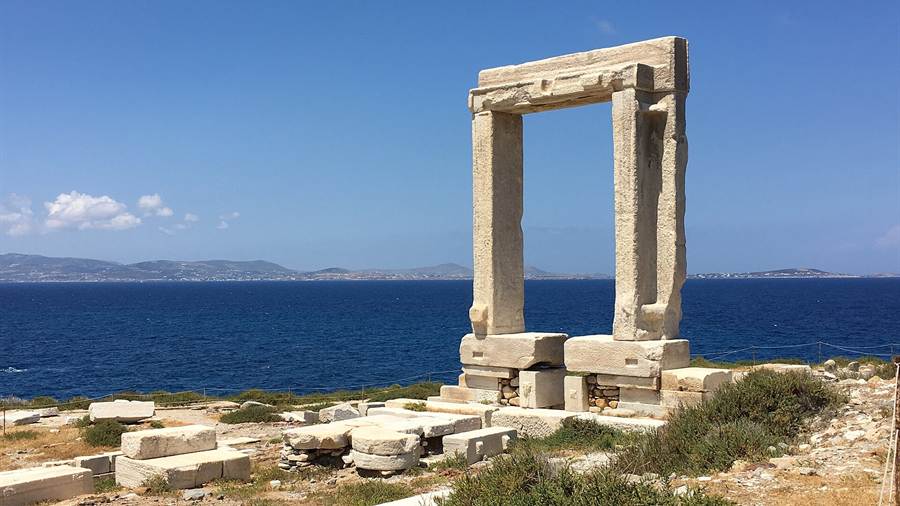
The archipelago holds about 220 islands, and nearly all the smaller ones have no permanent residents. Cyclades tours therefore centre on a short list of named islands that have ports, villages and beaches.
Syros has the largest population of any island in the group. The name of the whole archipelago comes from a Greek word for circle, as the islands lie around Delos, sacred to ancient Greek religion.
Two islands in the group, Milos and Santorini, are volcanic. The rest are the peaks of a submerged mountainous terrain, so Cyclades tours pass between volcanic bays and bare ridges of older rock.
In recent decades tourism has brought erosion, pollution and water shortages to the islands. Careful travel on small boats and village paths matters for that reason across the whole group.
- Islands: The group counts about 220 islands, and nearly all the smaller ones are uninhabited.
- Volcanic pair: Milos and Santorini are the two islands built on volcanic rock.
- Centre: Delos, the sacred island, gave the whole archipelago its name.
- Soil: Apart from Naxos, the soil of the islands is not very fertile.
The Santorini tours post covers the island with the flooded crater, and the Mykonos tours post covers the island of windmills. Cyclades tours begin from those names.


Why does Naxos anchor Cyclades tours of the central islands?
Cyclades tours reach Naxos, the best-watered farming island of the group, where Mount Zeus rises to 1,001 metres, traps passing clouds and feeds the farms, villages and marble quarries of the interior with rain that other islands rarely receive.
Mount Zeus is the highest peak in the Cyclades. It traps clouds, so more rain falls on Naxos than on islands nearby, and that makes Naxos the island of the archipelago that feeds itself best.
In Greek myth the young Zeus was raised in a cave on Mount Zas. Tradition also holds that Dionysus protected the island and that Naxos was his wedding isle.
Byzantine officials arrested Pope Martin I in Rome, and he was held on Naxos for almost a year before trial in Constantinople. The Naxos tour post covers the town and the villages. The Naxos ATV tour post covers the island by quad bike, from Chora to Halki, Filoti and Apiranthos.
In 1341 Umur of Aydin carried off 6,000 people from the island and demanded tribute. In 1566 the Ottoman sultan Selim II named Joseph Nasi as duke. The Naxos boat trip post covers the coast.
Seven sports clubs on Naxos offer windsurfing, kitesurfing and other water activities. Cyclades tours of Naxos suit the strong summer wind, since the island is counted as a windy place like its neighbours.
- Peak: Mount Zeus reaches 1,001 metres.
- Myth: Tradition places the childhood of Zeus in a cave on Mount Zas.
- Arrest: Pope Martin I was detained on the island before his trial in Constantinople.
- Water sports: Seven clubs on the island teach windsurfing and kitesurfing.
The Naxos sailing post covers days under sail, and the Naxos cooking class post covers the island kitchen. Both belong to Cyclades tours of Naxos.
How do Cyclades tours combine Paros and Antiparos?
Cyclades tours pair Paros, a round island built around a marble mountain of 724 metres, with Antiparos, a smaller island across a strait less than two kilometres wide, reached by a local ferry that carries cars and passengers.
Parian marble is white and translucent. Quarriers exported it from the sixth century BC, and Praxiteles was among the sculptors who used it. Tunnels worked by lamplight gave the stone the name Lychnites.
A medieval castle above the seafront of Parikia was built almost entirely from the marble of an ancient temple of Apollo. The church of Ekatontapiliani, tradition says, was founded by Saint Helen.
The Archaeological Museum of Paros holds a fragment of the Parian Chronicle, a marble chronology of Greek events that runs from 1500 BC down to 264 BC. Manto Mavrogenous, a heroine of 1821, lived on Paros.
Antiparos had 1,265 permanent residents in 2021. Giovanni Loredan built its Venetian castle in 1440. The cave at the centre of the island bears names carved by Lord Byron and King Otto.
- Peak: The single mountain of Paros stands 724 metres high and slopes evenly to the coast.
- Wind: A constant strong wind in the strait between Paros and Naxos favours windsurfing.
- Saliagos: This islet holds the oldest known settlement in the Cyclades.
- Figurine: Excavators at Saliagos found a marble figure known as the Fat lady of Saliagos.
The Paros boat trip post covers the coast from the sea, and the Paros snorkeling post covers the shallow bays. Both suit Cyclades tours of the pair.
What do Cyclades tours show on volcanic Milos?
Cyclades tours reach Milos, the south-western tip island of the group, a volcanic island with white rock formations, hot springs, ancient ruins and the find spot of the statue known as the Venus de Milo, now in the Louvre museum.
Cyclades tours place Milos 120 kilometres east of the coast of Laconia. Mount Profitis Elias, 748 metres high, is its highest point, and the main crater forms a natural harbour that splits the island in two.
Volcanic activity began two to three million years ago, and the last eruption came 90,000 years ago. The volcano counts as dormant, and heat is still strong in a cave on the south coast.
Phylakopi, on the north-east coast, grew in the Bronze Age. Its Pillar room held the famous fresco of flying fish. The British School at Athens dug there in 1896, and Colin Renfrew returned in 1973.
Ancient Melians struck coins stamped with an apple, because the Greek word for apple sounded like the name of the island. Cretan refugees founded the port town of Adamantas in 1841.
- Population: Milos had 5,193 inhabitants at the 2021 census.
- Natura 2000: The west holds over 800 taxa, and 35 are endemic to Greece.
- Revolution: The first naval battle of the war of 1821 took place off Milos on 11 April.
- Crowds: Milos receives fewer visitors than Santorini and Mykonos.
The Milos boat tour post covers the coast by sea, and the Milos sailing tour post covers days under sail. Both belong to Cyclades tours of Milos. The Milos kayak tour post covers the volcanic coast from the water, with Kleftiko and Sarakiniko.
Which islands do Cyclades tours include among the Small Cyclades?
Cyclades tours of the Small Cyclades visit a scatter of 32 islands and rocks southeast of Naxos, where only four islands have permanent residents: Ano Koufonisi, Irakleia, Donousa and Schoinoussa, while uninhabited Keros is a protected archaeological site.
Ano Koufonisi covers 5.8 square kilometres and had 391 residents in 2021, the smallest island of the group with the densest population. Its fishing fleet is among the largest in Greece relative to population.
Donousa lies 16 kilometres east of Naxos, and its highest point is 385 metres. It had 213 residents in 2021. Evidence of settlement there dates from about 3,000 BC, in the Early Cycladic period.
Schoinoussa had 229 residents in 2021 and covers 8.512 square kilometres. It lies between Irakleia and Koufonisia and has three settlements, Chora, Mesaria and the port of Mersini, so Cyclades tours there stay compact.
During the last ice age nearly all the Cyclades formed one large landmass. The sea rose about 9,000 BC and flooded it, which created the small islands that Cyclades tours now cross.
- Keros: This uninhabited island is a protected archaeological site with rich Cycladic finds.
- Saint George: A procession on 23 April carries his icon over streets covered in rose petals.
- Name: One account links Koufonisia to Koufos Limin, a lee port where ships anchor.
- Easter: On Good Friday torches light the port of Ano Koufonisi.
The Koufonisia cruise post covers the sea route to the sandy coves. The Small Cyclades are the quietest corner of Cyclades tours.
Why do Cyclades tours stop at Amorgos?
Cyclades tours stop at Amorgos, a long island where 1,961 residents live in six communities and where Archaic city-states, a Hospitaller sea victory and a Turkish-era name each add a layer to a cliff-lined coast.
Amorgos had a population of 1,961 at the 2021 census. Aigiali counted 536 residents, Tholaria 154, Arkesini 182 and Vroutsis 75. Six communities make up the municipality of the island.
In the Archaic period three independent city-states shared the island. They had autonomous constitutions but the same currency. Cyclades tours of Amorgos therefore cross a coast that once held three small capitals.
In 1312 the Hospitaller fleet defeated a fleet of Menteshe at the island. In the fifth century Bishop Theodore signed as Bishop of the Parians, Sifnians and Amoulgians. It joined the Greek state in 1830.
Older names include Yperia, Platagy, Pagali, Psichia and Karkisia. The Periplus of Pseudo-Scylax mentions it as Tripolis, and the island’s name later shifted to Amolgon and then to Amourgon.
Hiking paths are relatively well maintained, and scuba diving and free-diving are among the activities. Tourism grows slowly because the geography prevents mass tourism, and the island is reachable only by boat.
- Population: The island had 1,961 residents at the 2021 census.
- Hospitallers: Their fleet beat a fleet of Menteshe at Amorgos in 1312.
- Bishop: Theodore signed as Bishop of the Amoulgians in the fifth century.
- Tripolis: Pseudo-Scylax mentions the island under that name.
The Amorgos boat trip post covers the coast from the sea. It adds the deepest layer to Cyclades tours of the eastern islands.
What do Cyclades tours offer on Ios between Naxos and Santorini?
Cyclades tours reach Ios, a hilly island halfway between Naxos and Santorini, where whitewashed lanes climb from the port to the village of Chora and where Venetian ruins, Phoenician traces and a famous poet add depth to the shoreline.
On Cyclades tours of Ios the highest point is Kastro, also called Pyrgos, at 723 metres. Three more peaks rise around it. The rock is almost entirely metamorphic, with limited quaternary deposits.
Travellers once called Ios Little Malta, a nickname that reflected its reputation as a haven for pirates in Ottoman times. Phoenicians arrived and stayed until the ninth century BC.
Palaiokastro, a ruined Venetian castle of the fifteenth century, stands on the northern part of the island. Albanians settled on Ios in 1579, after the earlier inhabitants had been sold into slavery in 1558.
From the 1970s Ios became a popular destination for young people from Europe, and it keeps that reputation today. European Community funds have supported infrastructure on the island since the 1990s.
- Homer plan: The municipality keeps an emergency plan named Homer for quakes and fires.
- Little Malta: Ottoman-era travellers used this nickname for a haven of pirates.
- Roman era: Rome used the island as a place of exile, and its decline began in that period.
- Church: Ios now belongs to the Metropolis of Thera, Amorgos and the Islands.
The Ios boat trip post covers the coast and the bays by sea. It closes the first half of Cyclades tours, which run on through the western islands.
What do Cyclades tours cover on Sifnos?
Cyclades tours reach Sifnos, a western island between Serifos and Milos, about 130 km from Piraeus, with a shoreline of 70 km and a permanent population of 2,625. Apollonia, the main town, stands near the centre of the island.
The name of Apollonia is thought to come from an ancient temple of Apollo. Apollonia holds the folklore museum and the library of Sifnos, and its population was 918 in 2021.
The Bolognese Gozzadini family gained power over Sifnos around 1440 through a dynastic marriage and ruled until 1617. Both ruling dynasties became Greek in outlook, yet they kept their Roman Catholic faith for centuries.
Rich clay veins made Sifnos a pottery centre, and the oldest workshops stood inland at Artemonas and Ano Petali, away from pirate attacks. In the local dialect, the word Sifnios was a variant for a potter.
Revithada is chickpea soup left overnight in clay skepastaria and traditionally served after Sunday church services. Mastelo is traditionally served on Holy Saturday evening, during Orthodox Easter. Cyclades tours link such dishes to village life.
- Sarcophagi: Three Roman sarcophagi remain in the streets of Kastro, and the museum there holds 80 Byzantine coins.
- Liberation: A fleet sent by Alexander the Great freed the island after a brief Persian takeover.
- Minister: Nikolaos Chrysogelos, born in 1780, served as the Greek Minister of Education.
- Language: A fragment of Aristophanes uses the verb to play the Siphnian, explained as a reference to transgression.
The Sifnos boat trip post covers sea outings around the island. Cyclades tours that stop at Sifnos therefore pair the coast with the villages inland.
Why do Cyclades tours stop at Syros?
Cyclades tours stop at Syros because it has the largest population in the group, with 21,124 inhabitants at the 2021 census, and because the church of Kimisis tis Theotokou in its port town of Ermoupoli hosts a work by El Greco.
Syros lies 78 nautical miles, or 144 km, south-east of Athens. Cholera and other epidemics struck the island in 1854, and charitable institutions followed, among them orphanages, poorhouses and a mental hospital.
Syros stayed neutral at the start of the revolution of 1821 and became a shelter for refugees. Ermoupoli later gained a commercial court, insurance brokerages, one of the first post offices in Greece and a branch of the National Bank of Greece.
The Greek Steamship Company was founded on Syros in 1856. Sailing then gave way to steam, and Piraeus took the leading place among Greek harbours. Cyclades tours therefore read Ermoupoli as a record of a rich trading past.
Catholics and Orthodox share a common date for Easter on Syros, and the shared date is the Orthodox one. The Catholic diocese counts 9000 worshippers, 7 parishes and 57 chapels.
- Education: The Aegean University has a department of Fine Arts and system design in Ermoupoli.
- Cemetery: A British cemetery holds seamen and servicemen who died in the Cyclades, especially during the Second World War.
- Consulates: Consulates of France, Britain, Italy, the Netherlands and Scandinavian countries show the European ties of the island.
- Occupation: Italy occupied Syros in the Second World War, and a famine caused thousands of deaths.
The Syros day trip post covers a visit to the island and its harbour town. Cyclades tours that include Syros add a city of marble squares to the beaches of other islands. The Andros tour post covers Andros, the northernmost island of the group, with Chora, its villages and its trails.
What do Cyclades tours show on Kythnos and the western islands?
Cyclades tours show Kythnos, 56 nautical miles or 104 km from Piraeus, together with Kea and Serifos in the western group. Kythnos rises to 365 m at Mount Kakovolo, and its streets in the two main villages are narrow and stepped.
Katafyki Cave in Dryopida is one of the largest caves in Greece. Visitors first entered it in the 1830s, and an iron mine worked there until 1939. Cyclades tours note its rock curtains.
At Vryokastro, archaeologists found an unplundered inner sanctum of a 2,700-year-old temple, dedicated to Hera or Aphrodite. More than 1,400 objects came out of it, among them jewels, bronze work and painted vases.
Kythnos opened Greece’s first wind park in 1982. With a photovoltaic system and storage batteries added, the diesel fuel needed for its electricity fell by 11%. Cyclades tours cross an island that tests clean energy.
On Kea, the Neolithic settlement of Kephala is dated to about 4600 BC and held 45 to 80 people. Serifos had 1,241 residents in 2021, and its iron mines closed in the 1960s.
- Swings: At Easter, young men and women on Kythnos swing together and exchange praise and poetry.
- Carnival: A straw puppet called Lazanis is baptised and then plays the part of King Carnival.
- Poets: Kea was the home of the lyric poets Simonides and Bacchylides in the classical period.
- Tower: The Aspros Pyrgos on Serifos is a marble watchtower of about 300 BC.
The Kythnos boat trip post covers the coast of the island from the sea. Cyclades tours using the western islands then add the caves and ruins inland.
How do Cyclades tours explain the Cycladic culture and Delos?
Cyclades tours explain the Cycladic culture, a Bronze Age society dated from about 3100 BC to about 1000 BC, and Delos, the small sacred island near Mykonos, close to the centre of the group, that UNESCO added to the World Heritage List in 1990.
The Cycladic culture is best known for flat marble figurines of uncertain purpose. Around 90% of the known figures were looted or removed without scientific method, so their original context is lost.
Collectors prized the figures because they looked like sculpture by Jean Arp or Constantin Brancusi. Between 2009 and 2010, scholars met a man who called himself the forger and learned how fakes reached the market.
Late Cycladic boat models show crews of twenty-five oarsmen. When the palace culture of Crete rose, Cycladic influence faded, apart from Kea, Naxos and Delos. Cyclades tours treat Delos as the survivor.
People lived on Delos from the third millennium BC. The Delian League met there after 478 BC, and its treasury stayed until 454 BC, when Pericles moved it to Athens.
- Purification: Athens ruled that nobody was allowed to be born or buried on the island, and the order kept its trade neutral.
- Free port: In 166 BC the Romans made Delos a free port, and it became a centre of the slave trade.
- Decline: Forces of Mithridates VI attacked the island in 88 BC, and the island was abandoned around the eighth century AD.
- Population: The census of 2001 recorded 14 inhabitants on Delos.
The Delos tour post covers the sanctuary and its excavated houses. Cyclades tours that pass Delos therefore tie the island group to its oldest source of fame.
How do Cyclades tours handle ferries and island hopping?
Cyclades tours handle ferries and island hopping through Piraeus, the largest passenger port in all of Europe, which counted 18.6 million passengers in 2014, and through Lavrio, a port in Attica about 60 km south-east of Athens.
Terminal A at Piraeus can handle 1,200 passengers an hour, and two medium-sized ships can check in there together. Terminal B was built in 2013 for large cruise ships and has space for 120 coaches.
Sifnos lies about 130 km from Piraeus, Kythnos 104 km and Serifos 170 km. Cyclades tours therefore treat the western islands as the nearest stops, with Syros and Delos further east.
The harbour of Kythnos once lacked a deep-water dock, and the tourist boom of the mid-20th century largely passed it by. A new mole of 1974 changed that, and a larger one was finished in 2008.
- Cruise traffic: Piraeus recorded 1,098,091 cruise passengers in 2019, a rise of 14.2% on 2018.
- Vehicles: Vehicle traffic at Piraeus reaches 2.5 million, and passenger traffic reached 15.5 million in 2017.
- Quay: The passenger quay at Piraeus has a total length of 2.8 km.
- Destinations: Ferries from Piraeus serve the Saronic islands, the Cyclades, Crete, the Dodecanese and the northern Aegean.
Cyclades tours also pass through Lavrio, once known for the silver mines of Laurium. The wind decides when a sailing goes, a topic covered in the next section. The Greek island hopping tours post covers the routes that link the Cyclades with the other island groups.
How do the winds and the months shape Cyclades tours?
Cyclades tours depend on the etesian winds, or meltemia, the strong dry north winds of the Aegean that blow periodically from the middle of the fifth month to mid-September, with the highest frequency recorded in July and August.
The etesians are due chiefly to a deep continental depression centred over southwest Asia, and sometimes they last for days without a break. Cyclades tours plan around that rhythm.
Etesians have been described since ancient times and can blow at force 7 to 8 on the Beaufort scale. In such conditions yachts and inter-island ferries cannot sail.
The word etesian comes from the Greek word etos, meaning year. Though sometimes called a monsoon wind, the meltemi is dry and has no opposite wind in winter.
- Direction: In the central Aegean the etesians blow from the north, and in the southern Aegean they blow as north-westerlies.
- Cooling: The northerly winds temper the fierce summer heat of the region.
- History: Philip II of Macedon timed his campaigns so that southern fleets were unable to reach him under these winds.
- Season: Another source gives the span as the fifth month to October.
Calm spells between etesian days suit the shorter crossings. Cyclades tours therefore leave the final choice of route to the weather of each day.
What do travellers ask about Cyclades tours?
Cyclades tours cover an archipelago of about 220 islands in the Aegean Sea, southeast of the Greek mainland, and the islands form a circle around Delos, which was sacred in ancient Greek religion and gave the group its name.
What size is the island group in Cyclades tours?
The archipelago has about 220 islands, and the larger share of the smaller ones is uninhabited. Cyclades tours reach major islands such as Amorgos, Anafi, Andros, Antiparos, Delos, Ios, Kea, Kimolos, Kythnos, Milos, Mykonos, Naxos, Paros, Folegandros, Serifos, Sifnos, Sikinos, Syros, Tinos and Santorini.
Why are Cyclades tours named after a circle?
The Greek phrase Kykladhes nisoi means the surrounding islands, and the word is cognate with the English word cycle. The name refers to the islands forming a circle around the sacred island of Delos. Cyclades tours thus carry a name that points to a single centre.
What does the farmland on Cyclades tours produce?
The climate is dry and mild, and with the exception of Naxos the soil is not very fertile. Agricultural produce includes wine, fruit, wheat, olive oil and tobacco. Higher ground on Cyclades tours records lower temperatures and seldom sees wintry weather.
What strain do visitors place on Cyclades tours?
In recent decades the Cyclades have become popular with European and other tourists. As a result the islands have faced problems with erosion, pollution and water shortages. Cyclades tours therefore run across a dry group of islands where such resources are limited.