
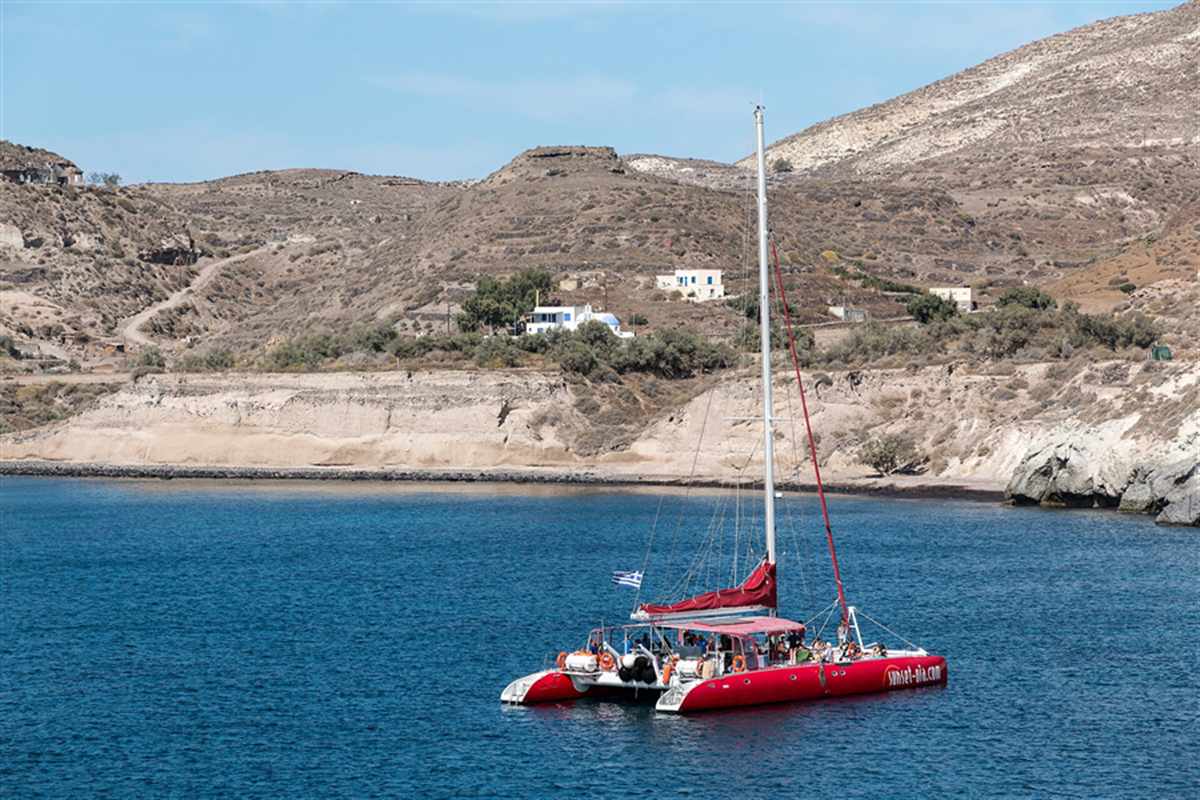
Catamaran vs sailing yacht is the first choice on a Greek boat trip: two hulls and a wide deck, or one hull that heels and points into the wind. The post is part of the Greece Tours on Greece Ville, listed with the other Greece multi-day tours and Greece sailing tours.
This post covers how the two boat types are built and how they sail, then how to choose between them for seasickness, wind, families and island routes. Common questions come last.
What does catamaran vs sailing yacht mean?
Catamaran vs sailing yacht names a comparison between two kinds of pleasure sailing boat. A catamaran carries two parallel hulls of equal size, while a sailing yacht normally rests on one hull, a design called a monohull, and both types can sail under canvas.
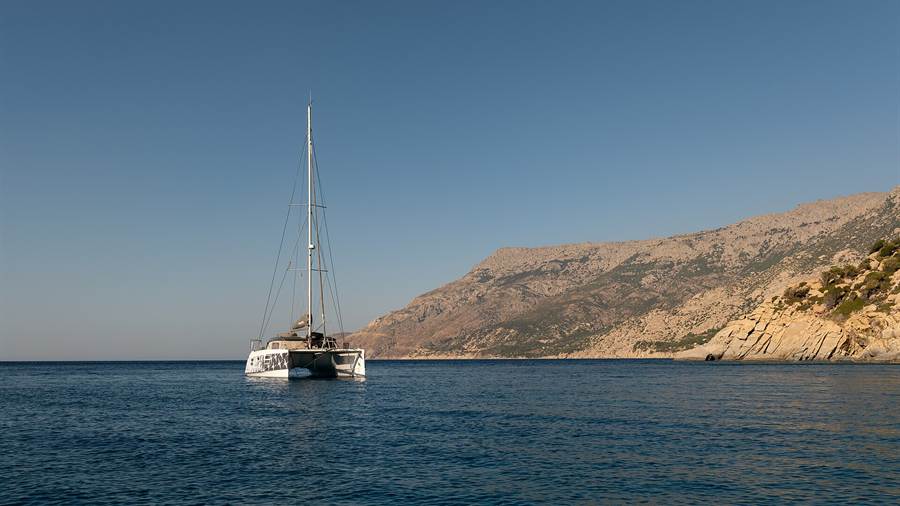
The hulls of a catamaran are linked by a bridgedeck, or on simpler cruising boats by a trampoline stretched between the crossbeams. The wide gap between the hulls gives the boat its stability and its character.
A monohull is a boat with only one hull, unlike a multihull, which has two or more hulls joined to one another. The monohull is the commonest waterborne vessel, and the sailing yacht belongs to it.
The word yacht has no standard definition. It names a sail- or motor-propelled watercraft made for pleasure, cruising or racing, and the term applies to vessels with a cabin intended for overnight use.
A sailing yacht is therefore a yacht driven by sails. Catamaran vs sailing yacht is a split in hull count and design, not a split between sailing and motoring.
Multihulls also include trimarans with three hulls, and boats with four or more hulls are very rare. The Greece boat tours post covers boat trips around the Greek islands.
- Catamaran: Two hulls joined by a bridgedeck or a trampoline.
- Monohull: One hull, with weight carried low to keep the boat upright.
- Trimaran: Three hulls, a close relative of the catamaran.
- Yacht: A pleasure craft with a cabin intended for overnight use.
The rest of this post compares the two by ballast, stability, space, speed, draught and history. Each design wins in a different area.



Why does ballast matter in catamaran vs sailing yacht?
Catamaran vs sailing yacht differs first in ballast, because a monohull needs heavy weight low in the hull to stay upright, while a catamaran relies on the broad stance of its two hulls and carries no ballast at all for stability.
Early hulls were simple logs, and they rolled over easily. Hollowing a log into a dugout canoe helped only when the hollow reached below the centre of buoyancy and the load sat low.
Naval architects therefore place the centre of gravity well below the centre of buoyancy, which in practice means adding weight. Stones served as ballast among the Romans, Phoenicians and Vikings.
On a sailing yacht the ballast sits in the keel as lead or cast iron. It runs from 20 to 50 percent of the displacement. Catamaran vs sailing yacht begins with that weight.
A catamaran gives up ballast and relies on geometry instead. Designers of performance multihulls go to great lengths to cut weight, and the work has been compared to designing an aircraft.
Modern trimarans can be rated as unsinkable, so the hull floats if every compartment fills with water. A monohull without foam or air tanks sinks when flooded, so catamaran vs sailing yacht differs here too.
- Racing monohulls: Ballast in a racing boat can reach 50% of the weight of the boat.
- Inertia: Heavy ballast gives a monohull great inertia, so it accelerates less readily.
- Catamaran: No ballast is needed, as hull spacing gives stability.
- Capsize: A well designed ballasted boat can recover from a full capsize.
Ballast explains the character of each boat. The monohull gets safety from weight and the catamaran gets safety from width.
How do catamaran vs sailing yacht compare for stability?
Catamaran vs sailing yacht compares two kinds of stability, because a catamaran resists heeling through the distance between its hulls, while a sailing yacht leans under the wind and returns upright through the weight of its ballast keel.
Catamarans rely primarily on form stability, which comes from hull shape and spacing. The greater the distance between the hulls, the greater the stability of the whole boat.
Monohulls larger than a dinghy require built-in ballast, so a sailing yacht of that size takes its stability from weight. In catamaran vs sailing yacht terms, a catamaran takes it from width and carries none.
A sailing yacht leans over as the wind fills the sails. Its keel works as a counterweight to the lateral force of the wind, and it offsets the heeling moment more as the heel grows.
The trade-off appears after a capsize. A well designed ballasted boat can recover, even from turning over completely, while a multihull that lies upside down is hard to right without help.
Multihulls can also prove more difficult to tack, because reduced weight means reduced momentum, so speed drops faster into the wind. Catamaran vs sailing yacht therefore differs in handling as well as steadiness.
- Form stability: A catamaran stays upright through the distance between its hulls.
- Keel weight: A sailing yacht offsets the wind through a counterweight in the keel.
- Righting: A ballasted boat recovers, but an upturned multihull needs help.
- Structure: Strength is easier in a one piece monohull than in a multihull.
Neither design is safer in every respect. Catamaran vs sailing yacht stability depends on the event, and each boat handles one kind better.
How does space compare in catamaran vs sailing yacht?
Catamaran vs sailing yacht trades space against weight, because a catamaran has less hull volume and smaller displacement than a monohull of comparable length, and a design built light can lose cruising amenities and storage in exchange for that.
Catamarans have less hull volume, smaller displacement and shallower draught than monohulls of comparable length. Each hull of a multihull can also be narrower than a monohull hull of the same displacement.
A multihull optimised for light weight can lose cruising amenities and storage for food and supplies. Catamaran vs sailing yacht talk therefore turns on how much gear and provision a crew carries.
The choice between the two designs includes carrying capacity, speed and efficiency. A catamaran fills the niche where speed and sea-kindliness are favoured over bulk capacity, and a monohull fills the other.
Figures show the trade-off. Calm-water transport efficiency runs from 100 to 1,000 for large transport ships and from 11 to 18 for transport catamarans, which denotes higher efficiency per unit of payload for monohulls.
The Commercial Yacht Code classes yachts of 79 feet and over as large, and such yachts require a hired crew. The Santorini sailing tour post covers sailing trips on the sea around Santorini.
- Hull volume: A catamaran has less hull volume than a monohull of comparable length.
- Weight: Light construction costs cruising amenities and storage.
- Capacity: Monohulls win on bulk capacity, and catamarans win on speed and sea-kindliness.
- Efficiency: Transport ships score 100 to 1,000, and transport catamarans 11 to 18.
Space is a question of purpose. A boat built for speed gives up room, which is the core of catamaran vs sailing yacht.
Which is faster in catamaran vs sailing yacht under sail and motor?
Catamaran vs sailing yacht favours the catamaran for raw speed, because two slim hulls meet less resistance than one beamy hull, and a catamaran without ballast gains in acceleration, top speed and manoeuvrability when it is built light.
Together, the two hulls of a catamaran have a smaller hydrodynamic resistance than a comparable monohull. That calls for less propulsive power from either sails or motors, though a powered catamaran needs two engines.
Without a ballast keel, a lightweight multihull reaches the plane more easily, which cuts wetted surface area and drag. Catamaran vs sailing yacht speed therefore depends on weight as well as on sails.
Racing results show the gap. In 1978 the trimaran Olympus Photo won the first Route du Rhum, and after that no open ocean race was won by a monohull.
Size grew with speed. The Race, a circumnavigation challenge from Barcelona, led to four new catamarans over 100 feet in length. The largest, PlayStation, was 125 feet in length.
Under motor the picture changes. A sailboat can carry an inboard engine, or an outboard motor on the transom, in case the wind dies. Catamaran vs sailing yacht under motor depends on the engine fitted.
- Resistance: Two slim hulls need less propulsive power than one comparable hull.
- Planing: Without ballast, a light multihull gets on plane more easily.
- Foils: Around 2016 the first large foil-borne racing catamarans were built.
- Engines: A sailboat keeps an alternate means of propulsion for calm weather.
Speed matters less on a cruise than on a race course. Catamaran vs sailing yacht figures describe design limits, not the choice for a trip.
What does draught mean in catamaran vs sailing yacht?
Catamaran vs sailing yacht differs in draught, the depth of a vessel below the waterline, because a ballasted monohull keel reaches deep while a catamaran has no ballast keel and can enter shallow water where a monohull cannot.
Draft is the depth of the vessel below the waterline, measured vertically to its lowest point, whether keel, propeller or rudder. Draft grows as the vessel is loaded.
Draft sets the minimum depth of water in which a boat can navigate, set against the under keel clearance available. Navigators compare draft with charted depth to avoid grounding.
Reduced weight means a reduced draft, and without a ballast keel multihulls can go in shallow waters where monohulls cannot. Catamaran vs sailing yacht draught therefore favours the catamaran in shallow bays.
Monohulls manage draught in other ways. Fin keels are the standard on modern monohulls, and they are heavy and deep but short in relation to the hull length.
A related term, air draft, is the maximum height of any part of the vessel above the water. In catamaran vs sailing yacht talk, draught is depth below the water.
- Draft: The depth from the waterline to the lowest point of the hull, propeller or rudder.
- Trim: The difference between the forward and aft drafts of a vessel.
- Fin keel: A heavy, deep keel that is short in relation to the hull length.
- Twin keel: Gives a shallower draft and lets the boat stand on dry land.
Draught decides which anchorages a boat can use. Catamaran vs sailing yacht on this point is simple: the catamaran draws less water, and the monohull trades depth for ballast.
How old is the catamaran in catamaran vs sailing yacht?
Catamaran vs sailing yacht compares a very old twin-hull idea with a younger pleasure boat, because catamaran-type vessels were an early technology of the Austronesian peoples, and the modern beachcat and racing catamaran arrived only in the 20th century.
Early researchers believed catamarans evolved from outrigger canoes. Modern authors now believe the opposite, and hold that the outrigger developed later from the double hull of two canoes bound together.
Single-outrigger boats, double canoes and double-outrigger boats of the Austronesian peoples are the direct antecedents of modern multihull vessels. These craft are still widely used today by traditional fishermen.
Until the 20th century, catamaran development focused primarily on sail-driven concepts. Commercial catamarans began in 17th century England, so catamaran vs sailing yacht history overlaps in that period.
Roland and Francis Prout experimented with catamarans in 1949 and moved their boat factory at Canvey Island, Essex, to catamaran production in 1954. Their Shearwater catamarans easily won races against monohulls.
In the middle of the 20th century, beachcats became a widespread category, owing to ease of launching and mass production. Hobie Alter, a maker of surfboards, produced the 250-pound Hobie 14 in 1967.
- Origin: Catamaran-type vessels were an early technology of the Austronesian peoples.
- Commerce: Commercial catamarans began in 17th century England.
- Prout: The Shearwater catamarans easily won races against monohulls.
- Trimaran: The word joins tri and catamaran, and Victor Tchetchet is thought to have coined it.
The Santorini catamaran cruise post covers a day on a modern catamaran. Catamaran vs sailing yacht history shows an old design in young leisure use.
How did the sailing yacht develop in catamaran vs sailing yacht?
Catamaran vs sailing yacht ends in history with the monohull, because the sailing yacht was shaped by wars, peace and racing, and by the 1850s yachts had large sail areas, a narrow beam and a deeper draught than was customary before.
Yachting declined when England entered a series of wars from 1739. With maritime peace from 1815 came a resurgence of interest, and boatbuilders who had made fast vessels for smugglers and the government turned to yachts.
England’s oldest yacht club, the Cumberland Fleet, was founded in 1775. Racing between yachts owned by wealthy patrons was common in the 1850s, with large wagers at stake.
The America’s Cup arose out of a contest between the yacht America and its English competitors. The English rated yachts by tonnage and the Americans by length. Catamaran vs sailing yacht inherits this racing past.
Power changed the yacht next. Early steam yachts were large sailing yachts with a steam auxiliary engine, and power yachts adopted a bridge in a forward cabin structure for better visibility.
- Decline: A series of wars from 1739 reduced yachting in England.
- Club: The Cumberland Fleet of 1775 is England’s oldest yacht club.
- Rating: The English rated yachts by tonnage and the Americans by length.
- Engines: Diesel power plants for boats were demonstrated in 1903.
The Mykonos yacht cruise post covers cruises by yacht around that island. Catamaran vs sailing yacht, the two designs share the same sea and differ in the points set out above.
How does catamaran vs sailing yacht change the risk of seasickness?
Catamaran vs sailing yacht matters for seasickness because the illness comes from a gap between expected and actual motion. A catamaran spreads its saloon across two hulls, while a sailing yacht rides on a single ballasted hull, so passengers feel the sea differently.
Motion sickness occurs when the body senses a difference between the motion it expects and the motion it receives. Seasickness is the same condition on water, where the rhythm of a watercraft tends to be regular.
Water offers no fixed points, so the eyes struggle to judge movement even when a passenger looks outside. Poor visibility, such as fog, can make the problem worse on a catamaran vs sailing yacht trip.
The greatest contributor is the urge to shelter below decks. Down there, a passenger cannot relate to the surroundings of the boat, and the mismatch between the eyes and the inner ear grows stronger.
A cruising catamaran keeps its saloon across two hulls, and the layout minimises boat motion in a seaway. A sailing yacht has one hull and relies on ballast in a deep keel for stability.
- Cause: A gap between expected and actual motion triggers the sickness.
- Horizon: Water gives no fixed points, so a clear view outside helps the eyes.
- Cabin: Sheltering below decks is the greatest contributor to seasickness.
- Layout: A catamaran saloon spans two hulls, while a yacht has one ballasted hull.
The Crete catamaran cruise post covers catamaran trips off Crete. A passenger who worries about seasickness can weigh catamaran vs sailing yacht against those trips.
How does the meltemi shape catamaran vs sailing yacht choices?
Catamaran vs sailing yacht choices depend on the meltemi, the strong, dry north wind of the Aegean Sea. A catamaran is harder to tack, while a sailing yacht leans on a ballasted keel, so each meets the wind differently.
The Etesian winds, known in Greek as meltemia, blow over waters where sailing is mainly a form of recreation or sport. Any catamaran vs sailing yacht decision for the Aegean has to allow for them.
Weather under these winds is ordinarily fine and clear. The northerly flow tempers the fierce summer heat of the region, which makes a breezy deck a welcome place on a hot day.
A smaller headsail is easier for a short-handed crew to manage. A sailing yacht in a strong north wind can therefore carry less sail, and the crew keeps control of the boat while the wind builds.
Cruising sources list catamarans as harder to tack than monohulls. Tacking means turning the bow through the wind to change course, so a catamaran crew asks more of the boat on a course against the wind.
Larger sailboats carry deep keels with ballast, which adds stability against the push of strong wind. The keel is the main reason a sailing yacht stands up to a gusty afternoon.
- Weather: Etesian weather is ordinarily fine and clear.
- Heat: The northerly winds temper the fierce summer heat.
- Tacking: Catamarans are harder to tack than monohulls.
- Keel: Larger sailboats carry ballast in deep keels.
Milos sits in the south-west of the Cyclades. The Milos sailing tour post covers sailing trips around the island, which helps a reader weigh catamaran vs sailing yacht.
Which is easier for families, catamaran vs sailing yacht?
Catamaran vs sailing yacht for families comes down to layout, because a cruising catamaran places its saloon between two hulls with the staterooms and engine compartments inside them. A sailing yacht keeps all cabins in one hull, so rooms sit closer together.
The saloon of a cruising catamaran spans two hulls, and the staterooms and engine compartments lie inside them. Parents and children can therefore sleep in separate hulls with the shared saloon between.
A sailing yacht is a monohull, the commonest form of waterborne vessel. Its cabins share a single hull, so a family on a sailing yacht sleeps closer together than on a catamaran.
The word yacht applies to vessels with a cabin intended for overnight use. Both boat types meet that rule, so a family compares cabin plans, not labels, in a catamaran vs sailing yacht choice.
Cruising catamarans take up more space in a marina than monohulls. A berth can therefore be harder to find in a busy port, which matters for a family with a fixed plan.
Lifeboat tenders on cruise ships favour catamaran designs, since catamarans roll less in calm to moderate conditions. The same steadiness suits young passengers who dislike rocking, and it keeps the saloon calm.
- Catamaran cabins: Staterooms lie in the two hulls, with the saloon between them.
- Yacht cabins: All cabins share a single hull.
- Berths: A catamaran takes up more space in a marina.
- Rolling: Catamaran tenders roll less in calm conditions.
The Rhodes catamaran cruise post covers catamaran trips from Rhodes. Families can read it next to the catamaran vs sailing yacht cabin points above.
What does catamaran vs sailing yacht mean for swimming stops?
Catamaran vs sailing yacht affects swimming stops because both boats anchor in the same Aegean bays but differ in hull shape. The Aegean surface layer is forty to fifty metres thick, so a swim from either boat meets the same sea.
Aegean surface water forms a veneer of forty to fifty metres in thickness. Summer swimmers from a catamaran or a sailing yacht therefore enter the same warm top layer of the sea.
The bays and gulfs of the Aegean include the Mirabello, Almyros, Souda and Chania bays on Crete. Each bay is a possible stop for a swim, whichever boat type reaches it.
Milos shows how old the habit of landing in coves is. People who wanted obsidian arrived by boat and beached it in a suitable cove, and the mining never led to permanent habitation.
A monohull rides deeply in the water in what is known as a displacement hull. A catamaran has two narrower hulls, so the shape of the boat at anchor differs.
Cruising catamarans carry two engines and two rudders. The extra equipment adds expense, and it is a point to weigh when comparing the two boat types for a swimming holiday.
- Surface layer: Aegean surface water forms a veneer forty to fifty metres thick.
- Crete bays: Mirabello, Almyros, Souda and Chania are bays of the island.
- Old landings: Obsidian seekers beached their boats in coves on Milos.
- Hull: A monohull rides deeply, in a shape called a displacement hull.
For swimmers the sea is the same on either boat. The remaining catamaran vs sailing yacht differences lie in hull shape and equipment.
Which suits larger groups, catamaran vs sailing yacht?
Catamaran vs sailing yacht for larger groups depends on charter type, because a bareboat charter lets a party hire a larger and more comfortable yacht. Greece keeps a significant charter market, with more than two thousand vessels available for hire.
A bareboat charter is an arrangement to hire a boat with no crew or provisions included. The renter takes responsibility for matters such as insurance, maintenance and repairs.
Bareboat charter is well suited to multi-couple or multi-family holidays. A large party can share the cost of a bigger, more comfortable yacht than a single couple can afford.
Greece maintains a significant charter market, with more than two thousand vessels available for hire. A group choosing catamaran vs sailing yacht therefore meets a wide fleet of both boat types.
Yachts of seventy-nine feet and over count as large under the Commercial Yacht Code. Such yachts require a hired crew and have higher construction standards than smaller craft.
Bareboat hire has become increasingly common since the mid-1990s. Experienced sailors find it easier to hire a bareboat at the destination than to own and maintain a yacht.
- Bareboat: The charter includes no crew or provisions.
- Parties: Bareboat hire suits multi-couple and multi-family holidays.
- Fleet: Greece has more than two thousand vessels for hire.
- Large yachts: Yachts of seventy-nine feet and over require a hired crew.
Group size, cabin plan and the type of charter decide the final choice in catamaran vs sailing yacht. A larger party benefits from asking for the number of berths on each boat.
How do island routes affect catamaran vs sailing yacht choice?
Catamaran vs sailing yacht choice follows the island route, because Greek waters range from the Ionian Sea in the west to the southern Aegean around Crete and the Dodecanese. Each route has its own wind pattern, so the boat type matters differently on each.
Milos is the south-western island of the Cyclades and lies about one hundred and twenty kilometres due east of the coast of Laconia. A route there crosses open water in the Aegean.
Crete forms the southern boundary of the Aegean, with the Sea of Crete to the north. In the southern Aegean the Etesian winds blow as north-westerlies, which shapes routes along the island.
Rhodes lies in the Dodecanese, which are located to the north-east of Crete. A catamaran vs sailing yacht trip there faces a long sea route and the same summer north wind.
The Ionian Sea is connected to the Adriatic Sea to the north, and similar winds to the meltemi blow in the Adriatic and Ionian regions. Corfu lies at the northern end of that sea.
The Venetians used the fortifications of Corfu to defend against Ottoman intrusion into the Adriatic. The island therefore stands at the entrance to that sea, where boats pass.
- Milos: The island lies at the south-western end of the Cyclades.
- Crete: Etesian winds blow as north-westerlies in the southern Aegean.
- Rhodes: The Dodecanese lie north-east of Crete.
- Corfu: The Ionian Sea connects to the Adriatic Sea to the north.
The Corfu sailing tour post covers sailing trips around Corfu. Readers planning in the west can set it beside the other routes in this catamaran vs sailing yacht comparison.
Who crews the boat, catamaran vs sailing yacht?
Catamaran vs sailing yacht crewing depends on the charter, because a bareboat charter leaves the renter to hire a master and crew. A crewed charter keeps the owner’s crew on board, so passengers on either boat type can leave the sailing to professionals.
In a bareboat charter the owner gives possession of the boat to the charterer. The charterer then hires its own master and crew, so the renter decides who sails the boat.
In a voyage or time charter the owner keeps possession through the master and crew. Passengers on such a trip join a boat that already has its professional crew on board.
Under the Commercial Yacht Code, large yachts of seventy-nine feet and over require a hired crew. The rule follows length, so it applies equally to a large catamaran and a large monohull.
Cruising catamarans carry two engines and two rudders, and they are harder to tack. A skipper therefore needs to know the boat, so experience counts in the catamaran vs sailing yacht decision.
Larger sailboats carry ballast in deep keels, and a sailing yacht has one hull to manage. The skipper of a monohull handles a single engine and rudder, a simpler layout than two of each.
- Bareboat: The charterer hires its own master and crew.
- Crewed: The owner keeps the master and crew in a time charter.
- Large yachts: Yachts of seventy-nine feet and over require a hired crew.
- Catamaran: A cruising catamaran carries two engines and two rudders.
A passenger comparing catamaran vs sailing yacht trips needs to ask who holds the helm and what experience that person has on the boat.
What do travellers ask about catamaran vs sailing yacht?
Catamaran vs sailing yacht questions from travellers cover seasickness, wind, cabins and crew. The answers depend on hull layout, the Aegean summer wind and the charter type, and each point is covered in the sections above for readers who want more detail.
Is catamaran vs sailing yacht better in the meltemi wind?
Neither boat type avoids the meltemi in the Aegean. Sailing there is mainly a form of recreation or sport. A catamaran is harder to tack, while a sailing yacht relies on ballast in a deep keel. The choice depends on the route and the crew.
Does catamaran vs sailing yacht change how much space a family gets?
A cruising catamaran spreads its saloon across two hulls, with the staterooms and engine compartments inside them. A sailing yacht keeps its cabins in one hull. Capacity matters more than length, since a catamaran must be longer for the same load.
Is a skipper needed for catamaran vs sailing yacht trips?
A bareboat charter includes no crew, so the renter hires a master and crew or acts as skipper. Large yachts of seventy-nine feet and over require a hired crew. A crewed charter leaves the sailing to the owner’s professionals.
Why do travellers pick a catamaran vs sailing yacht for seasickness?
Seasickness comes from a gap between expected and actual motion. Cruising catamarans spread the saloon across two hulls, and the layout minimises boat motion in a seaway. A sailing yacht has one hull, so passengers feel the sea in a different way.
Featured photo: Dietmar Rabich, CC BY-SA 4.0, via Wikimedia Commons.