

Greece weather by month sets out the climate of the country across the year, with its Mediterranean, semi-arid, mountain and temperate types, the snow of the Pindus ranges and the stations of Athens, Heraklion, Thessaloniki and Rhodes. The post is one of the Greece Tours on Greece Ville, listed with the other Greek island tours and Athens tours.
This post covers the climate types and pressure systems, each month from January to December, snow, sea temperature, heat waves, the Ionian rain belt and the climate stations. Common questions come last.
What is the Greece weather by month?
Greece weather by month is the yearly pattern of temperature, rain, snow and wind in a country that is predominantly Mediterranean. Mountains, seas and moving pressure systems give each month a different character in each region of the mainland and the islands.
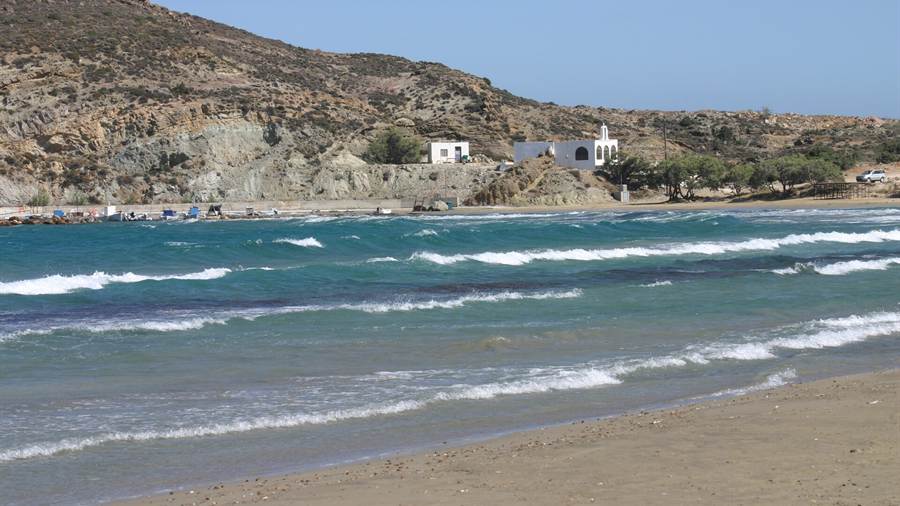
The climate of Greece is predominantly Mediterranean, yet complex geography produces a wide range of micro-climates and local variations. One month reads differently from one region to the next.
The Greek mainland is extremely mountainous. Height lowers the temperature by about 9.8 °C for every kilometre in dry air. The Greece weather by month depends on elevation as much as on the calendar.
The Mediterranean basin has mild wet winters and calm, dry and hot summers. The Greece weather by month follows that rhythm, with wet cooler months from autumn into spring and dry heat across the summer.
The sections below read the climate system first, then the months from January to June, and then the snow and the sea that complete the picture for the first half of the year.
- Climate: The climate of Greece is predominantly Mediterranean, with a wide range of micro-climates.
- Terrain: The mainland is extremely mountainous, which splits the weather into local zones.
- Basin: The Mediterranean basin has mild wet winters and dry hot summers.
- Height: Dry air cools by about 9.8 °C for every kilometre of altitude.
The Greece weather by month therefore needs two readings at once, the calendar month and the place. The next sections set out the climate types and the pressure systems behind the pattern.
Which climate types shape the Greece weather by month (Mediterranean, semi-arid, mountain, temperate)?
The Greece weather by month rests on four climate families: Mediterranean, semi-arid, mountain and temperate. The Mediterranean type dominates, the semi-arid type ranks second, and altitude and latitude add the mountain and transitional variants that change the picture.
The Mediterranean type covers the North Aegean islands, the Ionian Islands, Evia, low-lying Crete and Peloponnese, and the western coast. Winters there are wet, but any snow stays only briefly on slopes that face south.
The semi-arid type reaches Piraeus, the Athens Riviera, West Attica, the Gulf of Corinth and Gavdos. Karpathos, Nisyros and Kasos are semi-arid too, as are Neos Marmaras and central Thessaloniki.
A cold semi-arid type, coded BSk, covers Macedonia and Thessaly. It includes the largest part of Thessaloniki and Larissa, so the Greece weather by month turns sharper on those plains than on the coast.
The mountain family takes in Crete, where peaks above 2,000 metres can show a continental type, and Mount Olympus, which is Mediterranean with continental influence. The north blends continental, Mediterranean and humid subtropical traits.
- Islands: The North Aegean islands and the Ionian Islands sit in the Mediterranean zone.
- Semi-arid: Gavdos, Nisyros and the centre of Thessaloniki fall in the hot semi-arid zone.
- Plains: Larissa lies in the cold semi-arid category of Thessaly.
- Peaks: Cretan summits above 2,000 metres can show a continental type, coded Dfb or Dfc.
Each family sets its own limits for the months that follow. The pressure systems that drive the seasons act on all four families at once and complete the Greece weather by month.
How do the seasonal pressure systems shape the Greece weather by month?
The Greece weather by month follows a swing between the Azores High, which dominates summer, and the travelling low-pressure systems of winter, while the Siberian High sends cold air south from the end of the summer into the spring.
The Azores High is a large semi-permanent centre of high pressure near the Azores. It is strongest in the northern summer, and its sinking air mainly causes the summer drought of the Mediterranean basin.
The Icelandic Low forms the opposite pole of the North Atlantic oscillation and carries frequent cyclone activity. It weakens and splits in summer. Pressure readings at Ponta Delgada, Azores, measure the oscillation.
The Siberian High is a mass of cold dry air over north-eastern Eurasia, centred on Lake Baikal. It builds from the end of August, peaks in winter and stays strong until April ends.
Its reach extends west as far as Italy, where it brings freezing conditions to a warm southern land. A weaker Siberian High drives warmer winters, so the Greece weather by month shifts with its strength.
- Azores High: It reaches full strength in the northern summer and dries the basin.
- Icelandic Low: It weakens and splits into two centres in summer.
- Siberian High: It builds from the end of August and holds until the end of April.
- Sirocco: Warm dry air from the Sahara or Arabia rides north ahead of eastward low-pressure cells.
These four systems set the stage for every month, and the Greece weather by month shows them in turn. January is the first month in which the northern cold meets the wet Mediterranean winter.
What is the Greece weather by month for January?
The Greece weather by month for January is cold in the north, wet across the Mediterranean zone and snowy on high ground. Thessaloniki records January as its coldest month, while the southern coasts and islands stay far milder than the mainland interior.
The coldest month of the year in downtown Thessaloniki is January, with an average 24-hour temperature of 8 °C. The city lies on the edge of multiple climate zones, with cool winters.
Winter also makes Thessaloniki quite windy. January and February both have an average wind speed of about 11 km/h, so the Greece weather by month in the north feels colder.
Snowfall is relatively uncommon in Athens. On 24 January 2022, however, a snowstorm blanketed the entire urban area, apart from parts of the districts next to Piraeus, and the capital turned white.
Heraklion lies further south than Athens and has a warmer winter, with moderate rain. Crete also holds the record for the highest January temperatures recorded in Europe among W.M.O. stations.
- North: Thessaloniki averages 8 °C across a January day and night, the coldest reading of its year.
- Wind: Thessaloniki sees an average wind speed of about 11 km/h in January.
- Capital: A snowstorm covered the whole Athens urban area on 24 January 2022.
- Crete: Cretan stations hold the European record for the highest January temperature.
The Greece weather by month for January therefore spans snow in the capital and record warmth on Crete. February keeps the same split but adds a second cold peak on the mountains.
What is the Greece weather by month for February?
The Greece weather by month for February is the coldest of the mountain year on Mount Olympus and stays wintry in the north. Snow still reaches the cities, although the southern coasts hold milder air and the Cretan stations hold European warm records.
On Mount Olympus the coldest month is February, while the hottest is August. That gap shows the full seasonal range of a high Greek mountain, where the winter reading falls far below the coastal figures.
Athens met a February snowstorm on 16 February 2021, when the entire urban area lay under snow. Snowfall there is relatively uncommon, and it does not cause heavy disruption to daily life.
Heraklion shows the other side of the Greece weather by month. Its last significant snowfall with a measurable amount on the ground came in February 2004, and snowfalls there are rare.
In Thessaloniki, snowfalls come more or less every winter, but the snow cover lasts only a handful of days. The Greece weather by month in the north swings between brief snowy spells and cold dry air.
- Olympus: February is the coldest month of the year on the mountain.
- Athens: A snowstorm covered the entire urban area on 16 February 2021.
- Heraklion: The last significant snowfall on the ground there came in February 2004.
- Crete: Cretan stations also hold the European record for February warmth.
The Athens walking tour post covers the historic centre of the capital on foot. The Greece weather by month then turns with the March equinox, when the sun crosses the celestial equator.
What is the Greece weather by month for March?
The Greece weather by month for March is a month of change, because the sun crosses the celestial equator and spring begins. Winter pressure systems linger, the sirocco reaches its peak, and the Mediterranean rainy season carries on into the new season.
The March equinox falls on or close to 20 March. It marks the start of astronomical spring in the northern hemisphere, when the Sun crosses the celestial equator heading north.
The sirocco peaks in March and again in November. This warm wind from the Sahara or Arabia brings storms to the Mediterranean Sea, and the Greece weather by month changes sharply when it arrives.
The Siberian High has not yet gone. It remains strong until the end of April, so cold northern air still presses south in March while the sun climbs higher.
Areas with a Mediterranean climate receive almost all of their precipitation in winter and spring. March therefore still belongs to the wet half of the year, and the Greece weather by month stays changeable.
- Equinox: The March equinox marks the start of astronomical spring in the northern hemisphere.
- Sirocco: The warm wind from the Sahara or Arabia peaks in March and November.
- Cold air: The Siberian High stays strong until the end of April.
- Rain: Winter and spring carry almost all the precipitation of a Mediterranean climate.
March is the hinge of the Greece weather by month, since the cold and the warmth both reach the country in the same month. April settles that contest and ends the northern cold.
What is the Greece weather by month for April?
The Greece weather by month for April is the fading of winter, as the Siberian High reaches the end of its season and the rain becomes irregular. Mountain slopes still catch moisture, so the wet and dry sides of each range show clearly.
The Siberian High stays strong until the end of April and then fades. Its fade removes one source of cold air, and the Greece weather by month turns warmer as April closes.
Rainfall in a Mediterranean climate is irregular. It can vary considerably from year to year, and rain does not fall evenly or at the same intervals, which accentuates the droughts of the dry season.
Mountains still collect moisture. Moist air driven upslope expands and cools, and its vapour condenses. Mount Olympus shows the effect, since its coastal north-eastern slopes receive more rain than the continental north-west.
The same slopes differ in plant cover. The north-east side of Olympus is densely forested because of the heavy rain, while the south-west side is sparser, so the Greece weather by month shows in the trees.
- Northern cold: The Siberian High fades after the end of April.
- Rain pattern: Rainfall in a Mediterranean climate varies considerably from year to year.
- Uplift: Moist air forced up a slope expands and cools, and its vapour condenses into rain.
- Olympus: The coastal north-eastern slopes receive more rain than the north-west.
April therefore divides the wet slopes from the dry plains. May completes the move into the dry season and brings the first steady northern wind.
What is the Greece weather by month for May?
The Greece weather by month for May is the start of the dry, windy season of the Greek year. The etesians, the strong, dry winds from the north across the Aegean, begin to rise and lower the temperatures across the islands.
The etesians, also known as meltemia, blow strongly and dryly from the north across the Aegean Sea. They are a dominant weather influence in the Aegean basin, and they first blow in May.
They keep temperatures and the swing between day and night lower in the Aegean than in the Ionian Sea or on the mainland. The Greece weather by month in the Cyclades therefore feels cooler.
Low pressure in a trough above the eastern Mediterranean pushes the etesians along. The wind has no opposite wind in winter, unlike a true monsoon, and stays dry. It is distantly tied to the Indian summer monsoons.
High ground keeps its own rules. On the upper slopes of Mount Olympus, rain and snow are not unusual even in the summer, and winds are an almost daily event there.
- Wind: The etesians are strong, dry north winds that dominate the Aegean basin in summer.
- Cooling: They keep the Aegean cooler than the Ionian Sea or the mainland.
- Cause: Low air pressure in a trough above the eastern Mediterranean drives them.
- Name: The word comes from the Greek étos, meaning year.
The Greece weather by month in May turns on the wind rather than on the rain. June adds the longest daylight and the first real heat.
What is the Greece weather by month for June?
The Greece weather by month for June is the longest daylight of the year and the first full heat. Skies are clear and dry, the sea breeze softens the coasts, and the Cyclades face the windiest days of the Mediterranean zone.
The June solstice falls between 20 and 22 June. In the northern hemisphere it is the day with the longest period of daylight, and the Sun stands directly over the Tropic of Cancer.
Thessaloniki shows the pattern. Its summers are hot and moderately dry, with maximum temperatures above 30 °C that rarely exceed 40 °C, and rain falls in thunderstorms. A sea breeze moderates the heat.
Heatwaves in the true Mediterranean zone are quite mild near the coast, because the relatively cooler sea and the sea breeze moderate the temperature. Very windy days occur, especially in the Cyclades.
Heraklion sits in the same pattern. Its summer maximum is not more than 28 to 30 °C, while Athens normally runs about 5 °C higher, so the Greece weather by month differs between the two.
- Solstice: The Sun stands directly over the Tropic of Cancer on the longest day.
- Thessaloniki: Maximum temperatures rise above 30 °C but rarely exceed 40 °C.
- Cyclades: The windiest days of the Mediterranean zone fall in and around these islands.
- Heraklion: The summer maximum stays about 5 °C lower than the normal maximum in Athens.
June closes the first half of the Greece weather by month with long light and dry heat. The mountains, however, still hold the last of the winter snow, which the next section follows through spring.
How do snow and the Pindus ranges change the Greece weather by month in spring?
The Greece weather by month in spring changes with snow and the Pindus ranges, which hold winter on the high ground while the lowlands warm. Drifts and ravines keep the mountains cold, and the range dries the winds that cross it.
On Mount Olympus, winds gather snow into drifts 8 to 10 metres thick, known in Greek as anemosouria. In deep ravines the snow lasts all year, so the mountain stays wintry.
The highest weather station in Greece stood on the summit of Aghios Antonios, at 2,815 metres. Annual precipitation runs from 149 cm at Prionia to 170 cm at Aghios Antonios, about half of it snow.
The snow line adjusts with the seasons, and its final height at the end of the melting season differs each year. Cameras, aerial photographs and satellite images track it across the Greece weather by month.
The Pindus substantially dries the westerly winds that cross it, which helps explain the dry climate of Thessaloniki, as it does for Athens. The villages of Zagori carry stone roofs that bear heavy winter snowfalls.
- Drifts: Olympus winds pile snow 8 to 10 metres thick in places.
- Ravines: Snow lasts all year in the deep Olympus ravines.
- Snow line: Its height at the end of the melt differs from year to year.
- Zagori: The stone roofs of the villages bear heavy winter snowfalls.
The Mount Olympus day trip post covers the mountain and its approaches. Snow links the winter and summer halves of the Greece weather by month.
How does the sea temperature follow the Greece weather by month from January to June?
The Greece weather by month reaches the sea with a delay, because water warms more slowly than land. Mild in winter and warm in summer, the Mediterranean Sea gives its name to the climate type that surrounds it.
The water temperatures of the Mediterranean Sea are mild in winter and warm in summer. They give the Mediterranean climate its name, since the majority of precipitation falls in the cooler months.
The sea has a greater heat capacity than land, so its surface warms more slowly than the shore. That difference starts the afternoon sea breeze, which blows from the water onto the land.
In summer, high air temperatures warm the surface waters of the Mediterranean. The Greece weather by month therefore reaches the sea only after the land has already warmed through the spring.
Evaporation exceeds precipitation and river runoff across the Mediterranean. The effect is strongest in the eastern half, where the water level falls and salinity rises towards the east.
Beneath the warm skin, the Aegean intermediate water runs from 11 to 18 °C. The Aegean bottom water holds a very uniform 13 to 14 °C, and the deepest Mediterranean water sits at 13.2 °C.
- Winter: Mediterranean water is mild in winter and warm in summer.
- Lag: The sea has a greater heat capacity than land and warms more slowly.
- Depth: Aegean bottom water holds a uniform 13 to 14 °C.
- Salt: Basin salinity averages 38 PSU at 5 metres.
Sea and land together close the first half of the Greece weather by month. The Aegean and the Ionian then diverge as the warm season advances.
What is the Greece weather by month in July?
Greece weather by month in July brings dry, sunny days across the lowlands, with the etesian winds near their peak frequency, hot afternoons inland, and sea breezes that soften the heat along the coast and over the islands.
The Greece weather by month in July follows the dry summer pattern of the Mediterranean climate. The weather is sunny and dry, and any rain that falls comes as showers or thunderstorms from cumuliform clouds.
The etesian winds, also known as meltemia, reach their highest frequency in July and August. They blow strongest in the afternoon and ease at night. Evenings on the Aegean coasts feel calmer than the afternoons.
Thessaloniki records its hottest months in July and August, with an average 24-hour temperature of 28.0 degrees Celsius. Rain in summer falls mainly in thunderstorms, and a sea breeze off the Thermaic Gulf moderates the heat.
Coastal heat waves in July stay mild, because the cooler sea and the sea breeze temper the air. At the shore the Greece weather by month feels milder than on the inland plains.
- Wind: Depending on local landforms, the etesians come from anywhere between north-east and north-west.
- Sky: Sunny and dry weather is the norm in the Mediterranean zone of Greece.
- Cloud: Rain that falls in July comes from cumuliform clouds.
- Night: Nights on the lowlands stay pleasantly warm after hot days.
July sets the base for the Greece weather by month in the hot half of the year, and August keeps the same dry pattern with shifts in heat and wind that the next section sets out.
What is the Greece weather by month in August?
Greece weather by month in August holds the dry heat of July, with warm tropical nights on the coasts and islands, cooler air on the high mountains, and the etesian winds still near their highest frequency of the entire year.
Mount Olympus shows the August contrast between sea and summit. The coastal north-east slopes receive more rain than the continental north-west, and the weather there can change more than once in a single day.
Warm nights mark the coast in August. A tropical night is a night when the temperature does not fall below 20 degrees Celsius, and such nights occur mostly over seas and coasts.
The islands record higher counts than the mainland. Kastellorizo can climb close to 160 tropical nights in a year, which shows how long the warm nights of the Greece weather by month last.
Thessaloniki averages 32 days a year above 32 degrees Celsius, and its summer maxima rarely pass 40 degrees Celsius. The Greece weather by month in August there stays hot but bounded.
- Sea: Heat stored in the water by day is emitted at night, which keeps night temperatures up.
- Wind: Etesian days are fine and clear, since the northerly flow brings settled weather.
- Record: The highest temperature recorded in Thessaloniki is 44 degrees Celsius.
- Mountain: The north-east slopes of Olympus carry a richer cover of plants than the north-west.
August closes the hottest stretch of the Greece weather by month, and September brings the first change of pattern, with the etesians fading and the first autumn storms forming over the sea.
What is the Greece weather by month in September?
Greece weather by month in September marks the turn from the dry summer to autumn, as the etesian winds fade by mid-month, the sea stays warm and the first strong Mediterranean storms of the season start to form.
The etesians blow from about the middle of May to the middle of September, so September closes their season. After that the northerly flow that cooled the Aegean in summer loses its hold.
A low formed over the Ionian Sea and moved inland on 4 September 2023, bringing torrential rain to Thessaly. The Hellenic National Meteorological Service named it Storm Daniel.
Storm Daniel shows how the Greece weather by month in September can turn wet and violent after a dry summer. The system became a Mediterranean tropical-like cyclone on 9 September and then struck Libya.
Cyclone Ianos hit on 17 and 18 September 2020. It peaked with gusts up to 195 kilometres per hour, flooded Karditsa and Mouzaki, and led to a state of emergency on Ithaca, Kefalonia and Zakynthos.
- Wind: The etesians fade by the middle of September on the Aegean.
- Sea: Cyclone Ianos grew over warm waters, where sea temperatures reached 27 to 28 degrees Celsius.
- Rain: Torrential rain fell on Thessaly as Daniel came inland.
- Names: The National Observatory of Athens named Ianos, while the national weather service named Daniel.
September links the dry heat of summer to the wet months ahead, and October carries the Greece weather by month further into rain, fog and the record warmth that Crete has logged in autumn.
What is the Greece weather by month in October?
Greece weather by month in October brings the return of rain after the dry summer, fog in the northern cities and record warmth on Crete, which holds the European highs for the month among World Meteorological Organization stations.
The highest temperatures ever recorded in Europe in October and November, at World Meteorological Organization stations, belong to Crete. The island keeps its warmth well into autumn.
Thessaloniki counts roughly 17 foggy days a year, mainly in autumn and winter. Fog is rare in the centre of Athens but more frequent near Mount Hymettus to the east.
In regions with a Mediterranean climate, a dry spell of four to six months runs from summer into early autumn with no significant rain. The Greece weather by month in October ends that dry run in places.
A spell of unseasonably warm, dry weather in autumn is known in English as an Indian summer. Greek tradition links such a spell to Saint Demetrius, a name-day tie that Greece shares with Cyprus.
Two climatic zones meet on Crete, the semi-arid and the Mediterranean, and the island sits mainly within the Mediterranean one. Parts of the south and east also have a hot semi-arid climate.
- Crete: Its higher elevations fall into the cold-summer Mediterranean class, so altitude changes the picture.
- North: The climate of Thessaloniki is transitional, on the edge of multiple climate zones.
- Ridge: The subtropical ridge starts to shift toward the equator, which raises the chance of rain.
- Variation: Rainfall varies considerably from year to year in a Mediterranean climate.
October opens the wetter half of the year, and November sharpens the change, with named storms, flooding and cooler nights shaping the Greece weather by month.
What is the Greece weather by month in November?
Greece weather by month in November is the wet and stormy part of autumn, when low-pressure systems deliver heavy rain, flooding hits low ground and the first real cold reaches the northern mountains and the cities of the mainland.
Cyclone Numa made landfall in Greece on 18 November 2017, after it crossed southern Italy and Sicily. The flooding it triggered became the worst weather event that Greece had experienced since 1977.
The National Observatory of Athens named the system Zenon. Numa is the deadliest medicane on record in Europe, with 22 deaths in Greece. A medicane is a Mediterranean tropical-like cyclone.
A Mediterranean climate brings almost all of its precipitation in the winter and spring seasons, so the Greece weather by month in November begins the rain that fills those seasons.
The sirocco arises when low-pressure cells pull warm, dry tropical air north from the Sahara or Arabia. A spell lasts as little as half a day or runs on for days.
- Name: A university in Berlin named Numa, while Greek forecasters used the name Zenon.
- Track: Numa split into two centres on 13 November, and the stronger one crossed the Adriatic.
- Pause: Numa stalled over Sicily on 15 November before it neared the Greek coast.
- Type: A medicane develops a cyclonic eye in the centre of the low, much like a tropical cyclone.
November shows the stormiest side of the Greece weather by month, and December adds the first lasting cold, with frost in the north, mountain snow and mild air on the southern coasts.
What is the Greece weather by month in December?
Greece weather by month in December splits the country in two, with mild, moderately wet winters on Crete and the south coasts, cold mornings with frost in the north, and heavy snow on the high mountains of the Pindus.
Heraklion records its lowest air temperature at the airport, minus 0.8 degrees Celsius, while the port has never dropped below 1.4 degrees Celsius. The city falls in hardiness zone 11a.
In Thessaloniki, winters are cool with cold nights, and morning frost is common. January is the coldest month, with an average 24-hour temperature of 8 degrees Celsius. The record minimum is minus 14 degrees Celsius.
Snow falls there more or less every winter, but the cover lasts no longer than a handful of days. The Greece weather by month in December brings short cold spells there.
On Mount Olympus, winds pile snow into drifts that reach 8 to 10 metres in thickness in places, and deep ravines keep snow through the whole year. The December cold reaches far up the heights.
- Rain: Winter rain in the Mediterranean zone is persistent, and the west receives a relatively higher amount.
- Frost: Frost is less common near the centre of Thessaloniki because of the urban heat island effect.
- Wind: Thessaloniki is windy in winter, and January and February average about 11 kilometres per hour.
- Summit: The average temperature on the Olympus heights is minus 5 degrees Celsius in winter.
December closes the year of the Greece weather by month with the widest gap between regions, from mild air on Crete to snow on the mountains, and the next sections turn to the causes of that gap.
How do heat waves and the urban heat of Athens show in the Greece weather by month?
Greece weather by month shows the urban heat of Athens clearly in summer, when the dense city holds heat, readings of 47.5 degrees Celsius and more have been reported in the metropolitan area, while the Saronic Gulf cools the south.
An urban heat island is a built-up area that records clearly warmer temperatures than the rural land around it. The gap is larger at night than by day, and clearest when winds are weak.
In Athens, parts of the urban agglomeration feel the island effect more than the central station and so have higher mean annual temperatures. Thessaloniki shows a similar pattern in a small patch of its centre.
One of the longest and fiercest heat waves on record struck Greece from 26 July to 10 August 2021, and records that had stood for decades broke. Officials then weighed naming heat waves.
The Athens Riviera, the coast south of the city, has a mean annual temperature of up to 19.4 degrees Celsius and counts as the warmest area in continental Europe in the Greece weather by month.
- Cause: Changed land surfaces are the main cause of the island effect, and waste heat is a secondary cause.
- Season: The island effect is noticeable in both the summer and the winter.
- Rain: Monthly rainfall is greater downwind of cities, partly because of the heat island.
- Crops: Heat in urban centres lengthens the growing season.
Urban heat adds a local layer to the Greece weather by month, and the next section turns from the city to the west coast, where the Ionian rain belt sets a different pattern from the Cyclades.
How does the western rain belt of the Ionian coast differ from the Cyclades in the Greece weather by month?
Greece weather by month differs between the western rain belt of the Ionian coast and the Cyclades, because the Pindus range dries the westerly air before it reaches the Aegean, leaving the west wetter and the islands drier.
The Ionian Islands and the western coast lie in the Mediterranean climate zone, whose western areas receive a relatively higher amount of precipitation than the eastern parts of the zone.
Epirus holds the wettest large city of the mainland. Ioannina has more than 50,000 inhabitants and receives just short of 1,100 millimetres of precipitation a year, far above the dry Cyclades.
The Cyclades are the peaks of a submerged mountainous terrain, and Milos and Santorini are the only volcanic islands. Their climate is dry and mild, and the higher ground rarely sees wintry weather.
Santorini lies in the rain shadow of the Cretan and Peloponnesian mountains. The National Observatory of Athens classes it as hot semi-arid, with dry summers and relatively wetter winters.
- Ionian: The islands belong to the Mediterranean class that also covers much of the western coast.
- Cyclades: Higher ground there records lower temperatures than the coast.
- Athens: The Dirfys and Parnitha mountains dry the northerly winds, adding to the Pindus rain shadow.
- Atlas: The Climate Atlas of Greece, published by the national weather service, maps these zones.
The two coasts form opposite ends of one scale in the Greece weather by month. The Santorini volcano tour post covers the volcanic island in the south of the Cyclades.
How do the climate stations of Athens, Heraklion, Thessaloniki and Rhodes compare month by month in the Greece weather by month?
Greece weather by month differs across the four city stations: Athens is hot-summer Mediterranean with a dry basin, Heraklion has mild winters, Thessaloniki is transitional with cold nights, and Rhodes is hot-summer Mediterranean with very mild winters.
Athens has a hot-summer Mediterranean climate, while the south near Elliniko shifts toward hot semi-arid. Piraeus is the extreme case and receives just 331.9 millimetres of precipitation a year.
Heraklion has a hot-summer Mediterranean climate, coded Csa. Summers are warm to hot and dry with clear skies, and dry hot days are relieved by seasonal breezes in the Greece weather by month.
Thessaloniki is the second largest city in Greece, and its climate is transitional, on the edge of multiple zones. Mediterranean and humid subtropical influences reach it, and the Pindus range dries its westerly winds.
Rhodes has mild winters and hot summers. The airport at Paradeisi on the coast has never dropped below 1.2 degrees Celsius since its station opened in 1977, so frost stays out of its record in any month.
- Athens: Downtown falls in hardiness zone 10a, and the Athens Riviera mostly in zone 10b.
- Thessaloniki: The city straddles hardiness zones 9a and 9b.
- Rhodes: The coastal parts of the island fall in hardiness zone 11a.
- Spring: Advection fog can occur in Athens in spring, especially along the coastline.
The four stations give four monthly patterns in the Greece weather by month. The Lasithi Plateau tour post covers the mountain plain in the east of Crete.
What do travellers ask about the Greece weather by month?
Greece weather by month answers the common questions about hot summers, autumn storms, winter cold and regional contrasts: July and August are the hottest months, September opens the storm season, December splits north and south, and the west is wetter.
Which month is the hottest in the Greece weather by month?
In Thessaloniki, July and August are the hottest months, with an average 24-hour temperature of around 28.0 degrees Celsius. The etesian winds reach their highest frequency in those two months, and heat waves on the coast stay milder. The Greece weather by month peaks in midsummer.
Which months bring storms in the Greece weather by month?
Autumn brings the storms. Storm Daniel formed around 4 September 2023 and flooded Thessaly, Cyclone Ianos struck on 17 and 18 September 2020, and Cyclone Numa made landfall in Greece on 18 November 2017. The Greece weather by month turns stormy from September.
Is the Greece weather by month cold in winter everywhere?
No. Thessaloniki sees morning frost and snow in nearly every winter, and Mount Olympus averages minus 5 degrees Celsius on its heights. Heraklion has a port that has never dropped below 1.4 degrees Celsius. The Greece weather by month in December splits the cold north from the mild south.
Is the west wetter in the Greece weather by month?
Yes. The west of the Mediterranean zone receives a relatively higher amount of precipitation, and Ioannina in Epirus receives just short of 1,100 millimetres a year. The Cyclades lie in a drier class, so the Greece weather by month in the west brings heavier rain through the cooler months.
Featured photo: brunobarbato, CC BY 3.0, via Wikimedia Commons.