
Greek mythology sites are the places tied to the myths, from Mount Olympus, Delphi, Delos and Knossos to Mycenae, Epidaurus, Eleusis, the Acropolis, Cape Sounion, Olympia, the entrances to Hades and Nisyros. The post is one of the Greece Tours on Greece Ville, listed with the other Greece historical tours and Greek archaeological site tickets.
This post covers what the sites are, Olympus, Delphi, Delos, Knossos and the Minotaur, Mycenae and the Argolid, Epidaurus, Eleusis, the Acropolis, Sounion, Olympia, Hades and Nisyros. Common questions come last.
What are Greek mythology sites?
Greek mythology sites are real places in Greece where tradition sets the tales of the gods and heroes, from the home of the twelve Olympians on a mountain to the palace of Knossos, the citadel of Mycenae and the sanctuary of Epidaurus.
In ancient Greek religion, the twelve Olympians are the major deities of the Greek pantheon. Tradition names Zeus, Poseidon, Hera, Demeter, Aphrodite, Athena, Artemis, Apollo, Ares, Hephaestus and Hermes, with Hestia or Dionysus as the twelfth.
Zeus led his siblings to victory over the Titans in a ten-year war of the gods. Tradition holds that the winners resided on Mount Olympus, and that is why they carry the name of Olympians.
Hades was a brother of Zeus, yet his realm lay far from Olympus in the underworld. The tradition therefore leaves Hades outside the twelve. Greek mythology sites of the underworld form a separate group, covered later.
Greek mythology sites outside Olympus include cults of the twelve gods. Delos, Chalcedon and Leontinoi in Sicily kept such cults, and the earliest evidence for the practice comes no earlier than the late sixth century BC.
- Mountain: Mount Olympus stands as the home of the twelve Olympians in Greek tradition.
- Oracle: Delphi holds the oracle of the Pythia, the priestess of Apollo.
- Island: Delos holds the birth of the twin gods Apollo and Artemis.
- Palace and citadel: Knossos and Mycenae hold the tales of Minos and of Agamemnon.
Greek mythology sites cover mountain, island, palace and sanctuary, so the sections that follow move from Olympus to Delphi, Delos, Knossos, Mycenae and Epidaurus, and each one names the tale first.
How does Mount Olympus stand as the seat of the twelve Olympians among Greek mythology sites?
Greek mythology sites include Mount Olympus, the seat of the twelve Olympians, because tradition places the gods in their home on a massif between Thessaly and Macedonia, whose highest peak, Mytikas, is also the highest point in all of Greece.
Mytikas carries the name Pantheon, a word that suits a peak known as the home of the gods. The massif holds Aghios Antonios at 2,815 metres, Profitis Ilias at 2,803 metres and Toumpa at 2,801 metres.
Heracles became a resident of Olympus after his apotheosis and married Hebe. Diodorus Siculus records a report that Heracles refused a place among the twelve, because it meant casting out one of the original twelve.
In the Iliad, the goddess Themis, who belongs to the twelve Titans, dwells on Olympus alongside the other gods. A Titan can therefore also count as an Olympian.
Other residents named in the sources include the Muses, the Graces, Iris, Dione and Ganymede. Among Greek mythology sites, Olympus therefore houses a wider court than the canonical number of twelve gods suggests.
- Children of Styx: Hesiod names Zelus, Nike, Kratos and Bia as residents who always dwell with Zeus.
- Altar: The Olympian gods received sacrifice at an altar.
- Pit: Chthonic gods such as Hades and Persephone received sacrifice in a pit or a sunken chamber.
- National park: Olympus has been a national park since 1938, the first in Greece.
The Mount Olympus day trip post covers a visit to the massif. Greek mythology sites gain from that visit, because the seat of the twelve is a real mountain with named summits.
How do Delphi and the oracle of Apollo belong to myth among Greek mythology sites?
Greek mythology sites include Delphi because myth names it as the place where Apollo killed the serpent, took over the shrine from earlier powers and spoke through the Pythia, the priestess whom the ancient Greeks consulted on important decisions.
Delphi is one of the Greek mythology sites whose name holds a tale. The Suda says Delphi took its name from Delphyne, the she-serpent that lived there and that Apollo killed.
The Homeric Hymn to Delphic Apollo tells how Apollo chose his first priests from Cretans of Knossos who were voyaging to Pylos. The god leapt into their ship in the form of a dolphin.
Diodorus Siculus tells a later tale of the goatherd Coretas, whose goat behaved strangely after it fell into a crack in the earth. Coretas entered the chasm and felt a divine presence.
Myth ties the oracle to other tales. Acrisius of Argos heard from the oracle that his own grandson was destined to kill him, and Minos took advice from the oracle before Daedalus built the Labyrinth.
- Name: In legend Delphi was called Pytho, a name that Greek writers derived from the verb for rot.
- Womb: The name Delphi shares its root with the Greek word for womb.
- Poseidon: Later belief held that the site was sacred to Poseidon, the god of earthquakes.
- Pythia: The oracle was established by the 8th century BC at the latest, and it was consulted until the late 4th century AD.
Among Greek mythology sites, Delphi turns a mountain slope into a place of divine speech, with the Pythia at the centre of the story and the myths of Perseus and Minos leading back to her.
How does Delos hold the birth of Apollo and Artemis among Greek mythology sites?
Greek mythology sites include Delos, a small island near Mykonos in the Cyclades that Greek myth makes the birthplace of the twin gods Apollo and Artemis, and that had served as a holy sanctuary for a millennium before that tale.
Thucydides reports that the first inhabitants of Delos were piratical Carians, whom King Minos of Crete eventually expelled. The report joins the island to Knossos, the palace of that king, which a later section covers.
The Temple of the Delians, dedicated to Apollo, is a classic example of the Doric order. Beside it stood a colossal sixth-century kouros of Apollo, and a foot of the statue is in the British Museum.
Among Greek mythology sites, Delos kept a cult of the twelve gods, which links the island to the Olympians. The Temple of Hera, built around 500 BC, rebuilt an earlier Heraion.
Delos produced no food, fibre or timber of its own, so all three were imported. An extensive system of cisterns, wells and an aqueduct handled the limited water of Delos.
- Mysteries: Iamblichus writes that Mysteries were established on Delos.
- Proverb: The Suda records a Greek proverb, you sing as if sailing into Delos, said of a happy person.
- House of Dionysus: A floor mosaic of Dionysus riding a panther gives its name to this luxurious second-century house.
- Theatre: The marble theatre rebuilt an older one, shortly after 300 BC.
The Delos tour post covers the visit to the island. Greek mythology sites of this kind link a tale to a landing place, and Delos is the one that holds the twins.
How do Knossos, the Labyrinth and the Minotaur connect among Greek mythology sites?
Greek mythology sites tie Knossos to the Labyrinth because tradition makes the palace the seat of King Minos, where Daedalus built the maze that held the Minotaur until Theseus killed the monster with help from Ariadne, the daughter of Minos.
Arthur Evans established the word Minoan for the Bronze Age civilisation of Crete, drawing on the myth of King Minos. He also suggested that the complex palace architecture inspired the story of the Labyrinth.
Evans found bull motifs and carvings of a labrys in the ruins. A later idea of over 1300 maze-like compartments in the palace draws doubt today, and the Labyrinth itself was never discovered.
Coins minted at Knossos from the fifth century showed labyrinth patterns around a goddess’s head, a bull’s head or a star. The single-path seven-course design appears on coins as early as 430 BC.
Among Greek mythology sites, the Labyrinth stays hard to place. Nicholas Howarth searched the Skotino cave and found it natural, while the tunnels at Gortyn have smooth walls and columns that look partly human-made.
- Homer: The shield of Achilles passage says Daedalus made a dancing ground for Ariadne, but it does not use the word labyrinth.
- Pliny: Pliny the Elder names Cretan, Egyptian, Lemnian and Italian labyrinths as ancient examples.
- Word origin: Labyrinth is a word of pre-Greek origin whose meaning is uncertain.
- Gortyna: Caverns near Gortyna were called labyrinthos in the first century AD.
The Knossos tickets post covers entry to the palace site. Greek mythology sites of this kind ask the visitor to hold the tale and the ruin together.
How do Mycenae, the Lion Gate and the Argolid hold the myths of Agamemnon, Perseus and the Hydra of Lerna among Greek mythology sites?
Greek mythology sites in the Argolid include Mycenae, where tradition places the royal line of Perseus and King Agamemnon behind the Lion Gate, and nearby Lerna, where Heracles killed the Hydra as the second of his Twelve Labours.
Among Greek mythology sites, the Lion Gate counts as the only monumental Mycenaean sculpture to survive. Two lionesses stand in relief above the lintel, and their heads are missing.
Tradition makes Agamemnon a king of Mycenae who commanded the Achaeans in the Trojan War. On his return from Troy, Clytemnestra killed him, or in an older version her lover Aegisthus did.
Perseus was the son of Zeus and the mortal Danae, and tradition makes him the founder of the Perseid dynasty. He beheaded the Gorgon Medusa and saved Andromeda from the sea monster Cetus.
At Lerna, Hesiod makes the Hydra the offspring of Typhon and Echidna. The oldest images, on bronze fibulae from about 700 BC, show six heads, while Alcaeus fixed the number at nine.
- Heads: Simonides raised the number of heads to fifty.
- Regrowth: Euripides first has the Hydra grow back two heads for each head cut off.
- Stars: Hera set the Hydra in the sky as a constellation and turned the crab into Cancer.
- Spring: Poseidon gave the Lernaean spring to Amymone, a daughter of Danaus.
Among Greek mythology sites, the Argolid holds a citadel, a hero and a monster in one region, and Homer and Hesiod supply the tales that the stones recall.
How does Epidaurus hold the cult of Asclepius among Greek mythology sites?
Greek mythology sites include Epidaurus, where tradition places the birth of Asclepius, the healer son of Apollo, and where the sanctuary of the god became a celebrated healing centre of the Classical world, beside a theatre that still stages ancient drama.
Among Greek mythology sites, Epidaurus took its name from the hero Epidauros, a son of Apollo. Strabo records two earlier names: the Carians called the city Epikaros, and the Ionians called it Epitauros, before the Dorians conquered it.
Asclepius learned medicine from the centaur Chiron. Hades complained to Zeus that Asclepius was taking his subjects by raising the dead, and Zeus killed him, after which Asclepius became a star.
Asclepius also had three sons, named Machaon, Podaleirios and Telesphoros. Among Greek mythology sites, Epidaurus also recalls the snake-entwined rod of Asclepius, which remains a symbol of medicine today.
The ancient theatre stands on the west side of Mount Cynortion. The orchestra is a circle 20 metres across, and a drain called the euripos runs underground around it.
- Epidauria: Athens held the Epidauria as a festival honouring Asclepius.
- Oath: The Hippocratic Oath began with an invocation of Apollo, Asclepius, Hygieia and Panacea.
- Town theatre: Epidaurus town had a separate theatre with about 2000 seats, dating from the 4th century BC.
- Mapping: A conservation scheme has mapped 140 ancient arenas across Greece.
Greek mythology sites such as Epidaurus join a tale to a working institution, since the god of the myth also presided over a sanctuary that people used for centuries.
How does Eleusis hold the Mysteries of Demeter and Persephone among Greek mythology sites?
Greek mythology sites include Eleusis, the Attic town where the Eleusinian Mysteries honoured Demeter and Persephone each year. The rites retold the abduction of Persephone by Hades, the search of her mother, and the return of the daughter to the upper world.
Among Greek mythology sites in Attica, Eleusis lies in the Thriasian Plain at the northern end of the Saronic Gulf. Its hill faced the island of Salamis, on the road from Athens to Corinth.
The Homeric Hymn to Demeter, dated to about 650 BC, tells the central myth. Hades seized Persephone, and Demeter searched for her and caused a drought. Zeus then allowed the daughter to return.
A cave on the coast of Eleusis is said to mark where Hades seized Persephone. It was treated as a gateway to Tartarus, and a sanctuary of Hades and Persephone, the Ploutonion, stood there.
Initiates of the Lesser Mysteries at Agrai sacrificed a piglet and purified themselves in the river Ilisos. The Greater Mysteries followed in Boedromion, when a procession walked the Sacred Way from the Kerameikos to Eleusis.
- Telesterion: Strabo compared the capacity of the great hall to that of a theatre.
- Secrecy: Only initiates knew what the sacred chest and the lidded basket contained.
- Bridge: A Roman bridge with four arches carried the Sacred Way over the Kephissus river.
- End: The emperor Theodosius I closed the Mysteries in 392 AD, according to Eunapius.
Eleusis is now a suburban city in the Athens metropolitan area, with the largest oil refinery in Greece. Among Greek mythology sites, it joins a myth about a lost daughter to a working industrial town.
How does the Acropolis hold the contest of Athena and Poseidon among Greek mythology sites?
Greek mythology sites on the Acropolis of Athens keep the tale of a contest for the city. In legend, Athena became the patron goddess of Athens after a competition with Poseidon, who stayed on the rock in the form of Erechtheus.
On the west pediment of the Parthenon, supporters of Athena stand behind the left chariot and defenders of Poseidon behind the right. The corners are read as the rivers Kephisos and Ilissos and the nymph Kallirhoe.
Among Greek mythology sites in Athens, the Erechtheion stands on the north side of the Acropolis and was primarily dedicated to Athena. Its traditional date of building is 421 to 406 BCE.
The joint cult of Athena and Poseidon-Erechtheus appears to have begun on the Acropolis at a very early period. The traditional view places both in one temple, but scholars have not reached consensus.
A war between Athens and Eleusis is also told in myth. Roberto Calasso wrote that Athens belonged to Athena and Eleusis to Poseidon, and that the founding kings Erechtheus and Eumolpus both died in it.
- Plan: The asymmetrical composition of the Erechtheion does not follow the usual canon of Greek temples.
- Roots: The earliest buildings on the site date to the late Bronze Age Mycenaean period.
- Homer: The Homeric tradition records a strong-built house of Erechtheus on the hill.
- Influence: The Ionic design influenced later Hellenistic, Roman and Greek Revival architecture.
The contest survives in cult places, carved figures and scholarly argument rather than in one object. Greek mythology sites on the Acropolis therefore depend on how ancient writers described the cults.
How does Cape Sounion hold the temple of Poseidon and the tale of Aegeus among Greek mythology sites?
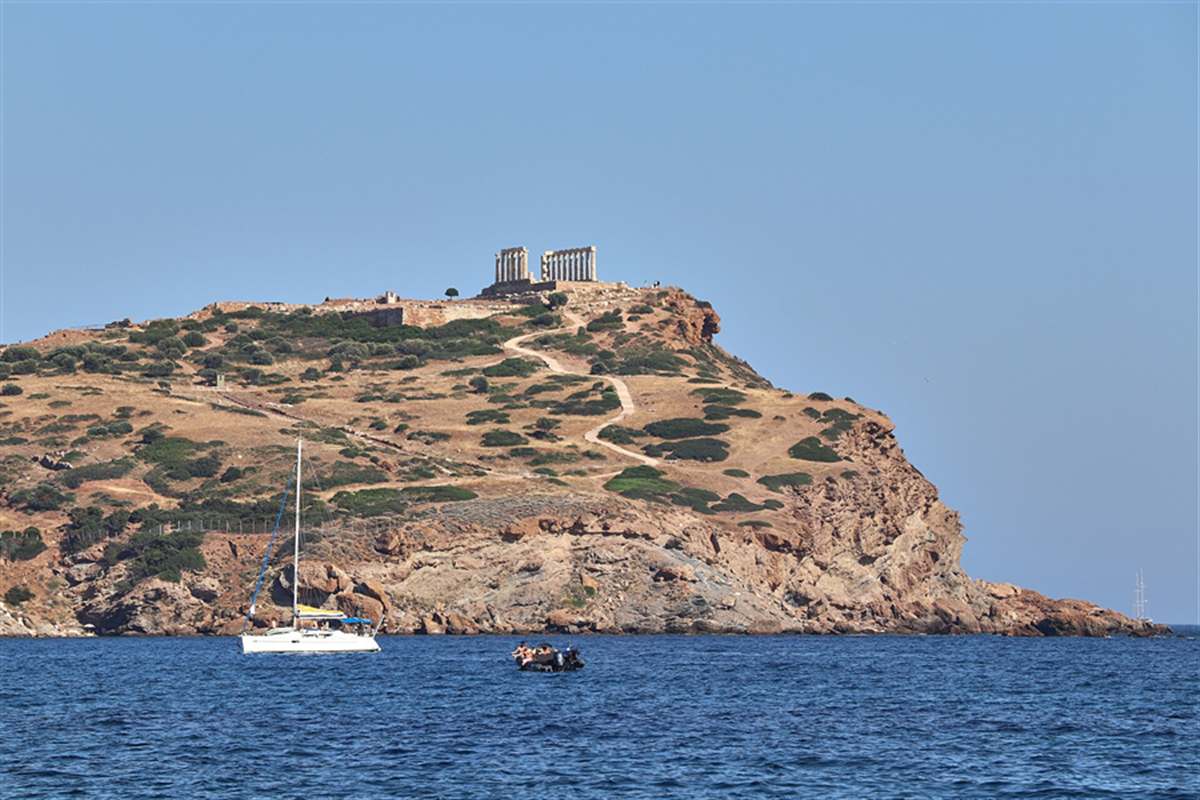
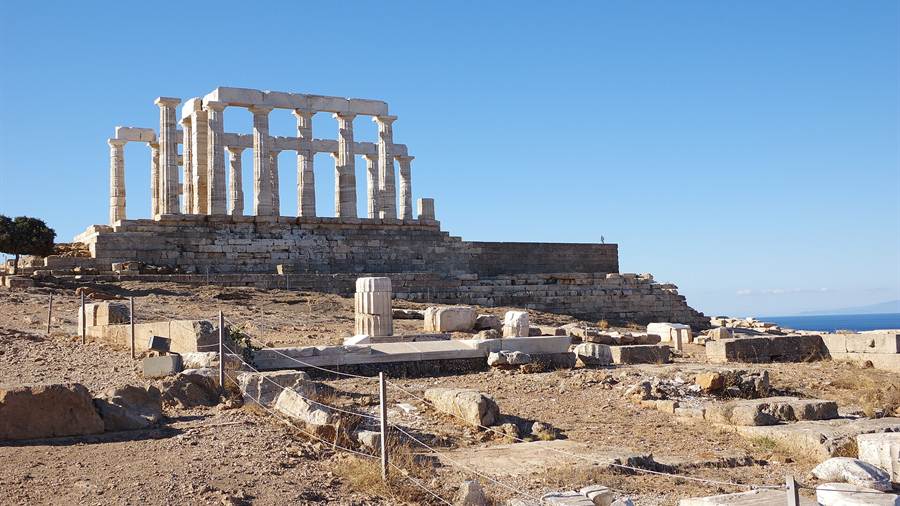
Greek mythology sites at Cape Sounion pair a temple of Poseidon with the tale of King Aegeus. The cape lies at the southernmost tip of the Attica peninsula, and its headland is surrounded on three sides by the Aegean Sea.
At Sounion, the Athenians set up a captured enemy trireme as a trophy dedicated to Poseidon after the naval Battle of Salamis. Reconstructions place a colossal bronze statue of the god, 6 metres high, inside the temple.
In Greek myth, Aegeus was a king of Athens. Lacking an heir, he asked the oracle at Delphi for advice. The reply told him not to loosen a wineskin before reaching the height of Athens.
Aegeus told his son Theseus to hang white sails on return from Crete if the Minotaur was dead. Theseus forgot. Aegeus saw black sails, took his son for slain, and jumped from a height.
Accounts differ on the height. One names the Acropolis or an unnamed rock, while Latin authors say the sea, hence the Aegean Sea. His name is also read as goat, shield or protector.
- Collapse: Two columns of the temple fell in 1825.
- Venice: Amilcare Paulucci had one column taken to the Venetian Arsenal in 1826.
- Plan: Wilhelm Dorpfeld found an original plan of 6 by 12 columns, not 6 by 13.
- Digs: Valerios Stais excavated the temples of Poseidon and Athena from 1897 to 1915.
The Cape Sounion tour post covers the headland and the temple on the ground. Among Greek mythology sites in Attica, the cape joins a sea god with a king who gave his name to the sea.
How does Olympia hold the sanctuary of Zeus among Greek mythology sites?
Greek mythology sites include Olympia, the sanctuary of Zeus on the Peloponnese, whose sacred precinct was the Altis. Its great cult image, a seated Zeus made by Phidias, was counted among the Seven Wonders of the Ancient World.
The archaeological site held over 760 significant buildings. Among Greek mythology sites, Olympia is the one built around the Altis, a precinct primarily dedicated to Zeus, although other gods were worshipped there.
The statue of Zeus was a giant seated figure, about 12.4 metres tall, made by Phidias around 435 BC. It was a chryselephantine sculpture, with ivory plates and gold panels on a wooden framework.
Strabo wrote that the seated Zeus seemed so tall that, standing, he must lift the temple roof. Antipater of Sidon named it one of the Seven Wonders of the Ancient World.
Pausanias reports that the statue was kept coated with olive oil against the damp of the grove. A black-tiled floor with a raised marble rim held the oil in front of the image.
- Model: Asked for a model, Phidias named the lines of Homer on the dark brow of Zeus and the quake of Olympus.
- Sign: Legend says that a thunderbolt struck the floor after Phidias prayed for a sign.
- Earlier work: Phidias had already made the statue of Athena Parthenos in the Parthenon.
- Loss: The statue was lost and destroyed before the end of the 6th century AD, and accounts conflict on how.
Nothing of the statue survives, so its form rests on ancient descriptions and images on coins. Greek mythology sites of this kind therefore work through words as much as through stone.
How do the Acheron river and Cape Tainaron stand for the entrances to Hades among Greek mythology sites?
Greek mythology sites mark two entrances to Hades, one in the north and one in the south. The Acheron river in Epirus is shown in classical accounts as the entrance to the Underworld, and Cape Tainaron was a conventional gateway.
The Acheron is a river in Epirus, 52 km long. Greek writers sometimes called it a lake or swamp, as Aristophanes does in The Frogs and Euripides does in Alcestis.
Plato also placed the river beneath the earth in the Phaedo. In that account it flowed in the opposite direction from Oceanus under desert places, which gave the Acheron a hidden course.
Among Greek mythology sites, Cape Tainaron, also called Cape Matapan or Taenarum, lies at the end of the Mani Peninsula. Birds heading to Africa pass it on migration, and the ancient Spartans raised temples there.
Oracles of the dead are known at the Temple of Poseidon at Taenaron and at Cumae. Greeks coined the phrase Tainarian evil after Spartans killed Helots who had fled into the temple.
- Offspring: Accounts name Acheron as the father of Ascalaphus by Orphne or Gorgyra.
- Founder: Taenarus, eponym of the cape, is a son of Zeus, Poseidon or Elatus in different accounts.
- Church: Under the Byzantine Empire the temple of Poseidon became a Christian church, and rites are held there today.
- Cave: Greek legends placed the home of Hades in a cave near Taenarum.
The Acheron River tour post covers the river and the Necromanteion near its mouth. Among Greek mythology sites, the pair shows a gateway in the north and another in the south.
How does Nisyros hold the tale of Polybotes and the giants among Greek mythology sites?
Greek mythology sites on Nisyros keep the tale of the giant Polybotes, who fought Poseidon in the Gigantomachy. In myth, Poseidon broke off a piece of Kos and threw it on the giant, and that piece became the island.
According to Hesiod, the Giants were children of Gaia, born from the blood that fell when Cronus castrated Uranus. Their battle with the Olympian gods for supremacy of the cosmos is called the Gigantomachy.
Apollodorus says that Poseidon chased Polybotes through the sea to Kos. Poseidon then broke off the piece of that island called Nisyros and threw it upon the giant, who was crushed beneath it.
Strabo records that Poseidon broke the fragment from Kos with his trident and that the giant lies beneath it. Among Greek mythology sites, Nisyros therefore carries a rival claim from Kos itself.
On a sixth-century BC amphora in the Louvre, Poseidon carries Nisyros on his left shoulder, ready to hurl it. Pausanias saw a statue at Athens of Poseidon on horseback hurling a spear at Polybotes.
- Ancient name: Nisyros was called Porphyris in antiquity.
- Variant: In one version Polybotes swam away after Zeus struck him, and the trident of Poseidon missed and became the island.
- Enceladus: Athena crushed the Giant Enceladus under the island of Sicily.
- Vase: A fragmentary dinos in the Getty shows Polybotes opposed by Zeus, as an inscription identifies.
The Nisyros volcano tour post covers the island, its caldera and its gases. Among Greek mythology sites, Nisyros is the one that explains a volcanic island as a hurled rock.
What do travellers ask about Greek mythology sites?
Greek mythology sites bring together myth, cult and archaeology in Attica, Olympia, Epirus, the Mani and the Dodecanese. Travellers ask which places belong to Athena, Poseidon, Zeus and Hades, and how far the ancient writers can be trusted on each place.
Which Greek mythology sites lie in Attica?
Eleusis lies in West Attica, on the plain west of Athens. The Acropolis holds the Erechtheion and the pediment tale of Athena and Poseidon. Cape Sounion stands at the southernmost tip of the Attica peninsula, with its temple of Poseidon and the tale of King Aegeus.
Which Greek mythology sites belong to Hades and the Underworld?
The Acheron river in Epirus is shown in classical accounts as the entrance to the Underworld. Cape Tainaron in the Mani was a conventional gateway as well. At Eleusis, a cave on the coast was treated as a gateway to Tartarus, and a sanctuary of Hades stood there.
Which Greek mythology sites tell of Poseidon?
Poseidon appears at the Erechtheion, where a joint cult linked him with Athena, and at Cape Sounion, where Athenians dedicated a captured trireme to him. A temple of Poseidon stood at Cape Tainaron. On Nisyros, he threw a piece of Kos at the giant Polybotes.
Do Greek mythology sites prove the myths?
Greek mythology sites hold temples, cult places and finds, not proof of the tales. Scholars have not reached consensus on whether Athena and Erechtheus were worshipped in one building. Accounts of Polybotes differ on whether the giant lies beneath Nisyros or beneath Kos.
Featured photo: George E. Koronaios, CC0, via Wikimedia Commons.