
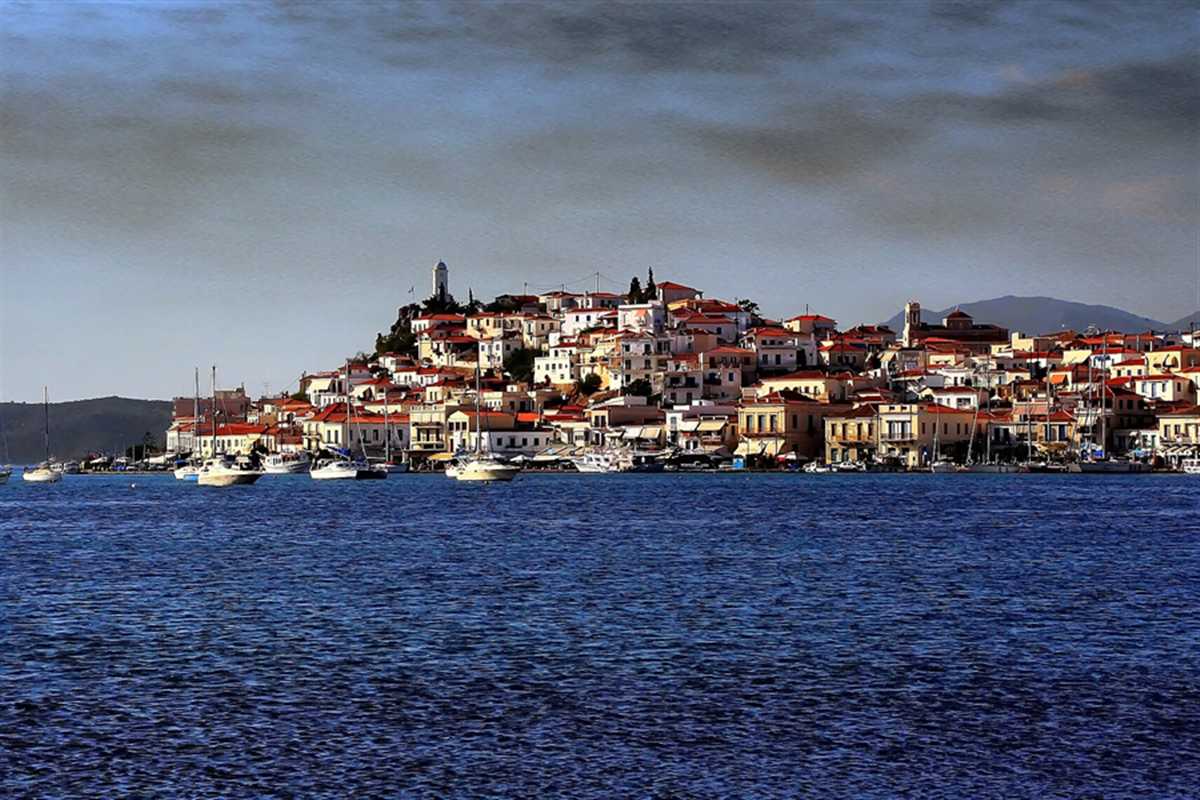
Poros day trip visits the island in the Saronic Gulf, with Poros Town and its clock tower, the old Russian naval station, the Temple of Poseidon, the Lemon Forest and the Zoodochos Pigi monastery. The trip is one of the Greece Tours on Greece Ville, listed with the other Saronic islands tours and Greece boat tours.
This post covers what the trip is, the two islands and Poros Town, the clock tower, the naval station and training school, the temple, Demosthenes, Troezen, the Lemon Forest, food and formats on sale. Common questions come last.
What is a Poros day trip?
A Poros day trip is a one-day visit to the island pair of Poros in the Saronic Gulf, made by sea from Athens. It combines a harbour town, a naval history, an ancient sanctuary and a view across the strait to the Peloponnese.
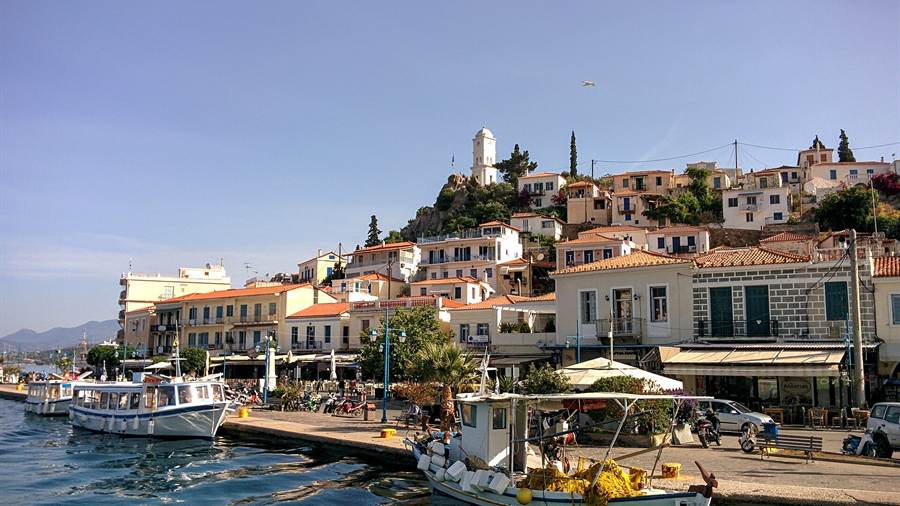
Poros lies in the southern part of the Saronic Gulf. Athenian travellers treat it as a weekend destination, and the same short sea hop suits a day out. The island has no airport, so every visit arrives by water.
A car ferry joins the island to Galatas on the mainland. Agios Nektarios and Kyani Akti are the smaller villages beside the main town.
A good road network and adequate tourist infrastructure make Poros a resort for short holidays. A bike sharing system named Cyclopolis adds one station with a capacity of 13 bikes, which gives visitors another way to move around.
This post follows the island in order. A Poros day trip here covers the two islands, the town, the clock tower, the Russian station, the naval school, the Temple of Poseidon, Demosthenes and Troezen. The Hydra Poros Aegina cruise post covers the wider three-island sea route that includes Poros.
- Setting: Poros occupies the southern part of the Saronic Gulf, close to the Peloponnese coast.
- Access: The island has no airport and links to the mainland by a car ferry to Galatas.
- Villages: Agios Nektarios and Kyani Akti are the smaller villages beside the main town.
- Bikes: The Cyclopolis system offers a single station with room for 13 bikes.
The short crossing, the compact town and the sites in the north explain why a Poros day trip fits the habits of Athenian weekend travellers.
How do the two islands of a Poros day trip fit together?
A Poros day trip covers two islands joined by a bridge: Sphairia in the south, where the modern capital stands, and Kalavria in the north. Antiquity treated them as separate places, and the larger northern island held the sanctuary of Poseidon.
The island names appear in more than one spelling. Sphairia is also written Sfairia, and Calauria is the ancient form of Kalavria, with Kalaureia as a variant. A narrow strait divides the two parts, and a bridge crosses it.
Kalavria is the northern and largest part of the pair. Smooth hills and shallow valleys mark its western and northern sides, while small creeks and seasonal streams run through steep valleys in the south and the north-east.
During the period of Mycenaean dominance, from 1400 to 1100 BC, Calauria was powerful. The leading naval base of the region stood on the islet of Monti, also called Liontari, off its eastern coast.
The municipal area reaches beyond the two islands. It includes part of the adjacent Peloponnese coast near Galatas and Thermisia, and it also takes in the island of Hydra, which a Poros day trip does not visit.
- Sphairia: This southern part carries the town where harbour life concentrates.
- Kalavria: This northern part is the larger of the two islands.
- Strait: A narrow channel separates the islands and a bridge carries traffic across it.
- Names: Calauria and Kalaureia are older or variant forms of Kalavria.
Knowing which island holds which site makes a Poros day trip easier to read, since the town lies south of the bridge and the sanctuary lies north of it.
What does Poros Town add to a Poros day trip?
A Poros day trip starts in Poros Town, a port of neoclassical buildings. The waterfront reflects the shipping and commerce that formed the main work of the island’s people under Ottoman rule, which began there in 1715.
Venetian rule ended in 1715, and Ottoman rule began in the same year. That was much later than in the rest of Greece. Arvanites were recorded among the inhabitants in 1688.
Shipping and commerce were the main activities of the islanders in Ottoman times. The fleet of Poros was not as well known as the fleets of Hydra or Spetses, and it joined only a handful of sea battles. The Hydra day trip post covers the neighbouring island whose ships gained wider fame.
The American writer Henry Miller described arriving in Poros in The Colossus of Maroussi. He felt the boat was sailing through the streets.
Other writers also wrote about the island, among them the Nobel laureate Giorgos Seferis, Kosmas Politis, Kostis Palamas and Ioulia Dragoumi. Their work gives a Poros day trip a literary background.
- Occupations: Early in the twentieth century islanders worked in agriculture, livestock, fishing and shipping.
- Crops: The farms grew wheat, grapevines and olives.
- Koryzis: Alexandros Koryzis, prime minister of Greece, lived from 1885 to 1941, and a museum in Poros honours him.
- Bourtzi: Von Heideck built this castle around 1828 where an old church of St Constantine had stood.
Poros Town therefore gives a Poros day trip its working harbour, its writers and its layered rule, and the next stop above the quay is the clock tower.
Why does the clock tower matter on a Poros day trip?
A Poros day trip meets the clock tower as the best-known landmark of the town. Clock towers once told a community the hour by sound and sight, so the structure marks the working centre of the settlement above the harbour.
A clock tower such as the one met on a Poros day trip houses a turret clock and carries one or more clock faces on its upper exterior walls. A tower can stand free, or it can adjoin or crown another building such as a church or a town hall.
The first clocks had no faces. They only struck bells, which called the surrounding community to work or to prayer. Builders placed them in towers so the sound carried.
Towers stood near the centres of towns and tended to be the tallest structures there. Before the middle of the twentieth century the majority of people owned no watch, so a dial on the outside let townspeople read the time whenever they wanted.
The earliest clock tower in the record is the Tower of the Winds in Athens, built in the first century BC. It carried eight sundials, and a water clock inside ran on water from the Acropolis.
- Mechanism: The machinery inside such a tower is called a turret clock.
- Sound: Large bells or chimes mark the hour for the whole community.
- Position: Builders set these towers near the centre of the town.
- Precedent: The Tower of the Winds in Athens counts as the earliest known clock tower.
For a Poros day trip, the tower works as a fixed point. Visitors can use it to find their way back to the harbour from the streets above.
What was the Russian naval station on a Poros day trip?
A Poros day trip passes the ruins of a Russian naval station at the edge of the town. Russia built the supply base after the Treaty of Kuchuk Kainarji secured free shipping for its navy across the waters of the Ottoman Empire.
As Russian naval activity grew, the navy needed a supply station, a need that shaped the site a Poros day trip now shows. It acquired land at the edge of Poros town and built extensive storage facilities for materiel, coal and food, along with a hardtack baking factory.
After Greek independence, Governor Capodistrias requisitioned these facilities for the Greek war navy. He offered the Russians a different location in a nearby cove, where the new facilities were far larger.
Ships of Russia used the cove throughout the nineteenth century. The number of Russian residents on Poros increased, and the community even founded a Russian school beside the base.
Russian naval activity then declined, and the base declined with it. By the early twentieth century a single Russian watchman remained on guard. The Czar granted the base to the Greek Navy, which never put it to real use.
- Treaty: Kuchuk Kainarji gave the Russian navy free shipping through Ottoman waters.
- Bakery: A factory on the site baked hardtack, a hard ship’s biscuit.
- School: A Russian school served the growing Russian community.
- Watchman: Only one Russian guard remained at the base by the early twentieth century.
The abandoned buildings decayed in the open. A Poros day trip therefore sees the base as a ruin of carved stone rather than a working yard.
What is the naval training school on a Poros day trip?
A Poros day trip includes a site that the Hellenic Navy still uses as a training centre for naval personnel. The base on Poros began as the navy’s headquarters, and the bulk of its activity later moved to Salamis.
Ioannis Capodistrias became governor of liberated Greece in 1828. The Hellenic Navy then set its headquarters on Poros, and builders at the naval base that a Poros day trip passes began a new series of ships while old vessels retired.
Konstantinos Kanaris served as the first minister of naval affairs. The strongest ship of the fleet was the frigate Hellas, which builders had constructed in the United States in 1825.
In 1831 Greece fell into anarchy and areas such as Mani and Hydra revolted. During that revolt Admiral Andreas Miaoulis set fire to the flagship Hellas while it lay at anchor at Poros.
Later, a French naval mission under Admiral Laurent Joseph Lejeune introduced a new naval organisation. It trained enlisted personnel at a school in the old building of the naval base on Poros.
- Officers: Young men first trained at the military school of Scholi Evelpidon and then moved to the navy.
- Flagship: The frigate Hellas was the strongest ship of the early Greek fleet.
- Mission: The French mission set up methodical training for enlisted sailors.
- Move: A larger base later rose at Salamis, where the Naval Academy was founded.
A Poros day trip thus links the island to the long story of Greek naval education, which still continues on the same site today.
What does the Temple of Poseidon add to a Poros day trip?
A Poros day trip reaches the Temple of Poseidon on Kalavria, a Doric building in an ancient sanctuary. Researchers date it to about 520 BC, and its plan shows six columns on each short side and twelve on each long side.
The temple measured 27.4 by 14.4 metres. A Poros day trip reaches this Doric building on a hilltop close to the town. It was a peripteral building, which means a single row of columns ran around the whole structure, and builders made it mainly from poros stone.
A low wall surrounded the temple. The main entrance lay on the east side, and a smaller entrance opened in the south. By the time modern work began, only foundation trenches and roof tiles remained.
Other buildings stood around it. Stoa D was a simple colonnaded hall, and Building E, read as the propylon or gateway, had two rooms in addition to the entrance way.
Swedish archaeologists excavated the sanctuary in 1894. Excavations resumed in 1997 under the Swedish Institute in Athens, working with the Greek National Heritage Board on the site.
- Epithet: Strong evidence suggests that Poseidon bore the title Geraistos at this sanctuary.
- Plaque: A plaque of the third century BC celebrates the revival of the Kalaureian League.
- Founding: Archaeology led Thomas Kelly to place the sacred league between about 680 and 650 BC.
- Stoa A: This Doric hall had polygonal walls covered in red plaster.
The temple gives a Poros day trip its oldest religious ground, and the same hilltop leads directly into the story of Demosthenes.
Why is Demosthenes linked to a Poros day trip?
A Poros day trip recalls Demosthenes, the Athenian orator who died at the sanctuary of Poseidon on Kalavria in 322 BC. A decree condemned him after the Lamian War, and he took poison before Macedonian officers reached him.
Demosthenes was born in 384 BC. His story gives a Poros day trip its link to Athenian politics. At the age of 20 he delivered his first judicial speeches, and for a time he earned his living as a professional speechwriter and a lawyer.
After Alexander the Great died in 323 BC, Demosthenes urged Athens to seek independence from Macedon. Antipater quelled the revolt and demanded that the Athenians hand over Demosthenes and Hypereides.
The Athenian assembly had no choice but to adopt a decree condemning the leading anti-Macedonian speakers to death. Demosthenes escaped to the island, where Archias, a confidant of Antipater, later found him.
Plutarch reports his last words. He told Archias to play the part of Creon in the tragedy and cast out the body unburied. He added that Antipater had left not even the temple unpolluted.
- Career: His speeches remain a major expression of Athenian intellectual life in the fourth century BC.
- Decree: The sentence of death also named Hypereides among the condemned.
- Honour: Years later the Athenians raised a statue to him.
- Meals: The state decreed free meals for his descendants in the Prytaneum.
The sanctuary thus marks both a religious site and a place of political refuge, and a Poros day trip treats it as the setting for the orator’s final act.
What lies across the strait from a Poros day trip at Troezen?
A Poros day trip looks across the strait to Troezen, a town of the Argolid Peninsula in the northeastern Peloponnese. Myth says Pittheus named the city after his dead brother, and the Third National Assembly of 1827 met there.
Troezen, seen from a Poros day trip, belongs to the municipality of Troizinia-Methana. In the 2021 census it had a population of 4,668. In Greek myth, two ancient cities, Hyperea and Antheia, joined under Pittheus to form it.
The ancient city had a spring that tradition links to the place where the winged horse Pegasus came to ground. A cult also grew there around Hippolytus, and girls dedicated a lock of hair to him before marriage.
Sybaris in Magna Graecia was a Troezenian colony, founded in 720 BC. Before the Battle of Salamis in 480 BC, Themistocles sent Athenian women and children to Troezen for safety.
In 1959 workers found a stele in a coffee house in Troezen. It shows the Decree of Themistocles, the order to evacuate Athens, though it dates about 200 years after the battle, which suggests a commemorative copy.
- Chair: Georgios Sisinis presided over the Third National Assembly.
- Governor: Delegates elected Kapodistrias on 3 April for a seven-year term.
- Constitution: The assembly approved a text of 150 articles on the first day of the fifth month.
- Capital: On the fourth day of the fifth month it voted to make Nafplion the capital of Greece.
Troezen therefore widens a Poros day trip from an island visit to a view of the mainland, where myth, war and the early Greek state all left traces.
What does a Poros day trip show of the Lemon Forest?
A Poros day trip looks across the strait towards the lemon groves that Henry Miller wrote about in The Colossus of Maroussi. The lemon is a small evergreen tree of the citrus genus, and its ripe fruit is yellow.
Miller reached Poros by boat. He wrote that the story of the lemon groves just opposite affected him deeply, and the sight of the town affected him as much.
The word lemon travelled a long way before it reached English. It draws from the Old French limon and the Italian limone, and those words come from an Arabic word for citrus fruit of this kind.
Lemons entered Europe near southern Italy no later than the second century AD, in the age of ancient Rome. They reached Persia, then Iraq and Egypt, around 700 AD, so the tree has a long record.
Miller also described the approach to the harbour. He wrote that the land converges on all sides and that the boat is squeezed into a narrow strait, the view that opens a Poros day trip.
- Writer: Henry Miller described the lemon groves in The Colossus of Maroussi.
- Family: The lemon tree belongs to the family Rutaceae.
- Word: Lemon comes from Old French limon and Italian limone.
- Route: Lemons reached Persia, Iraq and Egypt around 700 AD.
The lemon groves give the Poros day trip a view across water and a long fruit history behind it. The next section turns to a monastery on a pine slope.
Why does a Poros day trip visit the Zoodochos Pigi monastery?
The Poros day trip reaches the Holy Monastery of Zoodochos Pigi, founded in 1720 and set on the slope of a pine forest. The monastery lies 4 km east of the main town, and its main church is a domed basilica.
The monastery was founded in 1720, and a gift of 1770 tied it to the harbour. From that year Antonios Serfos gave the island of the Bourtzi castle to the Poros monastery.
The buildings stand on the slope of a pine forest, 4 km east of the main town. The Poros day trip therefore leaves the harbour front behind and climbs into the trees.
The main church of the monastery is called the katholiko. Here it is a basilica with a dome and a tower-like belfry, which gives the buildings two distinct shapes against the trees.
In 1814 a group of monks from Mount Athos took refuge in the monastery. Mount Athos is a mountain on the Athos peninsula in north-eastern Greece, directly on the Aegean Sea.
Not long after, the same monks founded the Zoodochos Pigi Monastery at Longovarda on Paros. The shared name links a pine slope on Poros with a second island, and the visit follows that thread.
- Founded: The monastery dates from 1720.
- Distance: The site lies 4 km east of the main town.
- Church: The katholiko is a basilica with a dome and a belfry.
- Refuge: Monks from Mount Athos took shelter there in 1814.
The monastery shows the religious side of Poros in a Poros day trip, set among pines. The next section turns from the building to the ground and the villages around it.
What landscape does a Poros day trip cross between the shore and the hills?
A Poros day trip crosses a landscape that is very hilly and mountainous, with steep valleys in the south and north-east and smooth hills in the west and north. Small creeks and seasonal streams run through the steep valleys.
Bushy ground covers the northern side of the island, and the far eastern and western sides are bushy as well. A Poros day trip passes this low growth beyond the town.
Smooth hills and shallow valleys mark the west and the north of the island. That ground is gentler than the steep valleys of the south and the north-east.
The island contains the main village, Poros, and the smaller villages of Agios Nektarios and Kyani Akti. These names mark the settled points of the island beyond the harbour front.
Marine fossils are found mainly in the limestone of the island. No occurrences of precious stones or ore deposits are known there, so the rock is of interest for its fossils alone.
A bike sharing system named Cyclopolis has one station on the island, with a capacity of 13 bikes. It gives a Poros day trip a second way to cover the ground.
- Cover: Bushy ground fills the north and the far east and west.
- Valleys: Steep valleys lie in the south and the north-east.
- Villages: The smaller villages are Agios Nektarios and Kyani Akti.
- Bikes: Cyclopolis runs one station with 13 bikes.
The land sets the pace of a Poros day trip. The day trips from Athens post covers the other sea routes from Piraeus to the Saronic Islands.
How did shipping shape the harbour and Neorio on a Poros day trip?
A Poros day trip arrives in a harbour that lived by shipping and trade. The Ottoman period began in 1715, and shipping and commerce were the main activities, although the Poros fleet was not as famous as the fleets of Hydra and Spetses.
The Poros fleet saw little fighting at sea. Its work was to carry goods, and the island stayed a trading port while Hydra and Spetses built the larger fame.
In Byzantine times, pirates that dominated the Aegean Sea raided Poros and other islands. The raids belong to the long record of danger on the water around the Saronic Gulf.
Bourtzi castle was built by von Heideck around 1828, on the spot where an old church of St Constantine had stood. The castle gives the harbour a fortified island.
At the start of the 20th century the people of Poros worked in agriculture, mainly wheat, grapevines and olives. They also kept livestock and worked in fishing and shipping.
A local bus service runs from Poros harbour to Neorio and to Monastiri. A Poros day trip can use that line to reach the two places along the coast.
- Rule: Ottoman rule on Poros began in 1715.
- Fleet: Poros ships were less famous than those of Hydra and Spetses.
- Castle: The Bourtzi dates from around 1828.
- Bus: Local buses run to Neorio and Monastiri.
Shipping explains the harbour front of the Poros day trip. The museum in the next section shows what lay beneath that waterfront in much older times.
What does the archaeological museum show on a Poros day trip?
A Poros day trip includes the Archaeological Museum of Poros at Korizis Square. The museum holds finds from the Sanctuary of Poseidon, from ancient Troizen and from other archaeological sites nearby, so the rooms gather the history of the whole area.
The ruins of the sanctuary of Poseidon held evidence of an enormous feast from the Hellenistic period, together with a plaque that celebrates the revival of its old religious alliance.
Modern archaeology has found no evidence that the Calaurian League existed in early times. The current view is that it was a later Hellenistic invention, and the plaque fits that view.
The Poros Shell Museum was founded in 2006. It shows a permanent exhibition, Shells from the Greek Seas, so a Poros day trip also meets natural history beside the ancient finds.
The exhibition sits inside the Chatzopouleios Library. A library and a shell collection therefore share one address, a small stop on the route of a Poros day trip.
Writers have also taken Poros as a subject. Henry Miller wrote about the island, as did Kosmas Politis, Kostis Palamas, Ioulia Dragoumi and the Nobel laureate Giorgos Seferis.
- Square: The museum stands at Korizis Square.
- Finds: Objects come from Troizen and the Poseidon sanctuary.
- League: The Calaurian League is now seen as a Hellenistic invention.
- Shells: The Shell Museum was founded in 2006.
The museum rooms and the Shell Museum turn a Poros day trip into a visit to the records of the island as well as its views. The next section moves on to 1821.
What does a Poros day trip recall of Poros in 1821?
A Poros day trip recalls an island that held a strategic position in the Greek Revolution of 1821. The revolutionary leaders met on Poros to discuss and plan their actions, and the island later hosted a conference on the borders of Greece.
The island mattered because of where it lies. The Greek revolutionary leaders met there repeatedly to plan their actions, and a Poros day trip covers that role of the island.
In September 1828 the Conference of Poros opened to discuss the borders of Greece. On 21 December 1828 the ambassadors of Britain, Russia and France met on the island.
The ambassadors prepared a protocol. It provided for an autonomous state ruled by a monarch, and the authority of that monarch was to be confirmed by a firman of the Sultan.
The plan placed the Cyclades, the Sporades and Samos inside the new state, and Crete stayed an open question. Kapodistrias worked to widen these limits, but the plan stood.
The Greek state was established two years after the talks of 1828, in 1830. The meetings on Poros therefore stand early in the story of the borders of modern Greece.
- Leaders: Revolutionary leaders met on Poros to plan their actions.
- Conference: It opened in September 1828.
- Powers: Britain, Russia and France sent the ambassadors.
- State: The Greek state was established in 1830.
A Poros day trip therefore adds a diplomatic chapter to the island story. The next section turns from the council table to the dinner table.
What food does a Poros day trip bring to the table?
A Poros day trip serves food rooted in the sea. In ancient times fresh fish and seafood, such as squid, octopus and shellfish, were common in the Greek islands and on the coast, and the same waters surround Poros.
Sardines and anchovies were regular fare for the citizens of ancient Athens. They were sold fresh at times, but more frequently they were salted, which let the catch travel inland.
Ancient cooks seasoned vegetables with olive oil, vinegar, herbs or garon, a fish sauce. A Poros day trip meets the same seasonings in the family of Greek dishes built on oil and herbs.
Herodotus described a large fish of the sort called Antacaei, which he found good for pickling. He placed it in the Greek colonies along the Dnieper River, far from the Saronic Gulf.
Cheese was eaten alone or with honey or vegetables in ancient Greece. Olives were a common appetizer, so the plates of a Poros day trip have a very old pattern.
How much meat and fish a household ate varied with its wealth and its location. In the city, meat was expensive except for pork, while the coast kept fish within reach.
- Fish: Squid, octopus and shellfish were common on the coast.
- Preserved: Sardines and anchovies were more frequently salted than fresh.
- Sauce: Garon was a fish sauce used to season vegetables.
- Appetiser: Olives were a common appetizer.
Food on a Poros day trip follows the sea and the olive tree, as it did in antiquity. The next section lists the formats on sale.
Which formats of a Poros day trip are on sale?
A Poros day trip is on sale as a day cruise through three Saronic islands, as a private two-island day, as a fast ferry and as an island-hopping tour. Seven listings on the page cover these formats.
Three listings sell a day cruise that calls at Hydra, Poros and Aegina and includes lunch. One of them names a buffet lunch and port transfers in its title.
A fourth cruise carries the name Athens VIP Cruise and covers the same three islands. The Aegina leg of these cruises is the subject of the Aegina day trip post.
A private listing joins Hydra and Poros as a two-island day. It starts from Athens, and the Poros day trip of that listing is reserved for one party.
An island-hopping listing pairs Hydra and Poros, or Spetses, in a longer format. It suits a Poros day trip that grows into a stay on the Saronic Gulf.
A ferry listing runs fast to and from Poros island. It carries travellers who want the island alone, without the stops at Hydra and Aegina, and it is the plainest format on the page.
- Cruise: Three listings sell a day cruise to Hydra, Poros and Aegina.
- Lunch: Lunch is named in the titles of the cruise listings.
- Private: One listing offers Hydra and Poros as a private day.
- Ferry: One listing sells a fast ferry to and from Poros.
The tour cards and availability boxes on the page list live dates for every Poros day trip format, so the current choice and the open dates are checked there.
What do travellers ask about a Poros day trip?
A Poros day trip raises practical questions about the sea route, the museums, the old name of the island and the formats on sale. The answers below keep to the facts of the island and to the titles of the listings.
How does a Poros day trip reach the island?
Poros has no airport, so a Poros day trip starts at a port. Ferries and hydrofoils link Athens with the island, and a car ferry joins it to Galatas on the mainland across the strait, which is the other crossing point.
Whose life does a museum on a Poros day trip record?
A museum on Poros is dedicated to the life of Alexandros Koryzis, who was born in 1885. He became Prime Minister of Greece, and a Poros day trip can place that small museum beside the archaeological museum of the island.
Which names does a Poros day trip tie to the island?
The ancient name of Poros was Pogon, so the island carried an older label long before a Poros day trip used the present name. Among modern names, Minos Kyriakou, a Greek billionaire businessman, is listed among the notable people of Poros.
Does a Poros day trip come as a private format?
One listing is private and joins Hydra and Poros as a two-island day from Athens. The other listings are cruises, a fast ferry and an island-hopping format, so a Poros day trip exists in group and private forms.
Featured photo: Vlahos Vaggelis, CC BY 3.0, via Wikimedia Commons.