

Day trips from Athens leave the city in the morning and return the same evening. They reach ancient sites, monasteries, islands, mountain towns and the coast within range of the capital. The page is part of the Greece Tours on Greece Ville.
This page covers the ancient sites, Meteora, the Saronic islands, the Attica coast, Marathon, Hosios Loukas, the Peloponnese, the mountain parks, Thebes and Chalkis, Thermopylae and Methana. The motorways, the distances, the best months and common questions come last, and each section links to the Greece Ville post on that trip.
What are day trips from Athens?
Day trips from Athens leave a home, hotel or hostel in the morning and return to the same lodging in the evening. The destination lies close enough for a round trip within one day, so no overnight stay is needed.
A day trip is a round trip made within a day, and it does not require an overnight stay. Day trips from Athens avoid the logistics and costs of spending nights on the road.
In medieval times, a day trip had a religious goal, such as a nearby shrine, or a commercial goal, such as a seasonal fair. Railway excursions of the mid 19th century then grew a day-tripper industry.
Day trips from Athens start in the Attica region, set up in the 1987 administrative reform. Under the Kallikratis plan, it has governed itself since 1 January 2011. The region has eight regional units.
More than 95% of the region’s people live in the Athens metropolitan area. Four mountains frame the hilly plain on which that urban area spreads. Clockwise from the southwest, they are Aigaleo, Parnitha, Penteli and Hymettus.
- Aigaleo: This mostly limestone mountain lies west of the Athens plain and east of the island of Salamis.
- Hymettus: Locals call it Trellos, meaning crazy, for its winding length of 16 km.
- Evzonas: The highest point of Hymettus reaches 1,026 m.
- Kifisos: The longest river in Attica starts near Varibobi and empties into the delta of Faliro.
These figures set the starting frame. The sections below sort the destinations by direction, from ancient sites and a rock formation in Thessaly to islands, the coast and the plain of Marathon.


Which ancient sites do day trips from Athens reach?
Day trips from Athens reach the oracle at Delphi, the citadel of Mycenae, the theatre of Epidaurus, Ancient Corinth and the sanctuary of Olympia. Each of these five sites lies beyond the borders of Attica, in Central Greece or on the Peloponnese.
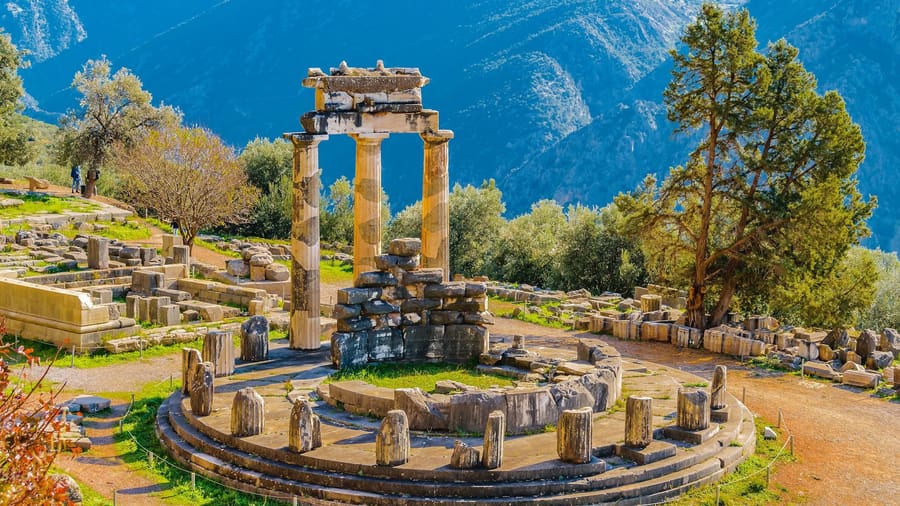
Delphi, on the southwestern slope of Mount Parnassus, was the centre of the world to the ancient Greeks. Haussoullier dug there briefly in 1880. The French School cleared landslide soil in 1893.
Day trips from Athens to Mycenae reach a hill 274 metres above sea level, about 120 kilometres south-west of the capital. At its peak in 1350 BC, the citadel and lower town held 30,000 people.
Day trips from Athens to Epidaurus meet the theatre designed by Polykleitos the Younger in the 4th century BC. Its original 34 rows gained another 21 in Roman times, and it seats up to 14,000.
Ancient Corinth had 90,000 people in 400 BC and lay on the Isthmus, roughly halfway between Athens and Sparta. Olympia held over 760 significant buildings, and the Kladeos River forms the site’s western border.
The Delphi day trip from Athens post covers the sanctuary and the oracle. The Mycenae Epidaurus day trip post pairs the citadel with the theatre in one outing.
- Guest house: The sanctuary of Asclepius at Epidaurus had a katagogion with 160 guest rooms.
- Pelopion: At Olympia, this is the tomb of the quasi-mythical king Pelops, who gave his name to the Peloponnese.
- Studio: The studio of Pheidias, beside the Temple of Zeus at Olympia, was excavated in the 1950s.
- Stone: Corinthian limestone was quarried extensively and traded widely across the Aegean.
The Ancient Corinth tour post covers the Isthmus city, and the Ancient Olympia tour post covers the sanctuary of Zeus.
Why does Meteora feature in day trips from Athens?
Day trips from Athens reach Meteora, a rock formation in the regional unit of Trikala in Thessaly. Twenty-four monasteries were founded on its pillars, mainly from the second half of the 14th century. The name Meteora means lofty or elevated.
Day trips from Athens to Meteora meet pillars of sandstone and conglomerate. About 60 million years ago, earth movements pushed the seabed upward and created a high plateau. Water, wind and extremes of temperature then weathered the pillars.
Hermit monks moved up to the pinnacles in the 800s CE. Monasteries followed only in the 1300s, when monks sought somewhere to hide from attacks. Access then ran by removable ladders or hoisting ropes.
Day trips from Athens now climb steps carved into the rock in the 1920s. Great Meteoron dates from 1356. Saint Stephen became a convent run by a community of nuns in 1961.
Theopetra Cave lies 4 kilometres from Kalambaka. Radiocarbon dating shows human presence there back 50,000 years. A stone wall closing two thirds of the entrance dates to 23,000 years ago.
- Earthquake: A magnitude 7 earthquake shook the rocks in 1954, yet the thin pillars still stand.
- Rock fall: In 2005 a massive rock fell and closed the access road for days.
- Hermit homes: Dwellings in the rock towers sat as high as 550 metres above the plain.
- Setting: Meteora lies between the town of Kalabaka and the village of Kastraki.
The Meteora day trip from Athens post covers the monasteries and the road there. The Delphi Meteora tour post joins Meteora with Delphi among the day trips from Athens.
What do the Saronic islands offer on day trips from Athens?
Day trips from Athens by sea reach the Saronic Islands, an archipelago named after the Saronic Gulf. The main inhabited islands are Salamis, Aegina, Agistri and Poros. Hydra and Dokos are sometimes counted too. Ferries from Piraeus serve them regularly.
Day trips from Athens to Aegina reach an island 27 km from the capital. It is roughly triangular, about 15 km from east to west and 10 km from north to south.
Hydra lies 69 km from Piraeus and covers 49.6 square kilometres. Its single main town, Hydra port, had 1,900 residents in 2011. Steep stone streets lead up and outward from the crescent-shaped harbour.
Poros lies 58 km south of Piraeus and is divided from the Peloponnese by a channel 200 m wide. Two islands joined by a bridge make up Poros, which had 3,261 inhabitants in 2021.
The Hydra day trip post covers the harbour town, and the Aegina day trip post covers the island’s sites. The Hydra Poros Aegina cruise post joins all three islands in one outing.
- Salamis: The largest island of the group is where the ancient Greek navy defeated the Persians in 480 BC.
- Coinage: An electrum stater with a turtle, struck on Aegina, dates from 700 BC.
- Poros stone: Limestone from Poros went into Mycenaean tholos tombs, including the Tomb of Aegisthus.
- Vigla: The highest peak of Poros rises to 358 m.
The Aegina boat trip post covers Aegina from the water. All four posts sit among the day trips from Athens that start at Piraeus.
Which Attica sites are reachable on day trips from Athens?
Day trips from Athens inside Attica reach the Temple of Poseidon at Cape Sounion, the Athens Riviera coast and Rhamnous in the north. Rhamnous is the best-preserved Attic deme site, and a deme was an ancient municipality created by the reform of Cleisthenes.
Cape Sounion is the southernmost tip of the Attica peninsula, 69.5 km south-east of Athens and 8 km south of Lavrio. The Temple of Poseidon dates to 444 to 440 BC, in the time of Pericles.
Of the 34 original columns, 15 still stand. They are Doric, made of local white marble, and 6.10 m high. Day trips from Athens reach a headland ringed by the Aegean Sea on three sides.
The Athens Riviera runs from Piraeus to Sounio and Lavrio and begins about 16 km from downtown Athens. Planning for its development started in 1957 with the creation of Asteria in Glyfada.
The orator Antiphon was born at Rhamnous. The small temple of the sanctuary dates from the late 6th century BC, and the larger temple of Nemesis began around 460 to 450 BC.
- Fortress: The fortification at Rhamnous embraced a little theatre, a gymnasium and a small sanctuary of Dionysos.
- Amphiareion: The sanctuary of Oropos was dedicated in the late 5th century BCE to the hero Amphiaraos.
- Decelea: Spartans under King Agis II fortified it around 413 BC on the advice of Alcibiades.
- Phyle: Exiles led by Thrasybulus, about 70 strong, seized the fort in 404/403 BC.
The Cape Sounion tour post covers the temple, and the Athens Riviera tour post covers the coastal strip. Both fit the day trips from Athens that stay inside Attica.
What does Marathon add to day trips from Athens?
Day trips from Athens to Marathon reach the plain of the battle against Persia. The playwright Aeschylus fought there, and his gravestone verse names Marathon rather than his plays. A bronze statue of Nike, goddess of victory, was placed there in 2014.
August Böckh concluded in 1855 that the battle took place on 12 September 490 BC. If the Spartan calendar ran one month ahead of the Athenian one, the date becomes 12 August.
Ancient writers disagree on the size of the Athenian army. Nepos, Pausanias and Plutarch each give 9,000 Athenians, while Justin gives 10,000. Herodotus gives no figure. Pausanias saw names of freed slaves on the monument.
The Marathon Dam was proposed, designed, funded and tendered in 1918. Prime Minister Dimitrios Gounaris declared the plan illegal, because the project had gone through no public bidding.
Day trips from Athens to Marathon also meet the lake. The finished dam was the largest project in the Balkans at the time, and about 10 square kilometres of forested land were flooded.
- Nike: The sculptor Nikos Georgiou made the larger-than-life bronze statue.
- Mound: The Athenian tumulus is a burial mound, called a tymbos in Greek.
- Theseus: Plutarch wrote that the Athenians saw the phantom of Theseus leading the charge.
- Echetlaeus: Pausanias told of a man in rustic dress who killed a number of the enemy with a plough.
Marathon therefore offers a battlefield, a burial mound, a reservoir and a set of legends within one stop among the day trips from Athens.
What do Hosios Loukas, Arachova and Galaxidi add to day trips from Athens?
Day trips from Athens to Hosios Loukas reach a historic walled monastery near the town of Distomo, in Boeotia. Founded in the mid-10th century, it ranks as a major monument of Middle Byzantine architecture and art. UNESCO has listed it since 1990.
Luke of Steiris lived from 896 to 953 and was a Byzantine saint of the tenth century. At 14 he lived as an ascetic on a mountain called Ioannou for 7 years.
Luke then served a stylite at Zemena for ten years. A stylite is a Christian ascetic who lives on a pillar. Tradition holds that Luke was among the earliest saints seen levitating in prayer.
Luke founded his hermitage around 946 in the area of Stiris and died on 7 February 953. The plan of the older church follows the Lips Monastery in Constantinople.
Day trips from Athens reach the Katholikon, or main church, tentatively dated to 1011 to 1012. It holds the best preserved complex of mosaics from the Macedonian Renaissance.
- Abbot’s gift: A mosaic shows the abbot Philotheos offering a likeness of the new church to the saint.
- Myron: The relics of Luke were said to have exuded myron, a sort of perfumed oil.
- Crypt: The Greek Archaeological Service cleaned the crypt in the 1960s and revealed well-preserved frescoes.
- Relics: The relics of Luke are kept in the monastery to this day.
The Arachova day trip post covers the town of Arachova. Galaxidi is built on a double harbour, and the Galaxidi day trip post covers it. Both extend the day trips from Athens beyond the monastery.
Which Peloponnese stops suit day trips from Athens?
Day trips from Athens reach the Peloponnese by crossing the Corinth Canal, and the stops include Nafplio, Mystras and Monemvasia. Each place keeps a fortress, a palace or a rock town from another period, so the visits differ widely.
The Nafplio day trip post covers the old port on the Argolic Gulf. Nafplio served as the first official capital of the modern Greek state from 1827 to 1834.
The Corinth Canal tour post covers the cutting through the isthmus. The canal was completed in 1893, runs 6.4 km at sea level without locks, and measures 24.6 m across.
The Nemea wine tour post covers the vineyards and the Temple of Zeus. It keeps the wine and the ruins together in one of the day trips from Athens.
The Mystras tour post covers the Byzantine hill town of Laconia, with its churches, its palace and its ruins. It suits readers who want one of the day trips from Athens that centres on the Byzantine period.
The Monemvasia tour post covers the walled town on an island off the Peloponnese coast. The name joins moni, single, and emvasis, approach, so the town is the city of the single entrance.
- Palamidi: Venetian builders finished this baroque fortress above Nafplio between 1711 and 1714.
- Bastions: The Miltiades bastion held the revolution hero Theodoros Kolokotronis.
- Nero: Nero broke the ground for the canal with a pickaxe in 67 AD, but the work stopped after his death.
- Plateau: Monemvasia carries a plateau 100 m above the sea and 1 km long.
Each post treats its stop in detail, so day trips from Athens to the Peloponnese can be planned one town at a time.
Which mountain parks and Kalavryta stops suit day trips from Athens?
Day trips from Athens reach the mountain parks of Attica, such as Parnitha, Tatoi and Pentelicus, and the highland town of Kalavryta in the Peloponnese. The Attica mountains hold forest, a royal estate and the quarries of Parthenon marble.
Mount Parnitha is the highest mountain on the peninsula of Attica, and its summit, Karavola, rises to 1,413 m. Much of the mountain is designated a national park and is a protected habitat for wildfowl.
Aleppo pine covers the slopes of Parnitha beneath 1,000 m, and Greek fir takes over above that height. Beneath 300 m the land is mainly farmland, with suburban housing to the east.
Tatoi was the summer palace and 42 km2 estate of the former Greek royal family, on a wooded slope of Parnitha. King George I bought the estate in 1872.
Mount Pentelicus peaks at Pyrgari, 1,109 m high. Its marble is calcitic in composition, with quartz as an accessory mineral, and builders used it for the Acropolis in ancient Athens.
The Kalavryta tour post covers the mountain town in the Peloponnese. Day trips from Athens that add Kalavryta swap the forests of Attica for the highlands of Achaea.
- Spilia: The ancient quarry, at about 700 m, produced the marble of the Parthenon.
- Chisels: The quarried rock faces still preserve the marks of chisels and wedges.
- Path: An ancient paved path survives, along which sledges dragged blocks down the slope.
- Dekeleia: This is the ancient and current official name of Tatoi, 27 km from the centre of Athens.
Parnitha, Tatoi and Pentelicus sit in Attica, while Kalavryta lies beyond it, so day trips from Athens to the mountains cover two regions.
What do Thebes and Chalkis add to day trips from Athens?
Day trips from Athens reach Thebes, the largest city in Boeotia, and Chalkis, the town beside the Euripus Strait. Thebes keeps the Cadmea citadel and a museum, while Chalkis links a Homeric name to Venetian and Ottoman walls.
Day trips from Athens to Thebes meet the remains of the Cadmea, the fortress of the ancient city. It was named after Cadmus, the legendary founder, and its settlement dates from about 1400 BC.
Thebans under Epaminondas defeated the Spartans at Leuctra on 6 July 371 BC. The Sacred Band of Thebes was an elite unit of 150 pairs, 300 men in all.
A rescue excavation at Thebes found about 250 Linear B tablets, 5% of the Mycenaean corpus. By the middle of the 12th century Thebes was the biggest producer of silks in the Byzantine Empire.
The earliest recorded mention of Chalcis is in the Iliad, and Aristotle spent the last year of his life in the city, in 323 BC. The Ottomans took the town in 1470.
The Evia tour post covers the island beside Chalkis. The Ottomans built Karababa Fortress in 1684, and the Venetian architect Gerolimo Galopo designed it, so it looks more European than Ottoman.
- Museum: The Thebes museum was rebuilt between 2005 and 2010 to designs by Michalis Souvatzidis.
- Rediscovery: The archaeologist Antonios Keramopoulos rediscovered the Cadmea.
- Railway: A railway connection with Athens and Piraeus was established in 1904.
- Castro: The old town, called the Castro, lost its walls around the start of the 20th century.
Thebes sits on a plain about 50 km north-west of Athens, which places the Boeotian stop well within day trips from Athens.
What does Thermopylae add to day trips from Athens?
Day trips from Athens reach Thermopylae, the narrow pass whose name means hot gates, after its hot sulphur springs. The A1 motorway now splits the pass, and the shoreline lies far from the site of the 480 BC battle.
The Thermopylae tour post covers the pass and its monuments. In Greek myth, the waters turned hot when Heracles tried to cleanse himself of the Hydra’s poison there.
The land surface of the battle in 480 BC now lies under 20 m of soil. Since then the shoreline has advanced by as much as 9 km in places.
The narrowest point on the plain was less than 100 m wide. On the third day the Greek force was outflanked via an obscure goat path, the Anopaea Pass.
Day trips from Athens pass a monument to King Leonidas I of Sparta, east of the A1 motorway. Across the road, an epitaph by Simonides is engraved in stone on a hill.
In 1821 Greek fighters under Athanasios Diakos blocked a force of 8,000 Turks near the pass. Diakos was captured and killed after a last stand at the Alamana bridge.
- Malis: The ancient name of the area was Malis, after the Malians, a tribe near Lamia.
- Amphictyony: The first known league of tribes centred on the cult of Demeter at Anthela.
- Antiochus: In 191 BC Antiochus III of Syria failed to hold the pass against the Romans.
- ANZAC: In 1941 ANZAC forces delayed the Nazi invaders, allowing the British expeditionary force to be evacuated to Crete.
The pass saw fighting in 480 BC and again in 1941, so day trips from Athens to Thermopylae link two invasions.
Why does Methana appear on day trips from Athens?
Day trips from Athens reach Methana, a volcanic peninsula attached to the Peloponnese that belongs administratively to the Attica region. The peninsula holds 32 volcanoes, chiefly lava domes of andesite and dacite, and its highest point, Helona, stands at 740 m.
On land, the historic lava dome of Kameni Chora erupted in 230 BC. The last eruptions took place in 1700, at a submarine volcano north of Kameni Chora.
The Methana peninsula has been inhabited since about 10,000 BC, and the first settlements date from about 6,000 BC. Excavations near the town of Methana found a village and sanctuary from Mycenaean times.
Methana lay in the territory of Troezen. Thucydides tells of an Athenian force under Nicias that built a wall across the isthmus in 425 BC to cut the peninsula off from the mainland.
Methana holds two ancient acropoleis, Paliocastro and Oga. Later buildings and sanctuaries were founded near the village of Vathy, at the Paliocastro hill and around it.
Day trips from Athens to the isthmus meet a fortress that Charles Fabvier built in 1826 and 1827. The town of Methana had 892 residents in 2011 and lies north of the road to Galatas.
- Names: Ancient writers also called the place Methone or Methene.
- Museums: Items dating from about 1500 to 1200 BC are preserved in the museums of Poros and Piraeus.
- Temple: A Geometric temple of about 800 to 700 BC stood near Kounoupitsa village.
- Municipality: In 1834 Methana became a municipality of its own.
Methana joins a long volcanic history to a human one, and day trips from Athens to the peninsula cover both.
Which motorways and distances shape day trips from Athens?
Day trips from Athens leave on the A1 north, the Olympia Odos west or the A7 into the Peloponnese. Mycenae lies about 120 km south-west of Athens, and Cape Sounion lies 69.5 km south-east of the city.
The Athens tours post lists the tours that start in the city. The A1 motorway, 557 km long, is the principal north–south road connection in Greece and runs from Athens to Evzonoi.
Olympia Odos is a toll motorway system on the Peloponnese. Starting from Eleusis in the Athens metropolitan area, it follows the Gulf of Corinth to the Rio–Antirrio bridge and the city of Patras.
The A7 runs 147 km from Corinth to Kalamata. The Rio–Antirrio Bridge, 2,380 m long, gives the Peloponnese a link that earlier needed a ferry or the isthmus of Corinth.
On day trips from Athens, Mycenae lies 48 km south of Corinth and 11 km north of Argos. The modern city of Corinth lies about 5 km north-east of Ancient Corinth.
Sounion stands 8 km south of the town of Lavrio. The sanctuary of Asclepius at Epidaurus lies about 8 km from the town, and Olympia lies 20 km from Pyrgos.
- Thebes: The city lies 100 km south-east of Lamia.
- Hexamilion: The stone wall across the isthmus of Corinth was about 10 km long.
- Olympia: The site lies around 18 km from the Gulf of Kyparissia in the Ionian Sea.
- Kalavryta: The town lies 40 km south-east of Patras and 62 km north-west of Tripoli.
These figures give distances only and leave out driving times, so day trips from Athens are compared by length alone.
Which months suit day trips from Athens?
Day trips from Athens meet hot, dry summers and cool, rainy winters, the pattern recorded at Tatoi on Mount Parnitha. The inland Peloponnese adds colder winters, and the etesian winds blow from the middle of the fifth month to mid-September.
Day trips from Athens to Tatoi meet a hot-summer Mediterranean climate with hot, dry summers and cool, rainy winters. The lowest recorded temperature there is −8.9 °C, set on 9 January 2019.
The highest temperature on record in Greece, 48.0 °C, was measured at Tatoi and Elefsina on 10 July 1977. That value was the European record until 11 August 2021.
Tripoli, inland in the Peloponnese, can see summer temperatures above 38 °C. Winter temperatures below −10 °C have been observed there, and snow or sleet can occur between November and early April.
The etesians, the strong dry north winds of the Aegean, blow periodically from about the middle of the fifth month to mid-September. Their highest frequency falls in July and August.
Parnassus has an abundance of trails for hiking in the three warm seasons, and its highest peak, Liakoura, rises to 2,457 m. The melting snows supply municipal water to the surrounding communities.
- Csa: The Mediterranean climate coded Csa is the predominant climate in Greece.
- Athens Riviera: A hot semi-arid climate is found in Piraeus and much of the Athens Riviera.
- Alpine: On high mountains such as the Pindus, winters are harsh with abundant snowfalls.
- Heat wave: A heat wave from 26 July to 10 August 2021 ranks among the longest in recorded history.
Heat peaks in July and August, and snow reaches the mountains from November, so day trips from Athens run in different conditions each month.
What do travellers ask about day trips from Athens?
Day trips from Athens raise questions about World Heritage sites, public holidays, the clock and the alphabet. Greece has 21 World Heritage properties, keeps Eastern European Time, counts every Sunday as a public holiday and writes Greek in a 24-letter alphabet.
Which World Heritage sites appear on day trips from Athens?
Greece has 21 properties on the World Heritage List. Five sites were added in 1988, two each in 1989 and 1990, and one in 1992. Greece has 11 sites on its tentative list.
Which public holidays affect day trips from Athens?
Under Greek law every Sunday of the year is a public holiday. Official holidays also include 1 January, Theophany on 6 January, 25 March, the Dormition on 15 August, 28 October and 25 December. A holiday that falls on a Sunday is not moved to another date.
What time zone applies on day trips from Athens?
Greece keeps Eastern European Time, UTC+02:00. Daylight saving time moves the clock one hour ahead, to UTC+03:00, from the last Sunday in March to the last Sunday in October. Greece adopted this standard time in 1916, before which Athens mean time was observed.
Which alphabet and road signs appear on day trips from Athens?
Danger signs on Greek roads are triangular with a red border, and prohibitory signs are round with red borders and a white background.